%20(1)-B86R08ZzwhPzS6UZbG3mSxRWPCwGwn.png)


Most advice on seo for B2B companies still starts in the wrong place. Teams export keywords, assign a few writers, and celebrate publish velocity while pipeline stays flat. I've watched that pattern burn budgets for years, because the work looks busy but never connects to the buying committee, the CRM, or the pages that win deals.
Organic search is too important for that kind of looseness. In B2B, it accounts for about 53% to 76% of all traffic to B2B sites, Google controls roughly 84.9% to 90% of the global search market, and about 90% of B2B buyers research online before engaging sellers according to the benchmark set in the opening source isolinecomms.com. If you're treating search like a traffic side project, you're probably underfunding your real acquisition engine.
My rule is simple. Start with pipeline potential, not keyword volume. Build for the person who starts the search, the stakeholder who vetoes it, and the page that gets the deal over the line.
Inhaltsverzeichnis
- Why Most B2B SEO Programs Leak Revenue
- Building a Keyword Map Tied to Pipeline, Not Volume
- Designing Page Architecture That Compounds
- Technical SEO Priorities for Long B2B Sales Cycles
- Link Building and PR That Lands in B2B
- Tracking AI Overviews, SERP Volatility, and Intent Shifts
- Measuring SEO as a Revenue Channel, Not a Traffic Channel
Why Most B2B SEO Programs Leak Revenue
The default B2B SEO workflow is seductive because it feels efficient. Someone exports a keyword list, filters by volume, hands a few terms to content, and waits for traffic to show up. That workflow usually produces blog posts that get impressions, but not enough of the right movement through the funnel.
The leak happens because early-stage B2B search is mostly non-branded and tied to real problems, not vendor names. One guide says 20% to 30% of B2B queries are branded and 70% to 80% are non-branded, which is exactly why the first useful win is usually an informational query that captures demand before a competitor's sales team does Onely. The better benchmark to care about is not “did we rank,” it's “did we claim a question the buying committee asks?”
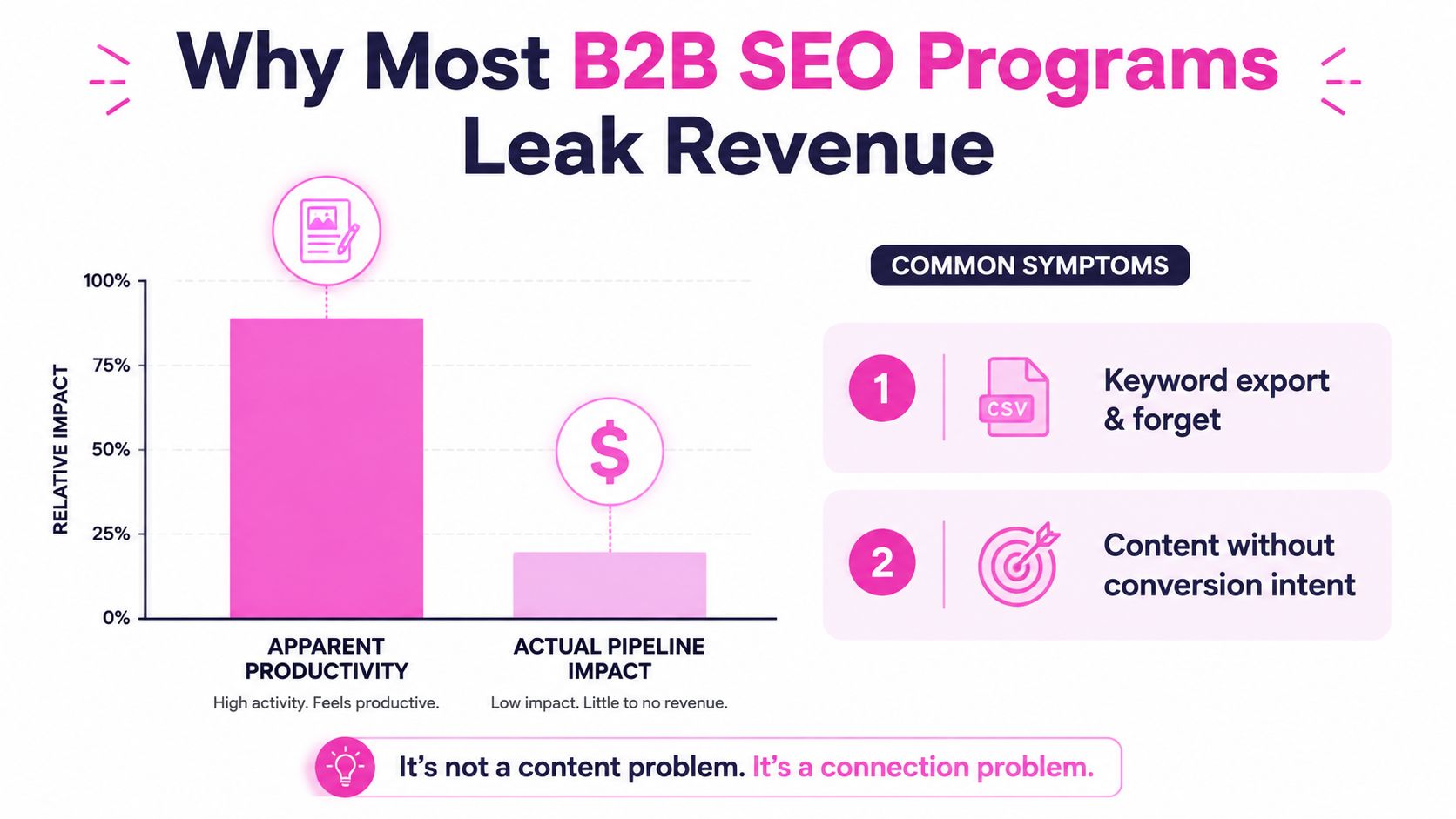
The other mistake is treating SEO like a channel for sessions instead of a channel for revenue influence. Organic search contributes 44.6% of total B2B revenue in one benchmark set, and another comparison says organic listings get 8.5x more clicks than paid ads beomniscient.com. That's not a vanity channel. That's a revenue path that deserves the same rigor you'd apply to paid spend.
Praktische Regel: If a keyword can't be tied to a buying stage, a buyer role, or a conversion asset, I don't want it in the roadmap.
When I audit a B2B site, I start with ROI rather than content calendars. A useful external reference for that mindset is UFO Performance Marketing on ROI audits, because the right audit question isn't “what can we publish?” it's “what's leaking pipeline right now?”
Building a Keyword Map Tied to Pipeline, Not Volume
I do not start keyword research with a tool. I start with the buying committee. In B2B, the same deal can involve a champion, einer technical evaluator, an economic buyer, und procurement, and each role searches for different proof at different moments Idea Digital Agency. If you ignore that split, you end up with one generic article trying to serve four people, and none of them feel understood.
Map questions to roles before you touch volume
The champion wants a fast answer to a practical problem. The technical evaluator wants architecture, compatibility, and failure modes. The economic buyer wants risk, payback, and business impact. Procurement wants terms, pricing structure, and vendor reliability. I write the questions first, then the keyword list.
I mine sales calls, demo notes, and win-loss reviews for the exact phrases prospects use. Then I validate those phrases against a broad keyword system like SemDash's 6,6B-Keyword-Datenbank, plus Domain Keywords and Keyword Gap reports, to see which terms competitors are winning and where we are missing intent coverage. For a cleaner method breakdown, SemDash's guide to keyword types shows how to separate informational, commercial, navigational, and transactional intent before you map pages. That keeps the map grounded in market language, not internal jargon.
| Funnel Stage | Buyer Role | Sample Query Pattern | Page Type to Create | Intent Signal |
|---|---|---|---|---|
| Awareness | Champion | How to fix, how to improve, why it matters | Guide or explainer | Problem recognition |
| Consideration | Technical evaluator | Best tools, comparison, integrations | Comparison or solution page | Active evaluation |
| Decision | Economic buyer | Pricing, ROI, vendor, platform | Pricing or proof page | Purchase readiness |
| Approval | Procurement | Security, compliance, contract, SLA | Trust and policy page | Risk review |
Use one page per intent, not one article per keyword
The fastest way to waste effort is to let multiple pages chase the same search job. SemDash's internal clustering and keyword mapping can help here, but the discipline is architectural, not software-driven. I assign one primary intent to one page, then let supporting pages handle adjacent questions so the site does not cannibalize itself.
A B2B SaaS analytics vendor is a good example. CFO queries usually lean toward cost control, budget justification, and reporting outcomes. RevOps queries usually lean toward instrumentation, pipeline visibility, and integration depth. Those are different jobs, so I would build separate pages for each instead of stuffing both into one “analytics platform” article.
The page wins when it matches the job the buyer is trying to do. The keyword only matters if it reflects that job.
Keep the language close to the market
The best keyword maps do not look clever. They look like your customers wrote them. I group phrases by stage, then by persona, then by page type, so content can be briefed without guesswork. If a query belongs to the technical evaluator, it should not land on a fluffy top-of-funnel post. If it is a procurement query, it should not be buried inside a thought-leadership essay.
Designing Page Architecture That Compounds
A keyword map is only useful if the site structure can carry it. I've seen B2B teams do the research right and still fail because the pages lived in silos, got buried five clicks deep, or competed with near-duplicate articles for the same query. That's not a content problem. It's an architecture problem.
Build pillars first, then clusters
I prefer 4 to 6 topical pillars because that's enough to cover the core commercial territory without turning the site into a junk drawer. Each pillar should represent a commercial theme, and every supporting cluster page should feed relevance back to that pillar while also pointing toward a conversion asset. That internal loop matters because B2B buyers don't move in a straight line, they hop across stages and revisit evidence.
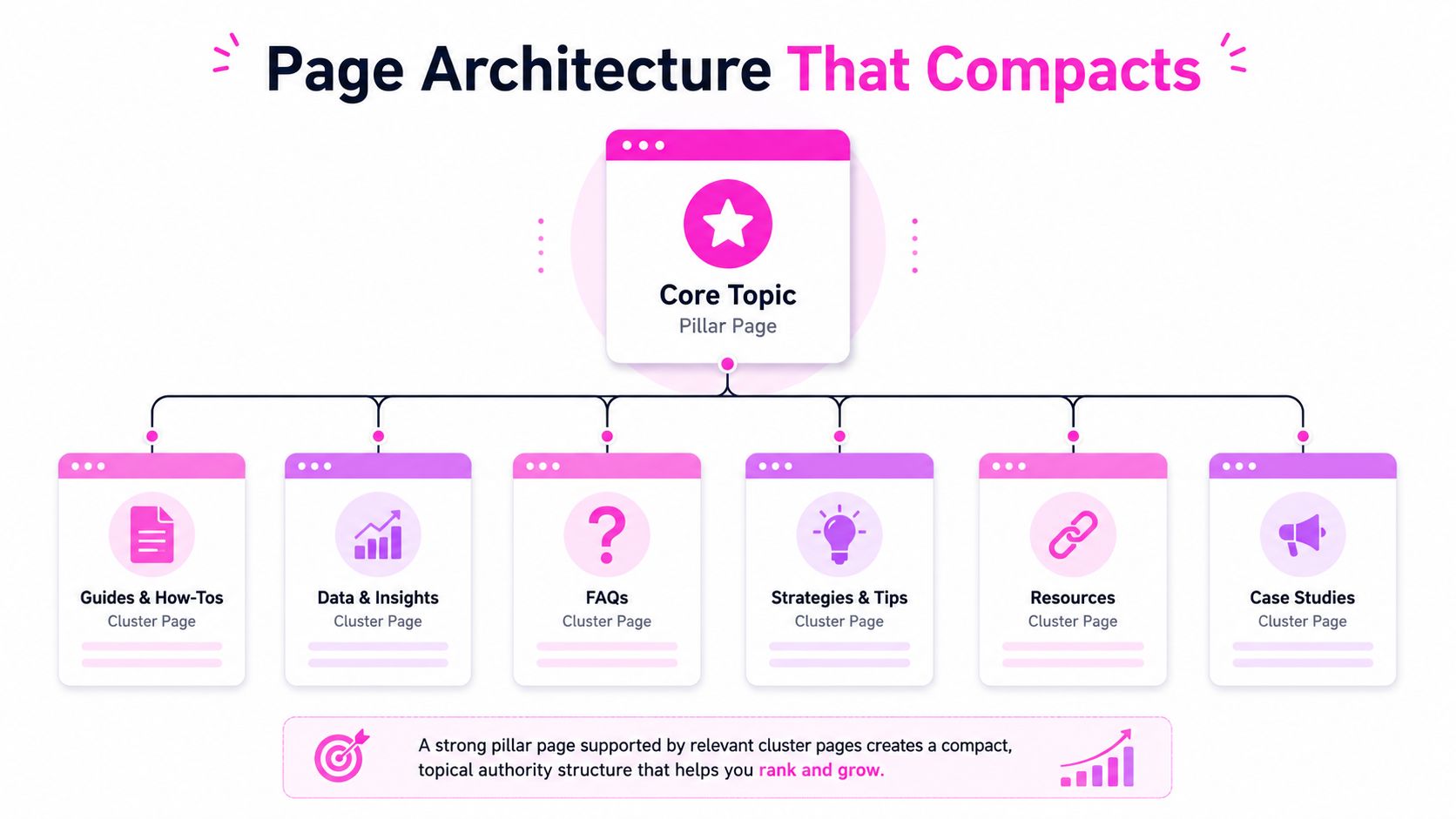
Here's where publishers waste money. They publish three articles on the same topic with slightly different angles, then wonder why none of them rank strongly. The better move is to consolidate near-duplicates, keep one authoritative page, and use cluster content to support it instead of competing with it.
Audit orphaned pages before you add more content
The cheapest authority gain I've found is re-linking pages that already deserve attention but can't get found. The operational rule I use is straightforward. If a valuable page is orphaned, it should receive 2 to 3 internal links from relevant existing pages, not a random footer dump Eleven Writing. That gives search engines a clearer map and gives humans a path from education to evaluation.
I also check whether every high-value transactional page has at least one supportive cluster page and one path back to the pillar. That bidirectional linking transfers topical relevance and keeps conversion flow intact. If a page can rank but can't lead a buyer anywhere useful, it's underperforming by design.
The mistake I see most often is over-creating and under-linking. Teams ship more pages, but they don't connect them, so authority stays trapped in isolated URLs. Fix the map first. Then publish.
A video walkthrough of the internal structure is often easier to show than describe:
Technical SEO Priorities for Long B2B Sales Cycles
I don't trust bloated technical audits in B2B unless they tie directly to crawling, indexation, or conversion. You do not need a 200-point checklist. You need the few fixes that keep revenue pages visible and make it easier for both crawlers and buyers to reach them.
Start with crawl waste and index bloat
If your site has faceted navigation, parameter URLs, or a growing resource library, crawl budget gets burned fast. Start by removing noindex or blocked pages from the indexable set, then clean up canonical signals, because search engines only rank what they can clearly interpret. The operational guidance from The Smarketers is useful here, especially the focus on keeping core revenue pages accessible and stopping duplicate template behavior.
I also check how many clicks separate an important page from the homepage. If a buyer has to dig for a core page, you have already added friction before the sales conversation starts. That slows discovery and weakens trust.
Fix the pages that touch the buying decision
B2B technical work should focus on pages that carry commercial weight, product comparisons, pricing, case studies, integrations, and trust pages. Those pages need clean indexation, unique titles, and structured data where it aids search understanding. I am not interested in schema added to blog posts just to make the audit look busy.
International sites need careful hreflang and regional targeting, but only after the commercial pages are stable. Gated content needs a clear decision too. Ask whether the page is valuable enough to index or valuable enough to keep gated, because half-measures create confusion. If a page matters to revenue, both users and crawlers should be able to find it without effort.
Technical SEO for B2B is not about impressing peers with audit depth. It is about making sure the pages tied to revenue do not disappear inside your own site.
Mobile performance still matters because buyers keep researching after they leave their desk. I treat speed as a conversion-path problem, not just a ranking problem. Slow commercial pages lose patience before they lose rank.
A lot of B2B teams also waste time on fixes they cannot maintain. If the same technical issue keeps returning, the process is broken. Use a repeatable workflow with SemDash link-building outsourcing guidance only where the work needs outside execution, then keep ownership of the page architecture and indexation rules inside the team.
Link Building and PR That Lands in B2B
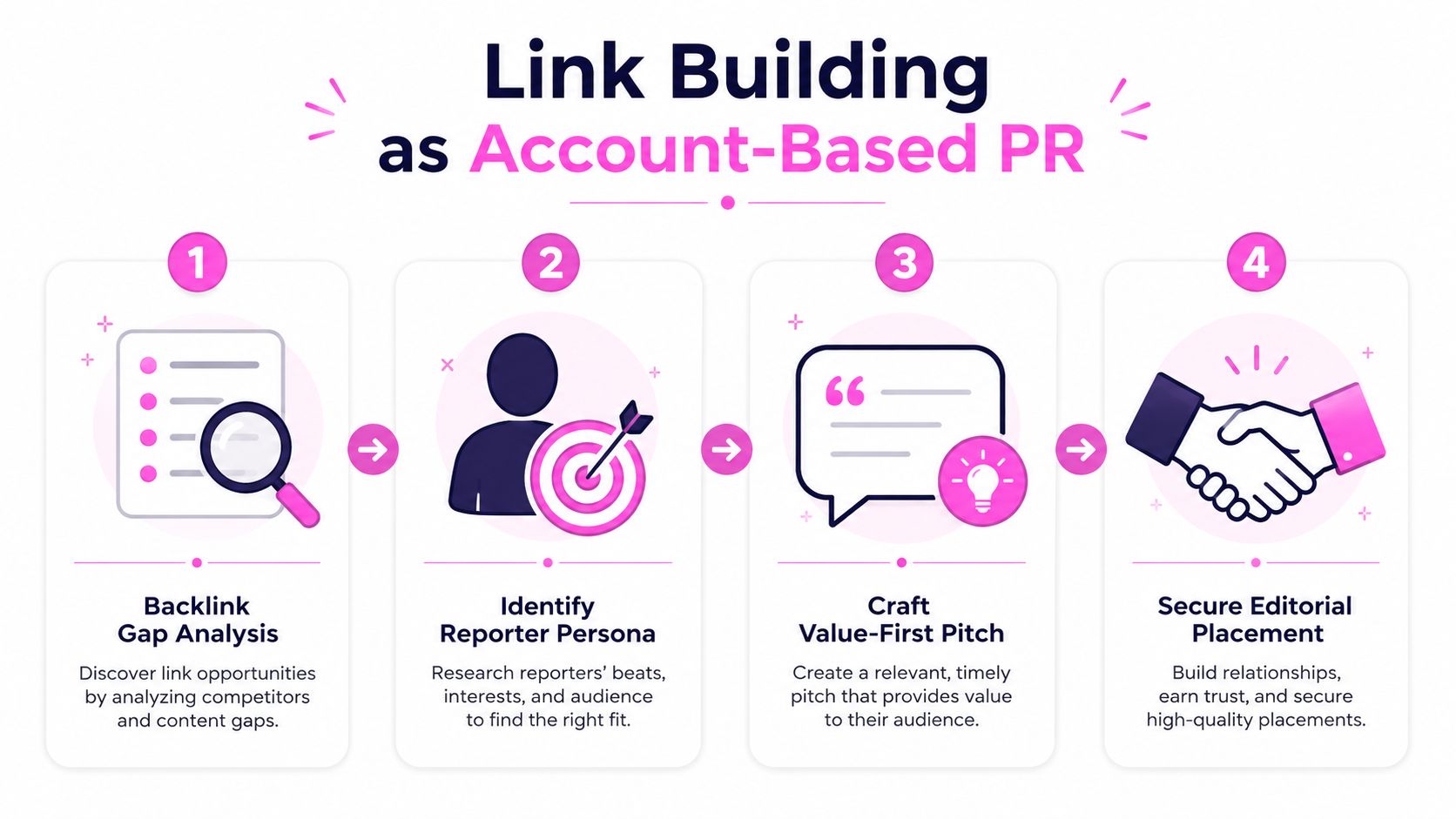
I've burned budget on weak link building, so I'm direct about this now. Generic outreach to high-DR sites with templated copy is theater. It creates replies, not placements. The campaigns that work in B2B behave more like account-based PR than old-school link spam, because they are built around the buying committee, the publication, and the page that needs to move pipeline.
Start with backlink gaps, then inspect the context
The first move is to find domains linking to two or three logical competitors but not to you. That shows which publications already cover the category and accept the kind of stories your market reads. Then I check anchor context, because a site that links to comparison pages behaves differently from one that only links to thought leadership. That difference changes the pitch.
My worst campaign was a broad list of generic “marketing” sites. The pitch talked about our product, pushed hard for inclusion, and ignored the publication's real audience. It got ignored. The better campaign targeted industry publications and trade press with a specific angle, a useful asset, and a reason their readers would care.
Pitch like you're helping a reporter do their job
The outreach lesson I learned slowly is simple.
Don't sell the link. Sell the usefulness of the story.
A reporter doesn't want a demo request. A reporter wants a clean angle, a real reference point, and a reason to trust the source. That is why the strongest B2B pitches look like short editorial briefs. They are specific, and they are built around the publication's audience, not your homepage.
For teams that need help structuring outreach at scale, how to outsource link building is worth reading because it shows how to delegate without pretending relationship quality can be automated. I use tools as support, not replacement. SemDash's optional Vorgestellt werden service can help amplify a campaign, but it does not replace a real editorial pitch or a useful asset.
Use the asset, not just the opinion
The strongest B2B link assets I've shipped were not “ultimate guides.” They were reference points, benchmarks, comparison resources, and opinionated data pages. Those get cited because they make the writer's job easier. If your asset saves the publisher time and makes the article stronger, you have a chance.
One practical note. I only build outreach around pages that can support the buyer journey. A link to a dead-end article is nice, but a link to a page that feeds a pillar, a comparison page, or a conversion asset is worth more. That is the difference between PR that pads vanity metrics and PR that supports revenue.
Tracking AI Overviews, SERP Volatility, and Intent Shifts
A lot of B2B SEO advice still assumes the blue-link SERP is stable. It isn't. Search behavior keeps shifting, and pages that ranked cleanly last quarter can lose visibility because the query now triggers an AI answer, a new intent pattern, or a different citation set. That's why I treat SERP monitoring as weekly operating hygiene.
Watch the page type, not just the rank
SemDashs 12-month SERP history und AI Overviews-Sichtbarkeit tracking are useful because they let you see when a keyword starts being answered differently over time. They show the exact URLs cited in AI-generated answers, which tells you whether your page should be optimized for ranking, citation, or both. That matters more than vanity position when the result page itself changes shape.
For a practical complement, ChatGPT visibility tools from Surva.ai can help you inspect how your brand is showing up in AI-oriented discovery. I'd use that kind of check to identify whether a page needs a refresh, a rewrite, or a different format entirely.
Make refresh, redirect, and rewrite decisions fast
I use a simple decision tree. If the intent is still the same but the citations changed, I refresh the page and tighten the answer. If the intent shifted and the page no longer matches, I rewrite or split it. If two pages are now competing for the same query, I consolidate and redirect so the site stops diluting itself.
The mistake is waiting for quarterly reviews to notice that a keyword has changed shape. By then, the page has already lost momentum. A weekly SERP review is enough to catch most of the drift before it becomes a cleanup project.
Measuring SEO as a Revenue Channel, Not a Traffic Channel
I ignore SEO reports that stop at sessions. Traffic can look healthy and still do nothing for the pipeline. The only report that matters ties a landing page to an opportunity, then to closed-won revenue.
Wire organic pages into the CRM
Set up organic-sourced contacts so you can follow first touch through closed deal and see which pages influence revenue. The right question is not how many visits a page gets, it is whether that page helped create pipeline. That is the standard I use, and it matches the revenue-attribution focus described in Sensoriium's practical SEO guide.
If your CRM cannot show that path cleanly, your SEO reporting is too shallow to defend budget. B2B marketing teams keep wasting money on pages that attract clicks but never move a buying committee closer to a sales conversation.
Review the right dashboards on the right cadence
Weekly, check sessions by funnel stage, top revenue pages, and any citation or backlink changes that could affect those pages. Monthly, review content-to-deal velocity, backlink velocity, and whether the pages tied to commercial intent are pushing opportunities forward. If a page gets traffic but never assists deals, it is a content asset, not a pipeline asset.
I use a blunt 90-day sequence. Start by mapping the buying committee and funnel stages. Then align keywords to page types and remove duplicate intent. After that, fix internal architecture and the technical issues that slow pages down. Only then should outreach begin, because promotion before conversion-ready pages just burns time and budget.
SemDash fits into that workflow because it helps pressure-test the whole map. Use SemDash to compare keyword clusters, page clusters, backlink gaps, and AI visibility before you publish the next batch of pages. If those pieces do not line up, the problem is not traffic. The problem is that your SEO program is not built to create revenue.