Outsource Link Building: A Small Business Owner’s Guide

TL;DR:
- Outsourcing link building is advisable when outreach is the main bottleneck, not just for faster results. A paid trial of five links over 30–60 days helps evaluate quality, communication, and reporting before committing long-term. Using a detailed one-page brief and tracking verified live links ensures better outcomes and reduces risks.
Outsource link building when outreach is the bottleneck, not when you simply want faster results. The safe path: prepare a one-page brief with target URLs, anchor rules, and quality thresholds, then run a paid trial of five links over 30–60 days before signing anything long-term. Three things you can do right now:
- Demand live, clickable URLs for every placement your vendor claims. Screenshots are not proof.
- Build your one-page brief today (template in Section 4 below).
- Set up a Semdash project to track backlink growth and flag link drops before your next vendor check-in.
Any provider worth hiring will also offer a 12-month replacement policy as a baseline SLA.
How to outsource link building: when does it actually make sense?
Outsourcing is a capacity decision, not a cost-cutting move. The clearest trigger: someone on your team is spending eight or more hours a week on outreach with little to show for it, or your target pages are stuck in positions 6–20 and you lack the publisher relationships to push them further.
Before you hand anything off, three preconditions must be true. Your technical SEO is clean (no crawl blocks, no broken redirects). You have content worth linking to — pages that solve a specific problem or offer genuine insight. And your target pages have validated commercial intent, meaning real search demand and some organic traction already. Link building works best when a site has proven market fit for a sustained period of time.
Modern link building also carries a semantic dimension. Links that reinforce brand authority and entity associations in AI-generated summaries matter more than raw link counts. If your strategy is still purely volume-focused, fix that framing before you brief any vendor.
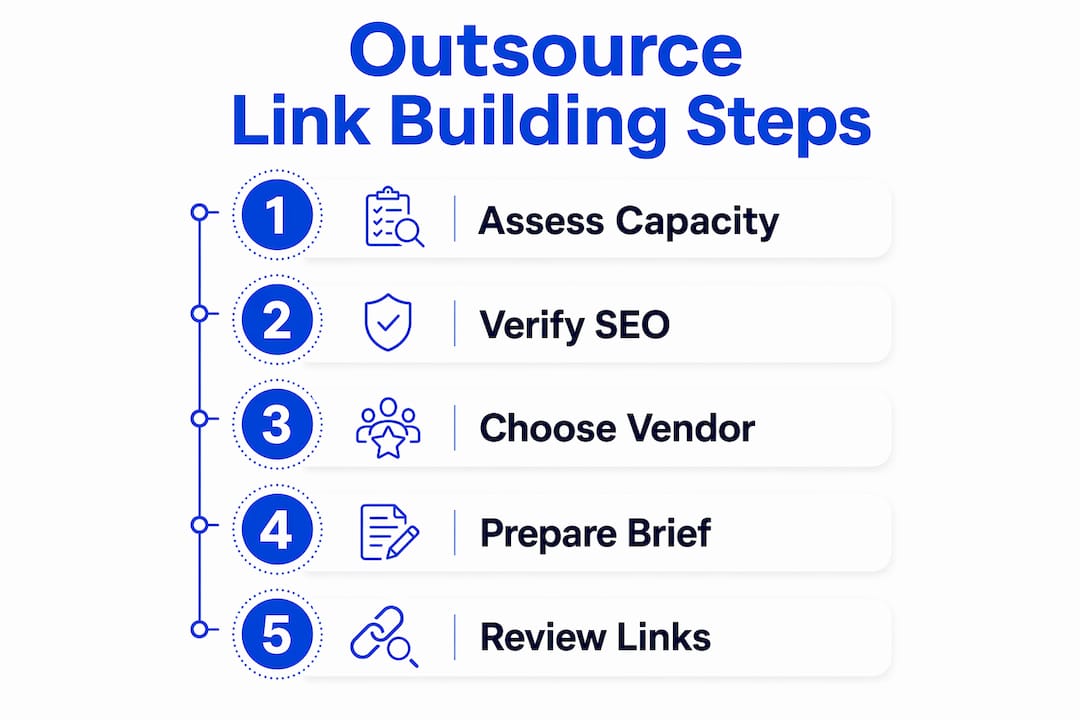
How do you choose and vet a link-building provider?
Four provider models exist, and each suits a different situation.
- Freelancer: Lower cost, more direct communication, but limited capacity and no built-in process. Best for small, well-defined campaigns.
- Managed agency: Higher cost, structured reporting, and a full outreach team. Best when you want to hand off strategy as well as execution.
- Marketplace / pay-per-link: You buy individual placements at set prices. Fast and flexible, but all strategy stays with you.
- White-label: Agencies resell another provider’s links under their own brand. White-label models require stronger vetting because your brand bears the penalty risk if the underlying tactics are spammy.
Questions to ask every candidate:
- Show me five live placements from the last 60 days (with URLs, not screenshots).
- Walk me through your outreach process from prospecting to placement.
- What is your replacement policy if a link disappears?
- Can I speak with two current clients?
Walk away immediately if a vendor:
- Refuses to share live URLs or hides behind “proprietary networks.”
- Promises guaranteed rankings or specific DA jumps.
- Cannot explain how they vet host sites for traffic and relevance.
- Uses private blog networks (PBNs) or owned placement networks.
Profi-Tipp: Run the vendor’s own domain through Semdash’s Backlink-Recherche-Tool before your first call. A provider who doesn’t invest in their own authority rarely builds it for clients.
What goes in the one-page brief you hand to any vendor?
A clear brief materially improves outcomes — a vague one produces generic links. Your brief should fit on one page and cover these fields:
- Target URLs with priority ranking (Page 1 = highest commercial value).
- KPI goals: referring domain count, target ranking positions, or referral traffic thresholds.
- Anchor-text distribution: a copy-ready example mix reduces over-optimization risk.
- Banned domains and categories: competitors, low-quality directories, irrelevant niches.
- Minimum host-site quality thresholds: organic traffic floor, spam score ceiling, topical relevance requirement.
- Reporting format and cadence: live URLs delivered within X days of placement, monthly summary report.
- Replacement SLA: 12 months is the industry baseline.
A safe anchor-text distribution for most small business sites: 40% branded (your company name), 30% naked URL or generic (“click here,” “this page”), 20% partial-match keyword phrases, and 10% exact-match target keywords. Skewing too heavily toward exact-match is the fastest way to trigger a manual review.
For the first 30–90 days, require pre-approval of each placement before it goes live. Review the host site’s traffic trend, the page’s topical relevance, and the surrounding anchor context before you sign off.
Profi-Tipp: Verify every delivered link manually: open the URL, confirm the link is live and clickable, check dofollow status with a browser extension, and log it in Semdash. Never accept screenshots only as delivery proof.
Onboarding and the day-to-day workflow with your vendor
A structured 30–60 day onboarding protects you from locking into a bad relationship.
- Week 1–2: Share the one-page brief, confirm target URLs, and agree on the approval workflow.
- Week 2–4: Receive the first trial batch of five links. Review each one against your quality thresholds before approving payment.
- Month 2: Schedule biweekly check-ins. Review anchor distribution and host-site quality together.
- Day 60: Decide whether to scale, adjust scope, or exit.
Request these SLA elements in writing before work starts: live-URL delivery within five business days of placement, indexing verification included in the report, a 12-month replacement window for any link that disappears, and a defined follow-up process for removed links.
Keep strategy and target-page selection in-house. Your vendor handles outreach, placement, and reporting. That division prevents scope creep and keeps your SEO direction aligned with business goals. Budget for consistent monthly acquisition over 4–6 months rather than a single large order — algorithmic signals respond to steady velocity, not spikes.

How do you measure success and audit the vendor’s work?
Track these KPIs monthly, not just at campaign end:
- Live link count: verified URLs only, logged in a backlink tracker.
- Dofollow/nofollow ratio: most campaigns should skew dofollow.
- Anchor-text distribution: flag any drift toward exact-match concentration.
- Referral traffic: check Google Search Console for traffic from linked pages.
- Target-page ranking shifts: measure over 60–90 days, not week to week.
- Link retention rate: links that disappear within 90 days signal low editorial quality.
| KPI | Verification step | Werkzeug |
|---|---|---|
| Live link count | Open URL, confirm link exists | Semdash backlink tracker |
| Dofollow status | Browser extension check | Semdash / manual |
| Host-site traffic | Check organic traffic trend | Semdash competitor analysis |
| Indexing status | Suchen site:URL in Google |
Google Search |
| Ranking movement | Track target page positions | Semdash SERP tracker |
| Link retention | Monitor for drops monthly | Broken link monitoring |
Semdash’s backlink research view lets you set a project, pull live referring domains, and export a verification log you can share directly with your vendor as SLA evidence.
What do pricing and timelines actually look like?
Industry estimates place a single quality backlink between $200 and $800, with industry averages in the $361–$509 range; managed monthly campaigns commonly run $1,500–$10,000 or more depending on volume and quality standards.
| Model | Typical cost | Control | Speed | Am besten für |
|---|---|---|---|---|
| Freelancer | $50–$150/hr | Hoch | Mittelmäßig | Small, defined campaigns |
| Pay-per-link | $200–$800/link (averages $361–$509) | Hoch | Fast | Testing a vendor or niche |
| Managed agency | $1,500–$10,000+/mo | Mittel | Steady | Scaling with full delegation |
| In-house | Salary + tools | Full | Slow to build | Long-term, high-volume needs |
Expect quality checks to take 30–60 days and ranking movement to appear within 4–12 weeks, depending on keyword competitiveness. Highly competitive SERPs can take longer. Do not evaluate a vendor on ranking results before the 60-day mark.
Your printable hiring checklist
Copy this to your task manager or print it for vendor interviews.
Preconditions (before you hire anyone):
- [ ] Technical SEO is clean (no crawl errors, mobile-friendly, fast load times).
- [ ] Target pages have quality content and validated search demand.
- [ ] One-page brief is written and ready to share.
Vetting steps:
- [ ] Reviewed five live placements from the last 60 days.
- [ ] Asked about outreach process and replacement policy.
- [ ] Spoke with at least one current client reference.
- [ ] Confirmed no PBNs or owned placement networks.
Trial rules:
- [ ] Ordered exactly five links as a paid trial.
- [ ] Required live URLs and indexing proof as delivery.
- [ ] Set 30–60 day evaluation window before any long-term commitment.
Reporting requirements:
- [ ] Monthly report includes publisher URLs, anchor text, and traffic estimates.
- [ ] 12-month replacement SLA confirmed in writing.
- [ ] Approval workflow for first 90 days agreed upon.
Wichtige Erkenntnisse
Outsource link building only after your technical SEO and content are solid, then protect yourself with a one-page brief, a paid trial, and consistent monitoring.
| Punkt | Details |
|---|---|
| Capacity is the trigger | Outsource when outreach consumes many hours per week or publisher relationships are the bottleneck. |
| Brief before you hire | A one-page brief with target URLs, anchor rules, and banned sources materially improves link quality. |
| Trial first, contract second | Run a five-link paid trial over 30–60 days to evaluate quality, communication, and reporting. |
| Verify every link | Demand live URLs and check dofollow status and indexing; never accept screenshots as proof. |
| Monitor with Semdash | Use Semdash’s backlink tracker to log verified links, flag drops, and export SLA evidence monthly. |
The trial-first approach is the only approach worth taking
Most small business owners get burned on link building outsourcing for one reason: they skip the trial and sign a three-month contract based on a sales deck. The vendor’s case studies look impressive, the pricing seems fair, and the replacement guarantee is buried in the fine print. Then the links arrive on sites with no real traffic, the anchor distribution skews toward exact-match, and fixing the mess costs more than the campaign did.
The trial-first model flips that dynamic. Five links, 30 days, full verification. If the vendor can’t deliver clean, contextually relevant placements on that small a batch, they will not perform better at scale. The one-page brief is what makes the trial meaningful — without documented requirements, you have no standard to measure against.
On the in-house versus outsourced question: keep strategy in-house, always. Target-page selection, anchor philosophy, and quality thresholds are decisions that require business context a vendor will never fully have. What you outsource is the labor: prospecting, outreach, and placement. Semdash gives you the monitoring layer that keeps you in control without micromanaging every email your vendor sends.
Semdash makes outsourced link building easier to manage
Tracking a vendor’s work manually across spreadsheets is slow and error-prone. Semdash brings backlink discovery, ranking movement, and AI Overview monitoring into a single interface, so you can verify vendor deliverables and catch problems before they compound.
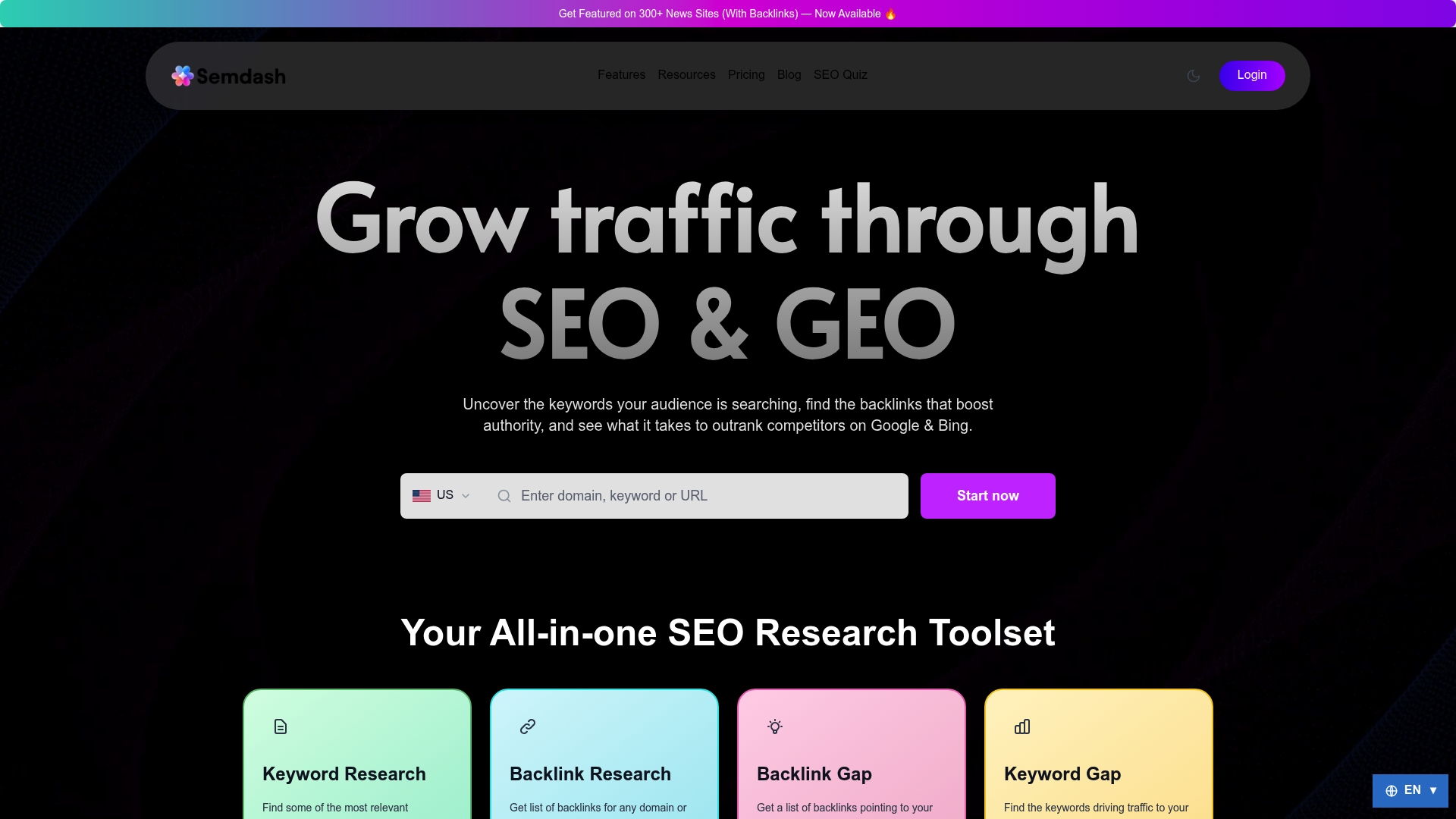
Set up a project for each target page, pull live referring domains after every vendor delivery, and export the verification log as SLA evidence. Semdash’s SERP tracker shows ranking shifts per target page over the 60–90 day window that actually matters for evaluating outsourced campaigns. The AI Overview monitoring feature tracks where your brand appears in AI-generated search summaries, an advanced signal most vendors don’t report on at all.
Semdash is an affordable alternative to the full-cost tool stack most agencies rely on. Start with the backlink research tool to audit your current profile before briefing any vendor, or explore the full platform to see how keyword research, competitor analysis, and link tracking work together in one place.
Useful sources
- Gatilab: Outsource Link Building — Provider Selection and Quality Management — primary source for the one-page brief template, trial order guidance, and live-URL verification practices used throughout this guide.
- linkbuildingservices.io: Outsource Backlinks — Costs, Risks, and How to Choose — source for per-link pricing ranges ($200–$800, averages $361–$509) and the 12-month replacement SLA baseline.
- NexKlicks: Backlink Outsourcing Guidance — supports the consistency-over-volume recommendation and the 4–6 month campaign cadence.
- Digital Gratified: How to Outsource Link Building — covers white-label model risks and vendor verification requirements.
- Victorious: Link Building Services — Strategy Note — explains the shift toward semantic relevance and AI visibility as link quality signals.
- WebSEOTrends: How to Safely Outsource Backlink Building — covers preconditions including the 119-day market-fit benchmark and technical SEO requirements.
Häufig gestellte Fragen
When should a small business outsource link building?
Outsource when outreach is consuming eight or more hours per week internally or your target pages are stuck in positions 6–20 despite solid content and technical SEO.
What is a fair price for outsourced link building?
A single quality backlink typically costs between $200 and $800, with industry averages in the $361–$509 range; managed monthly campaigns commonly run $1,500–$10,000 or more, depending on volume and quality standards.
How do you verify that a vendor’s links are real?
Demand live, clickable URLs for every placement, check dofollow status manually, confirm indexing with a site: search, and log everything in a backlink tracker like Semdash.
What is a reasonable replacement SLA to request?
A 12-month replacement policy is the industry baseline — any link that disappears within that window should be replaced or refunded without dispute.
How long before outsourced link building affects rankings?
Expect to see ranking movement within 4–12 weeks for moderately competitive keywords; run campaigns for at least 4–6 months before drawing conclusions about vendor performance.