


Google users clicked a traditional result on 8% of visits with an AI summary, versus 15% without one, in Pew Research Center's analysis of 68,879 searches. That's roughly a 47% relative reduction in the likelihood of a conventional-result click. If you're measuring search performance only through rankings and sessions, you're missing a separate outcome: whether your page supplies the answer someone reads before deciding whether to visit.
Inhaltsverzeichnis
- Why Generative Search Optimization Matters Now
- Where Generative Search Optimization Departs From SEO
- How AI Answers Choose Which Pages to Cite
- Reading AI Answers for Intent Shifts and Format Triggers
- Where AI Answers Get Their Facts and What Your Page Owns
- Measuring Citations Instead of Rankings Alone
- Audit a Page for Citation and Start Your Baseline
Why Generative Search Optimization Matters Now
Generative search optimization means making your pages sources an AI answer can find, trust, quote, and attribute. GEO and AEO describe overlapping work. The operational question is clear: what needs to change so your evidence earns inclusion?
Pew's browsing panel included 900 U.S. adults, und 58% conducted at least one Google search producing an AI summary during March 2025. Those figures put a practical limit on ranking-only reporting. A page can hold position three while fewer searchers need to visit the result list.
A lost click isn't necessarily a lost audience. An appearance in an answer isn't automatically a valuable audience, either.
Use of standalone generative-AI tools has grown across several countries. That broadening use makes it worth checking whether your pages supply accurate, useful evidence beyond conventional search results.
Protect the business outcome
Keep organic traffic as a business target, and add citation measurement beside it. Then assess whether cited appearances preserve accurate product understanding and support demand. Citation is a separate outcome from rank and clicks, not a replacement for either.
For a publishing-focused recovery checklist, Blog Health App blogger recovery tactics offers a companion to a page-level audit. Use recovery advice to prioritize a test, rather than rewriting an entire archive without evidence that it needs work.
Start with a 20-query log. For each query, record whether your page is cited, its position in conventional results, and any resulting visits you can track. Compare citation changes with traffic and the business outcome the page supports. Keep a citation-focused change when it improves accurate visibility without undermining useful visits or demand; if citations rise while traffic and business value fall, revise the page or test a narrower change.
The practical questions are straightforward:
- What changes from SEO? Track cited evidence as well as ranking URLs.
- How do AI systems pick sources? Distinguish retrieval eligibility from passage selection.
- How should you audit and rewrite? Record a query baseline before changing the page.
Where Generative Search Optimization Departs From SEO
| Attribut | Traditional SEO | Generative search optimization |
|---|---|---|
| Unit of competition | One URL per result slot | Passages extracted from a handful of cited sources |
| Query handling | One query matched to one result list | Query fan-out into related sub-searches across subtopics |
| Typical output | Ten blue links plus SERP features | Synthesized answer citing about five sources on average |
| What wins | Relevance, links and page experience | Claims that are easy to locate, verify and attribute |
| Keyword role | Exact and close-variant targeting | Entity and subtopic coverage; keyword stuffing underperforms |
| Success measure | Position and organic clicks | Inclusion, prominence and citation, then downstream visits |
The biggest change is the unit of competition. You can have the most thorough URL and still lack a passage that answers a narrow question without surrounding context. I'd inspect the candidate paragraph before expanding the article.
Say you sell subscription software. A pricing page might explain your plans beautifully but never state whether implementation costs extra. A competitor's short, explicit implementation-fee explanation can be more useful for that component of an answer.
Optimize the evidence, not the repetition
Die Princeton University publication describing GEO, developed with Georgia Institute of Technology and the Allen Institute for AI, introduced GEO-bench with approximately 10,000 queries across 25 domains and reported source-visibility improvements of up to 40% across tested optimization strategies. The work was published in 2023 and presented at ACM KDD in 2024; results differed substantially by subject and method.
Don't turn that upper bound into a forecast for your site. The useful finding is methodological: credible citations, statistics, fluent writing, and precise technical terminology outperformed keyword stuffing in the tested setting.
That changes the editing brief. Replace “mention the target keyword more often” with “identify the claim, supply its evidence, and make its subject unmistakable.” A paragraph beginning with “It supports this” is weaker outside its original context than one naming the product and the supported integration.
Keep the SEO foundation
Google's AI search documentation describes query fan-out, where AI features may issue related searches across subtopics and data sources. Your page therefore needs useful supporting answers, not just a close match to the head query.
Crawlability, quality, relevance, and conventional ranking work remain foundational. Don't create a competing GEO backlog that ignores indexing failures or weak internal links.
For your 20-query working set, map current reporting against the comparison table:
- URL coverage: Which page should answer each query?
- Passage coverage: Which section supplies the specific answer?
- Measurement coverage: Can you see attribution and prominence, or only rank and clicks?
Treat that count as an audit scope, not a statistically representative sample.
How AI Answers Choose Which Pages to Cite
Think of a research assistant receiving your question, resolving its component questions, selecting useful passages, and adding footnotes. For an audit, I'd name those stages decompose, retrieve, extract, attribute. That's a practical model, not a claim that every system exposes an identical pipeline.
Use the same evidence-gathering mindset when reviewing candidate sources.

Read rankings as eligibility signals
In a 400-search U.S. study described in this report on Kyle Eggleston's citation analysis, 51.0% of external AI Overview citations pointed to organic top-10 URLs, 99.2% of citations outside that group still ranked in the top 100, and first-position results were cited in 56.0% of overviews versus 9.9% for eighth-position results.
My practical reading: prioritize pages already close to the top before commissioning unrelated content. Ranking isn't the citation prize, but it's a useful eligibility signal.
A separate Surfer analysis of 405,576 English-language AI Overviews found approximately five cited sources per overviewmit 52% of cited sources also appearing in the organic top 10. Neither analysis supports treating first-page rankings as an absolute requirement.
Say your page ranks around position 40 but supplies a crisp, sourced definition missing from leading results. I'd keep it in the candidate set rather than excluding it solely because of rank. That's an edge-case hypothesis to test, not a promised shortcut.
For another format alongside the passage audit, use the video below.
Improve the selected passage
I'd use these checks before pursuing more domain-level links:
- Named subject: Can you identify exactly what the claim describes?
- Supporting evidence: Can you verify the statement without reconstructing the argument?
- Boundaries: Does the passage state relevant exclusions or limitations?
For editorial review, human-led content that earns reader trust is a useful companion to those checks. Better authority may help your page enter consideration, but it doesn't repair an ambiguous claim or make an unsupported passage attributable.
Reading AI Answers for Intent Shifts and Format Triggers
I'd read the generated answer before touching the page. Treat it as evidence of how the system interpreted that particular query, not as an authoritative statement of what every searcher wants.
Say you target “CRM pricing” with an article explaining CRM categories. If the answer emphasizes plan costs, billing conditions, and buying options, your category explainer may answer the wrong question. Changing its title to include “pricing” won't supply the missing commercial detail.
Read the structure before copying it
A numbered answer may indicate a procedural need. A comparison table may indicate that buyers need consistent attributes across alternatives. Match the format when it helps resolve the question, not because you assume every page needs a table.
For a hypothetical “how long does SSO setup take” query, suppose the answer presents a setup range and implementation conditions. I'd inspect whether the cited passage puts both together under a descriptive heading. Copying the range while omitting identity-provider requirements would make your rewrite less accurate.
Nutze search intent classification to organize the review, then check the actual answer rather than accepting a label unquestioningly.
| Log field | What to record | Editing consequence |
|---|---|---|
| Intent label | Informational, comparison, or transactional | Choose the job the page must complete |
| Answer format | Definition, list, table, or prose | Structure the relevant passage |
| Extracted wording | The exact sentence or faithful paraphrase | Check attribution and factual boundaries |
Separate format gaps from page-purpose gaps
If your page serves the correct intent but buries the answer, revise the section. If the query now requires a buying decision and your page deliberately teaches fundamentals, consider a separate commercial page rather than damaging a useful explainer.
Don't assume an unfamiliar claim came from your website. Open the cited URL and find the supporting passage. If a third-party review supplied the assertion, rewriting your introduction won't address that source.
Editing rule: Change the substance that answers the question before changing the keyword in the title.
Where AI Answers Get Their Facts and What Your Page Owns
Your website isn't the only place to audit. For a product query, I'd inspect cited publisher articles, affiliates, reviews, and community discussions before ordering another batch of onsite FAQs.
An industry whitepaper on ecommerce brands in AI search summarizes an analysis reporting a 0.218 correlation between brand-mention frequency and AI citations, approximately dreimal the influence attributed to backlinks in that analysis, with top-quarter brands averaging 169 Google AI Overview appearances versus 14 for the middle tier; it also cites separate industry estimates that owned websites supply only 5–10% of material used by AI search.
Those are industry correlations and estimates, not proof of cause or a universal source mix. I wouldn't use them to forecast returns from a mention campaign.
Audit the external evidence
Build a source inventory around the claims buyers encounter.
- Editorial pages: Check descriptions, dates, and factual statements.
- Affiliate comparisons: Check plan names, pricing conditions, and recommendation criteria.
- Review platforms: Separate current product limitations from resolved complaints.
- Community discussions: Identify outdated advice without trying to manufacture favorable conversation.
Think of each external page as a possible answer source, not merely a backlink opportunity.
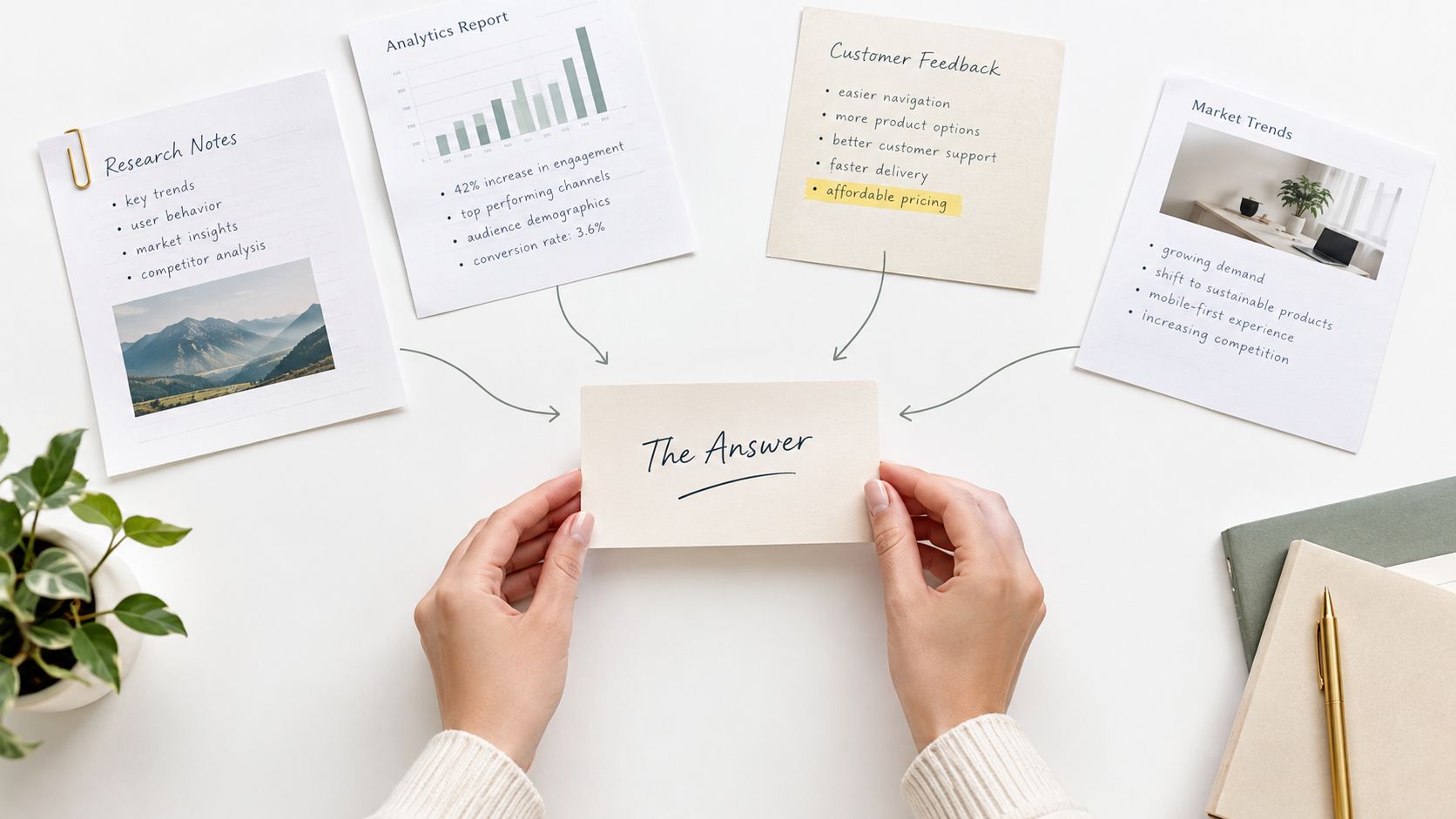
If a frequently cited publisher lists your old pricing, send a precise correction request: the incorrect passage, current documentation, and the relevant billing conditions. Don't demand a favorable verdict or a link in exchange.
I'd prioritize that correction over another FAQ repeating your existing claims. More pages create maintenance work without necessarily adding evidence.
Your own page still has a clear responsibility: publish the facts you can verify directly. Keep current pricing, product limits, effective dates, and exceptions explicit enough that an external editor can update their coverage accurately.
Measuring Citations Instead of Rankings Alone
A single visibility score hides too much. You can be discoverable without being cited, cited inaccurately, or prominently represented without receiving a visit. I'd keep those outcomes separate before deciding whether an optimization worked.
A study covering more than 3,100 queries from June 2024 through September 2025 reported a 61% decline in organic CTR when AI Overviews appeared, while cited pages had 35% higher organic CTR than uncited pages. That comparison doesn't prove that earning a citation caused the higher CTR.
Citation outcomes to track and what each one reveals
| Outcome | How to check it | Failure it reveals |
|---|---|---|
| Retrieval | Compare likely sub-questions with your page headings, using this as a coverage proxy rather than proof of retrieval | A missing answer may exclude the page from consideration |
| Zitation | Log the exact cited URL, not just the domain | An outdated support page receives the citation |
| Prominence | Note citation position and how many claims it supports | Your source appears only near the bottom |
| Genauigkeit | Compare summary wording against the page each month | A price, limitation, or date is misstated |
| Downstream traffic | Segment analytics by landing page and inspect branded-search trends | Citations increase without visits or demand signals |
You usually can't observe an engine's complete retrieval set. Don't mark “retrieved” as confirmed merely because your heading matches a likely sub-question.
Build your 20-query log with a row per query and repeat observations over time. Include query, intent, observation date, location, device, AI Overview presence, organic URL and rank, exact cited URL, citation position, extracted claim, accuracy, clicks, and publication-change notes.
Use this guide to tracking AI Overviews to organize citation checks alongside your existing search reporting.
Decide which trade is worth making
Citation volume can rise while visits fall. A citation supporting the opening recommendation deserves a different interpretation from a footnote attached to a minor qualification.
Keep location, device, and query wording consistent across checks. Record answer absence too, and don't treat a single snapshot as a stable result.
Trade-off rule: When citations rise and visits fall, keep the change only if accuracy holds and branded searches or assisted conversions improve over a comparable observation period.
Even then, check alternative explanations such as paid campaigns, seasonality, or a launch. Branded demand isn't automatically attributable to citations.
For a conversion-focused page, I'd also protect qualified leads and revenue. If citation gains coincide with poorer business outcomes and no credible compensating signal, revert the experiment or narrow the change rather than declaring a visibility win.
Audit a Page for Citation and Start Your Baseline
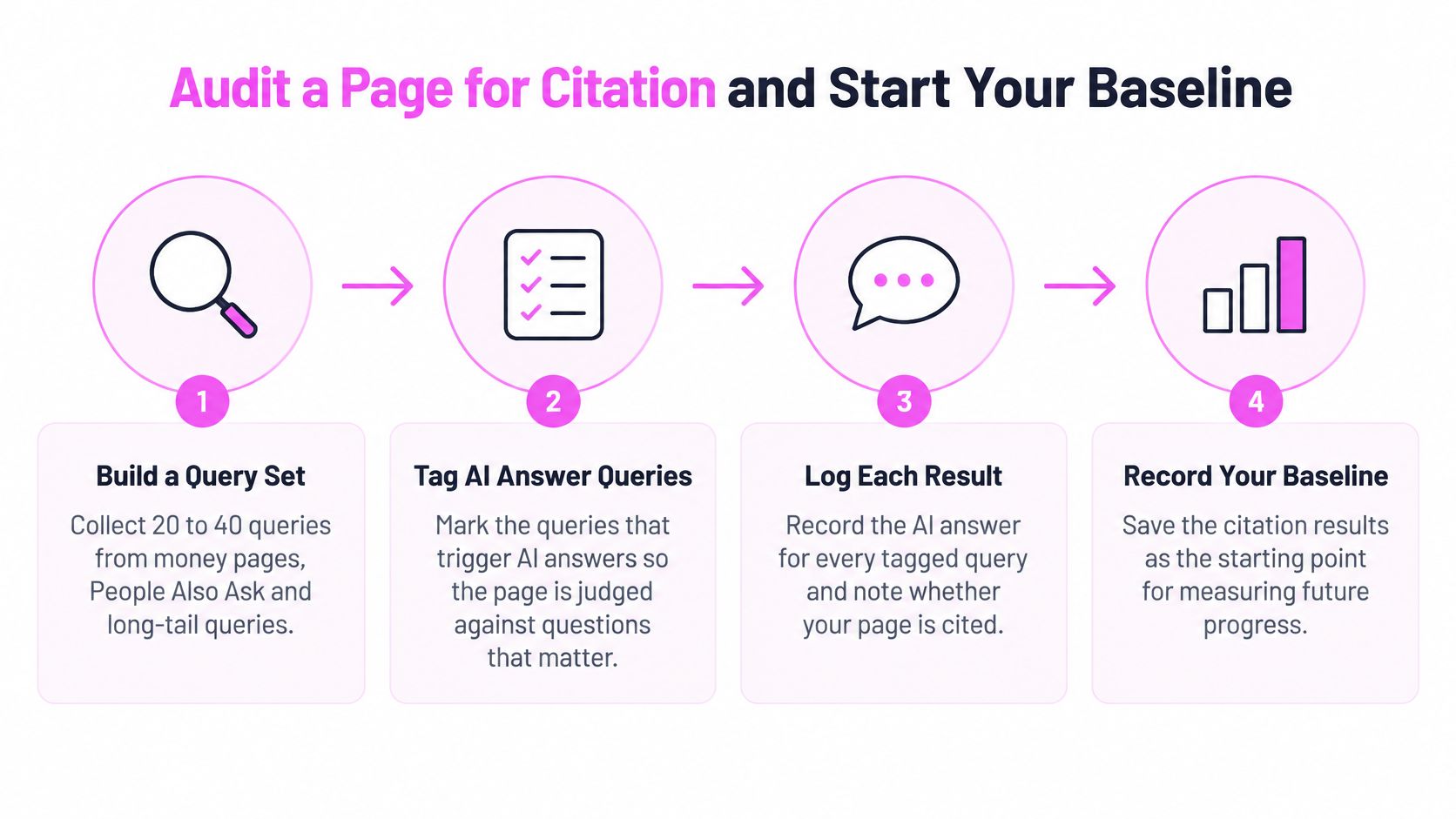
Start with a 20-query test, expanding toward 40 queries only if you can maintain consistent checks. Those are practical workload choices, not a sample-size claim.
The baseline process is simple enough to keep in a shared sheet.
Establish the test before editing
Build the query set. Pull questions from money pages, People Also Ask, and long-tail keyword suggestions. Tag the queries that currently trigger AI answers so you don't judge the experiment against unrelated impressions.
Record the starting state. Save your organic rank, ranking URL, citation status, and every relevant cited URL. Check competitors and third-party sources, not just your own domain, and retain the answer wording for comparison.
Map the missing components. Break each target question into the factual details needed to answer it. For a software comparison, that could mean billing, integrations, implementation requirements, exclusions, and suitable use cases.
Before commissioning changes, you can also evaluate readiness with Agentable as a complementary audit checklist. Keep the output tied to specific URLs and repair tasks rather than an unexplained readiness score.
Rewrite the evidence-bearing section
Answer the missing question directly. Give a distinct sub-question its own heading and a short, self-contained answer. I'd aim for two or three sentences before adding supporting detail, but wouldn't force a complicated limitation into an unsafe summary.
For example, replace “Our integration is easy to configure” with the actual prerequisites, setup responsibilities, and dependencies. Don't invent an implementation-time estimate to make the passage look more useful.
Attach evidence to quantitative claims. Identify the source, applicable date, method, and limitation where relevant. For your own product, link the authoritative documentation and specify which plan or configuration the statement covers.
Expose decisive content in HTML. Keep the answer readable without relying on an image, inaccessible tab, or client-side widget. Google's AI optimization guidance emphasizes accessible, crawlable source material; don't treat every accordion as automatically inaccessible, but verify what renders and what crawlers can access.
A reviewer should check every number, example, and product limit before publication. Google's guidance on generative-AI content requires accuracy, quality, relevance, and compliance with Search policies, not just fluent output.
Use generation for decomposition or drafting if it helps. Keep a human accountable for verification, and maintain a change log for pricing, legal, policy, or other high-risk material.
Recheck the selected URL
- Republish and validate. Confirm recrawling before interpreting the result. As a practical starting schedule, recheck after two to four weeks, then extend the observation period if crawling or answer availability makes that comparison inconclusive.
Choose one page already ranking in positions 2 to 10 for a triggering query. Pair AI Overviews citation tracking with the SERP Checker's 12-month history to distinguish your edit from a broader results change.
Apply a simple diagnostic:
- Wrong URL cited: Review overlap, internal links, and consolidation opportunities before redirecting anything.
- Right page ranks but isn't cited: Repair the relevant answer passage and evidence.
- Neither ranking nor citation: Investigate indexing, relevance, and authority as an SEO problem first.
If a change sends attribution to the wrong page, investigate and roll back when the change caused the problem. Don't scale the rewrite until the intended URL earns an accurate citation and the business trade-off passes your decision rule.
SemDash offers AI Overviews tracking for triggering keywords and exact cited URLs, alongside keyword research and historical SERP analysis. Visit SemDash to build your query baseline, choose a page-level test, and compare citation changes with the search outcomes you already measure.