
You've got the audit. It's thorough, it's prioritized, and almost nothing from it has shipped. Engineering says the tickets are underspecified, the regional teams say the templates are not theirs to change, and your dashboard still reports one global visibility number that hides which market is losing ground.
I've sat in that meeting more than once. Enterprise SEO consulting isn't a bigger version of agency SEO. It's an allocation and governance problem, deciding which URL families, templates, markets, and teams get attention first, then getting people you don't manage to ship the fix.
Inhaltsverzeichnis
- What Enterprise SEO Consulting Covers at Scale
- What Engagements Cost and How They Are Priced
- Crawl Budget as an Allocation Problem
- Core Web Vitals Fixed at the Template Level
- Multi-Market Targeting Without Duplicate Signals
- Getting Engineering, Legal and Accessibility Teams to Act
- Measuring Visibility Across Google, Bing and AI Answers
- Confirm the Scope Before You Sign
What Enterprise SEO Consulting Covers at Scale
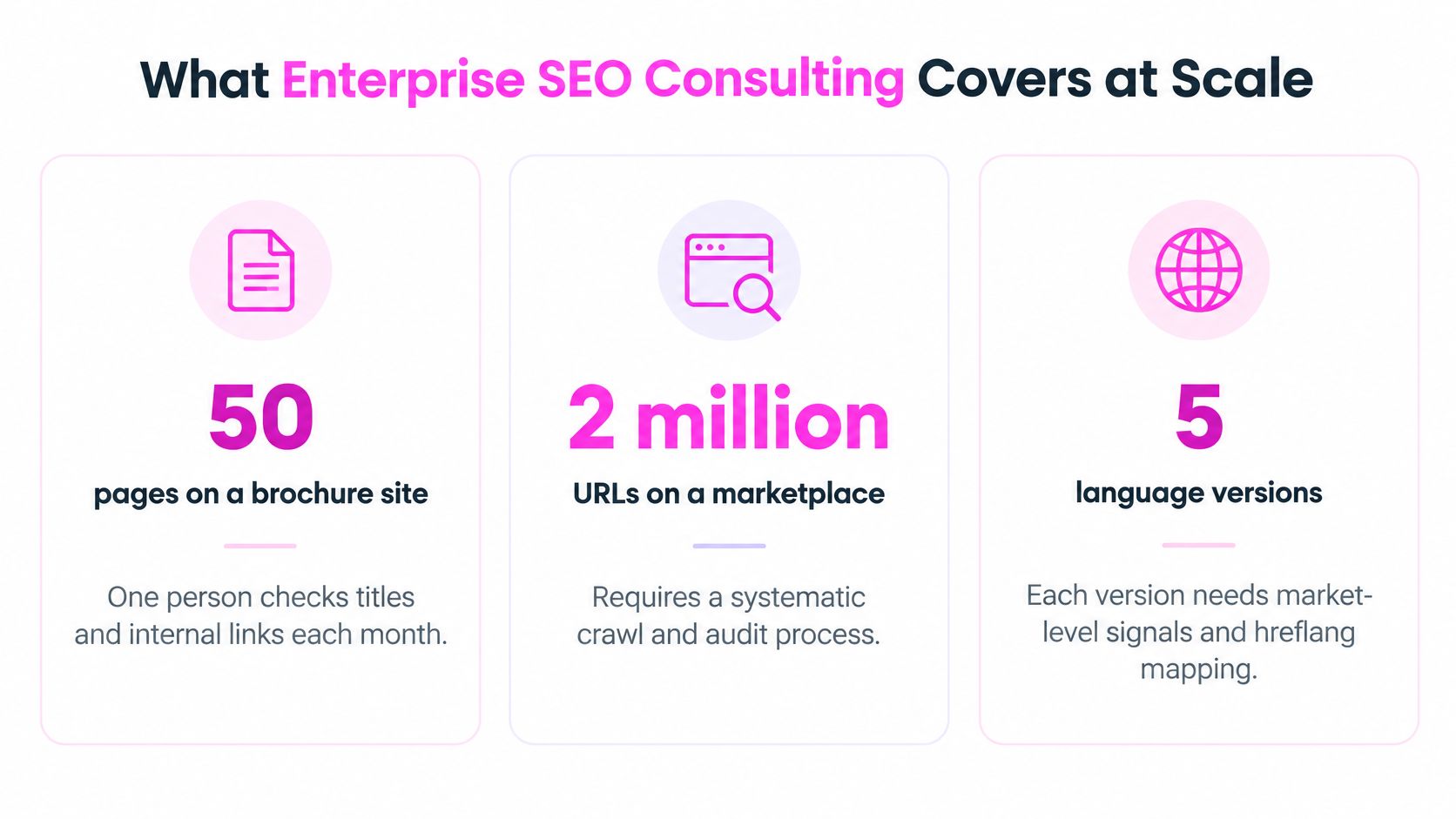
A 50-page brochure site needs one person checking titles and internal links each month. A marketplace with 2 million URLs, five language versions, and three engineering squads needs someone deciding which URL families get crawled, which templates can ship changes this quarter, and which market's decline gets an owner today. The job grows at that scale. It also changes shape.
I frame scope before deliverables because the wrong first fix burns a quarter.
Budgets make sense as exposure management. Organic search often carries a large share of discoverable demand, and on a template-driven site one change can alter millions of pages at once. A wrong canonical rule, a faceted URL pattern left open, or a release that removes internal links can outweigh a campaign's full year of work. I treat visibility as cross-functional work because templates, releases, localization, and legal approvals decide what ships.
How scope changes by size
| Site size | Typical scope | Main risk | Consultant focus |
|---|---|---|---|
| Under 10,000 indexable URLs | Monthly audits, one market, one CMS team | Thin pages and keyword cannibalization | Keyword-to-URL mapping and content consolidation |
| 10,000 to 1 million URLs | Quarterly technical audits, template QA, 2 to 5 markets | Crawl waste and template regressions after releases | Template ownership and release gates |
| Over 1 million URLs | Continuous log analysis, engineering SLAs, 5 or more markets | Crawl allocation, faceted URL growth, hreflang errors at scale | Crawl governance and cross-team prioritization |
My product in the top band is rarely a report. It's prioritization, governance, and measurement across teams I don't manage. I map keywords to exact URLs, segment performance by business unit and region, and name the owner who can ship each fix. If nobody owns the template, the recommendation stays in a doc.
Run three questions on your own site. How many indexable URLs do you have, how many markets and languages do you serve, and how many teams touch templates? More than two on each puts you in enterprise territory regardless of company revenue.
What Engagements Cost and How They Are Priced
Most buyers walk in expecting a monthly retainer. That's a reasonable starting point, but I've seen retainers fail without anyone noticing because they bought time when the site needed a bounded piece of engineering work. Price follows scope, and scope follows URL families and templates, not hours in a deck.
I don't quote market price bands here because I don't have verified ranges I can defend for your site. Get actual quotes against the same URL inventory. What I can give you is what drives each model, and where each one breaks.
Pricing models compared
| Model | What drives the price | What it includes | Main risk |
|---|---|---|---|
| Monthly retainer | Named lead hours and number of markets covered | Ongoing strategy, technical oversight, reporting | Paying for time rather than outcomes; scope drift |
| Fixed-scope audit or roadmap | URL count, template count and markets crawled | Crawl, template and market audit with a prioritized backlog | Stalls without an internal owner to ship fixes |
| Project sprint (migration or relaunch) | Redirect volume, template count and launch date | Redirect mapping, migration QA, launch monitoring | Cost spikes when launch dates slip |
| Hybrid retainer plus sprints | Retainer level plus a capped sprint budget per quarter | Ongoing governance plus scheduled, scoped projects | Hard to budget unless sprint caps are written in |
| Performance-linked fee | Base fee plus bonus tied to agreed KPIs | Share of measured incremental organic revenue | Attribution disputes; rarely the whole fee |
Retainers buy ongoing oversight and a named lead. They work when releases are constant and someone has to review templates before they ship. They fail when there's no ship list, so the retainer fills with reporting.
Fixed-scope audits buy a prioritized backlog. I've delivered audits I'm proud of that produced nothing, because nobody inside owned the fixes. If you buy an audit, name the internal owner on day one.
Migration sprints are priced by redirect volume and launch risk. When the launch date slips, you pay for standby, re-crawls of staging, and remapping. Put the slip terms in writing.
I worked with a 300,000-URL marketplace that bought a fixed audit first, then moved to a hybrid with a capped quarterly sprint budget. The audit showed template work that needed engineering capacity a retainer couldn't buy, so we priced each sprint by the URL families and templates it touched. That's what engineering schedules in practice.
If a proposal prices work in hours but can't name the templates it will change, I can't forecast its effect, and neither can your engineering lead.
Hybrids work when sprints carry a fixed cap. Without a cap, every discovery becomes a change request. Performance-linked fees need attribution agreed in advance, down to the landing pages and conversion window, and in my experience they rarely make up the whole fee. The contract terms that stop scope creep are in the pre-signing checklist at the end of this guide.
Crawl Budget as an Allocation Problem
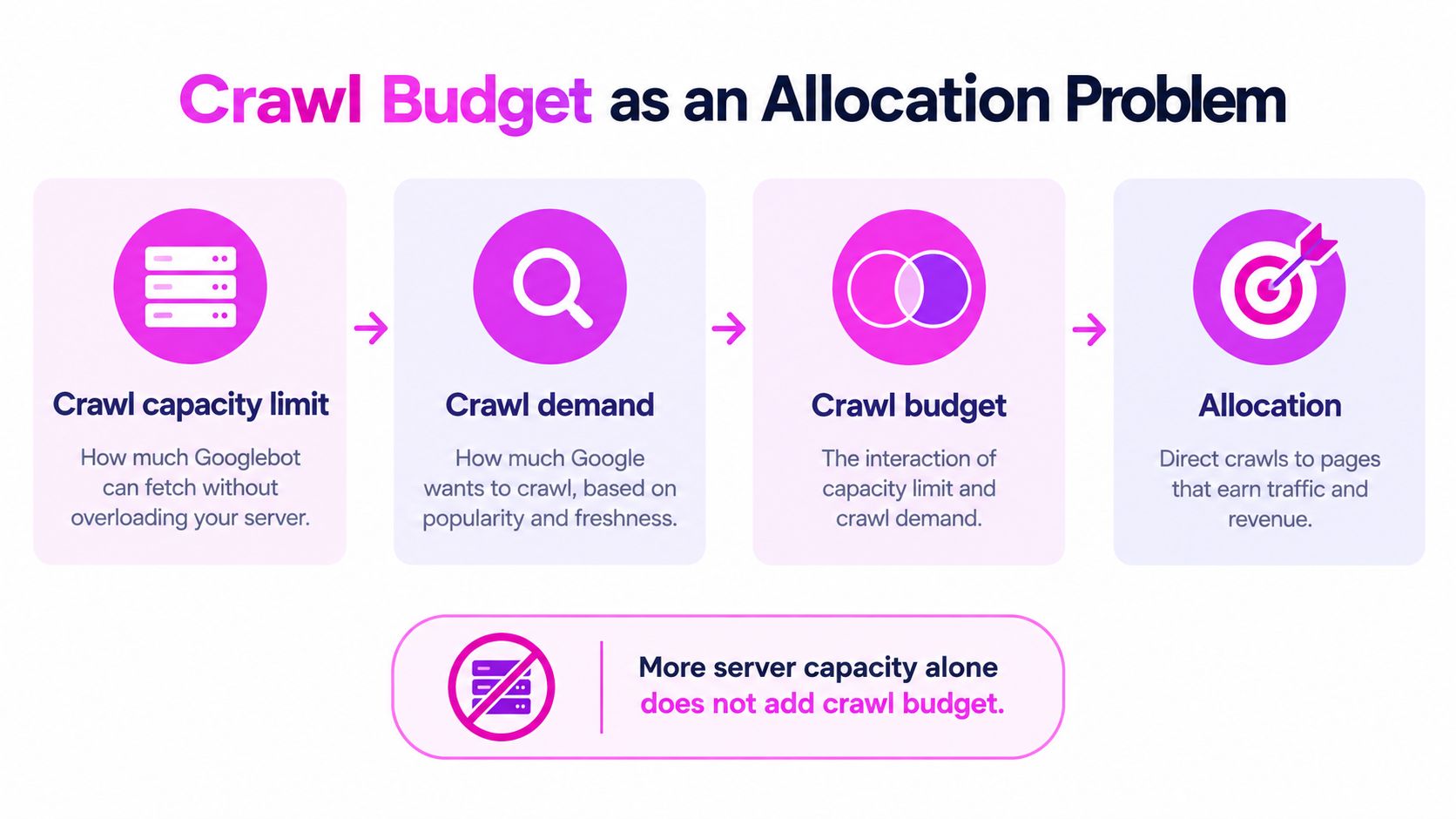
The myth I hear most is that more server capacity earns more crawling. It doesn't. Google defines crawl budget as the interaction between crawl-capacity limits and crawl demand, so raising capacity alone doesn't guarantee broader crawling. Demand follows URL popularity, update frequency, content uniqueness, and user value.
This visual shows why I treat the problem as allocation rather than server sizing.
Google's guidance targets sites with more than 1 million unique pages that change moderately often, sites with more than 10,000 pages changing daily, or properties with many URLs marked "Discovered – currently not indexed." If you're in one of those groups, I work through this triage in order.
My six-step triage
- Pull the logs: I take 30 to 90 days of server logs and bucket requests by template, market, status code, and rendering type.
- Match value: I join each URL family to search traffic and backlinks from analytics and Search Console, so I know what earns its crawl.
- Flag waste: I mark families with heavy bot requests and no indexable value, such as faceted filters, session IDs, internal search results, and duplicate pagination.
- Check collisions: Before writing any rule, I test each blocking candidate against category and product URLs that share the same pattern.
- Block proven waste only: I use robots.txt for demonstrably wasteful combinations and return accurate 404 or 410 responses for retired pages.
- Clean the sitemaps: I limit XML sitemaps to canonical, indexable URLs, and I treat sitemap inclusion and crawl control as separate mechanisms.
Step 4 exists because I've seen it skipped. A rule written to block a sort parameter also matched a category route, and the team removed discovery paths along with the waste. We only found it by comparing log requests before and after, segmented by template.
This walkthrough covers the same log-first workflow I use on large properties.
After the change, I measure two things. First, crawl requests on priority templates, because that's the allocation you were trying to shift. Second, time to index new product pages, because that's the outcome the business feels. Fewer unnecessary URLs reduce crawl waste, reliable responses improve capacity, and clearer canonical signals make it more likely priority pages get discovered and refreshed. Submitting more URLs does none of that on its own.
Core Web Vitals Fixed at the Template Level
One fix to a product-page script can improve tens of thousands of URLs at once. Page-by-page performance work never catches up on a site this size. That's why I assign every Core Web Vitals fix to a template and an owner, not to a list of URLs.
Google recommends a Largest Contentful Paint of 2.5 seconds or less, an Interaction to Next Paint below 200 milliseconds, and a Cumulative Layout Shift below 0.1. I monitor those thresholds by URL template, device, country, and release version. A sitewide average tells me almost nothing.
How I split the measurement
- Search Console field data: This shows how grouped URL sets perform for real users, and it's where I confirm whether a template is failing.
- Lab diagnostics: I use these to isolate the cause on a controlled test, such as a render-blocking stylesheet or an unprioritized hero image.
- Real-user monitoring: This ties a performance shift to a specific release, which is what engineering needs to accept or roll back a change.
The interventions themselves are familiar. For LCP, I prioritize the largest image or text block and reduce render-blocking resources. For INP, I split long JavaScript tasks and audit third-party tags that delay interaction. For CLS, I reserve dimensions for images, ads, and embeds so the layout doesn't jump after load.
What makes this enterprise work is the release habit. I tag every deployment, compare field data per template before and after, and agree a rollback trigger in advance. For example, if a product template's 75th-percentile LCP stays above 2.5 seconds for two weeks after a release, we revert or hotfix rather than debate.
The trap I see in board decks is a healthy homepage score presented as site health. Meanwhile category pages fail in specific countries on mid-tier devices. I segment by template and country every time, because that's where the failing script usually lives.
Template remediation is also the honest economic argument. One fix to navigation, product-page scripts, or a shared content module can improve thousands of URLs simultaneously, while individual page tuning burns the same engineering hours for a fraction of the coverage. I assign owners for these fixes in the RACI table in the governance section below, because a threshold without an owner is just a number in a report.
Multi-Market Targeting Without Duplicate Signals
A /de/ folder does not target Germany by itself. It only tells me a URL family exists; the targeting job is deciding which locales deserve separate URLs, who owns each mapping, and how conflicts get resolved before they ship. Google supports hreflang annotations and XML sitemaps when separate URLs exist, and that explicit mapping is the work.
On large sites I rarely annotate everything first. I start where market separation changes money or compliance: product templates, pricing pages, legal copy, support hubs, and country homepages. Low-value near-duplicates can stay consolidated until there is a reason to split them.
I implement targeting at the URL level rather than relying on automatic redirects or interface language. The market map is useful only when every marker becomes a decision: template family, locale code, canonical rule, owner, and release check.

The validation sequence I run
- Assign the method: I pick HTML link elements, HTTP headers, or XML sitemaps per template family, based on what your engineers can maintain.
- Fully qualify URLs: Every alternate includes https or http. Relative paths don't count.
- Use correct codes: Language uses ISO 639-1, with an optional ISO 3166-1 Alpha 2 country code, such as en-US.
- Confirm reciprocal sets: Each localized page lists all relevant alternates, including itself.
- Crawl rendered pages: I flag missing return links, redirected alternates, noncanonical targets, and language-region pairs that don't exist.
- Check market reality: Translated copy must differ enough to justify separate targeting, and currency, shipping, legal text, and availability must match each market.
- Monitor after release: I watch country landing pages in Search Console after every deployment, not just at launch.
Step 6 catches a quiet problem. I've audited sites where the copy was effectively identical across countries while pricing and legal text changed inconsistently. Google gets duplicate content with conflicting commercial facts, which helps nobody.
I choose one implementation method the engineering team can maintain reliably, then monitor it. Treating hreflang as a one-time tag insertion is how migrations break it six months later. For a fuller audit workflow, see our guide to running an international SEO audit.
Reporting follows the same scope. Engine mix and audience behavior differ by country, so I segment by engine, country, device, and language rather than trusting one global rank report. If Germany loses visibility while France holds steady, the fix usually sits in a template or release owned by one market team, and that is where I send the ticket.
Getting Engineering, Legal and Accessibility Teams to Act
I once watched a canonical fix sit in a backlog for six months because it touched a design system owned by a team that had never heard of SEO. The ticket was correct. It just had no owner. In my experience the stakeholder problem is almost always ownership, not persuasion.
Who owns recurring fixes
| Fix type | Responsible | Accountable | Consulted |
|---|---|---|---|
| Template Core Web Vitals fixes | Front-end engineering | Engineering director | SEO consultant |
| Accessibility remediation to WCAG 2.1 AA | UX and front-end team | Product owner | Legal, SEO |
| Hreflang and market URL mapping | International SEO lead | Head of digital | Localization managers |
| Release-gate SEO checks | QA team | Engineering manager | SEO consultant |
| Robots and crawl rule changes | SEO consultant | Head of SEO | Engineering, legal |
| Regional legal copy and compliance | Legal team | Legal counsel | Market managers |
Accessibility belongs in the same table, not a separate workstream. A 2025 systematic review notes that semantic HTML, descriptive image alternatives, and coherent heading structures support both screen-reader navigation and search-engine indexing, and recommends recurring audits against WCAG 2.1 Level AA.
I sell that case to clients without overstating it. The strongest case is reduced exclusion and better usability. Search benefits are a plausible secondary effect of better structure and content clarity, not a ranking guarantee. If I promise rankings from accessibility work, legal and UX stop trusting the program.
Three governance artifacts make the overlap manageable.
- Release-gate checklist: I check titles, canonicals, hreflang, heading order, and alt text on templates before they ship.
- Template-level QA: We test the template once, properly, instead of sampling pages after launch and finding the same defect thousands of times.
- Quarterly cross-functional audit: SEO, UX, and legal review the same findings together, so remediation doesn't create regressions in international sites or JavaScript applications.
The translation habit that gets tickets prioritized is simple. I express each finding as an affected URL count and a named template, because engineering schedules work by scope. "Improve headings" dies in triage. "Fix heading order on the product template, affecting every product URL in three markets" gets a sprint.
Measuring Visibility Across Google, Bing and AI Answers
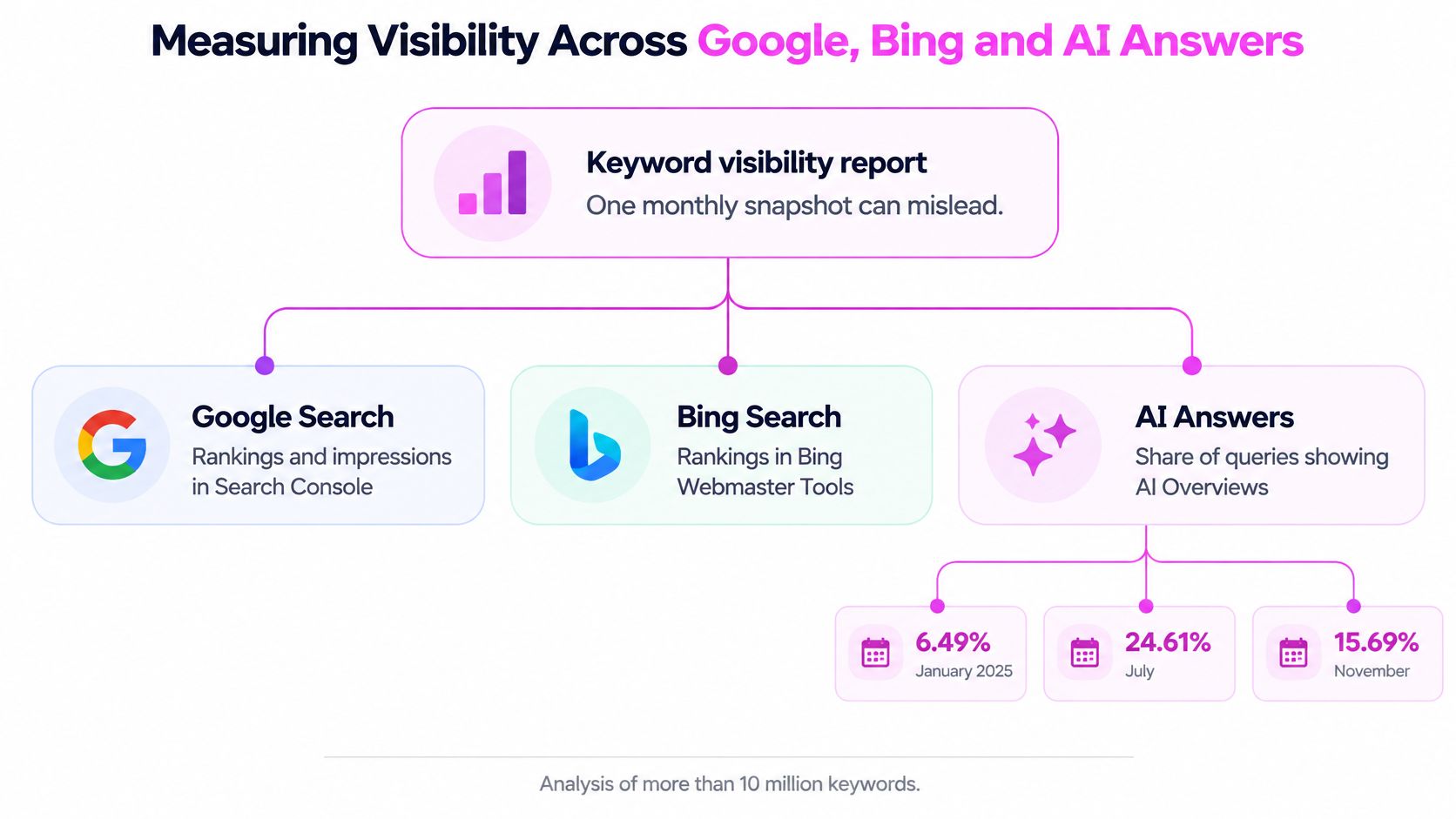
AI Overviews appeared for 6.49% of queries in January 2025, rose to 24.61% in July, and fell to 15.69% by November, across an analysis of more than 10 million keywords. A single monthly AI score is meaningless when coverage swings that much. I've stopped reporting one.
This hierarchy shows how I separate the layers instead.
Measurement layers and tools
| Schicht | Question it answers | What to check | Example tool |
|---|---|---|---|
| Keyword-to-URL mapping | Which exact URL ranks for each query in each market | URL-level mapping and historical SERP data | SemDash |
| Competitor gap | Where competitors take traffic and links I am missing | Gap reports with volumes and target URLs | SemDash |
| AI answer citations | Which queries trigger AI Overviews and which URLs are cited | Cited-URL export and query-level history | SemDash |
| Crawl and log analysis | What search bots actually request, by template | Log ingestion at your URL volume and template tagging | Your log analysis platform |
| Field performance (RUM) | Which templates pass Core Web Vitals in real sessions | Segmentation by template, device and country | Your real-user monitoring platform |
Each layer answers a different question. Classic rankings tell me where I stand. AI-answer inclusion tells me whether the query now produces a generated answer at all. Cited-URL visibility tells me whether my page is the source. Clicks, conversions, and brand mentions sit below that, and they don't always move together.
The order of work is set by eligibility. Google states its generative AI search models use publicly accessible, crawlable content to learn patterns and provide grounded responses. So I start with technical eligibility, not a separate AI content template. A blocked or wrongly canonicalized page can't reliably become a cited source.
I map target questions to the exact URLs that answer them, check those URLs are indexable, and separate brand mentions from URL citations. A company can be mentioned while its documentation or product page isn't the page retrieved, and that visibility produces little qualified traffic. For background on tracking this layer, see our overview of AI search visibility.
Publishing many near-duplicate AI-written pages to chase citations is the mistake I talk clients out of most often. I'd rather consolidate overlapping pages and strengthen unique first-party information.
My escalation rules are explicit. Update the page, consolidate competing URLs, build a stronger first-party source, or accept reduced clicks where the query is answered directly. For some informational queries, being cited preserves consideration even as visits decline, so I forecast at portfolio level with scenarios rather than promising traffic recovery query by query.
Confirm the Scope Before You Sign
Run this checklist before any signature. I want the URL inventory with counts by template and market, access to server logs, and named owners in engineering and legal. I want the markets in scope and the search engines you'll report on written down.
Deliverables should be written as URL families and template changes, not hours. Add a change-request threshold, and require reporting segmented by market, template, and engine. If a proposal can't survive that format, the scope isn't defined yet.
The 90-day pilot I ask for
- Days 1 to 30: Log segmentation and crawl triage, with every blocking rule documented before it's applied.
- Days 31 to 60: The top template performance fixes shipped and verified in field data.
- Days 61 to 90: Hreflang validation across priority markets and an AI-answer citation baseline for your top revenue queries.
Judge the consultant by whether fixes shipped and whether blocked owners were named. A monthly ranking screenshot proves neither.
Add one capability test. Ask for a template fix they shipped on a site over 1 million URLs, the log volume they process and how they tag it, and which client-side owner approved the last ticket they got shipped. A vague answer on any of the three tells me they've run a bigger version of agency SEO.
Baseline the pilot before you compare proposals. Export your keyword and URL mapping in SemDash, then hold each consultant's plan against that same map. You'll see quickly who priced your actual templates and who priced a generic program.
If you're scoping enterprise SEO consulting, start with the map you'll judge every proposal against. SemDash gives you URL-level keyword mapping, competitor gap reports, historical SERP data, and AI Overview citation tracking across Google and Bing, so you can baseline a 90-day pilot by template and market instead of by hours. Visit SemDash to build that baseline before you sign.