


“Find high-volume keywords, publish better content, and build links” skips the decisions that determine whether the work is worth doing. You can follow that advice carefully and still attract visitors who'll never become customers, or optimize a page that doesn't belong in the target results.
I'd rather start with a harder question: What would someone need to accomplish after searching this phrase, and which page should help them do it? That forces a choice before the keyword export becomes a publishing calendar.
A useful keyword ranking strategy connects intent, page ownership, business value, and a realistic competitive opening. It also accounts for what happens before anyone clicks, including AI Overviews that may answer the query directly.
Praktische Regel: Don't approve a keyword until you can name its intended page, its business purpose, and the evidence that makes ranking plausible.
The sequence below puts those decisions ahead of production. You'll work from intent to clustering and feasibility, then improve content, technical access, links, and snippets. Measurement closes the loop, so your next task comes from an observed problem rather than another oversized export.
Inhaltsverzeichnis
- 1. Map Search Intent and Ranking Pages
- 2. Build Topic Clusters Around One Search Theme
- 3. Prioritize Keywords by Business Opportunity and Ranking Feasibility
- 4. Strengthen the Page with Intent-Matched, Expert Content
- 5. Fix Technical SEO and Improve Page-Level Access
- 6. Earn Relevant Backlinks and Reclaim Lost Link Equity
- 7. Improve Titles, Snippets, and Search-Result Engagement
- 8. Measure Rankings, Traffic Quality, and Competitive Share
- 8 Keyword Ranking Strategy Steps at a Glance
- Put the Sequence to Work and Start Measuring Real Progress
1. Map Search Intent and Ranking Pages
Before choosing a keyword, inspect what someone expects to find. Informational, commercial, transactional, navigational, and local intent require different answers, even when the wording overlaps.
For a query such as “keyword ranking strategy,” compare the current results before assigning a software landing page. If you find practical guides and step-by-step articles, I'd recommend an educational page with a relevant commercial next step, not a sales page disguised as a tutorial.
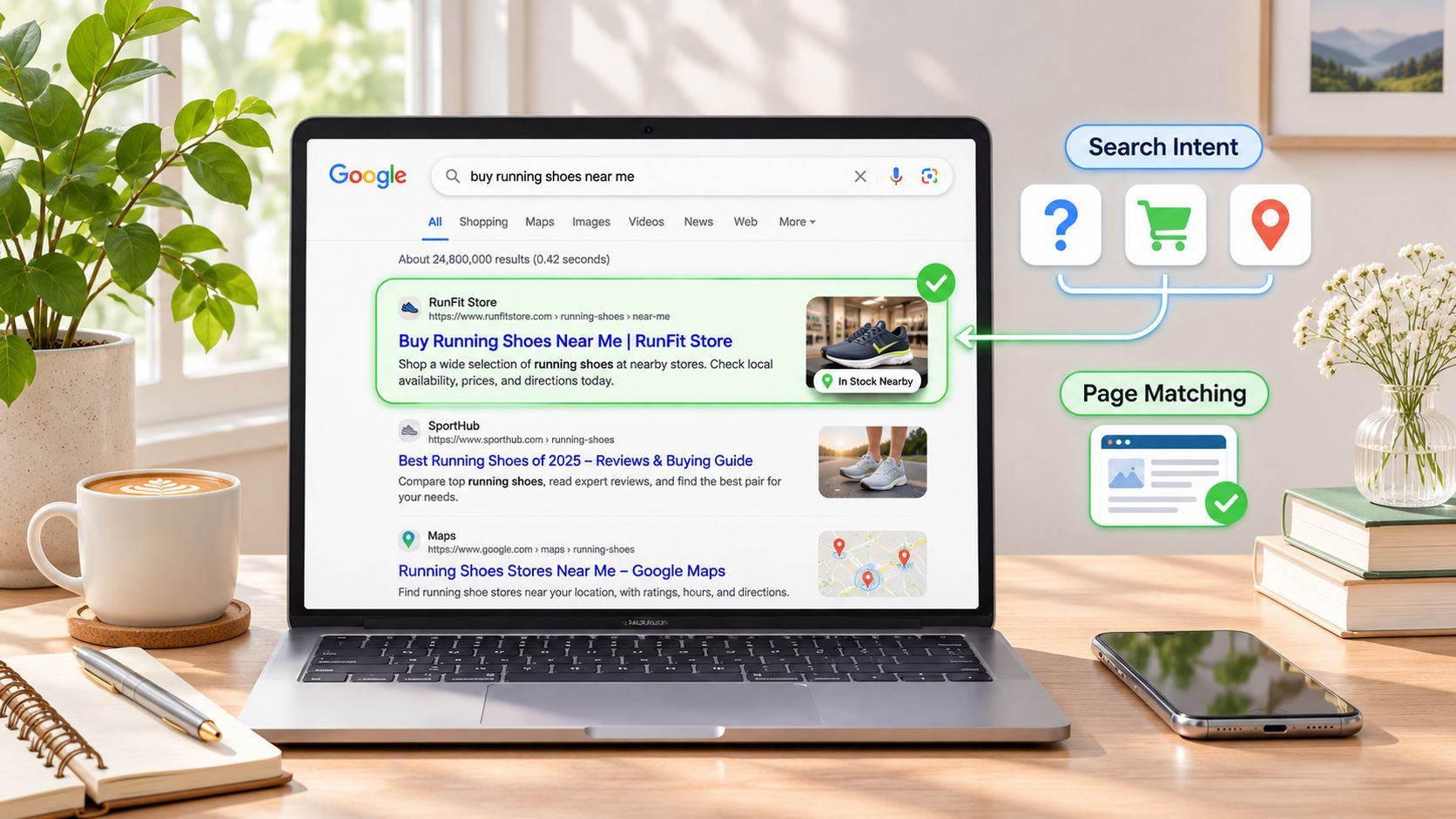
Record page ownership before making changes
Google's ranking systems guide explains that its systems work primarily at the individual-page level, which supports mapping each target query to a deliberately chosen URL rather than relying on a domain's reputation.
Build a working sheet with these fields:
- Search task: Describe what the searcher needs to learn, compare, buy, or locate.
- Current ranking URL: Record the exact page receiving visibility, including an unintended page.
- Dominant format: Note guides, category pages, comparisons, tools, videos, and local results.
- SERP-Funktionen: Record AI Overviews, featured snippets, shopping results, and other prominent elements.
- Decision: Keep, update, create, consolidate, or deprioritize.
Use automated intent classification to accelerate sorting, then manually review priority queries. Check historical results too, because a mixed-intent SERP deserves more caution than a stable set of buying pages.
For an e-commerce category ranking across loosely related product searches, don't immediately consolidate everything. Compare the actual buying tasks first. Separate categories may be justified when customers need different product selections, filters, or specifications.
2. Build Topic Clusters Around One Search Theme
A pillar page about keyword strategy doesn't need separate articles for every variation of “improve keyword rankings.” It needs supporting pages only where you can satisfy a distinct task better than a section within the pillar.
I'd build around page-level intent, not shared vocabulary. A guide to keyword clustering, a tutorial on mapping queries to URLs, and a rank-tracking workflow can support the same broader topic without competing for the same answer.

Validate the cluster against ranking URLs
Use the topic cluster framework to connect a broad resource with focused supporting pages. Then compare the results for your proposed targets: substantial overlap suggests a shared page may be appropriate; clearly different formats or tasks suggest separation.
Keyword discovery can consume the time you need for implementation. In a Search Engine Journal survey, 36.3% of surveyed SEO professionals reported spending most of their SEO time on keyword research.
To keep discovery useful, give every proposed page a job:
- Pillar resource: Explain the broader decision process and direct readers to deeper help.
- Supporting tutorial: Complete a specific task with enough implementation detail to stand alone.
- Commercial destination: Connect relevant research to a product, service, or category.
Before commissioning anything, inventory existing URLs. An underdeveloped guide may already have relevant links and impressions, making expansion more sensible than another article.
The failure mode is a tidy-looking cluster full of interchangeable pages. Merge those pages when their purpose and substance overlap, but preserve distinct resources when each helps with a different decision.
3. Prioritize Keywords by Business Opportunity and Ranking Feasibility
A specialist query with modest demand can deserve attention before a broad category term. For a keyword research product, “keyword gap analysis” may offer a clearer product connection than “SEO,” even if the broader term looks more attractive in an export.
I'd prioritize business fit and attainable click potential, then use search volume to distinguish otherwise comparable opportunities. Keyword Difficulty is useful for screening, not for deciding whether your specific page can compete.
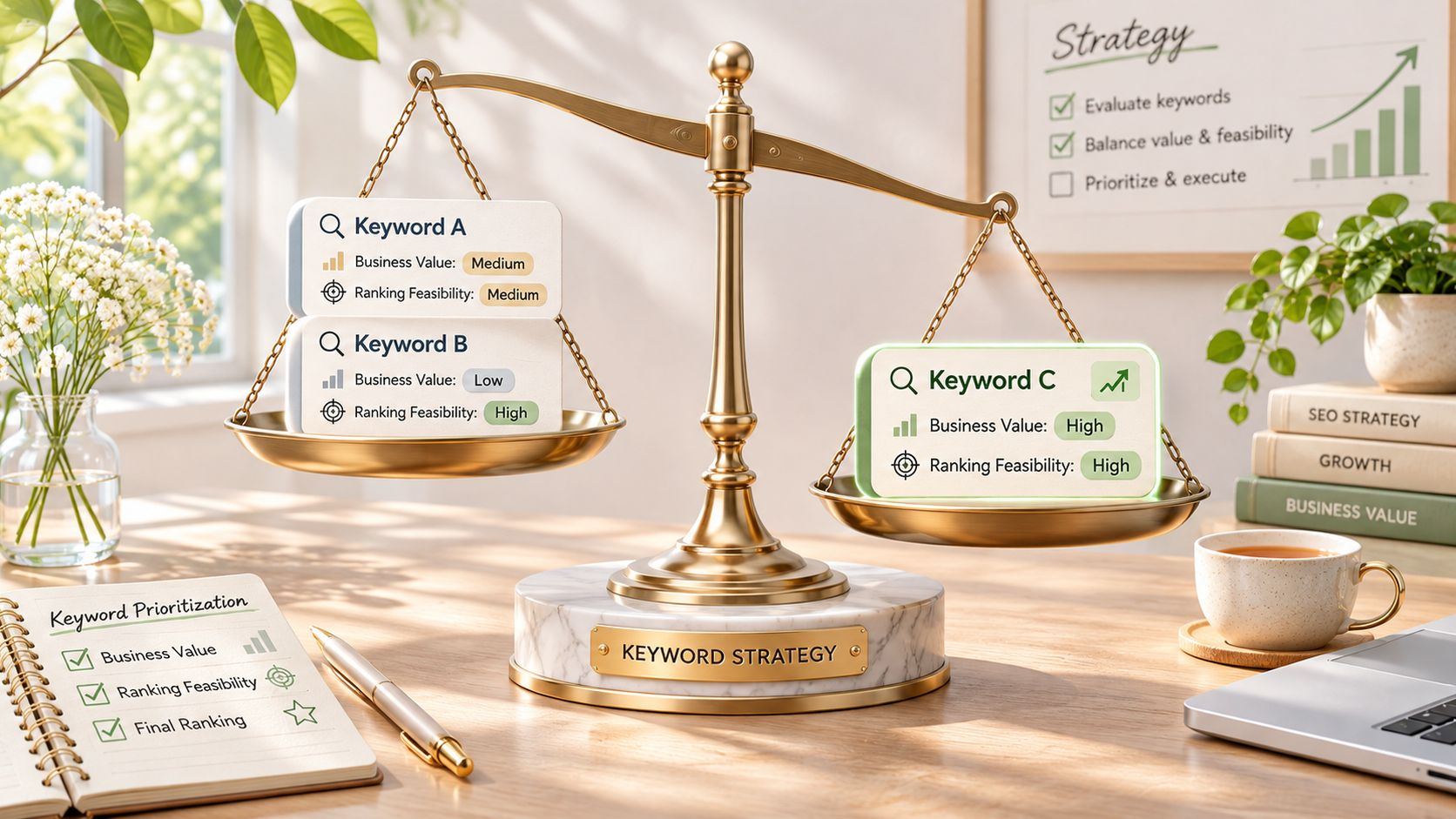
Score the opportunity and document the reasoning
Use low, medium, and high ratings rather than pretending a composite score can predict outcomes precisely:
- Business fit: Can you connect the search task naturally to an offer?
- Demand: Is there meaningful interest across the topic, not just the primary phrase?
- Feasibility: Can you match the required format, evidence, usefulness, and authority?
- Click opportunity: Will the results page give someone a reason to visit?
- Production cost: Can you create and maintain a competitive resource?
In Backlinko's analysis of Google search results, the first organic result received an average 27.6% CTR, while positions 8 through 10 had nearly identical CTRs. That makes the plausible destination more useful than a vague promise to move upward.
Inspect the exact competing URLs and their backlink context. An outdated guide with weak examples may present an opening; an established tool that completes the task interactively may require product development, not stronger prose.
Keep separate queues for near-term improvements and longer-term authority building. Also record irrelevant query variants so they don't creep back into briefs because they have volume.
4. Strengthen the Page with Intent-Matched, Expert Content
If your brief says “cover everything competitors cover,” you're commissioning a replacement summary. I'd rather specify the decision your reader must make and the evidence needed to make it confidently.
For a clustering tutorial, don't stop at definitions. Show a sample query set, explain why similar phrases belong together or apart, and show how that changes the publishing plan.

Require evidence before drafting
Google's March 2024 search update announcement describes changes intended to surface more helpful information and reduce unoriginal content, including stronger treatment of abusive scaled production regardless of how the content is created.
Translate that into editorial requirements:
- Answer first: Put the main recommendation near the top, before background material.
- Demonstration: Include a worked example, annotated screenshot, calculation, or decision tree.
- Trade-offs: Explain when the recommendation fails or becomes too expensive.
- Evidence ownership: Identify who can verify technical details, examples, and claims.
- Next action: Give the reader a useful step beyond finishing the page.
AI can help compare outlines, expand questions, and identify missing coverage. It can't supply first-hand measurements or campaign outcomes you don't possess, so label hypothetical examples clearly and verify every factual assertion.
A useful page should change what your reader can do, not just what your reader can define.
For AI citation opportunities, I'd make definitions concise and methodologies explicit, without treating extractable wording as a guarantee of inclusion. Preserve the depth that makes the answer trustworthy: assumptions, limitations, examples, and sources.
Adding more headings to interchangeable advice won't solve the underlying problem. Add something worth consulting.
5. Fix Technical SEO and Improve Page-Level Access
Start technical work with the URLs that matter commercially or already attract relevant visibility. A critical category page with the wrong canonical deserves attention before cosmetic audit warnings on an unused archive.
Separate access problems from experience problems. You need search engines to discover, render, and consider the intended page, and you need visitors to use it without broken controls, unstable layouts, or obstructive loading behavior.
Trace the problem to a priority URL
For each target page, compare the requested URL, final destination, source HTML, rendered HTML, and indexing information in Google Search Console. Use a crawler such as Screaming Frog to identify patterns across the template rather than treating every affected URL as an unrelated incident.
- Indexing signals: Check robots directives, canonical targets, sitemap inclusion, and internal discovery.
- Response behavior: Inspect status codes, redirect chains, and missing destinations.
- Rendered content: Confirm that the main answer, navigation, and product information appear reliably.
- User experience: Test mobile layouts, Core Web Vitals, intrusive overlays, and interactive controls.
- Duplication: Review alternate URLs before choosing consolidation or canonicalization.
Say your intended category page loads normally but declares an older category as canonical. I'd investigate that conflict before commissioning new copy, because the technical signals don't match the page-selection decision.
Use this walkthrough alongside your own URL inspection.
When consolidating overlapping pages, choose the destination based on relevance, existing performance, links, and usefulness. Redirect superseded pages, update internal links, and preserve unique material.
Test representative templates before release and keep a rollback log. After deployment, monitor the intended ranking URL and indexing behavior, not just whether your crawler reports fewer warnings.
6. Earn Relevant Backlinks and Reclaim Lost Link Equity
Before sending outreach, ask why someone would cite the destination page. “We also published a guide” isn't a compelling reason to replace an existing reference.
I'd start with an asset that deserves attribution: original measurements, a useful methodology, a detailed teardown, or a resource that completes a specific task. Then inspect competing pages' referring domains to find relevant editorial contexts, not merely available placements.
Recover useful references before expanding outreach
Broken backlinks and unlinked mentions can provide concrete, relevant outreach opportunities. Check whether the original reference still fits before asking for a change.
- Broken destination: Restore the useful resource or redirect it to an equivalent replacement.
- Unlinked mention: Suggest the clean canonical URL when it helps readers identify or use the referenced resource.
- Competitor citation: Inspect the surrounding argument and offer evidence that improves it.
- Outreach record: Track the referring page, target URL, relevance, response, and final placement.
Say a SaaS publication cites competing keyword-research guides. I'd recommend pitching an original comparison of clustering decisions, with transparent assumptions, rather than asking for inclusion based solely on topic similarity.
Outreach test: If you removed the SEO benefit, would the reference still help someone reading that page?
Keep anchor language natural and allow editors to describe the resource accurately. Don't prescribe repetitive exact-match wording.
Google's spam policies prohibit link spam and scaled content abuse, including content produced primarily to manipulate rankings without meaningful value. Avoid turning outreach into a factory for interchangeable guest articles.
Track earned and recovered links by destination page. For suspicious links, investigate context and manipulation before considering disavowal; unfamiliar domains alone aren't a sufficient diagnosis.
7. Improve Titles, Snippets, and Search-Result Engagement
A stronger title can clarify a good page's value. It can't make the wrong page satisfy the query.
For “keyword ranking strategy,” I'd favor a direct title such as “Keyword Ranking Strategy for Research and Prioritization” over a vague brand-first headline. The promise should reflect the content someone gets after clicking.
Align the signals before testing wording
Google's title-link documentation lists several possible sources for displayed titles, including the title element, visible headings, prominent text, and link text. If Google displays unexpected wording, inspect those signals together rather than repeatedly editing the title tag alone.
Align the title, H1, introduction, relevant internal anchors, and social metadata around the same task. You don't need identical wording everywhere, and I wouldn't change an established URL merely to make every element match.
For a controlled revision:
- Choose the problem: Identify a page with relevant impressions but weak click performance against comparable queries.
- State a hypothesis: For example, the current title hides the product category or practical outcome.
- Change a focused element: Avoid rewriting titles, descriptions, and the page simultaneously when attribution matters.
- Record context: Note ranking changes, device, country, seasonality, and changes to the results layout.
An academic study of Google result clicks found that both ranking position and SERP features affect organic CTR, so compare similar result environments rather than treating every CTR decline as a copy problem.
Use relevant structured data only when it accurately represents visible content and meets current eligibility requirements. Don't promise rich results from markup alone.
Finally, compare click changes with qualified enquiries, purchases, and engagement. A more attractive promise isn't an improvement if it brings the wrong visitors.
8. Measure Rankings, Traffic Quality, and Competitive Share
A keyword moving upward is useful diagnostic information, not proof of commercial progress. Keep the ranking URL beside the position so you can distinguish improvement on the intended page from an unwanted page taking over.
I'd segment reporting by URL, topic cluster, intent, and business value. Combine Search Console clicks and impressions with analytics outcomes, then compare relevant competitor pages rather than celebrating an expanding keyword count.
Separate traffic from AI visibility
Pew Research Center's analysis of browsing activity from 900 U.S. adults in March 2025 found that users clicked a traditional result in 8% of visits with an AI summary, verglichen mit 15% without one. That's a reason to record AI Overview presence, not an assumption that every informational target has become worthless.
Keep separate reporting lanes:
- Classic-result performance: Track the intended URL, position, clicks, and qualified outcomes.
- AI visibility: Record domain mentions, cited URLs, query context, and persistence.
- Business contribution: Evaluate leads, revenue, assisted conversions, and branded-search patterns without claiming causation you can't establish.
Use a broader organic search visibility framework to distinguish exposure from visits. For lead generation, connect landing-page reporting with measuring organic enquiries in GA4, and validate that recorded events represent genuine enquiries.
Say your guide gains citations while direct visits decline. Check whether qualified outcomes or later branded demand change before deciding to expand investment; citation visibility alone doesn't establish return.
Annotate releases, redirects, content changes, and outreach. When a keyword switches ranking pages, investigate intent overlap and internal links before adding another article.
8 Keyword Ranking Strategy Steps at a Glance
Use this sequence to decide what to target, which page should rank, and where effort is most likely to pay off. Intent comes before volume: a high-demand keyword is a poor target if its results serve a different need or the wrong page on your site. Then assess feasibility, check for competing pages, and decide what to improve.
| Schritt | Primary Focus | Key Question Answered | When to Apply |
|---|---|---|---|
| Map Search Intent and Ranking Pages | Match queries to user intent and ranking URLs | What do searchers want, and which page should address it? | Before creating, updating, or consolidating pages |
| Build Topic Clusters Around One Search Theme | Organize related queries into pillar and supporting pages | How should related searches be grouped into a useful site structure? | When planning content or reducing overlap between pages |
| Prioritize Keywords by Business Opportunity and Ranking Feasibility | Balance demand, business value, and ranking potential | Which keywords offer the best attainable business opportunities? | When choosing what to target with limited resources |
| Strengthen the Page with Intent-Matched, Expert Content | Create useful content that fits the query and demonstrates expertise | What content and evidence will best satisfy the searcher? | When creating or refreshing a priority page |
| Fix Technical SEO and Improve Page-Level Access | Resolve crawl, indexation, performance, and usability issues | Can search engines access and users effectively use priority pages? | When pages are blocked, underperforming, or affected by technical issues |
| Earn Relevant Backlinks and Reclaim Lost Link Equity | Build relevant authority and recover existing link value | Which relevant links can strengthen priority pages or be reclaimed? | When priority pages need authority or have broken links and unlinked mentions |
| Improve Titles, Snippets, and Search-Result Engagement | Align search listings with intent and page benefits | Does the search result clearly and accurately communicate the page's value? | When pages receive impressions but need more qualified clicks |
| Measure Rankings, Traffic Quality, and Competitive Share | Evaluate visibility alongside traffic and business outcomes | Are SEO gains attracting valuable visitors and improving competitive visibility? | After changes and throughout ongoing SEO monitoring |
The sequence is a decision workflow, not a checklist to run mechanically. If two pages target the same intent, settle page ownership before investing in content or links. If the right page exists but cannot be crawled or indexed, address access before interpreting its ranking performance. And if a keyword looks attractive on volume alone, compare its likely business value with the effort needed to compete. These checks help keep the eight steps focused on one clear destination and a measurable search opportunity.
Put the Sequence to Work and Start Measuring Real Progress
The order matters because each decision constrains the next. Intent determines the kind of page you need; clustering determines its boundaries; prioritization determines whether you should invest now.
Content, technical improvements, links, and snippets then support a specific destination. Measurement tells you whether that destination serves the right searches and contributes something useful to the business.
Start with an existing page
I'd recommend beginning with a page that already has relevant impressions or links, rather than making the first exercise a new publishing project. Existing visibility gives you something concrete to investigate, although it doesn't guarantee that the current page deserves to remain the target.
Write a short decision record before editing:
- Intended task: State what the visitor should accomplish.
- Page ownership: Name the URL that should rank and any competing internal pages.
- Competitive opening: Explain what you can provide that the current results lack.
- Primary constraint: Identify whether intent, usefulness, access, authority, or presentation is the strongest current limitation.
- Success condition: Define the qualified outcome you expect to observe, not just the position you hope to reach.
Don't fix every possible weakness at once. If the wrong URL ranks, resolve ownership before testing snippet copy; if the intended page isn't accessible, address that before expanding outreach.
Use a shared evidence base
SemDash consolidates keyword, SERP, backlink, and competitor research in one workspace, with more than 20 SEO research tools and a free way to get started. That can support the workflow without replacing the editorial and commercial judgment behind it.
Your strongest advantage is a clear explanation of why each action deserves attention. “Competitors cover this keyword” is a discovery observation; “we can satisfy this task with a useful resource that supports a relevant offer” is an investment case.
Be equally explicit about when to stop. Deprioritize a target when the required format doesn't suit your business, the production cost outweighs the likely value, or searchers can complete the task without needing what you provide.
Pick a priority page this week, map its intent and ranking URL, and document the next intervention. Review the resulting clicks and qualified outcomes alongside search visibility, then use that evidence to choose the following task.
We offer keyword, SERP, backlink, and competitor analysis to help you turn a keyword ranking strategy into page-level decisions. Visit SemDash to get started for free, inspect a priority URL, and identify the next opportunity to investigate.