


Almost two thirds of the web has never earned a link. In 2024, Ahrefs data reported that 66.31% of web pages had zero backlinks pointing to them, a figure collected in this link-building statistics roundup from Seomator. Read that from the other direction and it becomes useful: for the pages that do have links, every count you pull describes who noticed them, and those counts are small enough to be worth reading closely.
That's why the backlinks vs referring domains question isn't housekeeping. A profile showing 12,000 links sounds immovable. The same profile might show 40 sites behind those links, which is a completely different structure, one that can lose a large share of its apparent strength the moment a single publisher redesigns a template.
I read the two counts together, always, and I treat the ratio between them as the most informative number in the report. The sections below work through where the counts diverge, which one to trust for which decision, and the checks that stop a big number from carrying a conclusion it can't support.
Inhaltsverzeichnis
- Backlinks and Referring Domains Side by Side
- How Each Metric Gets Counted in Practice
- Which Count Tracks Rankings More Closely
- Reading the Ratio Between Links and Sites
- Which Links Actually Count Toward Authority
- Tracking Growth Through New Referring Domains
- Which Metric to Read First for Each Audit
Backlinks and Referring Domains Side by Side
Two columns sit at the top of every backlink report, and they measure different things. One counts hyperlinks. The other counts websites. Nearly every misreading I meet in a link audit traces back to reading the first column as if it were the second.
A backlink is one hyperlink from one page to another. That's the entire definition, which means a single template change can produce thousands of them.
A referring domain is one unique website that supplies at least one of those links. It counts publishers, not placements.
Backlinks and referring domains compared
| Metrik | What it counts | Best used for | Common misreading |
|---|---|---|---|
| Backlink | One hyperlink from one page to another | Locating the pages and placements that create links | Assuming each one is an independent endorsement |
| Referring domain | One unique website that links at least once | Judging how broadly the site has earned links | Treating it as a raw link count |
| Backlinks per referring domain | Total links divided by linking sites | Spotting concentration in one or a few sites | Reading a high ratio as healthy link volume |
The third row is the one I calculate before anything else. Divide total backlinks by referring domains and you get links per linking site, a figure that describes the shape of the profile rather than its size. A page with 1,000 links from one domain and a page with 1,000 links from 100 domains report the same total, and the ratio separates them in a single step.
The rule the rest of this article depends on: every number gets reported next to the other one. A backlink count with no referring-domain count beside it is an unfinished sentence.
Here's a check worth running before you read further, because it takes about four minutes. Pull both counts for three competitors at page level for a keyword you care about, then rank those three by backlinks, then re-rank them by referring domains. When the order changes, you've found the case where the two metrics disagree about who is strong, and that's the profile to open first.
If you want to see how other teams plan the acquisition side rather than just the measurement side, browse backlink strategy posts from Digital Skyrocket for campaign structures and outreach angles that generate the kind of placements this analysis is counting.
How Each Metric Gets Counted in Practice
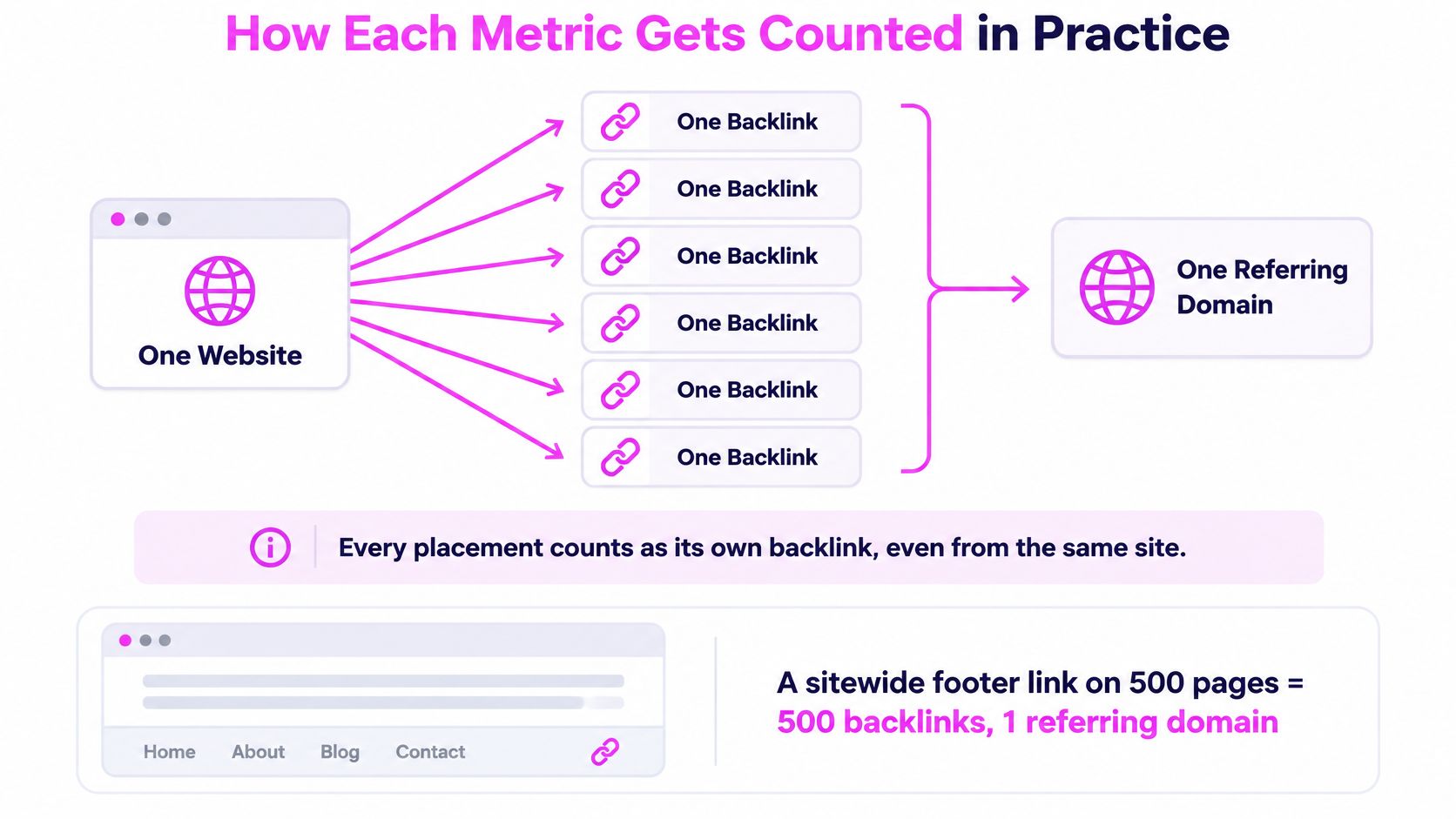
One website can hand you hundreds of backlinks. It can only hand you one referring domain. That asymmetry is the whole article in one line.
Take a footer link. A publisher adds your URL to its footer, and that footer renders on 200 pages. The tool reports 200 backlinks and 1 referring domain, and nothing has gone wrong. Each placement is counted as its own backlink even though every one of them comes from the same site, which is exactly how Ahrefs describes the referring domain and backlink distinction.
Here's the counting mechanic in one picture.
One thousand links, two very different pages
Put two pages beside each other. Page A has 1,000 backlinks from a single domain. Page B has 1,000 backlinks spread across 100 domains. The backlink column reads the same for both.
The acquisition profile doesn't. Page A depends on one publisher's editorial calendar, one template, one relationship. Page B depends on 100 separate decisions by 100 separate people. If you're deciding where to spend outreach effort, or which competitor is hard to displace, only one of those profiles tells you something you can act on.
Why two tools disagree on the same site
Each crawler discovers links on its own schedule and deduplicates at its own layer, so a number from one tool will not match a number from another, and chasing the difference is wasted effort. What matters is consistency within one dataset across the sites you're comparing.
When I pull a report, I export both columns into a sheet, add a ratio column, then sort by links per domain descending. Any domain contributing a large cluster of links gets opened manually to see whether those links sit on separate editorial pages or on one repeated template.
Before comparing counts across competitors, split followed from all links. A followed link carries no nofollow, sponsored oder ugc qualifier, and the followed referring-domain figure is the one that lines up with what ranking studies measure. Keep the followed and all-links columns side by side in every export so the two never get blended into one misleading total.
- State the unit every time: write "1,240 referring domains" or "1,240 backlinks", never a bare number, because your reader will assume the wrong one.
- Label the filter: note whether the figure is followed-only or all links, since a followed count and an all-links count can differ by an order of magnitude on the same page.
- Keep the export date: crawlers update at different rates, and a comparison across two different dates invites a false story about growth.
Which Count Tracks Rankings More Closely
In the analyzed sample of the top 1 million US keywords, referring domains had the strongest correlation with Google ranking position among the link metrics shown. The difference from total backlinks was small.
Correlation with Google ranking position by link metric
| Link metric | Spearman correlation with ranking position |
|---|---|
| Verweisende Domains | 0.255 |
| Followed referring domains | 0.250 |
| Total backlinks | 0.248 |
| Followed backlinks | 0.242 |
| Domain Rating | 0.131 |
Ahrefs reports a 0.255 Spearman correlation for referring domains and 0.248 for total backlinks in its analysis of whether links still matter. The same analysis reports 0.250 for followed referring domains and 0.242 for followed backlinks.
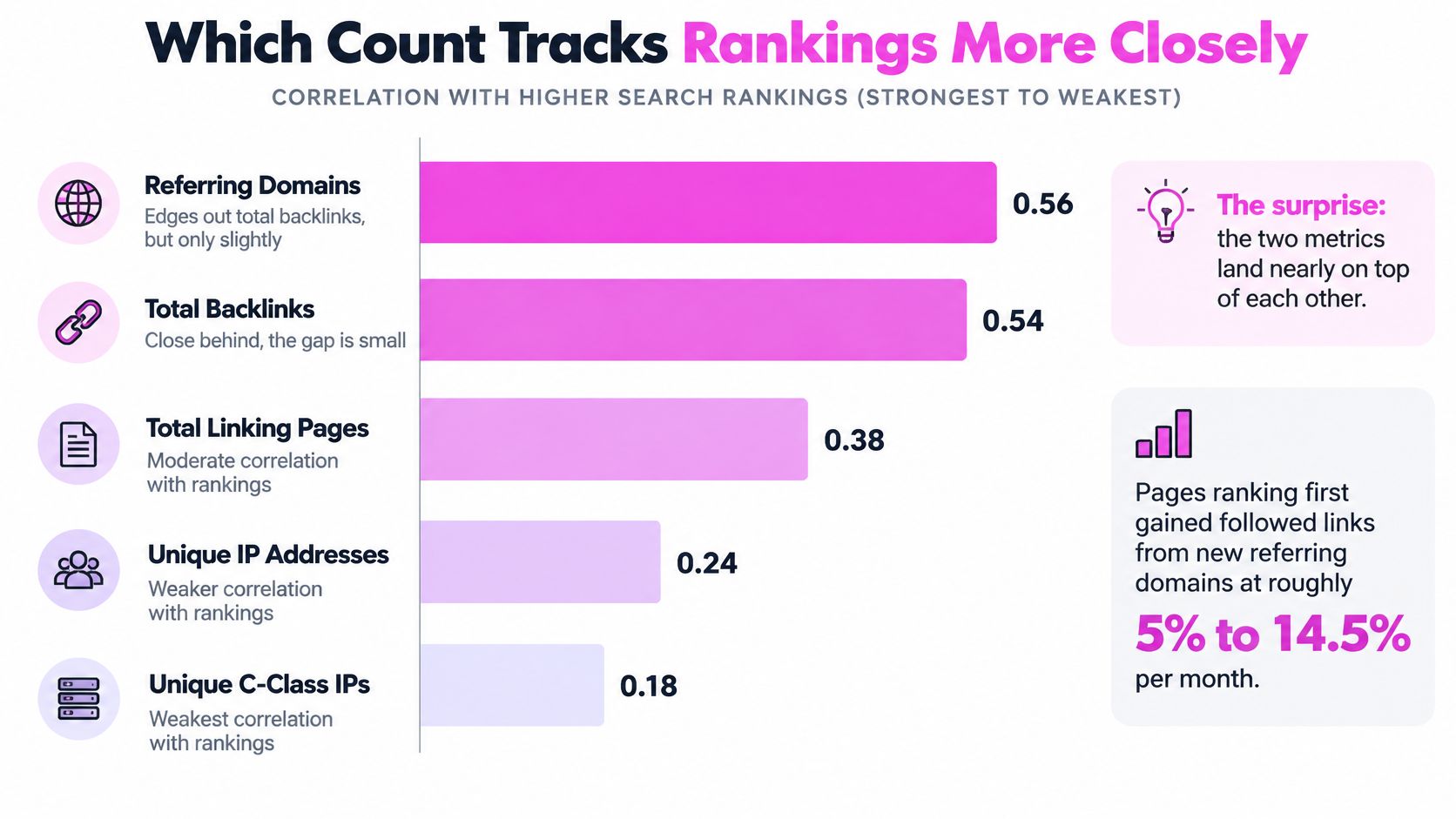
What the ranking data actually says
Referring domains edge out total backlinks by 0.007. Treat that as a directional result, not a decisive gap. Unique-site breadth is slightly more closely associated with rankings in this analysis, but the figures are close enough that neither count should stand alone.
For example, 100 links from 5 domains und 100 links from 50 domains produce the same backlink count. The second profile has more distinct linking sites, while the first depends more heavily on a smaller group. That difference makes referring domains useful for judging concentration, not just for comparing which site has the larger total.
Domain Rating's 0.131 correlation is lower than the link-count figures in this analysis. A single domain-level score therefore gives less information about link volume and distribution than reading both backlink and referring-domain counts together.
For an explanation of how link signals fit into Google's broader ranking systems, see this video.
The caveat that decides how you use this
These are weak correlations, not causal estimates. They do not show that earning a set number of referring domains will move a page by a predictable number of positions. Use the results to guide comparisons, not to forecast ranking gains.
Comparable earlier datasets showed somewhat stronger correlations for both metrics, but the relationship varies between datasets. Recheck old benchmarks rather than treating them as permanent targets.
The practical conclusion is to read profile shape alongside profile size. Backlinks divided by referring domains gives a concentration measure: it shows whether link volume comes from a broad set of sites or is concentrated among fewer sources.
Reading the Ratio Between Links and Sites
Divide total backlinks by referring domains. The result is links per linking site, and I read it before I read either raw number.
What a ratio near one tells you
A ratio close to 1.0 means most linking sites contributed a single link each. The profile is spread across independent publishers, and it holds up when any one of them changes a template, drops a page, or loses interest. When I see a near-1 ratio on a competitor, I assume the hard work is already done and the remaining opportunity is one earned link at a time.
What a high ratio hides
A ratio of 30 or 200 usually means repeated placements: sitewide footer or sidebar links, syndicated copies of one article, or a directory pattern that reproduces the same link across many URLs on one host. The link column swells. The number of people who chose to cite the page doesn't move.
That's the concentration risk, and it's not theoretical. Lose one publisher, redesign one template, or have one domain devalued, and a large share of the visible link volume disappears in a week. The audit approach Ahrefs sets out for reading these metrics makes the same point: a high backlink count with very few referring domains isn't automatically useless, but it often signals dependence on a small number of sources.
When the ratio is high, I open the excess links and sort them into two piles:
- Separate editorial pages on the same domain, each one placed because an editor chose to link.
- Repeated template placements, where one code change produced every link in the cluster.
Then I count how many of those links sit on one publisher. If a single domain accounts for more than about a fifth of a competitor's total link volume, I treat their apparent strength as conditional and go looking for the weaker half of their profile.
A smaller profile built from separate sites usually outlasts a bigger one built from a handful. The raw count rewards the second; the ratio rewards the first.
The mistake I see most often in client decks is a headline like "we have 8,000 backlinks" presented as though 8,000 separate sites had endorsed the page. They haven't. The unit of measurement is different, and the reader is drawing the wrong conclusion.
Next step on any profile you're reviewing: list the top five domains by link count and label each one either a single editorial source or a repeated placement. The label tells you how much of that profile you could lose at once.
Which Links Actually Count Toward Authority
A link only functions as a backlink if the source exposes a standard HTML anchor with an href attribute that a crawler can follow. Everything else is a mention, a widget, or a rendering problem, and it belongs in a technical queue rather than a link-building report.
The discovery test I run first
Google's documentation on crawlable links states that it generally crawls links when they're standard HTML anchors with an href, and that it uses links both to discover pages and as a relevance signal. So I test the rendered HTML instead of trusting a screenshot.
The failures repeat across audits: JavaScript widgets that build a link after a click, click handlers attached to a div with no anchor at all, malformed URLs with a stray character in the path, and links hidden behind tabs or accordions that never render for a crawler. Each one shows as a clickable element to a human and as nothing to Googlebot.
Attributes and the reason a link exists
Classify every link by why it exists before judging what it's worth. An editorial citation, a paid placement, a sponsorship and a forum post are four different objects, and only one of them is an unsolicited endorsement.
Google's spam policies documentation names buying or selling links for ranking purposes and excessive link exchanges as link spam, while allowing advertising and sponsorship links that carry rel="sponsored" oder rel="nofollow". It recommends rel="ugc" oder rel="nofollow" for links users insert into forums, comments and Q&A areas. It also describes these attributes as hints for Search systems rather than absolute guarantees.
A paid article that reads like editorial and carries no qualifier is a compliance problem even when it sits on a strong domain. The domain doesn't fix the intent.
Anchor text follows the same logic. A descriptive anchor such as "compare enterprise analytics platforms" tells a reader and a crawler what sits behind it. One exact commercial phrase repeated across hundreds of placements looks manufactured, and Google's guidance recommends natural wording over keyword stuffing.
To see why each source links, SemDash's Anchors report shows why people link to a page, which separates a genuine citation from a template phrase. For a deeper walkthrough of sorting strong links from weak ones, this backlink quality analysis guide covers the classification in more detail.
For every questionable link, I keep one row of record: source URL, target URL, anchor, HTTP response, attribute, placement, intent and commercial relationship. That row answers the two questions that matter later, whether the link works and whether it's allowed to.
Tracking Growth Through New Referring Domains
Growth gets measured in new followed referring domains, not in newly discovered URLs. The second number rises every time a crawler revisits a big site's template; the first one only rises when a new publisher decides to link.
An analysis covering 10,000 Google SERPs found that most pages ranking first tended to acquire followed backlinks from new referring domains at roughly 5% to 14.5% monthly growth, as detailed in Ahrefs' backlink growth study. I use that range to set direction. I don't use it as a target or a rule, because it describes what top pages did and not what your campaign will cause.
A monthly review keeps the measurement honest, and it takes three numbers rather than one.

- Net-new referring domains for the month, which is the only figure that represents new publishers.
- Followed-domain share, so a flood of nofollow or ugc links can't pass as authority growth.
- The share of new links coming from domains you already have, which exposes a campaign that's re-earning the same site instead of expanding.
Why link counts mislead during a campaign
Say one campaign adds 200 links from 2 new domains, while a second adds 20 links from 15 relevant domains. The first looks dominant in a dashboard. The second usually improves competitive position more efficiently, because it's buying 15 independent decisions instead of repeating one.
Segment growth by destination URL before drawing conclusions, then by relevance, anchor distribution and persistence. A domain that links in March and disappears in June overstates real authority, so I recheck each new domain at the 90-day mark and only then count it as progress.
Persistence is where the data source matters. SemDash's backlink data covers 2,7 Billionen Backlinks, which means a new domain is likely to be picked up quickly rather than waiting for the next crawl cycle of a smaller index. Whatever tool you use, the routine is the same: pull the counts, compare them with last month, and note which campaign produced the new domains. If you can't attribute a new domain to a specific piece of work, you can't repeat it.
Which Metric to Read First for Each Audit
Pick the metric that answers the question you have, then check the second one before you write anything down. That's the whole decision rule, and the table below maps it to the audits I run most often.
Which link metric to read first by audit situation
| Situation | Read first | Why |
|---|---|---|
| Competitor gap analysis | Referring domains, page level | Breadth shows which rivals earned independent endorsements |
| Link-building campaign tracking | New referring domains per month | Link counts can rise while domain growth stays flat |
| Concentration review | Backlink-to-referring-domain ratio | Shows how much visible volume depends on a few sites |
| Paid or guest-post audit | Link attributes and placement | Attributes decide whether a link is a compliance risk |
| Client reporting | Both metrics with the ratio | Stops one inflated number from misleading the conclusion |
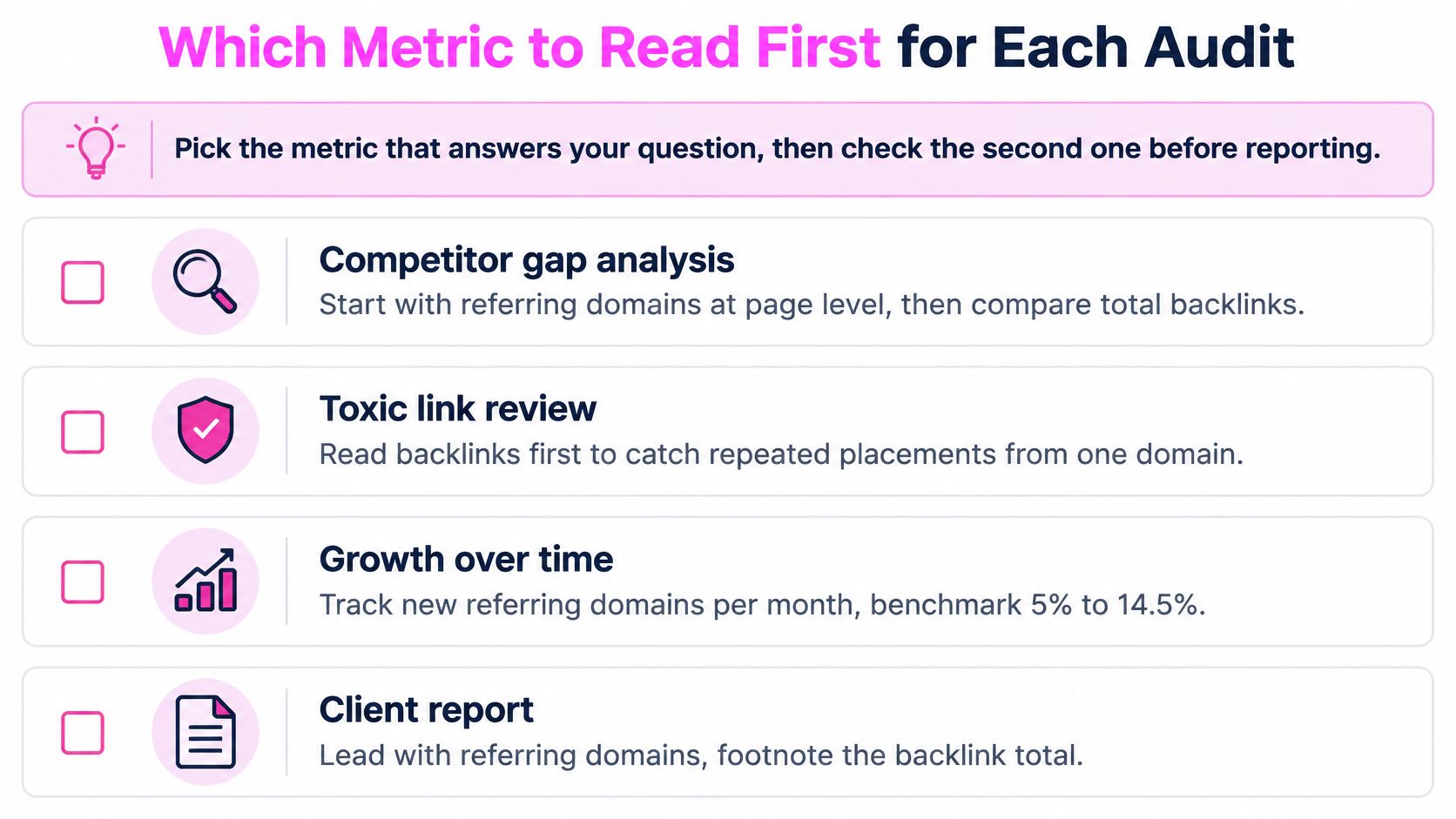
The same decision logic in a visual form, for anyone who wants it beside the spreadsheet.
Working through each situation
Competitor gap analysis. Start at page level, not domain level, because a competitor's homepage authority tells you nothing about the page ranking for your keyword. Compare referring domains for the specific URLs in the top ten, and note where the ranking page has 30 domains while the domain itself carries thousands.
Campaign tracking. Monthly new referring domains is the only figure that survives a template change. A campaign can add hundreds of links while domain growth stays flat, and that's the month to change the pitch rather than the budget.
Concentration review. The ratio is the entry point here, and the follow-up is a list of the top five domains by link count. A profile where one site supplies a fifth of the links needs a diversification plan before it needs more links.
Paid and guest-post audits. Read attributes and placement first. A sponsored post with rel="sponsored" is a legitimate placement; the same post without a qualifier is exposure. No amount of domain strength changes that ordering.
Client reporting. Lead with referring domains, keep the backlink total visible beside it, and include the ratio. One inflated number will otherwise carry the whole conclusion, and the next report has to walk it back.
For a gap check that produces a pitch list rather than a chart, pull the domains that link to two or more of your competitors but not to you. That shortlist gives you independent publishers who already covered your topic area, and SemDash finds domains that link to competitors but not to the user's site, which turns the exercise into a working prospect file. The step-by-step backlink analysis process covers how to sequence that work.
Pull both counts for your domain and your top three competitors this week. Calculate each ratio, list the new referring domains from the last 90 days, and flag any profile where a single site supplies a large share of the links. That's a two-hour job, and it settles the backlinks vs referring domains argument for your own market far better than any benchmark.
SemDash gives you the two counts side by side, with referring domains, pages by links and anchors in one workspace, so the ratio takes seconds instead of a spreadsheet. Enter your domain and three competitors to see who links to them but not to you, then work that list instead of guessing at outreach targets. Start at SemDash and run the comparison on your own market.