%20(1)-B86R08ZzwhPzS6UZbG3mSxRWPCwGwn.png)


Most keyword research fails because teams still treat Arten von Keywords like a word-count exercise. They sort a giant export into short-tail and long-tail buckets, then wonder why the list doesn't map to pages, doesn't match search intent, and doesn't move traffic in a useful way. That approach misses the job of keyword typing, which is deciding what a searcher wants, where the query belongs in the funnel, and whether your site can win it.
The better split is intent first, length second, and page type third. That's the model I use when I'm cleaning up a messy keyword list, because it turns a spreadsheet into a publishing plan instead of a pile of phrases. Long-tail keywords matter, but they don't matter in isolation, especially when broad terms, branded terms, question queries, and exclusion rules all need different handling.
Inhaltsverzeichnis
- Why Most Keyword Lists Fail Before the Tools Even Open
- The Four Intent Buckets Every Keyword Falls Into
- Head, Body, and Long-Tail Keyword Layers
- Discovering and Validating Each Type in SemDash
- Reading Volume, KD, and Traffic Estimates Together
- Keyword Types Most Guides Skip
- Matching Content, On-Page SEO, and Links to Each Type
- Keyword Types and Frequently Asked Questions
Why Most Keyword Lists Fail Before the Tools Even Open
The biggest mistake I see in audits is simple, teams export thousands of queries, sort by volume, and call that strategy. It looks organized, but it ignores what the query means, what page should answer it, and whether the site has any realistic path to ranking. That's why so many lists get stuck in a spreadsheet while the site keeps publishing disconnected content.
The old head-term versus long-tail split isn't wrong, it's just incomplete. Backlinko's analysis of 306 million keywords found that 91.8% of all search queries are long-tail keywords, while those long-tail terms account for only 3.3% of total search volume. The same study reported that the average keyword is 1.9 words long, keywords with 5+ words get about 10x fewer searches than 1 to 3 word terms, and the top 500 most popular search terms make up 8.4% of all search volume. That's not just a ranking insight, it's a planning warning, because chasing only popular head terms leaves most real search behavior untouched, while chasing only ultra-specific queries can starve a site of meaningful reach. Backlinko's keyword study
Praktische Regel: if a keyword can't be assigned to a page type, an intent bucket, and a realistic win condition, it doesn't belong on the priority list yet.
I've seen teams waste months because they confused volume with value. A query can be popular and still be a bad target for the current site, or it can be narrow and still be the exact phrase that converts because it matches a real buyer need. That's why I separate keyword types by decision category, not by vocabulary. The useful question isn't “Is this short-tail or long-tail?” It's “What does this searcher want, and what page should serve it?”
The Four Intent Buckets Every Keyword Falls Into
Keyword typing gets more useful once you stop treating it like a vocabulary exercise. The four intent buckets, informational, navigational, commercial, and transactional, map to the searcher's decision stage, which determines the page you should build. Semrush uses the same framework in its intent model, and analysts at ZipDo summarized a 2023 dataset showing that informational searches dominate while navigational and transactional queries make up smaller shares, a reminder that most searches begin with learning rather than buying. Semrush on keyword intent
A single query can move across the funnel
“Running shoes” is a useful anchor because the phrasing changes the intent fast. “How do I choose the right running shoes” is informational, because the searcher wants guidance. “Nike official website” is navigational, because the destination is already known. “Best running shoes for marathon training” sits in commercial intent, since the searcher is comparing options. “Buy lightweight running shoes online” is transactional, because the next step is a purchase. Semrush's four intent model
That classification matters more than the label itself. On real projects, I've seen pages underperform because the content format did not match the intent implied by the query. A category page can satisfy a commercial search, but it usually fails on an informational one. A product page may convert well, but it rarely earns trust for a query that starts with a question.
Question phrasing gives another clue. Backlinko's query analysis found that 14.1% of searches are phrased as questionsmit “how” as the most common question form, and that People Also Ask appears in 19.5% of common SERP features, while Top Stories appears in 15.5%. That is why I look at the SERP before I assign the page type. If the results are full of explainers, PAA boxes, and how-to phrasing, the query usually belongs in an informational treatment until the search results prove otherwise. Semrush keyword types overview
Rule I use on real projects: if the SERP is dominated by explainers, PAA boxes, and how-to phrasing, I treat the query as informational until proven otherwise.
The practical move is to classify the query before you classify the format. Blog posts, category pages, product pages, and branded landing pages each solve a different intent bucket. When teams skip that step, they publish the right topic on the wrong page, then spend weeks trying to fix a ranking problem that started with targeting.
Head, Body, and Long-Tail Keyword Layers
Length still matters, but only after intent is clear. I treat head terms as the broad anchors that define a topic, body terms as the supporting phrases that break that topic into usable sub-angles, and long-tail terms as the specific queries that usually reveal sharper intent. GeeksforGeeks describes short-tail keywords as one or two words and long-tail keywords as three or more words, which is a useful shorthand when you're sorting a raw list. GeeksforGeeks on SEO keywords
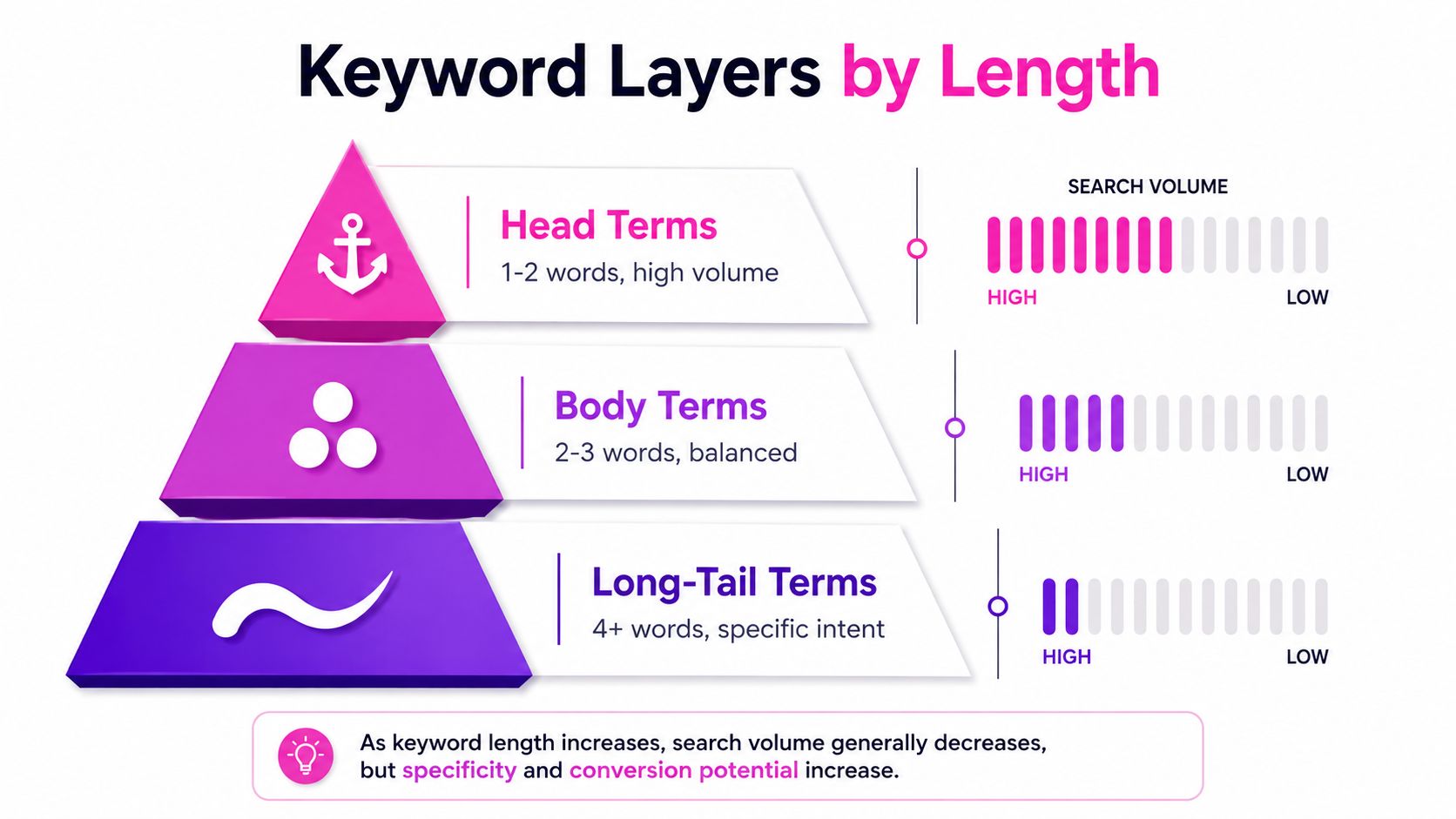
How I map one topic into page types
Using the same running shoes example, “running shoes” is the head term. I'd usually assign that to a pillar or core category page because it defines the topic at the highest level. “Trail running shoes” fits the body layer, because it narrows the topic into a meaningful subcategory. “Lightweight trail running shoes for wide feet under 150” is long-tail, and it belongs on a product page, collection page, or a buying guide built for that exact buying situation.
The trade-off is always the same. Head terms bring breadth, but they're vague and hard to win cleanly. Long-tail terms are narrower, but they tend to expose the modifiers and pain points people use when they're closer to a decision. I'd rather build a cluster of realistic long-tail pages around a head topic than burn time trying to outrank entrenched leaders for a vague term that doesn't convert well anyway.
What usually works: map the head term to the main page, then let body and long-tail phrases fill the supporting pages, FAQs, and subtopics.
That structure keeps the site from becoming a pile of competing posts. It also gives you a clean internal-link path from broad discovery terms into pages that are more specific, more persuasive, and easier to rank.
Discovering and Validating Each Type in SemDash
I start with discovery, not with a score. I seed a topic in the keyword discovery tool, then expand it with long-tail suggestions und People Also Search For ideas from a database of 6.6B keywords. That wider set matters because it surfaces the query variations a head-term search misses, especially on niche or B2B sites. SemDash keyword research workflow
What I check before I keep a keyword
I run SERP-Prüfer first and look at the live results, not just the label on the query. I want to see whether the page is dominated by brands, comparison content, product pages, or answer-style content, because that tells me what kind of page the SERP expects. Then I review the 12-monatige Historie to see whether the result set is stable or drifting. That matters a lot when intent is muddy or the query changes shape over time.
After that, I use Keyword-Clustern to keep the site from competing with itself. If three pages target the same intent, all three usually end up weaker than one well-aimed page. I also check Keyword Difficulty und PKD%, because generic difficulty can overstate or understate what a specific site can win. A domain-specific metric is usually more honest when I am deciding whether a long-tail page is worth publishing now or should wait.
Die Leute fragen auch is the other filter I use. If the PAA questions do not match the page I planned, I adjust the angle or drop the query. The same applies to AI Overviews-Sichtbarkeit, because if the SERP is already citing a different style of answer, I want to know that before I build a page that misses the mark from the start.
The sequence is simple. Discover the candidate, validate the SERP, cluster the list, then score what is realistic. That order saves far more time than trying to fix a weak keyword after the page is already live. For a step-by-step workflow, I point teammates to the SemDash keyword research workflow.
Reading Volume, KD, and Traffic Estimates Together
Volume alone doesn't tell me what to target. I read volume, traffic estimates, Keyword Difficulty, and PKD% together, because each one fills in a different blind spot. A keyword can look attractive on paper and still send very little usable traffic if the SERP is crowded with features or if the intent is off for the page type.
| Metrik | Head term (running shoes) | Long-tail modifier (lightweight trail running shoes for wide feet) |
|---|---|---|
| Search scope | Broad topic | Specific buying situation |
| Intent clarity | Weak without modifiers | Strong and actionable |
| Difficulty signal | Often higher and harder to win | Often lower and more realistic |
| Traffic estimate | Can overstate opportunity if SERP is crowded | Usually closer to actual click potential |
| Best page fit | Pillar or category page | Product page, guide, or niche collection |
How I choose between the two
If I'm comparing a head term with a high KD versus a long-tail phrase with a lower difficulty score, I don't look at the number in isolation. I ask whether the page can satisfy the intent better than the current results and whether the traffic estimate reflects available clicks. That matters because a query can show decent volume and still have weak click-through potential once People Also Ask, featured-style answers, or other SERP features take up space.
Semrush notes that PKD% measures difficulty for a specific domain rather than a generic SERP, which makes it more useful when I'm evaluating a newer site or a site that's strong in one niche but weak in another. Semrush on keywords A page doesn't need the lowest difficulty score on the board, it needs the right balance of intent fit, page fit, and realistic winnability.
The short version is this. A head term might be worth the wait if it anchors the whole topic cluster and the site has enough authority to compete. A long-tail modifier is usually the safer win if the page can answer the query better, faster, and more specifically. I've seen more rankings move from a clean long-tail decision than from six months of arguing about a glamorous head term that never had a fair path.
Keyword Types Most Guides Skip
Most keyword guides stop at intent and length, which leaves out the parts that save budget and clean up site architecture. The first omission is negative keywords. Google Ads treats them as a formal exclusion control for Search campaigns, which means they're not just a paid-search trick, they're a guardrail for keeping irrelevant queries away from budget and, in some teams, away from content planning when overlap starts to creep in. Google Ads negative keywords
The overlooked categories that change execution
Branded and competitor keywords need different handling. Branded terms usually deserve clean navigation, precise landing pages, and internal links that keep users on the right path. Competitor terms belong in comparison content or alternative pages if the brand strategy allows it. Semantic and question-based keywords matter more now because conversational queries and AI answers have changed how people phrase searches. I also keep an eye on seasonal and trending terms, because if a topic has a calendar pattern, it needs publishing lead time, not a last-minute reaction.
B2B and industrial lists need even more structure. SKU or part number queries signal exact-product searches, technical specification queries show a buyer who knows the parameters, application-based queries map to use cases, and problem/solution queries capture a pain point before the product is named. In practice, a spec query belongs on a spec-rich product or category page, not in a generic blog post that can't satisfy a procurement-minded searcher.
Praktische Regel: more keyword types don't automatically make a better strategy. Without exclusion rules and page ownership, extra categories just create overlap.
The other underused idea is AI-mediated search. Newer guidance increasingly talks about question-based, problem-based, and semantic keywords, because those are the patterns that line up with conversational results and AI answers. SemDash's AI Overviews citation tracking fits that shift, since it shows which keywords trigger domain mentions and which URLs are cited, which is useful when you're deciding whether a query deserves a page, a refresh, or both. Types of keywords in AI-mediated search
Matching Content, On-Page SEO, and Links to Each Type
The page type should follow the keyword type, not the other way around. Informativ terms usually work best with pillar pages, FAQs, and subheadings that mirror PAA-style questions. Commercial terms need comparison tables, category pages, and side-by-side feature framing. Transaktional terms belong on product pages or landing pages with clear calls to action and schema where it fits. Navigativ and branded terms need clean architecture, strong internal links, and zero confusion about where the searcher should land.
A practical content map
For the harder terms, I also look at links early. Backlink-Lücke against a 2,7-Billionen-Link-Index helps me find domains that already link to competitors but don't link to us, which is one of the fastest ways to close authority gaps around commercial and transactional pages. I'll also use unlinked mention recovery and broken-link workflows when the brand already has visibility but the equity isn't fully captured. That's especially useful when a page is structurally right but still struggling against stronger competitors.
A useful on-page helper here is a clean headline workflow. If you're refining page titles for intent fit, this guide to mastering SEO title examples is a solid reference point for tightening headline language without making it sound robotic.
The key is consistency. If a keyword type says the user is learning, the page shouldn't act like a product sheet. If the query says the user is comparing, the page shouldn't hide the comparison. Good content alignment isn't about writing more. It's about matching the page, the on-page elements, and the link path to the exact type of search you're targeting.
Keyword Types and Frequently Asked Questions
Which keyword types are most likely to surface in AI Overviews or featured-style answers? I'd prioritize question-based, informational, and problem/solution queries first, then audit the triggered URLs with AI Overviews citation tracking. Negative keywords belong in the workflow only if paid search or cannibalization control matters, not as a casual taxonomy add-on. For featured-style visibility, I also keep an eye on featured snippet patterns because SERP format often tells you more than the keyword label does.
How do you decide when to chase a head term? I only chase it when the site can support the topic with enough depth, links, and page authority, otherwise I build the long-tail cluster first. How often should intent be rechecked? I revisit it whenever the SERP changes shape, especially if the top results start shifting between informational, commercial, and AI-mediated answers.
If you want a faster way to sort keyword types into pages, intent buckets, and link opportunities, SemDash gives you the discovery, clustering, SERP history, and backlink gap data in one place. I use that kind of workflow when I need to move from a messy keyword export to a publishable plan without guessing. Visit SemDash and see how it fits into your next keyword research pass.