%20(1)-B86R08ZzwhPzS6UZbG3mSxRWPCwGwn.png)


A referring domain is the unique external website that links to your site, counted once even if it sends many backlinks. That's why 10 links from one site und 10 links from 10 sites are not the same thing.
People still start with raw backlink totals because the number looks clean in a dashboard. I stopped doing that years ago, because backlink counts can make a weak link profile look busy while hiding the question, how many distinct sites are vouching for you.
Inhaltsverzeichnis
- Why Backlink Counts Lie to You
- What a Referring Domain Actually Is
- Referring Domains vs Backlinks in Practice
- Why Domain Diversity Drives Rankings
- How to Analyze Referring Domains with SemDash
- Common Mistakes That Skew Your Analysis
- Fitting Referring Domains Into Your SEO Strategy
Why Backlink Counts Lie to You
In most audits I inherit, the first slide is a raw backlink total, and it looks impressive until you inspect where those links come from. A sitewide footer link, a directory template, or a repeated publisher placement can create a pile of backlinks without changing how many unique sites are backing you.
That is why I do not treat backlink volume as the headline metric. Verweisende Domains give a cleaner read because they measure source diversity at the domain level, which is harder to distort with repeated links from the same site and more useful for judging acquisition quality. The same domain-level idea also shows up in analytics tools, where a referring domain describes the site visitors came from, while SEO platforms use it to map the domains that link to you Metabase's explanation of referring domains.
Praktische Regel: if a campaign wins five links from one publisher, I count that as one source of diversity, not five separate endorsements.
What the raw number hides
A backlink count can rise for reasons that do little for rankings. One site can link ten times, fifty times, or more, but it still counts as one referring domain. Domain-level reporting gives a more honest view of whether outreach is broadening your footprint.
I have seen teams celebrate link growth while the profile barely changed in strategic terms. They picked up repeated mentions from the same partner network, then wondered why competing pages still outranked them. The problem was usually not a shortage of links, it was a shortage of unique endorsing domains.
Why I switched the way I report
When I show a client a backlink chart without context, the conversation goes sideways quickly. They focus on the count instead of the source mix, anchor relevance, page-level context, or whether the links came from pages that are indexed and cited.
Reporting by referring domains changes the question. It pushes the discussion toward coverage, authority, and dependence on a small set of sites, which is where real link-building risk lives.
What a Referring Domain Actually Is
A referring domain is the unique external website that sends traffic or links to your site. The metric is about source variety, not raw link volume, which is why it matters so much in SEO reporting.
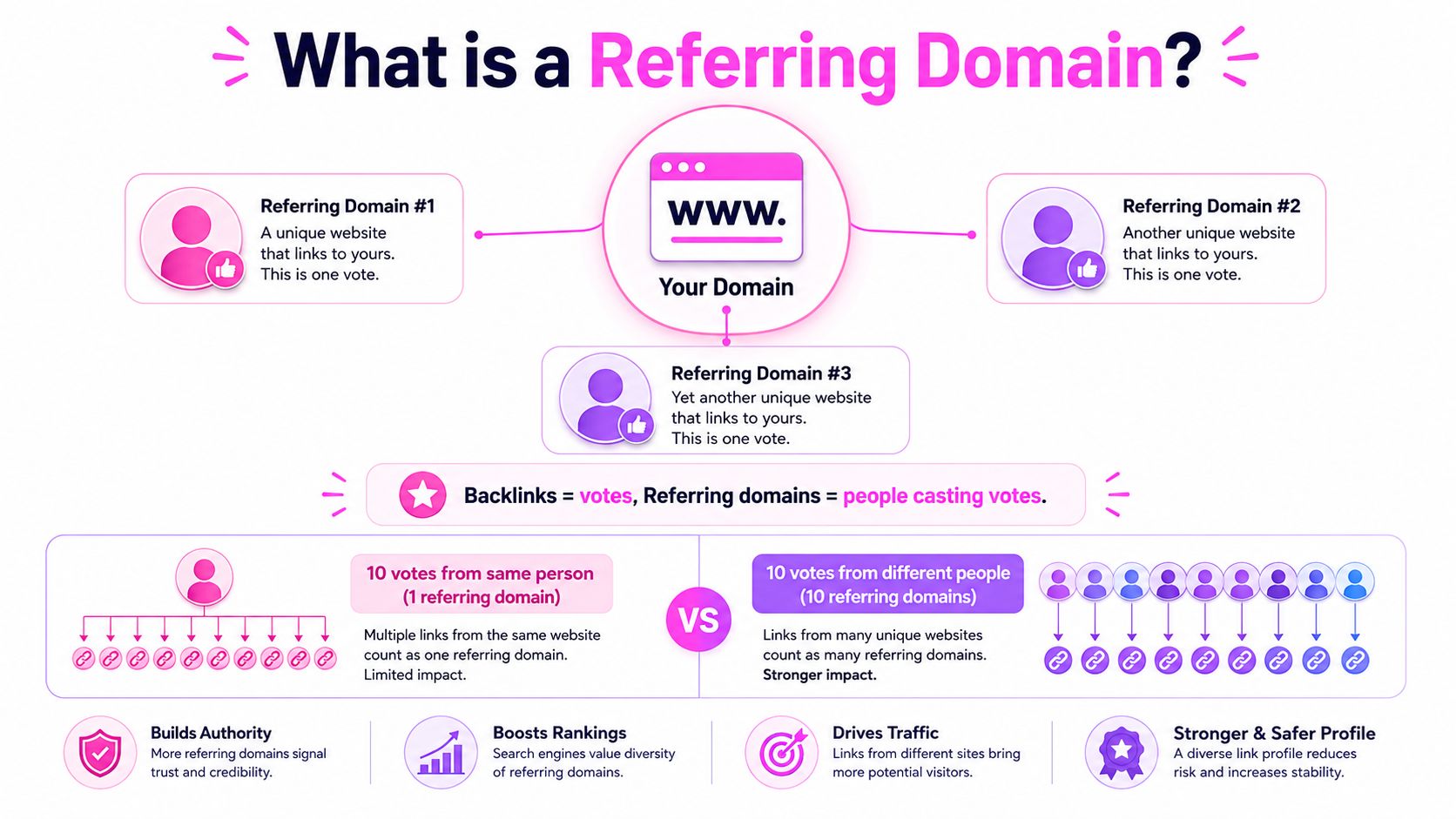
One site can create many backlinks while still counting once at the domain level. Ahrefs explains this directly, including the simple case where two backlinks from the New York Times still equal one referring domain Ahrefs help on referring domains vs backlinks. That is the same logic SE Ranking uses in its backlink reporting, where the domain count stays tied to the source site rather than every individual link SE Ranking's referring domains overview.
The cleanest mental model
One blog linking to you in five different articles still gives you one referring domain. Five different blogs linking once each gives you five referring domains.
That distinction is easy to explain without tool jargon. I usually put it this way, backlinks are the individual links, referring domains are the unique sites behind them.
Why tools count it this way
SEO platforms count the domain, not the individual hyperlink, because domain diversity shows how broad your link sources really are. That makes it easier to separate repeated placements from genuine reach across the web. It also matches the way I audit campaigns, where I want to know whether a site is earning links from new publishers or just collecting more mentions from the same ones.
Context still changes the value of a referring domain. A resource page link, a contextual editorial mention, and a sitewide footer link all count as one domain in the report, but they do not carry the same weight in practice. The raw count alone will not tell you that difference.
A referring domain tells you who is endorsing you, not just how many hyperlinks exist.
Referring Domains vs Backlinks in Practice
The confusion usually shows up the moment I open an audit and the backlink count looks healthy, but the domain count looks thin. That gap usually means the site is earning repeated links from the same publishers instead of broadening its source base.
A backlink is the hyperlink itself. A referring domain is the external site that hosts one or more of those links. One publisher can generate many backlinks while still showing up as a single referring domain in the report.
A simple audit scenario
A publisher can add your link to a resource page, then mention your brand in several posts over time. Your backlink total rises each time, but your referring domain count still increases only once. That is still useful coverage, but it is different from earning links across multiple sites.
| How Link-Building Activities Affect Each Metric | Backlinks Added | Referring Domains Added |
|---|---|---|
| One blog links to you in five articles | 5 | 1 |
| Five separate blogs link once each | 5 | 5 |
| One sitewide footer link appears on many pages | Many | 1 |
| One resource page plus two editorial mentions from the same site | 3 | 1 |
That table is why I split reporting into two layers. Backlinks show link volume. Referring domains show how widely your site is being cited across the web, which is the part that usually matters more when you are assessing whether a campaign is expanding reach.
Where the confusion costs teams money
I have seen B2B teams keep chasing the same partner sites because the backlink chart makes those relationships look productive. It is a poor trade-off if the goal is broader authority, since repeated links from the same source do not improve domain diversity the way new sites do. Analytics reports can add another layer of confusion here, because referral traffic and SEO link data answer different questions. A traffic report shows where visits came from, while an SEO report shows which external sites are linking to you.
The clean way to read the data is to start with new domains, then check whether those domains also send quality links and usable traffic. If a campaign adds links but not new sources, the dashboard can look better than the underlying profile really is.
Why Domain Diversity Drives Rankings
Search engines don't just count endorsements, they weigh how broadly those endorsements come from across the web. Historical SEO research summarized in 2026 reported that pages in Google's top 3 positions have, on average, 3.8× more referring domains than pages ranked positions 4 to 10 industry summary on backlinks vs referring domains in 2026.
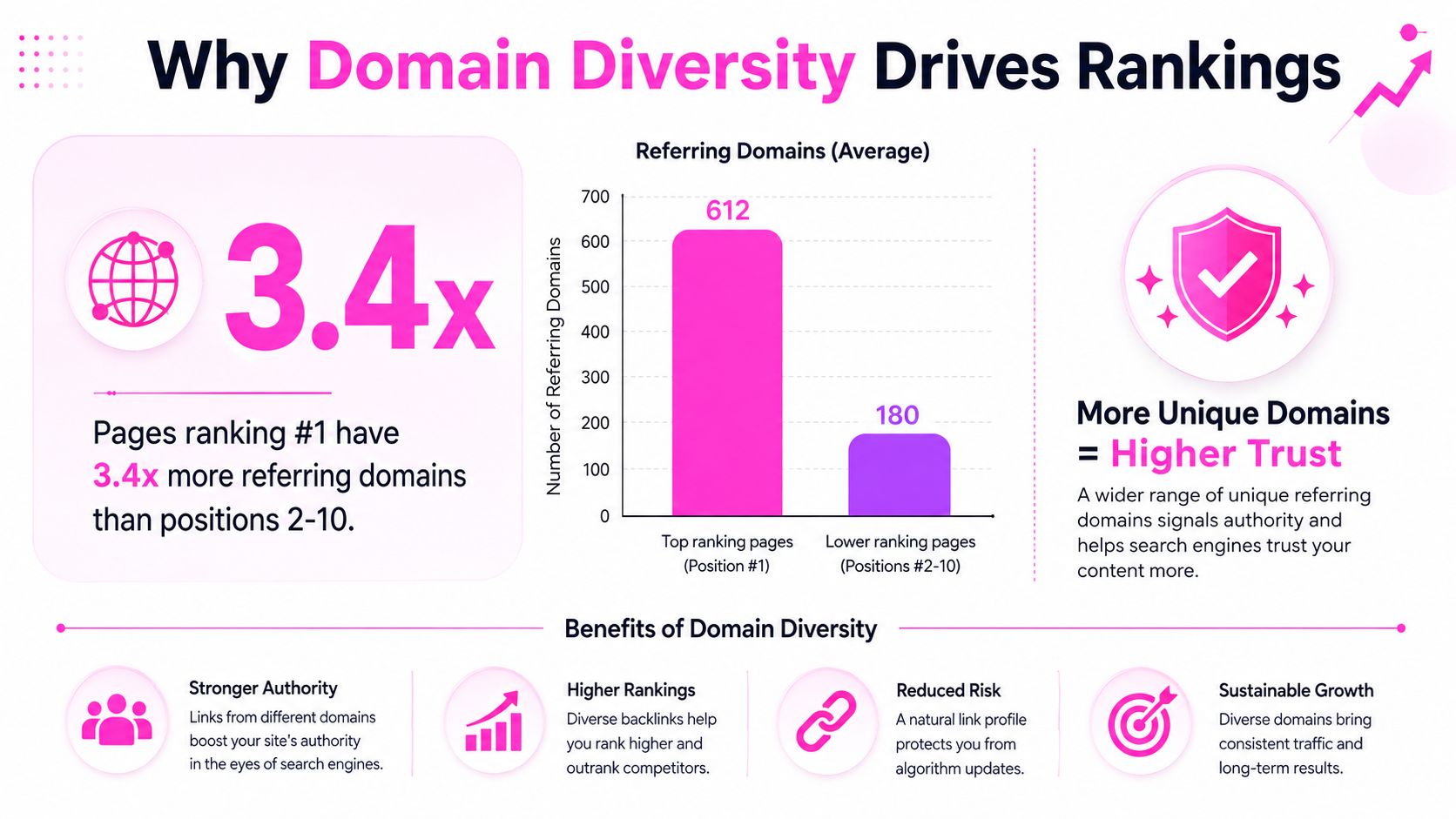
That pattern makes sense from an evaluation standpoint. A broader set of linking domains looks less like manipulation and more like real market endorsement. It also reduces dependence on any single publisher, which is one reason domain diversity tends to matter so much in competitive spaces.
Where diversity matters most
I care more about unique domains when the keyword is commercially contested. In those spaces, repeated links from the same few partners rarely move the needle on their own, because competitors usually have wider coverage and stronger editorial footprints.
For long-tail informational queries, the requirement is usually softer. A useful page with a small but relevant set of referring domains can still perform well if the content matches the search intent and the page is internally supported. The difference is that the competitive ceiling is lower, so the domain count doesn't need to be as aggressive.
Why outreach prioritizes new domains
From a mechanics perspective, it's more efficient to acquire links from new authoritative domains than to keep stacking links from the same places. That's because each new domain expands the set of sites that recognize your content, while repeated links from one site mostly deepen an existing relationship. SEO guidance from Amicited's glossary entry on referring domains frames this as a diversity signal, and that aligns with how I read link profiles in practice.
A good target isn't a vanity number. It's a profile that keeps growing in both relevance and source diversity without leaning too hard on one publisher network. If the new domains are topically aligned, the signal is usually stronger still.
Praktische Regel: I'd rather earn one relevant domain from a trusted niche publisher than three weak placements from unrelated sites.
How to Analyze Referring Domains with SemDash
I start with the referring-domains report and work outward from there. The point isn't to admire the list, it's to see whether the site is gaining new sources, whether the links are contextually relevant, and whether the anchors look natural. SemDash's Backlink-Forschung area surfaces referring domains, pages by links, and anchors in one place, which is the kind of view I want before I make any judgment.
The workflow I actually use
I first sort by new and lost referring domains, because movement matters more than static totals. Then I check the linking pages, not just the source domains, since a good domain can still place the link in a low-value context.
After that, I filter out noise. Sitewide placements, irrelevant directories, and obviously spammy domains can all inflate the count while adding very little practical value. I also review the anchor text mix and whether the linking page matches the topic I'm trying to rank for, because a relevant mention on the right page can outperform a louder but thinner placement elsewhere.
What I look at after the count
- Relevance of the source domain: if the topic is off, the link usually contributes less than the count suggests.
- Anchor text context: a branded or naturally placed mention is often easier to trust than over-optimized phrasing.
- Page-level placement: a link buried in a weak template footer tells me less than one inside an editorial paragraph.
- Change over time: new domains are useful, but lost domains matter too, because they show whether a profile is stable or leaking authority.
Why I use gap analysis
The fastest way to find missed opportunities is to compare my profile to competitors. If several competitors earn links from the same site and I don't, that domain goes on the outreach list. That's where SemDash's referring-domain reporting and Backlink Gap workflow become useful, because they show who is already linking to the market and who's missing from my side.
I've found that combining referring-domain data with traffic and ranking checks keeps me from overvaluing weak wins. A domain that adds a link but no contextual fit might still look good in a spreadsheet, but it won't help the strategy much. The report should inform decisions, not just count them.
Common Mistakes That Skew Your Analysis
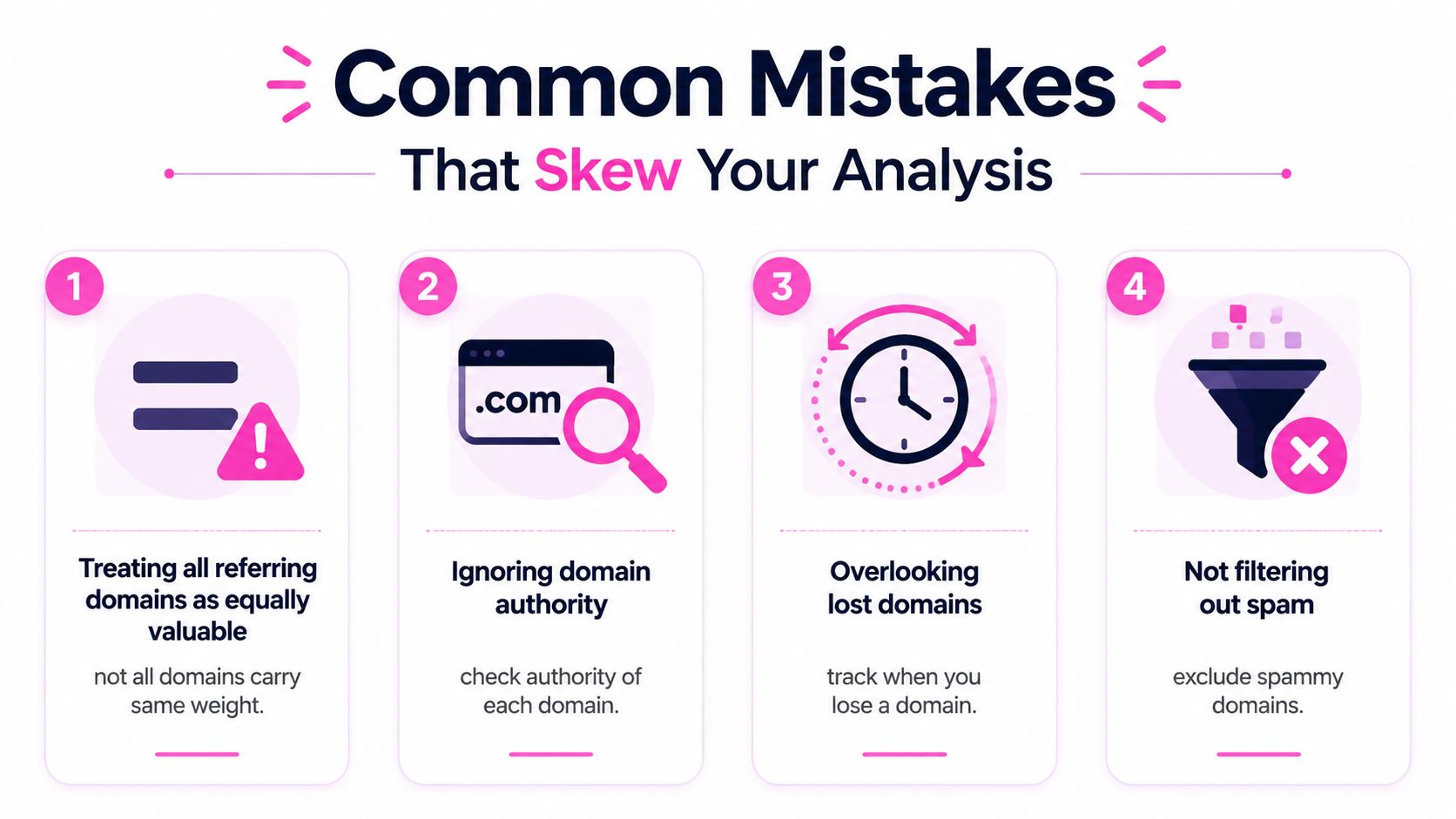
The biggest reporting mistake I see is treating every referring domain like it contributes the same value. It doesn't. A single relevant editorial domain can carry more strategic weight than several irrelevant placements, especially when those placements come from duplicated or sitewide patterns.
Mistake 1, reading SEO links like traffic reports
A backlink report and a referral traffic report answer different questions, and mixing them up leads to bad calls. A domain that sends visitors through analytics may have nothing to do with the links that support rankings. I've had to correct this more than once in audits where people assumed a traffic source and a link source were interchangeable.
Mistake 2, ignoring lost domains
Lost domains matter because they can reveal a profile that's shrinking. If a site removes old mentions or a publisher updates pages, your domain count can stagnate even when new links still trickle in. I watch this closely because ignoring losses makes growth look healthier than it is.
Mistake 3, chasing authority without relevance
A high-profile domain can still be a poor fit if the topic is off. SEO guidance consistently warns that relevance and authority both matter, and I've seen people overpay in time or budget for a link that barely supports the target page ClickRank glossary on referring domains. The fix is simple, match the source to the topic first, then judge the authority.
Mistake 4, counting spam as progress
Spammy domains can make the total climb while the profile gets worse. That is why I filter hard before I use any referring-domain chart to guide outreach or reporting. If a team is outsourcing link building, the sourcing rules need to be strict before any placements go live. You can also review how to outsource link building with the same filter in mind, because bad acquisition habits show up quickly in the domain mix.
The cleanest reports come from subtracting noise before you ever present the count.
The practical version of link building vs link earning matters here too. If a page earns links naturally, the referring domains usually show up with stronger topical fit and more useful page context. If the links come from outreach, I want to see whether the placements are editorial, whether the anchor text reads naturally, and whether the linking page supports the target topic.
A second mistake is treating one clean report as the whole story. I check the source domain, the linking page, the anchor text, and the traffic pattern together, because each one answers a different part of the same question. That is how I avoid calling a weak mention a win just because the domain count went up.
The cleanest reports come from subtracting noise before you ever present the count.
Fitting Referring Domains Into Your SEO Strategy
Referring-domain analysis works best when it sits next to keyword research, content planning, and technical SEO, not above them. I use it to decide where promotion effort belongs, which competitors are winning source diversity, and whether the site needs more linkable assets or better outreach discipline.
A useful framing is the difference between link building und link earning. The former usually means active outreach and placement work, while the latter comes from content people naturally want to cite. This breakdown from Press Release Zen on link building vs link earning is a good companion read when I'm explaining why some pages attract links on their own and others need help.
How it fits into decision-making
I use referring-domain data when a page is close to ranking, but not quite there. If the content matches the query and the technical setup is fine, the question becomes whether the page has enough distinct source support to compete. If not, I'll usually prioritize a focused outreach push or a linkable asset instead of waiting for passive growth.
I also use it to set expectations with stakeholders. Traffic and revenue are the outcomes they care about, so I don't sell them a domain count in isolation. I show how source diversity supports discoverability, then tie that back to ranking movement and page coverage.
What I'd do differently in weaker programs
If a campaign is leaning too hard on a few partners, I'd stop trying to squeeze more from the same names. I'd broaden the pitch list, clean up anchor targeting, and build assets worth citing. If internal capacity is the constraint, I'd look at how teams structure their outreach, including whether they should outsource link building instead of trying to do everything in-house.
SemDash fits into that workflow as a research layer for keyword discovery, backlink research, and domain gap analysis. It gives you a way to see which domains already support competitors, which pages attract links, and where your own profile is thin, so the strategy stays tied to actual source coverage instead of vanity totals.
If you want a cleaner way to track verweisende Domains, anchors, and competitor gaps in one place, SemDash gives you the research layer I use when I'm auditing link profiles and planning outreach. Pull the referring-domains report, compare it against competitors, and use the gaps to decide where the next real endorsement should come from.