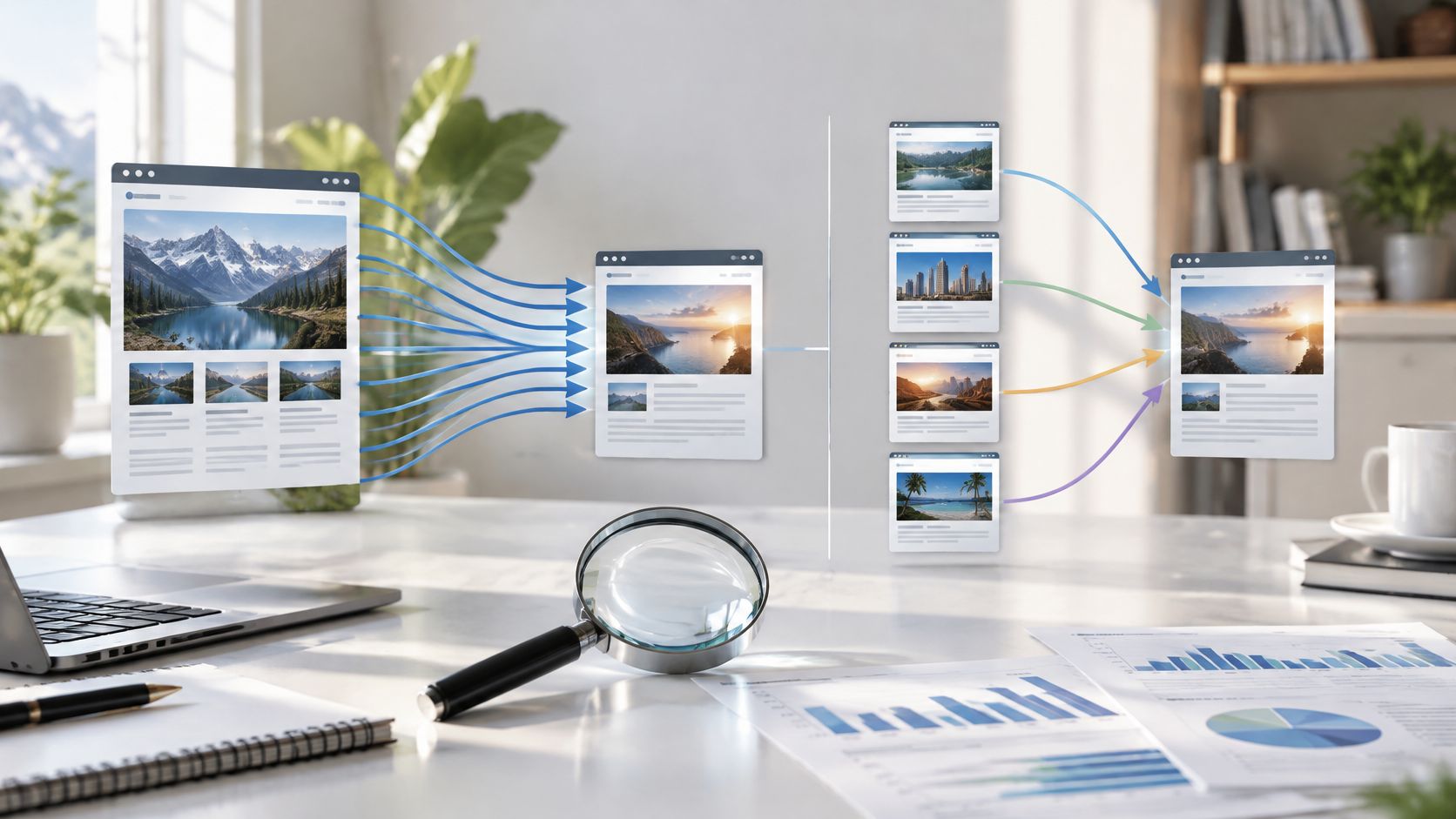

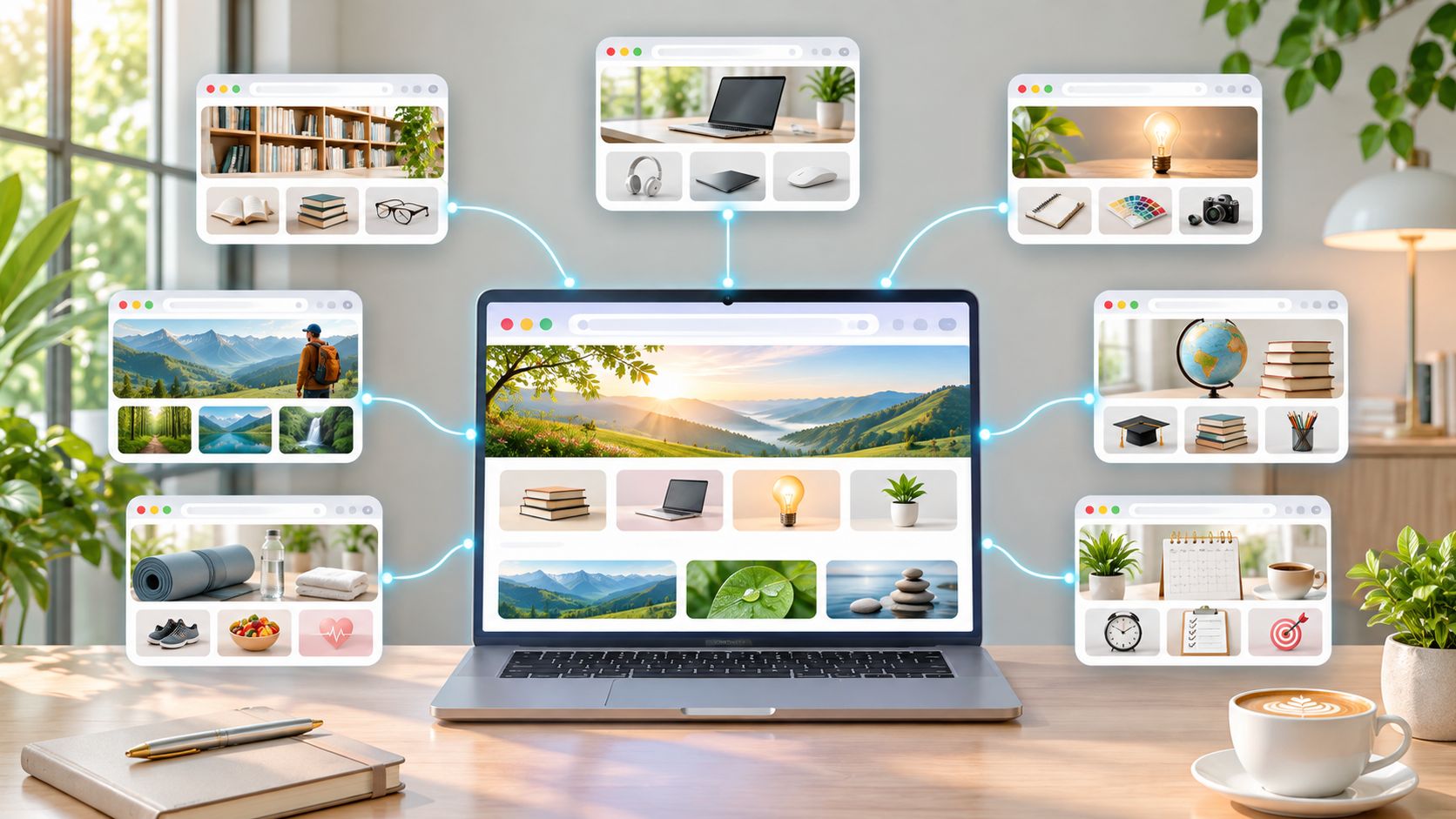
A pillar page is the primary hub for one subject, and the cluster pages around it each own a distinct sub-intent. Length is not the test; whether the right URL owns the right query is.
Search what is a pillar page and you'll meet the same advice everywhere: write 3,000 words, cover every angle, publish it as an ultimate guide. That advice produces the page I end up splitting most often. A hub doesn't earn rankings because it's long. It earns them because it sends the reader to the right next page and gives a search engine one unambiguous subject per URL.
The pages that fail in my audits are rarely too short. They're greedy. They try to hold a head term, every modifier, two audience stages and three product offers on one URL, then wonder why the ranking keeps flipping between pages and the internal links have nowhere honest to point.
Inhaltsverzeichnis
- What a Pillar Page Is and Is Not
- How the Cluster Links Back to the Hub
- When a Subtopic Deserves Its Own URL
- The Technical SEO Cluster I Would Map
- What Makes a Pillar Page Effective
- How AI Answers Change the Hub Job
- Measuring the Cluster and Mapping the First Topic
What a Pillar Page Is and Is Not
A pillar page is the primary navigational and contextual hub for one defined subject. It answers the broad questions a newcomer arrives with on the head term, names the subtopics that exist, and routes each distinct intent to the URL that owns it. That's the whole definition; everything after it is boundary work.
What made the model stick isn't length. HubSpot researchers formalized it through topic-cluster experiments in 2016 and detailed the framework publicly in 2017, and the HubSpot content marketing workbook records that the company's first pillar page launched in the first week of January 2017 and was optimized and promoted over the following six months. Six months of iteration on one page plus its supporting articles. The pillar was a routing decision maintained over time, not a publishing event.
The distinction that matters in planning is structural. The pillar carries the high-level explanation; cluster pages take narrower subtopics and queries deeper. Internal links run from those cluster pages back to the hub and, where it helps the reader, back out again. That gives you a page-level map between a broad topic and its subtopics, which is how related keywords get assigned to separate URLs instead of piling onto one.
Here's how I separate three things people routinely confuse.
| Page type | Job | Intent it should own | Linking role | Success signal |
|---|---|---|---|---|
| Pillar page | Broad hub for one subject | Head term and orientation queries | Links to each cluster and receives links back | Clear routes plus rankings across the cluster |
| Cluster page | One narrower sub-intent in depth | A distinct modifier or question | Links back to the pillar; sideways only when useful | That exact URL ranks for its primary intent |
| Standalone long guide | Tries to cover every related query | Mixed intents on one URL | Links become arbitrary | Overlap, weak focus, cannibalization risk |
Read the last row again. The everything guide isn't worse because it's badly written. It's worse because it has no defensible answer to which URL should rank for a given query. When one page covers a head term, four modifiers, a comparison and a pricing question, those intents start competing inside your own site, and the engine resolves the tie by picking one. It usually picks wrong for at least two of them.
The drafting test I use is blunt.
Drafting test: if two queries imply a different reader or a different next action, they don't share a URL.
A newcomer asking what technical SEO covers and a developer asking how JavaScript rendering hides links from crawlers are not the same reader, and they don't want the same next step. One belongs on the hub, the other on a cluster page. Answering both in a single long article feels efficient and is usually how cannibalization starts.
None of this depends on country, language or search engine. The model is information architecture plus internal linking, so it behaves the same on Google, Bing or Yandex. What changes is the query set, never the logic.
How the Cluster Links Back to the Hub
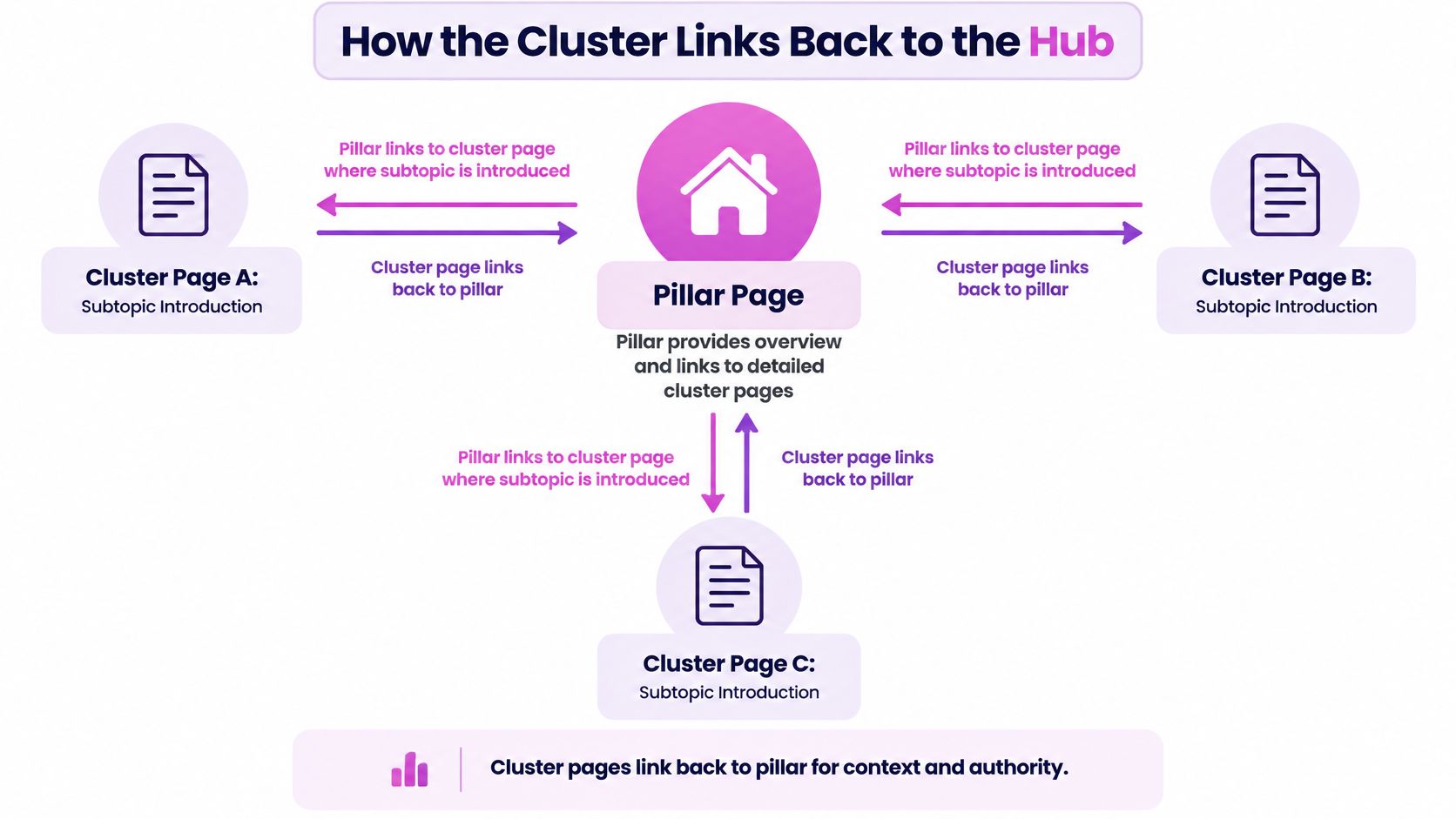
The mechanism is bidirectional internal linking, and it's the part often skipped. The pillar links out to each detailed subtopic page; those pages link back to the pillar with anchor text that names the destination. Done consistently, you get a navigable content graph instead of a pile of isolated articles, and crawlers find related URLs without guessing at the relationship. Google's sitelinks guidance is the floor I implement: link important pages from relevant pages, and make sure every page that matters has at least one internal link.
Here's the map I draw before a single draft exists.
Four rules cover almost every case.
- Link at the moment of introduction. The hub mentions crawlability, structured data or rendering, then links right there in the sentence. A resource dump at the bottom of the page tells the reader nothing about why they'd click.
- Anchor text names the subject. "Structured data" or "JavaScript rendering" tells a crawler what sits on the other side. "Click here" and "read more" waste the only context the link carries.
- Make the return path explicit. Every cluster page links back to the hub in body copy, not just the breadcrumb. Navigation menus and HTML sitemaps don't replace an in-content link whose surrounding sentence explains the relationship.
- Skip the sibling link unless it shortens the reader's journey. In a technical SEO cluster, the JavaScript rendering page can sensibly point at crawlability, because rendering problems turn into discovery problems. It has no reason to link to structured data just to close the triangle.
I don't work to a fixed link count, and I'd distrust any that gets published as a rule. The number that matters is a directional test: from any supporting article, can the reader reach the pillar, and from the pillar, do they reach the most useful next page without detouring through a generic resource hub?
Praktische Regel: document the map with the intended URL beside each query group before publishing. Missing return links are obvious on paper and invisible in a live site with 400 pages.
The failure this catches most often is the orphan page, and for a site-wide sweep Data Hunters Agency's guide to fixing orphan pages with internal links is a workable checklist. I also sketch hierarchy before anchors, because the web page architecture notes cover how structure and linking interact once a map passes a dozen URLs.
When a Subtopic Deserves Its Own URL
The decision that determines whether a pillar works happens before a word is written. Does this subtopic stay on the hub, earn its own URL, or get cut? Most pillar-page advice skips the question entirely and jumps to word counts, which is why teams end up with a hub that duplicates three cluster pages and competes with all of them.
The functional definition is the useful one: the pillar is the primary navigational and contextual hub, and cluster pages satisfy sub-intents that would be awkward or incomplete on the hub itself, as a topic-cluster glossary frames it. Combining every related query on one page produces an unfocused resource, overlaps the cluster URLs, and makes internal linking arbitrary.
The five signals I check
I compare the live SERP intent, the query modifiers, which URL already ranks, the audience stage and the conversion job. Never a word target.
| Signal I check | Stay on the pillar | Give it a cluster page | Exclude or merge |
|---|---|---|---|
| Same intent as the head term | Keep the full answer here | Do not split | Do not launch a thin URL |
| Distinct modifier and different ranking URLs | Short orientation and a link | Own URL with deeper coverage | Only if there is no real demand |
| Different audience stage or conversion job | Mention it and link out | Own page and its own next step | Drop it if it serves another product |
| People Also Ask question | Answer in a short block if the SERP is brief | Split when results are full guides | Skip pure noise |
| Overlaps a URL that already exists | Fold the unique points in | Do not create a second page | Redirect or consolidate the duplicate |
The second row decides most disputes. If the modifier pulls a visibly different set of ranking URLs, the hub keeps a short orientation paragraph and hands depth to a new page. If the ranking URLs barely change, a new page is a thin duplicate waiting to compete with its own parent.
The audience row is the one content teams argue about. A beginner question and a procurement question on the same head term are different journeys with different next actions. Burying the second inside the hub means neither reader gets a clean route, so mention the topic, link out, and let the dedicated page carry its own offer.
The everything-page trap
A shorter, better-segmented hub can beat a long everything page when the routes are obvious. That outcome isn't a trick of length; it's the predictable result of giving each URL one job. The long version loses because its internal links have to serve four intents at once, and every added section dilutes what the page is for.
A People Also Ask question answered in two sentences by the top results stays a short block on the hub. I only split it when the results are genuine guides with their own structure. Noise questions get skipped, because a page written for a query nobody clicks helps nobody.
The production sequence is always the same: validate demand, assign one primary intent per URL, then use competitor ranking pages only to find missing subtopics. Never to copy their length.
The Technical SEO Cluster I Would Map
A concrete build makes the rules checkable. The pillar is technical SEO, and its job is orientation: what the discipline covers, where each type of problem sits, and which page to open next.
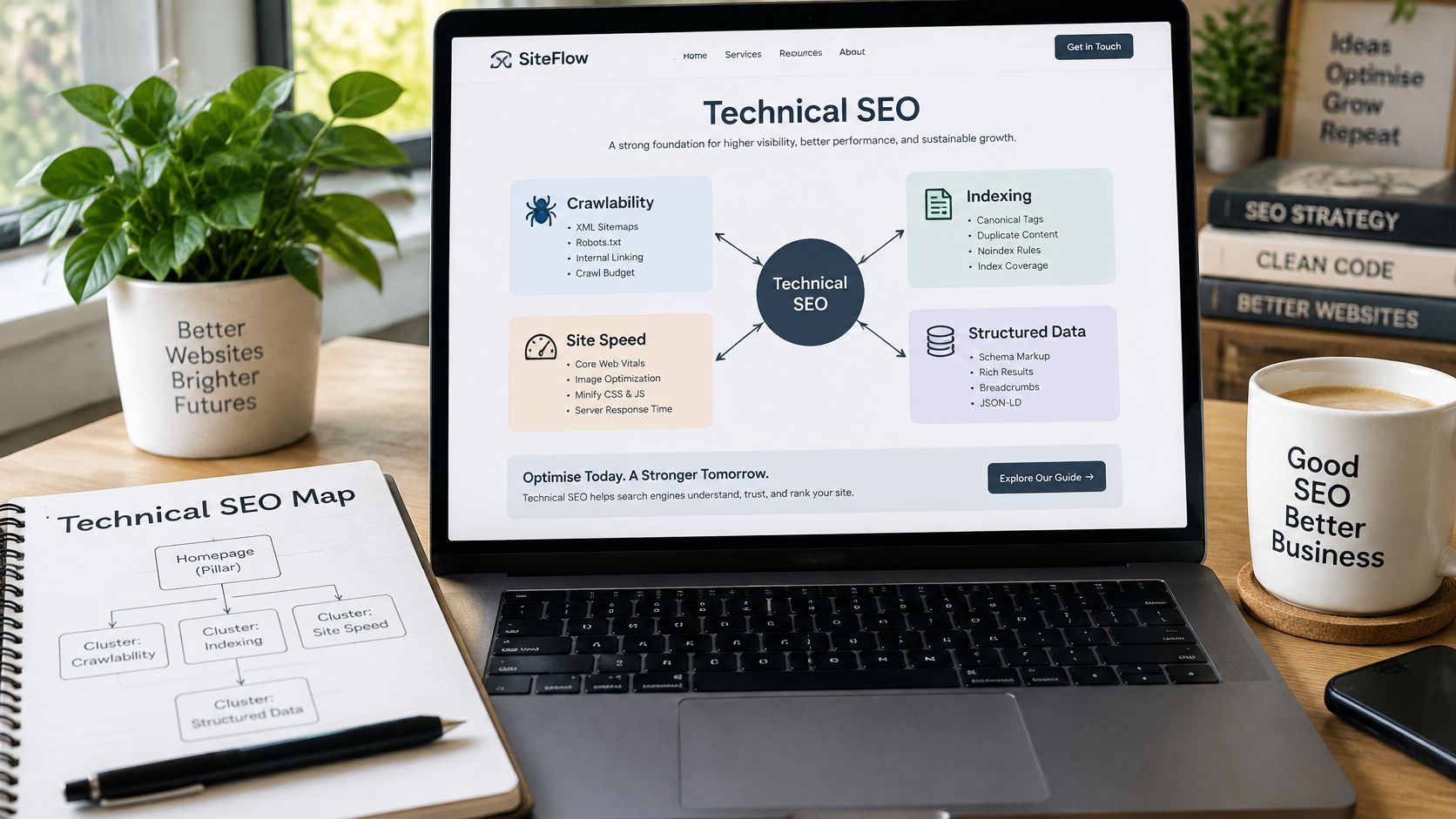
Three cluster URLs, each with a single primary intent, carry the depth: crawlability, structured data und JavaScript rendering. The hub introduces each subject in a short section and links at that moment. The crawlability page links back with anchor text naming technical SEO. The JavaScript rendering page links to crawlability because rendering failures become discovery failures. It doesn't link to structured data to complete a web nobody asked for.
That map goes on paper first, with the intended URL written next to each query group, before any draft exists.
For readers who prefer the walkthrough in motion, this covers the same architecture from a different angle.
The version of this that fails is one long technical SEO guide that also tries to rank for schema types and JavaScript frameworks. The SERP intents don't match, so the anchors have nowhere honest to point, and every later article competes with a section of the guide. Once that happens, the guide's rankings wobble, the cluster pages can't establish their own intent, and the team's instinct is to add another thousand words to the hub, which makes the overlap worse.
What I'd do differently is publish the hub thin on detail and rich on routes. Let the cluster pages carry the examples, edge cases and implementation steps, because that's where a reader with a specific problem lands. The hub's value is the decision it helps a reader make in ten seconds, not the volume of prose it holds.
After launch I check two things at URL level weekly for the first month: return links that never got added, and any query that switched to an unexpected URL. That switch is a routing signal. The fix is to merge, retarget or redirect, never to lengthen the hub.
What Makes a Pillar Page Effective
Five checks, in the order I run them.
- The top answers the head term in a short block. A plain definition and one clear next step, written so a reader skimming on a phone or a system extracting an answer gets the point immediately.
- The scope holds one intent. Every section either orients a broad visitor or routes to a cluster page that owns the depth. A section that does neither is material for a different URL.
- Each cluster page is introduced with a reason. One sentence explaining why the destination matters, plus a return link from that page to the hub. Both directions, every time.
- Original evidence sits in the body. A worked example, a framework, a comparison, findings from a real audit. A summary of what other pages already say can't differentiate the hub.
- The page has an owner and a review date. Someone is named, a trigger exists to update the answer block when search features change, and outdated sections have a scheduled review.
Google's guidance on helpful, people-first content governs all five: useful coverage, sourced claims, and a site readers trust. A pillar built to collect keywords fails that standard even when the link architecture is tidy.
Length isn't on the list. In the technical SEO build, the hub passes once it routes readers to crawlability, structured data and rendering with a short answer for each. The failed everything guide never had a single intent to defend, so no check could pass it.
How AI Answers Change the Hub Job
AI Overviews can answer a query before a reader visits a site, while also linking to sources for further exploration, as described in Google's overview of AI Overviews and AI Mode. For a pillar page, that shifts the goal: some informational clicks may disappear, but the hub can still provide the evidence and context that a short summary cannot.
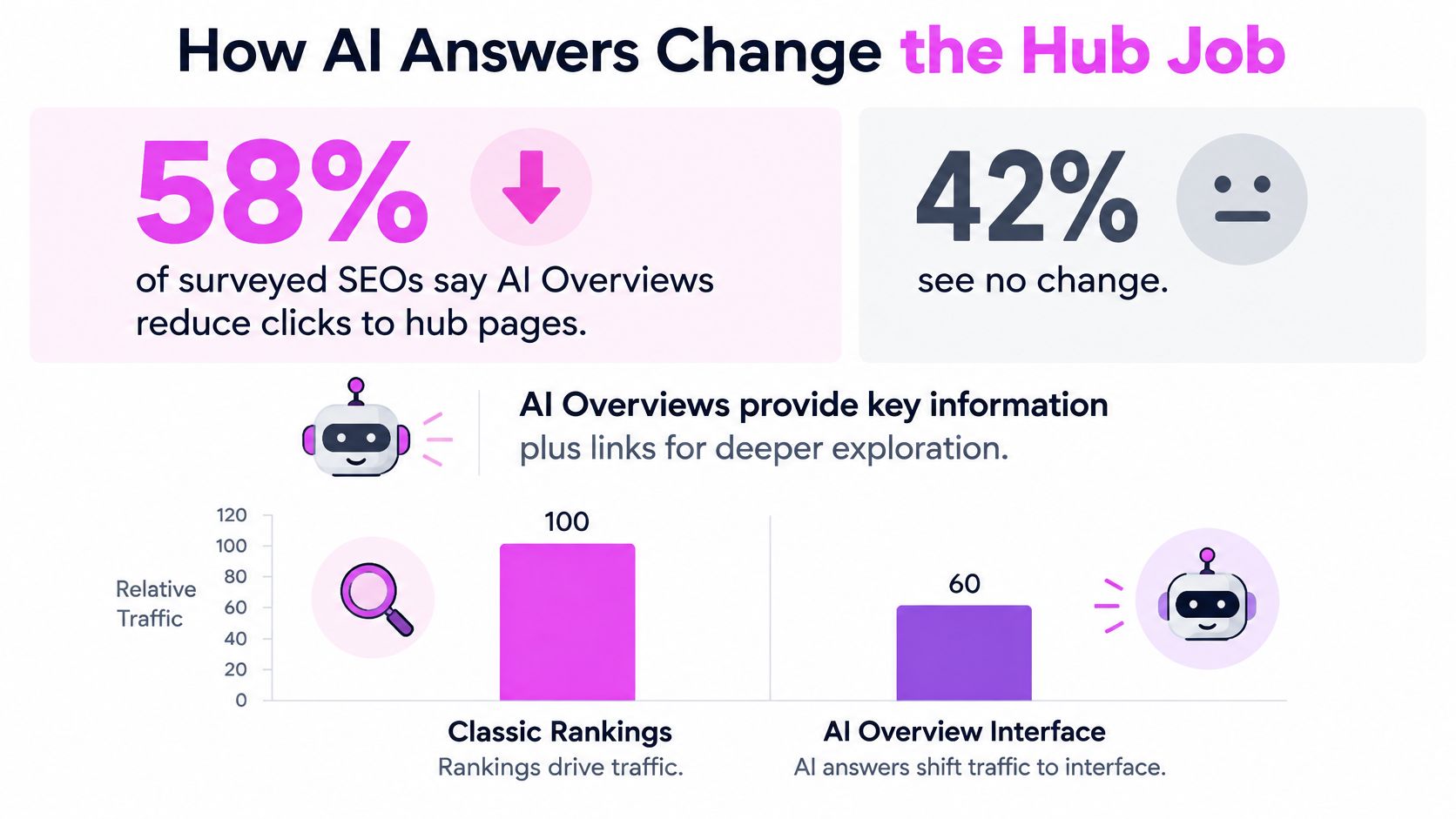
Treat AI visibility as volatile, not as a permanent feature of a query. Its presence can vary across searches and over time, so a hub should work whether an AI summary appears or not. The practical response is to make the page useful as a source, not to rebuild it around a temporary search feature.
A hub should answer the broad question clearly, then route readers to pages with the depth each subtopic requires. A concise opening gives search systems a direct answer to interpret. The rest of the page should provide frameworks, comparisons, evidence and links to cluster pages, where readers can examine a specific issue in detail.
A shorter, segmented hub can outperform an everything-on-one-URL guide. Adding every subtopic in the hope of earning a citation weakens page boundaries and risks overlap with cluster URLs. Keep each page responsible for a distinct intent.
Track which URL earns visibility for a query, whether clicks still reach the hub, and whether cluster pages address the questions left unanswered by the summary. If the hub and a supporting page compete for the same intent, adjust the boundaries rather than adding more copy.
When AI visibility changes around a query set, review the relevant answer block and its destination links. Update the affected URL, then leave the rest of the cluster intact unless its own intent or coverage has changed.
Measuring the Cluster and Mapping the First Topic
Judge the system, not the hub's word count, and not the pillar URL in isolation. The signals below tell me whether the map is working and what to fix when it isn't.
| Signal | Question it answers | Action when it slips |
|---|---|---|
| Exact ranking URL per target query | Does the right page own the query? | Fix the intent assignment or merge the overlap |
| Query flips to an unexpected URL | Are two pages competing for one intent? | Merge, retarget, or redirect |
| Internal-link coverage and return links | Can every cluster URL be reached and linked back? | Add an in-content link where the subtopic is introduced |
| Assisted discovery into cluster pages | Do readers move down the map? | Rewrite the route sentence |
| Conversions by page | Does each page finish its job? | Change the next step on that page |
Architecture can move rankings, and it's worth knowing the benchmark. In 2025, Brafton research reported by Button Block found that websites using pillar-cluster architecture saw a 63% increase in primary-topic keyword rankings within 90 days. I read that as evidence that page boundaries and linking carry weight, not as a promise attached to any single hub. I don't wait 90 days to check for URL mismatches, either, because a query sitting on the wrong URL is fixable in week two.
Maintenance follows the same checks. Refresh outdated sections, add a subtopic only after the boundary test confirms it's distinct, redirect pages that repeat an intent, and fold a new query into an existing article when the intent matches. The cluster stays a system instead of drifting into a set of near-duplicates.
For the first working session on a new topic, pick one money topic tied to a page that should earn revenue, pull the queries, group them by shared intent, assign one primary intent per URL, then look at the live SERP before trusting volume. Mark the subtopics competitors cover that your site doesn't. That grouping step is where Keyword-Clustern earns its keep, because it surfaces the queries that belong together before you've committed a URL to each one. SemDash supports the same session with a gap list of topics competitors cover that your site doesn't, AI-assisted content briefs built from live SERP data, and a SERP checker that holds 12 months of history so you can see intent move before a URL gets locked.
You should leave that session with a one-page map, the hub URL, and the first three cluster URLs worth writing. Not a 3,000-word draft.
If you'd rather test the boundaries before you write, SemDash gives you the pieces that decision needs: competitor topics your site hasn't covered, briefs built from real SERP data, and a year of SERP history per keyword to check whether intent has moved. Cluster the queries first, assign one intent per URL, and let the hub route rather than absorb. Start at SemDash and map the first topic before the next draft begins.