%20(1)-B86R08ZzwhPzS6UZbG3mSxRWPCwGwn.png)



A large keyword export isn't a content strategy. It's raw material, and a bad clustering tool can turn that material into a convincing spreadsheet of wrong decisions. Keywords that share words may trigger different SERPs, different formats, and different commercial goals. Put them on one page and you create dilution or cannibalization instead of coverage.
I judge a clustering tool by the work it helps me complete, not by the size of its feature list. I want reliable SERP overlap, useful control over thresholds and inputs, dependable bulk processing, page-level mapping, a practical path to briefs, a pricing model that fits the workload, and as little cleanup as possible after the clusters are generated. SERP-based grouping is usually safer than lexical similarity, but it still needs manual review, especially for niche and long-tail themes.
My strongest broader recommendation is SemDash, because clustering sits beside competitor keyword discovery, URL mapping, SERP history, backlinks, AI Overviews visibility, and briefs. Specialized tools can still win for very large bulk jobs, pay-as-you-go grouping, or content-first execution. Here are the ten options I'd shortlist, organized around the work they help complete.
Inhaltsverzeichnis
- 1. SemDash
- 2. Semrush
- 3. Serpstat
- 4. SE Ranking
- 5. Surfer
- 6. Keyword Insights
- 7. KeyClusters
- 8. WriterZen
- 9. Frase
- 10. Keyword Cupid
- Top 10 Keyword Clustering Tools: Feature Comparison
- Choose the Tool That Matches Your Clustering Job
1. SemDash
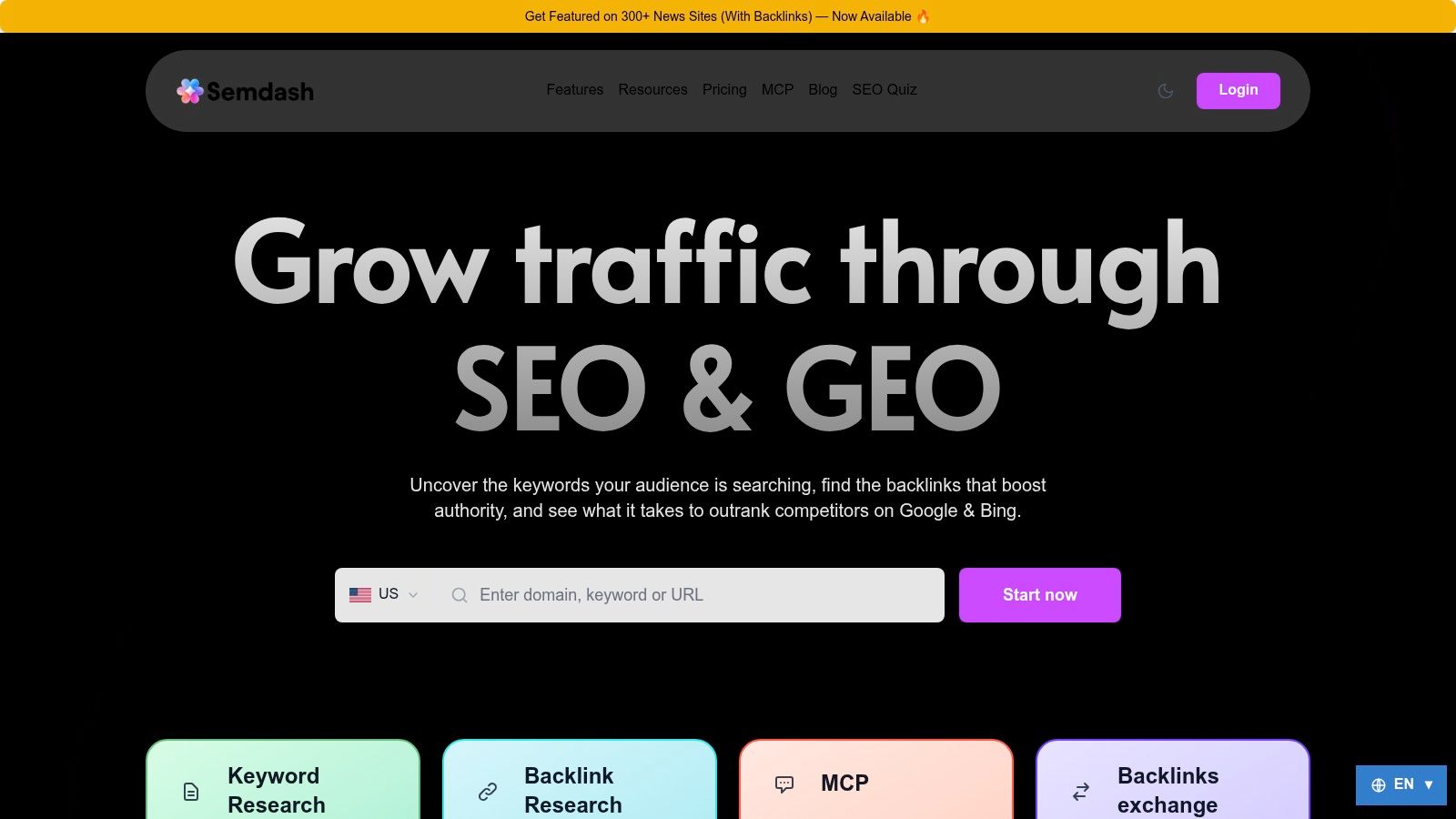
SemDash fits projects where keyword clustering must lead directly to publishing and measurement. It brings keyword research, competitor discovery, backlink analysis, historical SERPs, URL mapping, clustering, and AI-assisted briefs into one workspace. That connection matters in practice. A cluster has value only when it supports a clear decision about which URL should target it, what intent dominates, and what the writer needs to produce next.
I would start with a competitor URL, pull the terms driving that page, identify keyword and content gaps, then cluster related queries before assigning one page to each intent group. That workflow reduces the risk of spreading similar terms across thin articles or creating competing pages. Historical SERP data helps when the same theme shifts between informational, commercial, and mixed results over time.
Wo SemDash seinen Platz hat
The URL-level workflow is the main advantage. I can inspect a competitor's ranking terms, compare backlink gaps, review long-tail and PAA opportunities, and map clusters to existing or planned pages. The tool keeps research connected to decisions about page ownership, rather than leaving me with a spreadsheet that still needs manual interpretation.
Clustering also connects to content and search visibility tasks. AI-assisted briefs and intent classification use live SERP data, while AI Overviews tracking shows queries that produce domain mentions and the specific URLs cited. Unlinked brand mentions and broken-backlink recovery give the resulting plan an authority-building path alongside content production.
Praktische Regel: Treat the cluster as a decision layer between research and publishing. Approve a page only after checking its target URL, dominant intent, competing pages, and supporting internal links.
The trade-off is commercial clarity. SemDash offers a free trial and demo access to more than 20 SEO tools, but the referenced pages do not show exact plan pricing or enterprise quotas. I would test a representative export before committing, since some domains may return fewer keywords than larger platforms. That check matters for agencies and multi-domain projects.
For solopreneurs, agencies, and SMB teams seeking a broad SEO workspace, SemDash is a practical choice when clustering, competitor research, mapping, and briefs need to share one workflow. Teams focused only on high-volume clustering may prefer a specialist tool with a simpler pricing model.
SemDash supports English, German, Polish, and Spanish, and provides an SEO Academy, YouTube resources, a public roadmap, and free live calls. Those resources can shorten setup time for teams adopting the platform.
2. Semrush
Semrush makes the most sense when the rest of my workflow already lives inside Semrush. Its Keyword Strategy Builder supports two useful entry points, I can create a strategy from seed terms or cluster an existing keyword list. The output combines SERP similarity, search intent, keyword difficulty, and search volume, then presents a topical overview with pillar themes and page ideas.
That continuity is the main selling point. I can move from discovery to cluster organization, content planning, reporting, and rank tracking without rebuilding the project in another application. For a new site, the seed-driven path is convenient. For an established campaign, importing my own list gives me more control over the source data and lets me preserve the research decisions I've already made.
Wo ich vorsichtig wäre
Semrush's cluster workflow is less attractive when I need fine control over the grouping logic or when clustering is the only task. Actions and limits vary by plan, so I'd check the current allowance before uploading a large dataset. The broader ecosystem also tends to make this a more expensive choice than a focused clustering tool.
I'd choose Semrush when the handoff matters more than minimizing tool count. I wouldn't choose it solely because the brand is familiar. A mature SEO suite can still produce clusters that need inspection, and intent labels don't remove the need to compare the actual ranking pages.
A good cluster should survive a page-level review. If the top results split by format, audience, or buying stage, I separate the group even when the keywords look related.
Semrush is strongest for teams that need fresh ideation and existing-list organization in the same platform. It's less compelling for an agency that wants inexpensive, repeatable bulk jobs with no dependence on a broader suite.
Explore Semrush Keyword Strategy Builder
3. Serpstat
Serpstat is a practical choice when I need SERP-based grouping plus URL mapping. Its clustering approach uses all-to-all connection logic rather than comparing every keyword to one arbitrary cluster center. In practice, that aims to keep the group internally coherent instead of allowing a broad central term to pull in loosely related queries.
The domain-mapping option is particularly useful during cannibalization audits. I can assign a domain and let Serpstat suggest the most relevant existing page for each cluster, which turns a keyword file into an initial URL map. That saves time when the project involves consolidating pages, choosing canonical targets, or deciding whether a new page is necessary.
Best fit for bulk audits
Serpstat runs clustering at scale and supports exports, including Drive export. I'd use it when the deliverable is a structured cluster file with candidate pages rather than a complete content brief. It's also a sensible option for an existing Serpstat customer who wants research, rank tracking, audits, and clustering in one account.
The cost structure needs attention. Clustering consumes credits from a shared Serpstat feature pool, and the available volume depends on the paid plan. That makes an apparently simple upload more complicated if the same account is also used for other research tasks. Before running a client-wide audit, I'd confirm how many credits the job will consume and whether the export contains all the fields my content team needs.
The workflow is strongest at grouping and mapping, not at taking a cluster all the way to a polished brief. I'd pair it with an editorial system or a separate content platform if writers need detailed outlines, competitor coverage, and optimization guidance.
For a practical explanation of how grouping connects to page architecture, I'd also use this keyword grouping guide from SemDash.
Explore Serpstat Keyword Clustering
4. SE Ranking
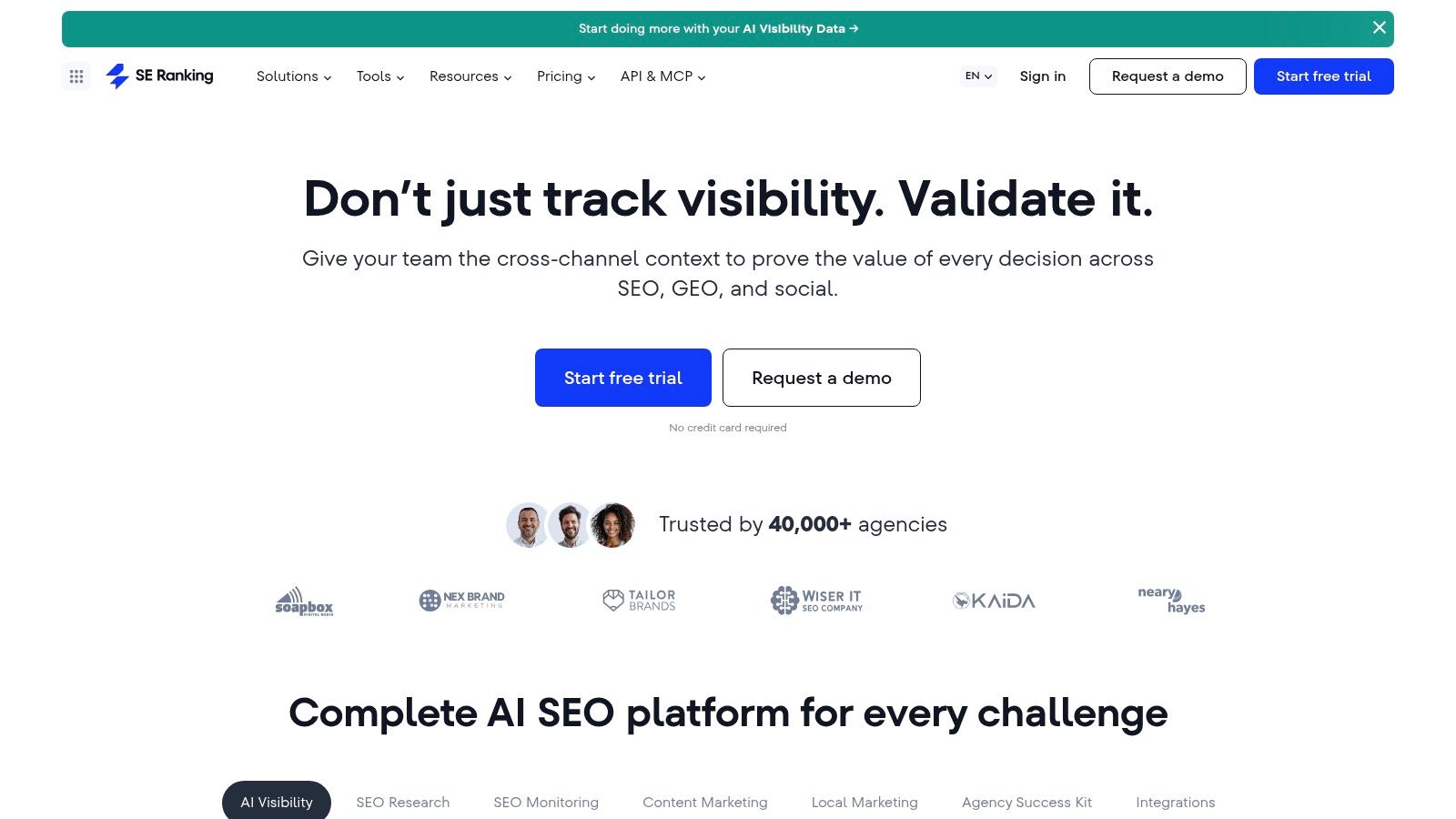
SE Ranking's Keyword Grouper is the kind of module I'd use when I want a straightforward SERP-overlap workflow without buying a heavyweight enterprise suite. It groups related queries, can check search volume, and can generate names based on group relevance. That keeps the process understandable for teams that still move their final clusters into spreadsheets, project management tools, or PPC structures.
The interface is practical. I can upload thousands of keywords, let the tool organize them, and then review the groups without a steep learning curve. The same capability can support information architecture, SEO content planning, and PPC ad-group organization, although the quality bar differs by use case. A PPC grouping may tolerate looser thematic relationships than a page map intended to prevent organic cannibalization.
What it does not replace
SE Ranking is part of a broader platform with rank tracking, keyword research, and site audits, but its content-planning layer is lighter than a dedicated content suite. I wouldn't expect the same depth of brief generation or on-page optimization guidance I'd get from Surfer or Frase. That isn't a flaw if my real requirement is fast grouping and export.
The pricing is positioned as more accessible than large enterprise platforms, with flexible keyword add-ons. I'd still check the current limits because a low entry price can become less attractive when recurring imports consume additional capacity.
Use case test: Upload the exact file you'll use in production. If the resulting groups are easy to map into URLs and editorial briefs, the lighter workflow may be an advantage rather than a limitation.
SE Ranking suits smaller internal teams, agencies that already use its rank tracking, and practitioners who want a clean operational tool. It's not my first choice when the next action after clustering is a thoroughly researched brief.
Explore SE Ranking Keyword Grouper
5. Surfer
Surfer is built for the handoff from keyword research to content brief to optimization. Its Keyword Research and Content Planner uses live SERP data to create topic clusters and a Topical Map, then lets me send a selected cluster directly into Content Editor. That short path is valuable when the person doing research is also responsible for producing or briefing the article.
I like the workflow because the cluster doesn't sit idle in a spreadsheet. I can select a topic, create a data-backed brief, and give the writer a content environment that includes SERP-derived guidance. Playbooks and collections also help organize cluster-level production, which is useful when a team is building a publishing plan rather than conducting a one-off audit.
The trade-off is specialization
Surfer is strongest after the topic has been chosen. It isn't the tool I'd rely on for a complete backlink gap program, deep competitor reverse-engineering, or technical SEO diagnosis. Those jobs require another platform, which can create duplicated research and separate reporting workflows.
I'd also verify current research and brief limits before choosing a paid plan. Pricing and allowances can change, and clustering capacity may not match the needs of a large agency importing many domains. For a content team with a clear research-to-draft pipeline, that limitation may be acceptable. For a consultant delivering broad SEO strategy, it may make the stack too narrow.
The most common mistake here is accepting the generated topic map without checking whether the suggested pages share intent. I still open the live SERP for ambiguous clusters, especially where commercial and informational modifiers appear together.
Explore Surfer Keyword Research and Content Planner
6. Keyword Insights
Keyword Insights is the specialist I'd shortlist for large, recurring clustering workloads. It's designed around bulk processing, topical cluster analytics, and competitor insights, with campaigns that can reach very large keyword lists. Agencies handling multiple domains often care less about having another backlink dashboard and more about whether a tool can process the next client file without a spreadsheet cleanup marathon.
The credit model is a useful operational feature. Pay-as-you-go credits suit irregular projects, while subscription credits make more sense for a team that clusters continuously. I'd choose between them based on workload shape rather than assuming a subscription is automatically better. A campaign with occasional large imports needs different economics from a weekly editorial operation.
Where it wins and where it stops
The main strength is throughput. Keyword Insights can take a huge list and turn it into topical groups with competitor context, which supports content planning and gap analysis. That's valuable when the bottleneck is processing rather than writing.
The limitation is scope. It's a focused clustering and content-planning product, so I'd still need separate tools for backlinks, technical audits, and broader competitive research. That can be a benefit for an agency with an established stack, but it creates another subscription and another place to maintain project data.
I'd use Keyword Insights when the brief begins with a large imported keyword universe. I'd use SemDash when the clustering decision needs to sit beside URL-level competitor discovery, backlinks, SERP history, and AI Overviews analysis. The choice depends on whether bulk grouping oder broader diagnosis is the actual constraint.
7. KeyClusters
KeyClusters is the focused option I'd use for a quick CSV-in, CSV-out job. It clusters with real-time Google SERPs by looking at shared top-ranking URLs, and its locale and device controls let me make the grouping more relevant to the market I'm targeting. That makes it useful for the question I ask most often during audits: should these queries share one page or become separate pages?
The pay-as-you-go model is its clearest advantage. Credits don't expire, and there's no subscription requirement, so I can run a project when I need it without adding another recurring platform cost. It also accepts Ahrefs and Semrush export formats, which reduces preparation time when the keyword file already exists.
Simple output, narrow purpose
KeyClusters doesn't try to become a full SEO suite. There are no integrated content briefs, backlink reports, or on-page optimization workflows. I see that as a fair trade if I only need SERP-grounded grouping and a clean export for a content strategist or developer.
The tool is especially useful during cannibalization checks. I can compare a set of existing page targets with the clusters and identify where several URLs are chasing one SERP pattern. It won't decide whether to merge, redirect, or rewrite those pages, but it gives me evidence for that decision.
The best low-friction tool is often the one that produces an export I can act on immediately. Extra dashboards don't help if the cluster file still needs restructuring.
I'd choose KeyClusters for occasional audits, freelancers, and teams that already have research and content systems. I wouldn't choose it when the project needs competitor discovery, page-level traffic analysis, or a brief-to-publishing workflow.
8. WriterZen
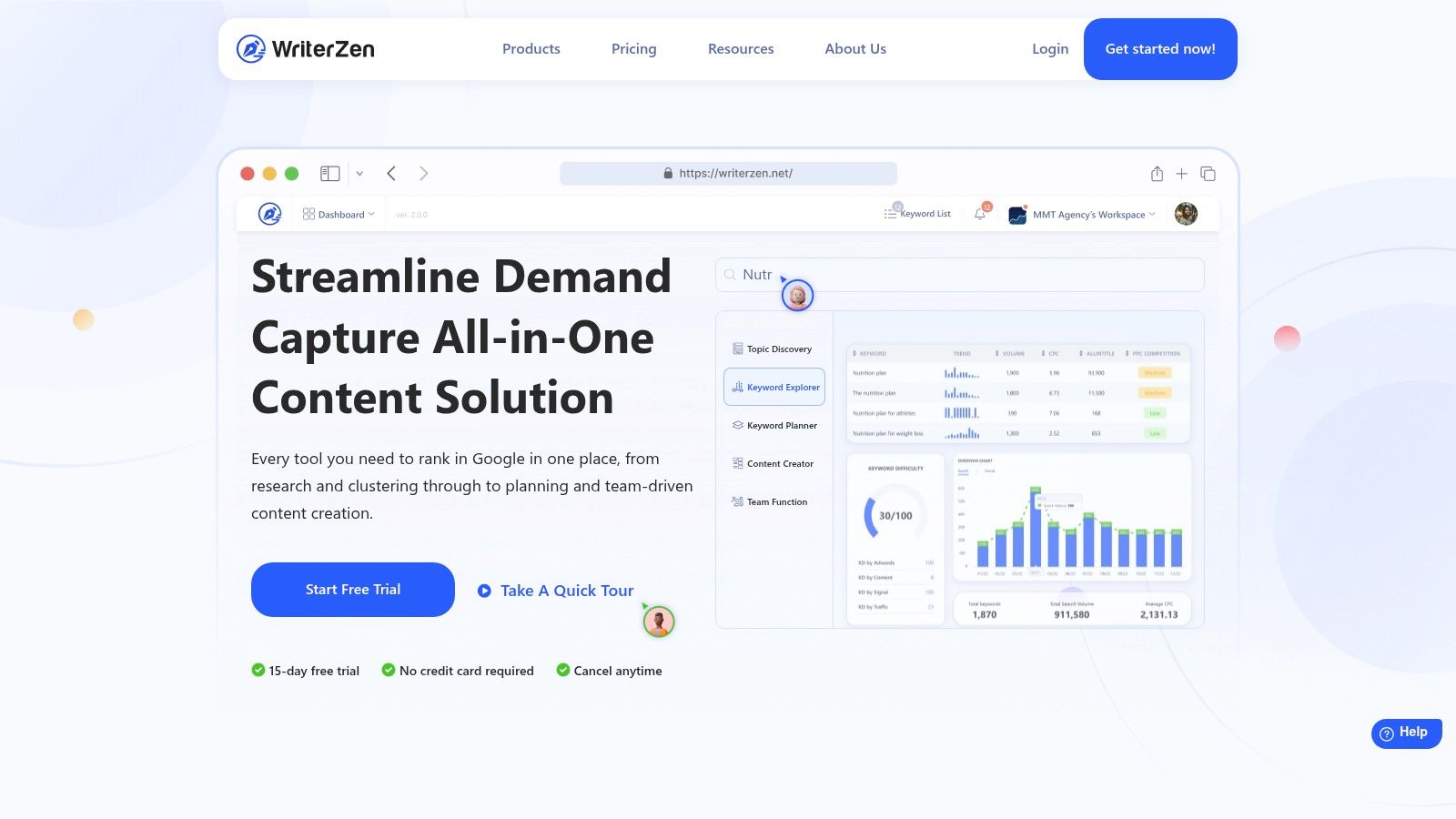
WriterZen is a content workflow platform with auto-clustering inside its Keyword Planner and Explorer. It's a good fit when I want to move from topic discovery to a usable editorial plan without asking a smaller team to learn a separate clustering application. Domain Focus and cluster-level performance insights add context to the planning process, while KGR and Allintitle utilities support more granular topic evaluation.
The practical benefit is continuity. A writer or content manager can research a topic, organize related terms, review cluster information, and move toward a brief in the same environment. That's less powerful than a full enterprise research stack, but it can be easier to operate for a compact team where one person handles SEO and production.
Know the ceiling before you scale
WriterZen's database, limits, and broader research depth are lighter than enterprise suites. I'd be cautious about using it as the sole platform for a large international site, a multi-domain agency, or an exhaustive competitor study. Those projects usually need more keyword breadth, more precise SERP controls, and deeper backlink or page intelligence.
I also wouldn't treat KGR or Allintitle as substitutes for intent validation. A keyword can look attractive in a formula and still belong to a different page type than its nearest linguistic relatives. I use those utilities to prioritize ideas, then inspect the SERP before finalizing a cluster.
WriterZen works best for content-first teams that value a simple planner-to-brief path. It's less suitable when bulk processing, competitor reverse-engineering, or highly controlled SERP overlap is the main requirement.
9. Frase
Frase treats clustering as part of a content operating system. I can start with seed keywords, map topic clusters, identify missing subtopics, generate briefs, and move into a research-to-publish workflow with CMS integrations. That makes it especially useful when the commercial outcome of clustering is a brief that a writer can execute, not a CSV that another strategist must translate.
The coverage-gap angle is valuable. A cluster isn't just a group of terms, it's a way to see where the current site lacks useful pages or where an existing article misses important subtopics. Frase's cluster recommendations and brief generation help shorten the distance between identifying that gap and assigning the work.
Content workflow over massive auditing
Frase is primarily a content platform, so I wouldn't choose it for extremely large keyword corpuses or broad technical audits. Dedicated bulk tools are better when the input is a huge export and the goal is a full site architecture map. Frase is better when the input is a focused set of content opportunities and the output needs to become a researched, optimized page.
The paid structure includes starter, professional, and scale tiers, with a free trial available. I'd verify the current feature allocation before committing, particularly if several writers need simultaneous access or if CMS publishing is central to the process.
I've found that content-first tools work best when the strategist defines the page boundary before generating the brief. If a cluster combines a comparison query with a how-to query, no amount of brief polish will fix the wrong architecture.
For a broader approach to finding ideas before grouping them, this keyword research guide for bloggers is a useful companion.
10. Keyword Cupid
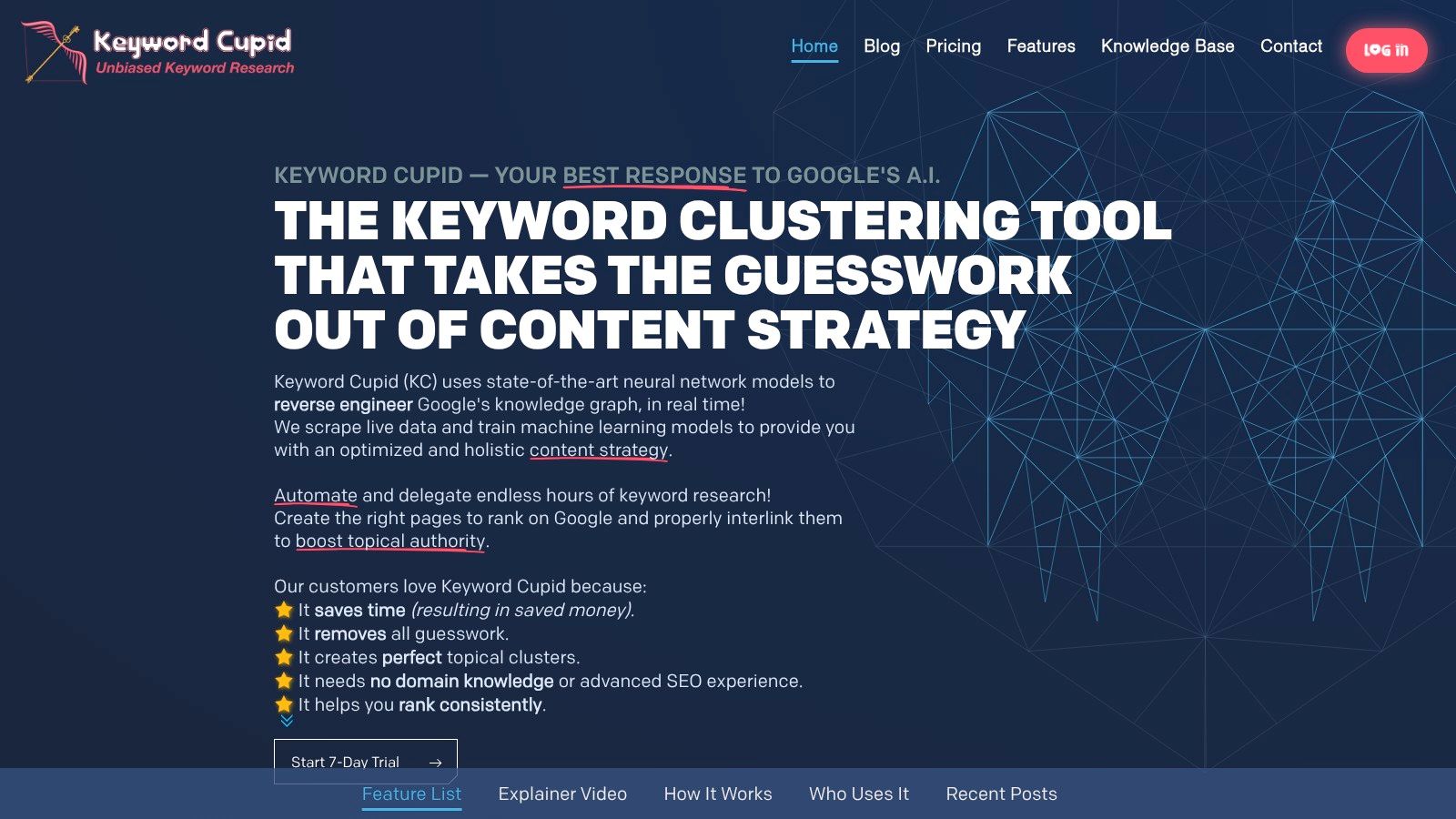
Keyword Cupid is a SERP-based clustering platform with neural network clustering, visual mindmaps, geotargeting, and device or search-engine targeting. I'd use it when the output needs to be understood by more than the person who ran the analysis. A mindmap can make a large topic architecture easier to explain in an audit, workshop, or stakeholder presentation.
The bring-your-own-data workflow supports large imports, so I can start with a list built in another research platform rather than relying only on a seed term. URL Analyzer and SERP Spy add useful diagnostic views when I need to investigate why a group formed or how the ranking environment is behaving.
Visual clarity versus stack breadth
Keyword Cupid's strongest differentiator is presentation. A visual cluster map can help a client understand the relationship between pillar pages and supporting content faster than a flat spreadsheet. Tiered credits and on-demand keyword packs also suit different project sizes, particularly when clustering is periodic rather than continuous.
The product is narrower than a full SEO suite. I'd pair it with separate tools for backlink intelligence, technical auditing, competitor keyword discovery, and content optimization. I also wouldn't select it solely for its visual output. Every mindmap still needs a SERP review, because a clean visual hierarchy can make a weak grouping look more authoritative than it is.
Keyword Cupid is a good choice for audits, planning workshops, and practitioners who need flexible targeting controls. If I need clustering to connect directly to competitor gaps and a brief workflow, I'd lean toward SemDash or a content-focused platform instead.
Top 10 Keyword Clustering Tools: Feature Comparison
| Product | Kernfunktionen | UX / Quality | Value & Pricing | Target audience & USP |
|---|---|---|---|---|
| SemDash 🏆 | 6.6B keywords, 2.7T backlinks, 600M SERPs; Keyword/Backlink Gap; URL‑level mapping; AI briefs & clustering | ★★★★★ Fast UI, frequently refreshed data | 💰 Affordable; free trial; pricing on request; optional 300+ news backlink add‑on | 👥 Agencies, SMBs, content/growth teams · ✨ URL-level insights, AI Overviews (citation tracking), broken‑link recovery, AI integrations |
| Semrush – Keyword Strategy Builder + Keyword Manager | SERP‑similarity clustering; topical map; KD/volume + intent labels; ecosystem integration | ★★★★★ Mature, polished UX | 💰 Premium plans; limits vary by tier | 👥 Larger teams already on Semrush · ✨ Seamless handoff to content briefs & tracking |
| Serpstat – Keyword Clustering | All‑to‑all SERP clustering; optional domain→page mapping; fast bulk exports | ★★★★ Tight semantic clusters, speedy | 💰 Mid‑tier; clustering consumes plan credits | 👥 SEO auditors & mid‑size teams · ✨ Strong URL mapping for cannibalization audits |
| SE Ranking – Keyword Grouper | SERP‑overlap grouping for thousands; auto‑naming; volume checks | ★★★★ Practical, user‑friendly | 💰 Affordable; part of broader suite | 👥 SMBs & PPC teams · ✨ Fast grouping at low cost |
| Surfer – Keyword Research and Content Planner | SERP‑driven clusters; Topical Map; 1‑click push to Content Editor | ★★★★ Tight research→brief→optimize workflow | 💰 Mid–premium; brief/cluster limits per plan | 👥 Content teams & editors · ✨ Direct handoff to Content Editor and scoring |
| Keyword Insights | High‑scale clustering; topical analytics; competitor insights | ★★★★ Built for very large lists | 💰 Flexible: pay‑as‑you‑go & subscription credits | 👥 Agencies & high‑volume teams · ✨ Scales to millions of keywords, transparent credit model |
| KeyClusters | Live SERP overlap clustering; configurable locale/device; CSV in/out | ★★★ Practical, lightweight | 💰 Low per‑keyword cost; no subscription (credit packs) | 👥 Freelancers & quick jobs · ✨ Cheap, real‑time SERP clusters for pragmatic decisions |
| WriterZen – Keyword Planner/Explorer | Auto‑clustering in planner; KGR/allintitle tools; domain focus | ★★★★ Smooth planner→brief UX | 💰 Budget‑friendly; smaller DB than enterprise tools | 👥 Small teams & content creators · ✨ KGR tools + integrated brief workflow |
| Frase – Topic Clusters + Briefs | Topic cluster mapping; coverage gap detection; briefs + CMS integrations | ★★★★ Efficient research→brief→publish loop | 💰 Transparent tiers with free trial | 👥 Content teams & publishers · ✨ Coverage gap detection and CMS publish integration |
| Keyword Cupid | Neural‑network SERP clustering; mindmaps; geotargeting & device targeting | ★★★★ Strong visual outputs for audits | 💰 Tiered credit packs; on‑demand pricing | 👥 Agencies & consultants needing visual reports · ✨ Interactive mindmaps, large report export |
Choose the Tool That Matches Your Clustering Job
There isn't one universal best keyword clustering tool because the job changes from project to project. A content team may need a clean path from a cluster to a brief, while an agency may care more about importing many client files without manual restructuring. An enterprise SEO team may need URL mapping and historical SERP context, while a freelancer may only need a reliable pay-as-you-go grouping job.
I'd choose SemDash when clustering needs to connect with competitor keyword discovery, URL-level mapping, SERP history, backlinks, AI Overviews, and content briefs. Its value comes from the surrounding decisions. I can identify a competitor page, find the keyword and backlink gaps around it, group the terms into page-level topics, inspect intent and historical results, and then create a brief without stitching together several separate tools.
I'd prioritize Semrush, Surfer, or Frase when the next step is content production. Semrush is the best fit when the team already relies on its wider SEO ecosystem. Surfer is strongest for research into Content Editor and on-page optimization. Frase suits teams that want topic mapping, coverage gaps, briefs, and CMS-oriented publishing in one content workflow.
For very large campaigns, Keyword Insights deserves the shortlist because its core proposition is bulk clustering with topical analytics and competitor context. I'd use KeyClusters for focused, pay-as-you-go SERP grouping, especially when I need a quick answer about one page versus several. Serpstat and SE Ranking are practical middle-ground choices when clustering needs to sit inside broader research or rank-tracking platforms. WriterZen and Keyword Cupid are more situational, with the former favoring smaller content teams and the latter adding useful visual output.
Before buying, I'd run the same representative keyword file through the shortlisted tools. Include head terms, long-tail queries, commercial modifiers, informational questions, brand terms, local variants, and keywords from existing pages. Then inspect false merges, false splits, unclustered terms, duplicate assignments, locale settings, export fields, and the exact page mapping each tool recommends.
My validation standard: Never publish or restructure pages from an unreviewed cluster. A tool can accelerate the analysis, but the final page boundary still needs a human who understands the SERP, the business, and the site's existing architecture.
Finally, verify credit consumption, import limits, processing rules, and plan allowances using the workload you currently have. A fast trial with a tiny file doesn't tell me whether the tool will remain practical for a client-wide audit. I'd also check whether the tool supports the countries, languages, devices, and search engines that matter to the project.
The right choice is the one that leaves me with fewer unresolved decisions. If the output is an accurate cluster, a clear target URL, a defensible intent classification, and a brief or export that the team can use immediately, the tool is doing its job. If it produces a polished list that still needs hours of manual regrouping, the apparent feature count doesn't matter.
SemDash combines keyword clustering with competitor keyword discovery, URL-level mapping, SERP history, backlink gaps, AI Overviews citation tracking, and AI-assisted content briefs. Test your own keyword file and see whether its broader SEO workspace reduces the cleanup between research and publishing by visiting SemDash.