%20(1)-B86R08ZzwhPzS6UZbG3mSxRWPCwGwn.png)


The Complete SERP Features List Every SEO Should Track
SERP features are any Google result block that isn’t a traditional organic blue link, and they now occupy most of the real estate on page one. This article gives you a complete, grouped list of current Google SERP features plus tactical steps for winning each one.
You already know the “10 blue links” era ended years ago. What replaced it is a patchwork of featured snippets, AI Overviews, local packs, and rich results that behave by different rules. Search Engine Land’s SERP features guide frames it plainly: different features respond to different signals, so a strategy built for Featured Snippets won’t move the needle on a Knowledge Panel. Structured data from Schema governs eligibility for several of these blocks, and platforms like Semdash now track AI Overview mentions directly, which matters because that feature barely existed two years ago.
Here’s what this article covers:
- A grouped, scannable list of every major SERP feature active today
- Feature-specific optimization tactics, including schema and content structure
- A prioritization framework based on prevalence and effort
- A monitoring workflow and technical checklist for validating your work
Wichtige Erkenntnisse
Winning SERP features requires matching the right tactic (content structure, schema, or Google Business Profile optimization) to the specific feature you’re targeting, since a single approach doesn’t work across all of them.
| Punkt | Details |
|---|---|
| Match tactic to feature | Featured Snippets need concise structured content; Local Pack needs a complete Google Business Profile; Knowledge Panels need entity authority. |
| Prioritize by effort | Reformat top 10 ranking pages for snippets first since it requires no new content, just structure. |
| Validate all schema | Run every JSON-LD implementation through the Google Rich Results Test before and after template changes. |
| Build for AI Overviews long-term | Topical authority and consistent citation across linked pages matter more than any single page’s markup. |
| Monitor continuously | Track feature impression share, clicks, CTR change, and zero-click rate on a fixed audit schedule. |
| Use Semdash to track feature eligibility | Semdash’s SERP analysis and AI Overview tracker show which queries already trigger features for your domain. |
What Are the Types of SERP Features? A Grouped List
Google now displays more than a dozen distinct feature types, and grouping them by function makes the list far easier to act on than a flat alphabetical dump. Each family responds to a different lever: content structure, structured data, business profile optimization, or pure algorithmic trust earned over time.
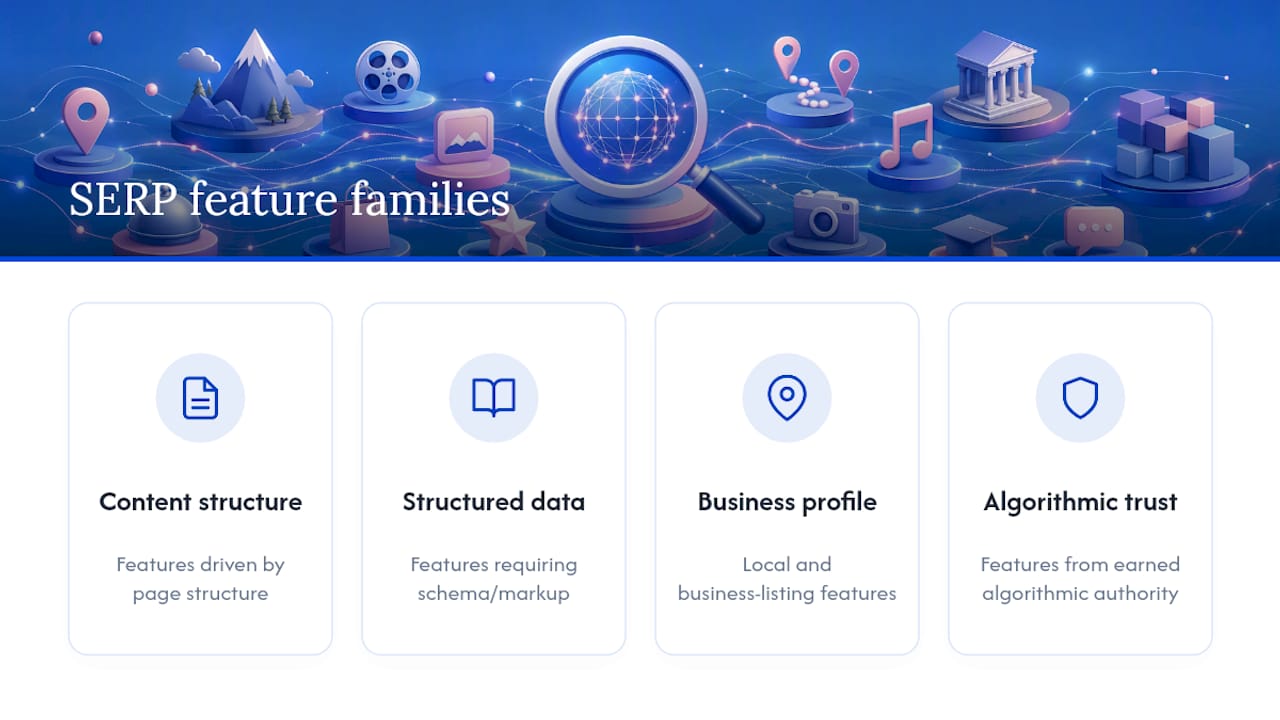
Answer and knowledge features
These blocks try to answer the query directly on the results page, often without a click.
- Featured Snippet. A boxed answer pulled from an existing organic result, typically triggered by question-based or definitional queries (“what is,” “how to,” “why does”). Winning it depends entirely on content structure: a tight 40 to 60 word paragraph, a numbered list, or a table placed directly under a matching H2. This is content-structure-dependent, not schema-dependent.
- People Also Ask (PAA). An expandable list of related questions, each revealing a short answer when clicked. PAA boxes cluster around informational intent and expand dynamically as users click, sometimes generating new questions in real time. Structuring your page around a cluster of related sub-questions, each with its own H2 and concise answer, is how you get pulled in.
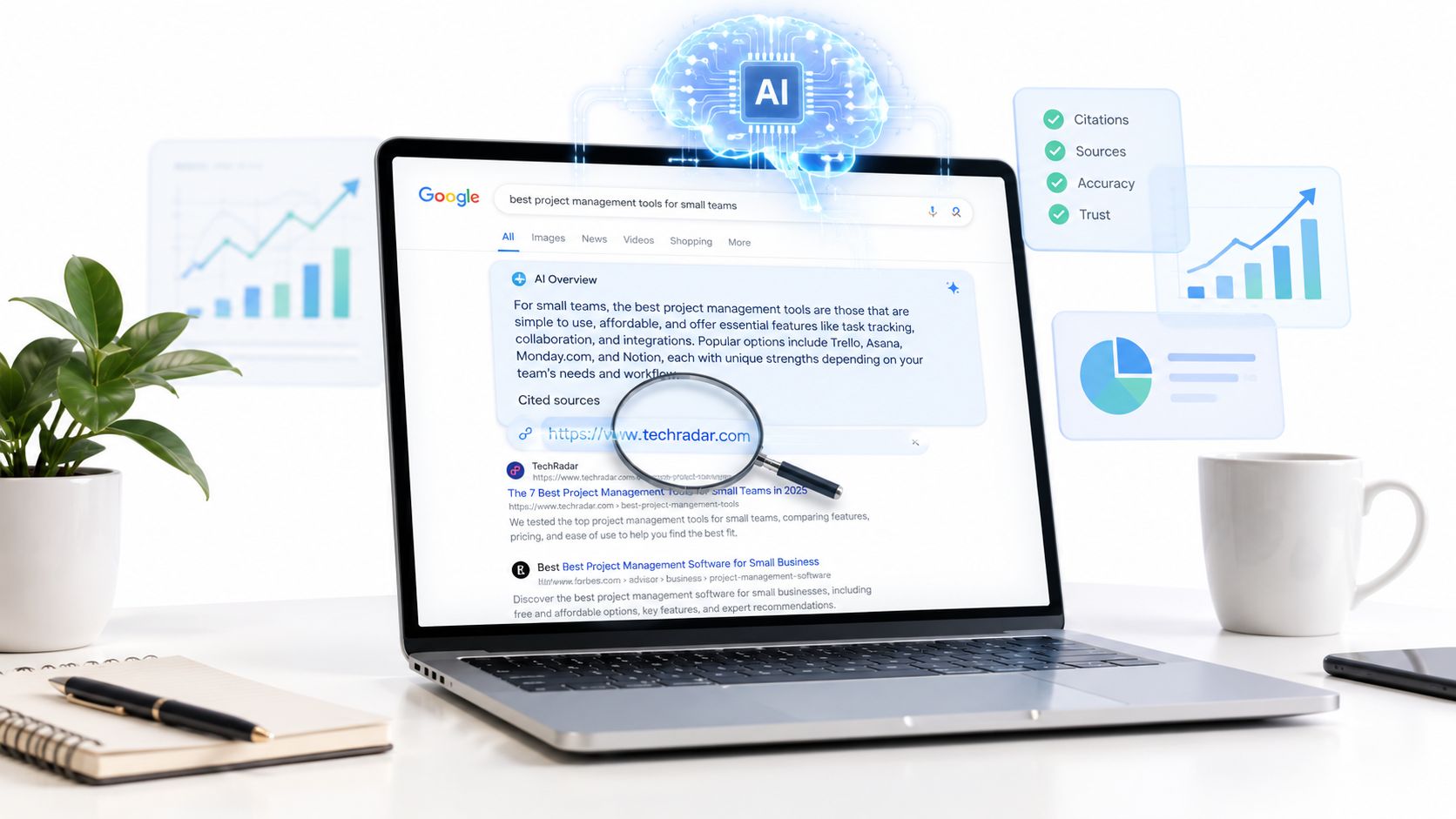
- AI Overviews. Google’s generative summary block, now appearing above traditional results for a wide range of informational and even some commercial queries. It draws on multiple sources at once and favors pages with strong topical authority and a track record of being cited elsewhere. This is algorithmic and reward-based, tied more to overall site authority than any single page tweak.
- Things to Know. A newer expandable module that breaks a broad topic into digestible sub-facts, often layered beneath an AI Overview or standard organic results. It rewards comprehensive, well-organized content that covers a topic’s common angles in one place.
- Knowledge Panel. The information box (often right-rail on desktop) covering entities: people, places, organizations, and brands. It pulls from structured data, Wikipedia, Google’s Knowledge Graph, and verified business or organization markup. This one is largely earned through entity authority built over months or years, not a quick content fix.
Media features
- Image Pack / Carousel. A horizontal row or grid of images inserted into organic results, common for visual queries (recipes, design ideas, product looks). Optimizing filenames, descriptive alt text, and
ImageObjectmarkup, as documented by Schema, all factor into eligibility. - Video Carousel. A row of video thumbnails, often YouTube-heavy but increasingly pulling from other hosts when
VideoObjectschema is present. Schema is the standard way to describe duration, thumbnail, and upload date to search engines.
Local and maps features
- Local Pack. A three-listing map block with business names, ratings, and addresses, triggered by “near me” and service-plus-location queries. This depends almost entirely on a fully optimized Google Business Profile, not on-page content, which makes it distinct from most other features on this list.
Commerce features
- Shopping Carousel. A horizontal row of purchasable products with images and prices, sourced from Merchant Center feeds rather than organic crawling.
- Popular Products. A grid-style module showing product categories and price ranges, drawing on Google’s retail data infrastructure similarly to the Shopping Carousel.
- Price and Availability Rich Results. Inline pricing, stock status, and review stars attached to a standard organic listing, powered by
Productschema. Google’s developer documentation on Product structured data lays out the exact required and recommended properties.
Site-structure features
- Sitelinks. The extra indented links that appear beneath a top-ranking result, pointing to a site’s key subpages. There’s no markup that directly requests these. Google generates them algorithmically based on site architecture, internal linking, and navigational clarity, which means sitelinks are a long-term reward for good site structure rather than a short-term content play.
- Breadcrumbs. The URL-path trail shown above a result’s title, generated from
BreadcrumbListschema or inferred from site navigation.
Rich snippets and other formats
- FAQ Rich Results. Expandable question-and-answer pairs attached directly to an organic listing, built from
FAQPageschema. - HowTo Rich Results. Step-by-step instructions with optional images, built from
HowToschema (though Google has scaled back visual display of this format on some query types). - Review Rich Results. Star ratings shown beneath a listing, sourced from
ReviewoderAggregateRatingschema. - Top Stories. A carousel of recent news coverage, reserved for queries with a clear news angle and generally limited to recognized publishers.
- Ads and Shopping Ads carousels. Paid placements that occupy the same visual territory as organic features, competing directly for above-the-fold attention on commercial queries.
Roughly a third of this list runs on structured data alone (Product, VideoObject, FAQ, Review, Breadcrumb). Another chunk runs purely on content structure (Featured Snippets, PAA, Things to Know). The rest, Local Pack, Sitelinks, Knowledge Panels, AI Overviews, blend technical setup with longer-term authority signals.
How to Optimize for Each SERP Feature
Winning a feature slot means matching the tactic to the feature family. Trying to schema-markup your way into a Featured Snippet, or trying to out-write your way into a Knowledge Panel, wastes effort on the wrong lever.
For Featured Snippets and PAA, structure beats volume. Write a direct question as an H2, then answer it in the first 40 to 60 words that follow, before adding supporting detail. Use numbered lists for process questions, bullet lists for feature comparisons, and HTML tables (per the W3Schools table reference) for anything involving side-by-side data points like pricing tiers or specs. Semdash’s guide to winning Featured Snippets breaks down formatting patterns that consistently pull position zero across different query types.
For rich results generally, JSON-LD is non-negotiable. Map your content type to its schema: Product for anything sold, FAQPage for Q&A blocks, Review for user or editorial ratings, VideoObject for embedded video, HowTo for step-based tutorials. Every property Google marks as required has to be present and has to match what’s visibly on the page, mismatches between visible content and markup are the single most common reason rich results get rejected.
For Local Pack visibility, your Google Business Profile does more work than your website. Complete every field: categories, service areas, hours, and photos, and keep review response rates high. A step-by-step guide to Google Business Profile optimization covers the specifics of category selection and review velocity that most businesses overlook.

For commerce features, your product feed in Merchant Center matters more than your product page copy. Accurate pricing, availability status, and GTIN or MPN identifiers, following Google’s Product structured data guidance, determine whether you show up in Shopping Carousels at all.
For media features, submit a video sitemap alongside VideoObject markup, and treat thumbnail quality as a ranking factor in its own right. Descriptive, keyword-relevant alt text still does real work for Image Pack eligibility.

For AI Overviews, there’s no schema shortcut. Google’s summarization model pulls from sources it treats as topically authoritative and citation-worthy, which means comprehensive coverage of a subject across multiple linked pages outperforms a single thin post trying to rank for everything. Building genuine topical depth, and tracking which of your pages actually get cited, is where a tool like Semdash’s AI Overview keyword checker earns its keep: it shows you which queries already surface your domain inside an AI Overview so you can double down on what’s working.
Profi-Tipp: Audit your existing top 20 organic pages for a “concise answer gap” before writing anything new. Add a 50 word direct answer under the H1 or first H2 of pages that already rank on page one. It’s often faster to win a snippet from position 3 to 8 than from a page that doesn’t rank yet.
General on-page fundamentals still underpin all of this. Semdash’s breakdown of how to structure content for SEO covers the header hierarchy and answer-first formatting that both traditional rankings and feature eligibility depend on.
How Common Are SERP Features, and Which Ones Should You Chase First?
Most searches today return at least one non-organic feature, and Search Engine Land notes that occupying this real estate has become essential rather than optional for visibility. That reality should shape where you spend your time, because not every feature is worth chasing for every query.
Query intent predicts which feature shows up. Informational queries (“how does X work”) pull Featured Snippets, PAA, and increasingly AI Overviews. Transactional queries (“buy X,” “X price”) pull Shopping Carousels and Popular Products. Local and service queries (“plumber near me”) pull the Local Pack almost exclusively. Navigational queries pull Sitelinks for brands with strong existing authority.
Prioritize by weighing traffic potential against technical lift:
- High traffic potential, low effort: Featured Snippets and PAA on pages that already rank in the top 10. Just needs reformatting, not new content.
- High traffic potential, moderate effort: Local Pack for any business with a physical or service area presence. Requires Google Business Profile completion, not code.
- Moderate traffic potential, higher technical lift: Shopping and product rich results, which require Merchant Center setup and ongoing feed maintenance.
- High long-term value, slow payoff: AI Overview citations and Knowledge Panels, both of which reward sustained topical authority rather than a single optimization sprint.
Start with the first bucket. Reformatting an existing page 3 to 8 result into snippet-ready structure is the fastest feature win most teams have sitting untouched in their existing content.
How to Monitor and Track SERP Feature Performance
You can’t optimize what you don’t measure, and SERP features are notoriously easy to lose track of because they shift week to week even without any changes on your end.
- Run a baseline audit. Pull your top 50 to 100 ranking queries and check which currently trigger a feature, and whether you occupy it. Google Search Console’s Performance report includes a Search Appearance filter for some feature types, giving you impression and click data split out from standard organic results.
- Implement targeted changes. Reformat content for snippet-eligible queries, add missing schema, or complete Google Business Profile fields based on what the audit revealed.
- Re-audit on a fixed schedule. Feature presence changes often. Rank trackers that flag feature type alongside position, including Semdash’s SERP analysis tools, let you see feature-level shifts without manually checking each query.
- Measure the actual impact. Compare impressions and click-through rate before and after your changes, not just ranking position, since a feature win can raise impressions while leaving clicks flat if the feature itself absorbs the click.
Track four KPIs consistently: feature impression share (how often you appear in the feature versus how often it’s shown at all), clicks generated from the feature itself, click-through rate change on the underlying query, and zero-click rate, the share of searches ending without any click at all. A rising zero-click rate on a query you own the snippet for isn’t necessarily bad; it often means you’re satisfying intent so efficiently that Google doesn’t need to send the click anywhere else.
Technical Schema Checklist for SERP Features
Engineers implementing structured data need a direct map from feature to schema type, plus a validation step before anything ships.
Run every implementation through Google’s Rich Results Test before deployment, and recheck after any template change, since a single missing required property (like image on a Product type) can disqualify the entire markup block. The most common failure isn’t malformed JSON-LD. It’s a mismatch between what the schema claims and what’s visibly rendered on the page, Google’s guidelines treat that as a policy violation, not just a technical error.
Teams running WordPress don’t need to hand-code this from scratch. Several Wordpress generate valid JSON-LD for common types, though you should still validate the output rather than assume the plugin got every property right.
Why Topical Authority Matters More Than Ever
Structured data gets you eligible. It doesn’t get you chosen, especially for AI Overviews, which weigh a source’s overall credibility more heavily than any single page’s markup.
Different SERP features require fundamentally different signals: concise, structured content wins Featured Snippets and PAA boxes, a complete Google Business Profile wins Local Pack placement, and established entity authority combined with verified structured data wins Knowledge Panels. AI Overviews lean hardest on topical authority and being cited as a dependable source across the web.
That last point is the one teams underestimate. Being “citable” isn’t a metadata setting. It looks like a stable, canonical page that other credible sites reference by name, backed by consistent coverage of a topic across several linked articles rather than one isolated post trying to cover everything at once.
Do SERP Features Look the Same in Every Language and Region?
They don’t, and assuming your English-language feature research transfers directly to another market is a common mistake. Feature availability, density, and format all shift by country and language.
Local Pack behaves differently depending on how mature Google’s local business data is in a given region; some markets show dense three-pack results for nearly any commercial query, while others show sparse or inconsistent local results because business listing coverage is thinner. AI Overviews rolled out unevenly across languages, appearing on a smaller share of queries in non-English markets during initial expansion, which means their impact on click-through rates varies significantly by locale right now.
Rich results also depend on schema adoption rates within a market. Regions with lower structured-data implementation among competing sites sometimes make certain rich results easier to win simply because fewer pages qualify. Featured Snippets exist in most major languages, but the phrasing patterns that trigger them (question structures, colloquial phrasing) don’t translate literally. A German or Japanese question-based query doesn’t map word for word onto English snippet-winning formats.
If you operate across multiple markets, audit feature presence separately for each language and region rather than assuming a single playbook. What wins position zero in the United States might not exist as a feature at all in a market where Google hasn’t rolled out that format yet.
What SEO Teams Get Wrong About Feature-Driven Search
The instinct to chase every feature type at once is the biggest mistake teams make once they see a list like this. Not every feature is worth building process around, and treating Sitelinks like a content project, when it’s really a downstream reward for solid architecture, wastes cycles that belong on snippet formatting or schema fixes.
AI Overviews are reshaping priorities faster than most editorial calendars can adapt. The teams handling this well aren’t the ones publishing more. They’re the ones consolidating scattered content into fewer, deeper, more citable pages. Start with the fundamentals: clean schema implementation and short, direct answers to the actual questions your audience types into Google. Everything else, Knowledge Panels, consistent AI Overview citations, builds on that foundation over time rather than through a single optimization push.
Track and Target SERP Features With Semdash
Building the list is the easy part. Knowing which of your own pages already show up in a Featured Snippet, a PAA box, or an AI Overview, and which ones are one formatting fix away from winning one, is where most teams get stuck without the right visibility.
Semdash pulls that visibility into one dashboard instead of forcing you to check queries one at a time. Its SERP analysis shows which feature types currently appear for your target keywords, its AI Overview tracker flags which of your pages already get cited in generative summaries, and its keyword research tool surfaces the queries in your niche most likely to trigger a Featured Snippet or Local Pack in the first place. If you’re structuring content around schema and short-answer formatting, pairing that work with actual feature-level data beats guessing at what Google currently rewards.
Start with a free SERP feature check on your target keywords to see exactly which features you’re already eligible for and which ones need work.
Quellen
Häufig gestellte Fragen
What Are the Key Features of a SERP?
The main features include Featured Snippets, People Also Ask, AI Overviews, Knowledge Panels, Local Pack, Image and Video Carousels, Shopping results, Sitelinks, and rich snippets like FAQ and Review markup. Each responds to a different combination of content structure, structured data, or business profile signals.
Can You Give Me an Example of a SERP Feature?
A Featured Snippet is a clear example: it’s a boxed answer, often a short paragraph or numbered list, pulled from an organic result and displayed above the standard listings for a question-based query like “how does compound interest work.”
How Do You Rank for SERP Features?
Ranking for a feature depends on which one you’re targeting: use question-based headers and concise answers for Featured Snippets and PAA, implement matching schema (Product, FAQPage, Review) for rich results, and fully complete your Google Business Profile for Local Pack visibility.
Are SERP Features the Same on Mobile and Desktop?
No. Mobile SERPs often show fewer simultaneous features due to screen space, prioritizing Local Pack, Featured Snippets, and AI Overviews, while desktop layouts have room for right-rail Knowledge Panels alongside other blocks.
Can Semdash Help Me Track SERP Features?
Yes. Semdash’s SERP analysis identifies which feature types appear for your target keywords, and its AI Overview tracker shows which of your pages are already being cited in AI-generated summaries.