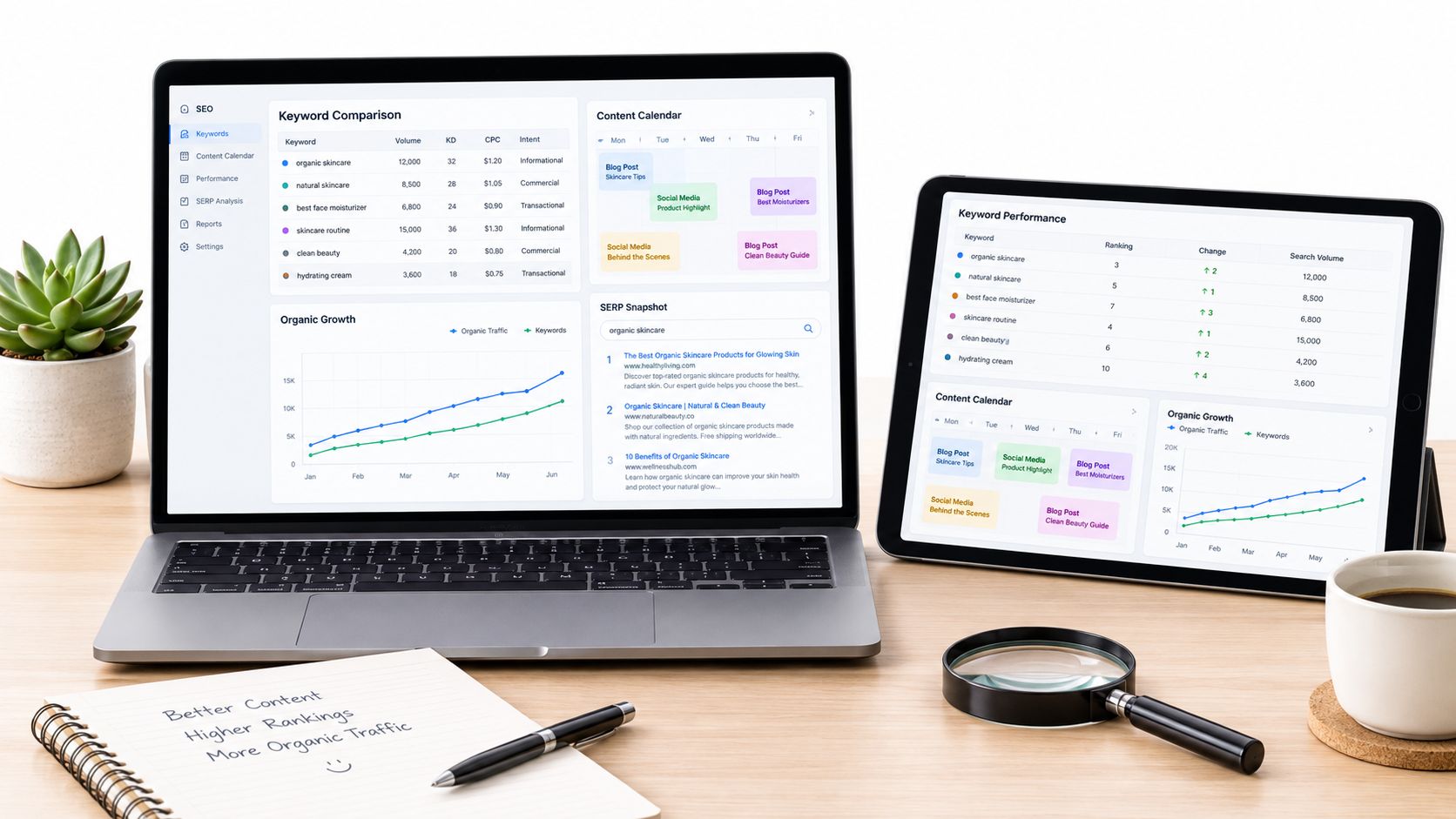

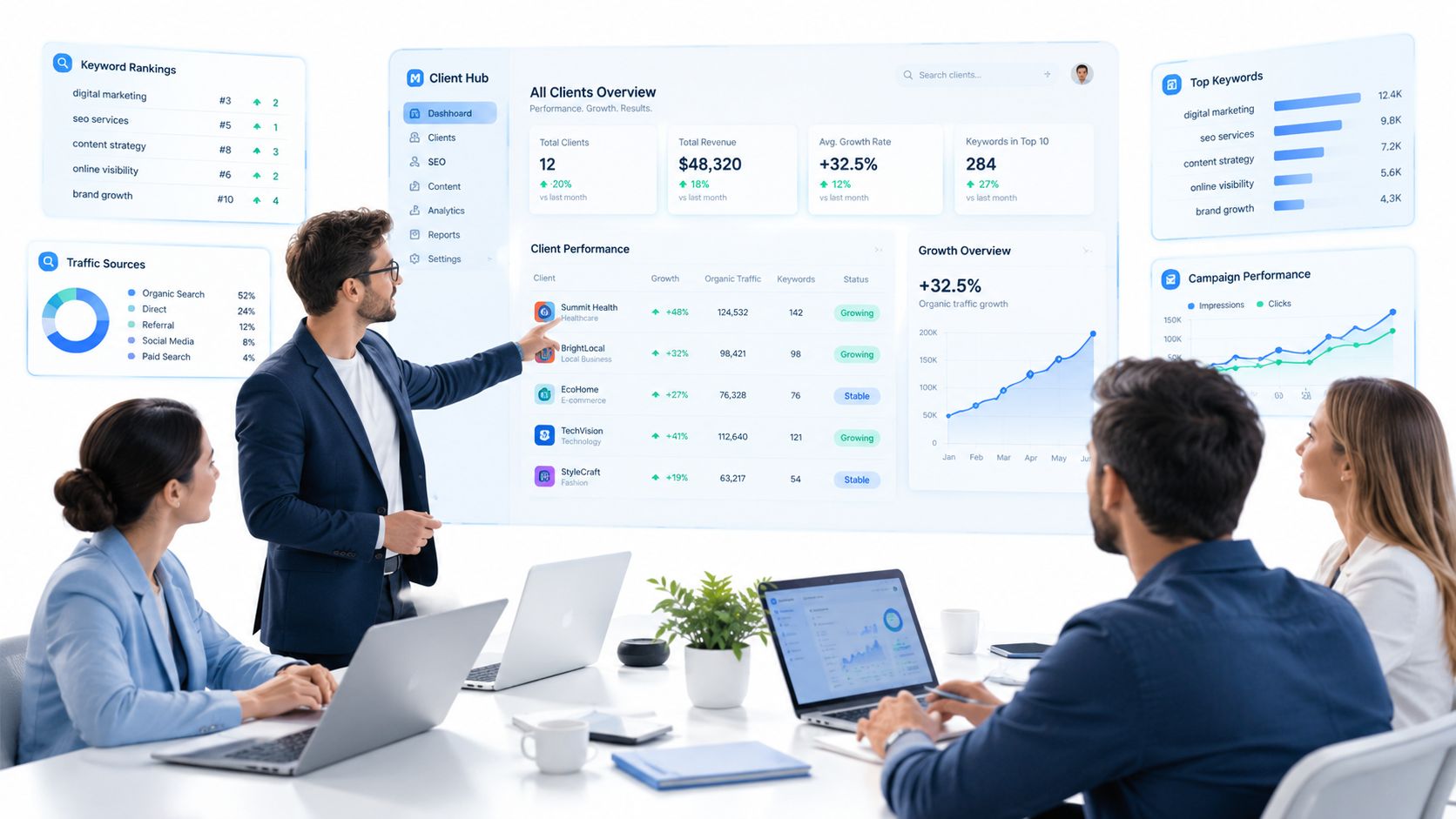
A client asks why organic traffic is flat. The strategist has one tab open for rankings, another for backlinks, a crawler running on a laptop, a spreadsheet for keyword gaps, and a reporting dashboard that still needs manual screenshots. The account manager is waiting for a clean explanation, while the content team is working from a brief that doesn't show which page should own each query.
That workflow can survive a small portfolio. It breaks when the agency manages multiple markets, websites, stakeholders, and reporting cycles at once. I've migrated teams across four SEO platforms, and the recurring lesson is simple: the wrong tool doesn't usually fail during the demo. It fails during handoff, reconciliation, onboarding, and the monthly client call.
An SEO platform for agencies has to do more than collect rankings. It must protect client data, preserve context between teams, expose actionable opportunities, and help prove visibility when AI-generated answers change the relationship between rankings and clicks.
Inhaltsverzeichnis
- What Makes an SEO Platform Truly Agency-Grade
- Must-Have Features at Multi-Client Scale
- How to Evaluate and Score SEO Platforms Before Buying
- AI Overviews Tracking and the New Visibility Problem
- Real Agency Use Cases and What Good ROI Looks Like
- Migrating to a New SEO Platform Without Losing Client Momentum
- Matching Platform Type to Your Agency Operating Model
What Makes an SEO Platform Truly Agency-Grade
The difference becomes obvious during a Monday morning handoff. A strategist has found a competitor gap, an SEO specialist needs to validate the target URLs, a technical lead is reviewing crawl issues, and the account manager needs a client-ready narrative. In a prosumer tool, each person may work in a different project, export a different file, and interpret a different version of the data.
That creates operational drag, not just inconvenience. Someone copies rankings into a spreadsheet, someone else renames URLs, and the account manager turns technical findings into slides without seeing the original evidence. By the time the recommendation reaches the client, its source and reasoning may be difficult to reconstruct.
The market is large enough that this problem isn't marginal. The SEO agency services market reached an estimated $83.98 billion in 2026, with more than 29,000 agencies operating worldwide, according to this industry summary of SEO tools and agency market data. Platform tooling has become infrastructure for a mature services business, not an optional layer for enthusiasts.
Isolation matters more than feature count
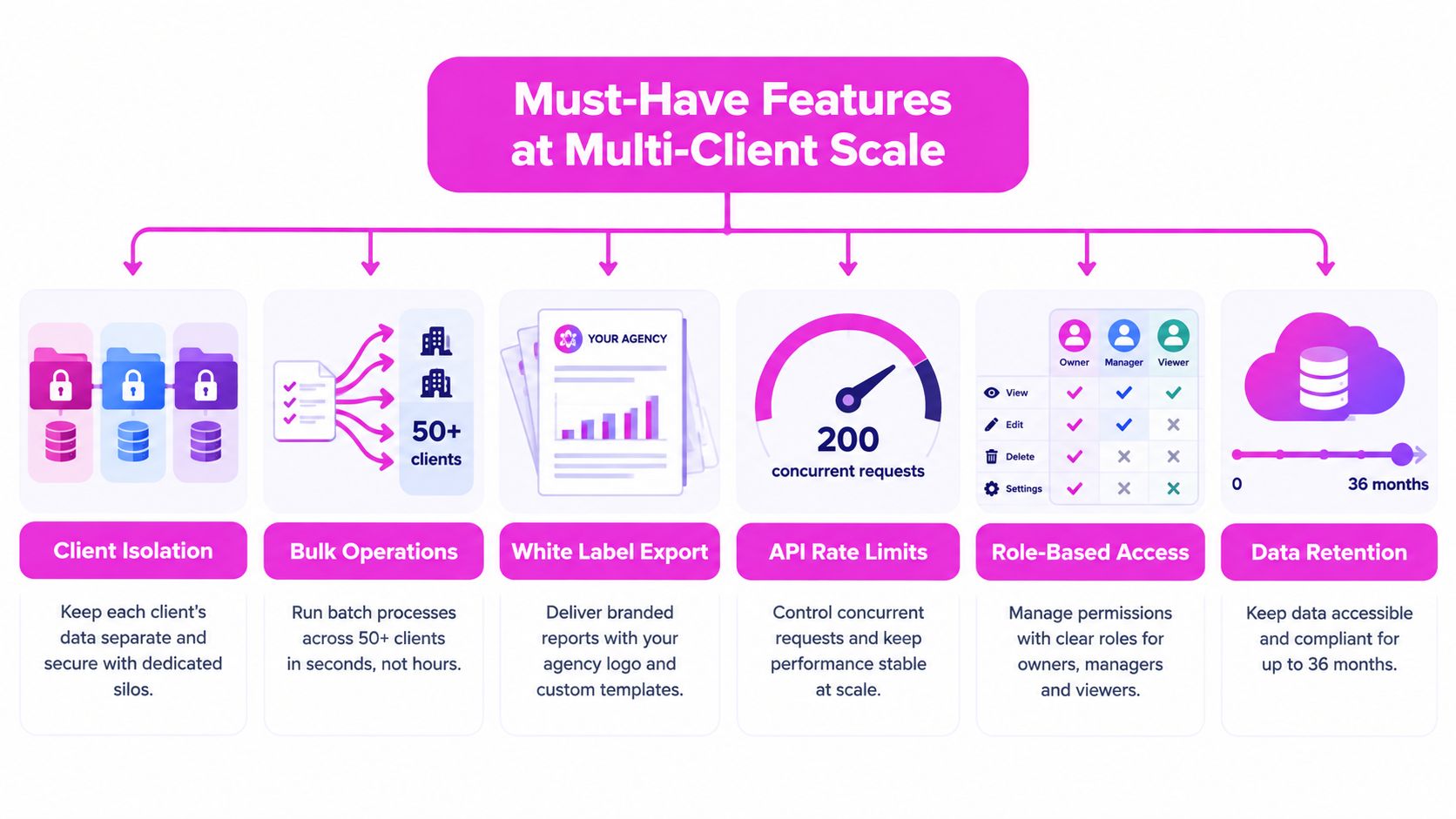
A genuine agency platform starts with workspace isolation. Each client needs separate projects, permissions, integrations, keyword sets, crawl settings, and reporting views. If a team member can accidentally add one client's competitor list to another account, the platform has failed at a basic operational requirement.
Role-based access matters for the same reason. Strategists may need full research access, account managers may need reporting and commentary, and clients may need a carefully limited view of approved metrics. Shared credentials and unrestricted workspaces create avoidable security and quality risks.
The reporting layer has a different job
Internal analysis and client communication aren't the same activity. A strategist may want thousands of rows, SERP history, anchor text, and crawl classifications. A client usually needs a concise explanation of what changed, why it matters, and what the agency will do next.
Enterprise reporting tools consolidate keyword rankings, organic traffic, technical audits, backlink data, and site health into one reporting layer, reducing the need to switch between point solutions while supporting reporting across many accounts, as explained in this overview of enterprise SEO reporting software.
Praktische Regel: If a recommendation can't move from evidence to assigned action without being rebuilt in another system, the platform isn't agency-grade for that workflow.
I test this during evaluation by assigning the same issue to three roles. Can the strategist attach the source URL? Can the specialist see the context without opening six exports? Can the account manager explain the recommendation without translating a technical dataset from scratch? The platform that handles those transitions cleanly will usually outperform the platform with the longer feature list.
Must-Have Features at Multi-Client Scale
An agency platform earns its place by reducing repeated work across accounts. I don't assess a feature by asking whether it exists. I ask what happens when the team uses it across a portfolio, under deadline, with several people touching the same project.
Client isolation and bulk operations
Multi-site management should let the team switch between accounts without losing project context. Workspace naming, domain grouping, country targeting, device settings, and competitor sets need to remain visible and consistent. Without that structure, bulk work becomes dangerous. A keyword import intended for one client can pollute another campaign, and a report can inherit the wrong brand settings.
Bulk operations are useful only when they preserve exceptions. I want to update recurring tracking settings across projects, but I don't want a single batch action to overwrite a client's local market or device configuration. The best systems make bulk work fast while keeping account-level controls explicit.
Dataset depth and freshness
Dataset scale changes the quality of agency research. A small or sampled index may surface obvious head terms but miss the long-tail queries that reveal content gaps, local intent, or competitor strengths. SemDash, for example, describes a 6.6 billion-keyword database, einer 2.7 trillion-link index, and URL-level mapping from keywords to ranking pages. Those capabilities are relevant when an agency needs to move from a broad opportunity to a specific page brief or outreach target.
The claim that matters isn't only the headline index size. Ask how recently the relevant dataset was updated, whether low-volume terms are sampled, and whether the platform can show the exact URL behind a ranking. A stale index creates false confidence, especially after a client changes its information architecture or a competitor publishes a new content cluster.
Reporting that doesn't require rebuilding the work
White-label reporting should preserve the analytical chain. A dashboard needs branded views, scheduled deliverables, commentary, annotations, and client-specific metric controls. If the agency still has to copy charts into slides every month, the reporting feature is mostly cosmetic.
A useful reporting workflow starts with the client's business questions, then connects each answer to a source. Agencies that are refining this layer can use examples of how to build trust with SEO reporting dashboards as a practical reference for presentation and communication choices.
Permissions, assignments, and audit trails
A platform should show who changed a project, who owns the next action, and which evidence supports the recommendation. Task assignment doesn't need to replace a dedicated project-management system, but it must prevent the common failure where a finding sits in an export with no accountable owner.
Audit trails become especially valuable during client disputes. If a ranking drop follows a migration, the team needs to distinguish a platform-data change from a site change, a tracking configuration change, or a genuine SERP movement.
APIs and integrations
An API is valuable when it removes repetitive handling, not because it looks impressive on a pricing page. I look for documented authentication, clear rate limits, stable field names, error responses, and access to the data the reporting team uses.
The integration should feed the agency's existing stack, whether that's a dashboard, data warehouse, CRM, or task system. If the API exposes only a narrow subset of the interface, the team may still depend on manual exports for the most important workflows.
URL-level SERP mapping and intent
Keyword-level rank tracking isn't enough for content operations. The team needs to know which page ranks for which query cluster, whether multiple pages are competing for the same intent, and whether a ranking change reflects a page change or a shift in the SERP.
URL mapping supports better briefs and cleaner handoffs. It also makes it easier to identify cannibalization, select a refresh candidate, and explain to a client why a new page isn't the right answer when an existing URL already owns related demand.
How to Evaluate and Score SEO Platforms Before Buying
Most buying mistakes happen because agencies test the interface instead of testing the work. A polished demo can show a chart. It can't prove that the chart is accurate for a difficult client, that the export preserves context, or that the account manager can use it without strategist support.
I use a weighted scorecard and adjust the weights to match the agency's operating model. The exact weights matter less than making the trade-offs visible before procurement.
| Evaluation Criteria | Gewichtung | What to Test in Trial |
|---|---|---|
| Data scale and freshness | 25% | Test low-volume keywords, recent ranking changes, backlink discovery, and update timestamps |
| Workflow fit and multi-client management | 20% | Create separate workspaces, assign roles, hand off a finding, and test bulk actions |
| Client reporting quality | 20% | Build a branded report, add commentary, schedule delivery, and restrict client visibility |
| Integration depth and API | 15% | Connect analytics sources, export structured data, inspect API documentation, and test errors |
| Support and roadmap transparency | 20% | Ask about incident handling, migration support, roadmap priorities, and data limitations |
Multiply each score by its weight, then compare the weighted total rather than relying on an unstructured impression. A platform that scores highly for research but poorly for reporting may suit a strategy consultancy. It may frustrate a high-volume retainer agency.
Test the claims vendors emphasize
I don't accept an index-size claim without testing the edge cases. Choose specific low-volume terms, niche competitors, and pages with unusual URL structures. Compare whether the platform returns the same opportunities consistently and whether it identifies the page that ranks.
For freshness, record a known ranking movement and check how quickly the platform reflects it. Don't ask only, “How often do you update?” Ask whether the update applies to the database, the project, the country, the device, and the report you'll use.
URL-level accuracy deserves its own test. Search for a keyword where several client pages are relevant, then trace the platform's selected URL back to the live SERP. If the mapping is wrong, every downstream brief, cannibalization decision, and client explanation becomes less reliable.
Use a real trial, not a toy project
Run the evaluation against an active client account with permission to use the data internally. Import the existing keyword set, recreate a report, run a gap analysis, assign a finding, and let an account manager produce the client explanation.
Vendor question: “Show me the raw source, the update timestamp, the mapped URL, and the export field for this exact keyword.”
Track the time and friction at each handoff. Note where someone has to leave the platform, clean a file, or ask another team member for interpretation. Those moments reveal the operating cost that feature comparison pages rarely quantify.
AI Overviews Tracking and the New Visibility Problem
A client can hold a strong traditional position and still receive fewer visits when an AI-generated answer satisfies the searcher before the blue links. Reporting only position makes that change difficult to explain, because the ranking may look stable while the click opportunity changes.
The practical unit of analysis is now query, AI Overview trigger, cited URL, organic position, and business outcome. An agency needs to know whether the client's page was cited, which competitor pages were cited instead, and whether the cited page matches the page being optimized.
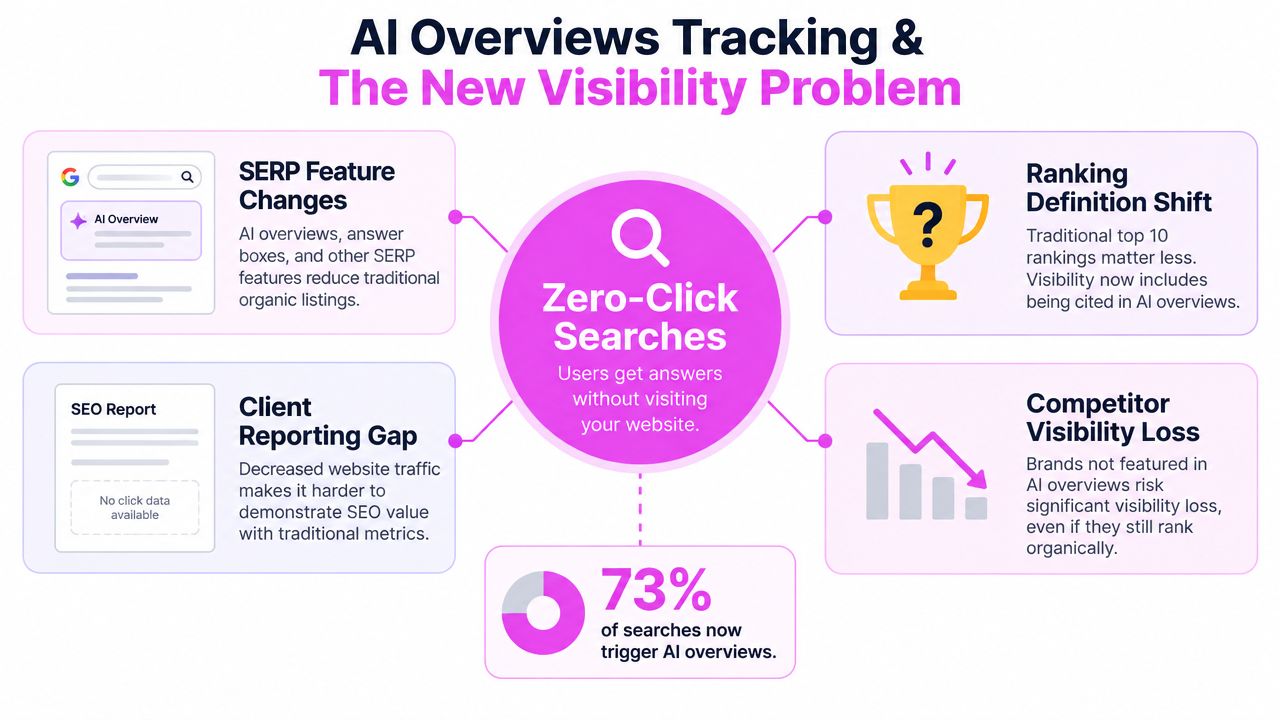
An Ahrefs study covering 863,000 keywords and 4 million AI Overview URLs found that only 38% of cited pages were in the top 10, while the remaining cited pages came from positions 11–100 or beyond, according to Ahrefs' analysis of search rankings and AI citations. Page-one visibility is therefore not a dependable proxy for inclusion in an AI answer.
What I want the platform to expose
The platform should surface cited URLs at the query level, show citation frequency over time, identify competing cited pages, and connect the citation to traffic and conversion data where possible. It should also distinguish a domain mention from a citation to the page that contains the answer.
When a client page ranks near the top but isn't cited, I compare its answer structure with the cited competitors. I check whether the definition is clear, whether the page answers the question early, whether supporting proof is easy to extract, and whether the page covers the surrounding intent cluster without burying the useful information.
CXL's study found 55% of AI Overview citations came from the top 30% of a page, 24% from the middle 30–60%, und 21% aus den unteren 40%, wie berichtet in CXL's study of AI Overview citation sources. I use that as a briefing principle, not a guarantee. Put the direct answer, definition, and relevant proof near the top, then develop the nuance below.
For agencies building a broader visibility practice, demand gen resources for AI visibility can help expand the conversation beyond traditional rank reporting. A practical tracking workflow is also outlined in this guide to tracking AI Overviews.
The client-facing explanation should be specific: rankings remain useful, but they're only one visibility signal. Show the cited page, the query, the competing source, the affected landing page, and the content change you recommend. That turns an unfamiliar SERP feature into an actionable account conversation.
Real Agency Use Cases and What Good ROI Looks Like
The strongest platform workflows begin with a client question and end with a decision. I've seen three patterns consistently produce better agency economics: competitive content discovery, focused link prospecting, and repeatable reporting.
Competitive content gaps
A strategist starts with a client domain and three competitors, then separates shared rankings from competitor-only rankings. The useful output isn't a giant keyword export. It's a prioritized set of terms grouped by intent, with the existing ranking URL checked for relevance and cannibalization before anyone commissions new content.
The team turns those groups into page briefs, each with a primary intent, supporting questions, competing URLs, internal-link opportunities, and a clear reason the page should exist. The dataset needs enough breadth to find meaningful gaps, but the workflow needs enough URL precision to avoid producing pages the client already has.
Link acquisition with a reason to contact
Backlink Gap analysis changes outreach from broad prospecting to qualified research. The team identifies domains linking to relevant competitors but not the client, reviews the linking page and anchor context, and removes prospects that are irrelevant, inaccessible, or already linked to the client elsewhere.
The outreach list becomes more useful when the strategist records why each domain might care. A resource replacement, expert contribution, broken-link recovery opportunity, or original data reference gives the writer a credible angle before the first message is sent.
Reporting across the portfolio
Reporting is where many agencies discover that their platform isn't connected to delivery. A good system carries annotations, landing-page context, technical findings, and next actions into the client view instead of presenting isolated charts.
I'd test whether a monthly report can answer three questions without manual reconstruction: what changed, why it changed, and what happens next. For a broader look at the reporting workflow, this guide to SEO reporting tools ein nützlicher Referenzpunkt.
The shift toward automation is already visible. 64% of digital marketing agencies worldwide have integrated at least one AI SEO tool, and AI SEO tool usage grew 190% from 2020 to 2025, laut Coherent Market Insights' SEO services market report. The operational value isn't generating text for its own sake. It's accelerating gap analysis, clustering, briefing, and reporting while keeping the strategist responsible for judgment.
Good ROI should therefore include more than subscription cost. Measure analyst time avoided, handoff errors prevented, reporting consistency, evidence reuse, and the speed at which a new team member can work independently. If those measures don't improve, a larger dataset or a longer feature list may not justify the migration.
Migrating to a New SEO Platform Without Losing Client Momentum
Platform migrations fail when agencies treat them as software changes instead of delivery changes. A new interface can alter keyword baselines, report definitions, URL mappings, and client expectations in the same month.
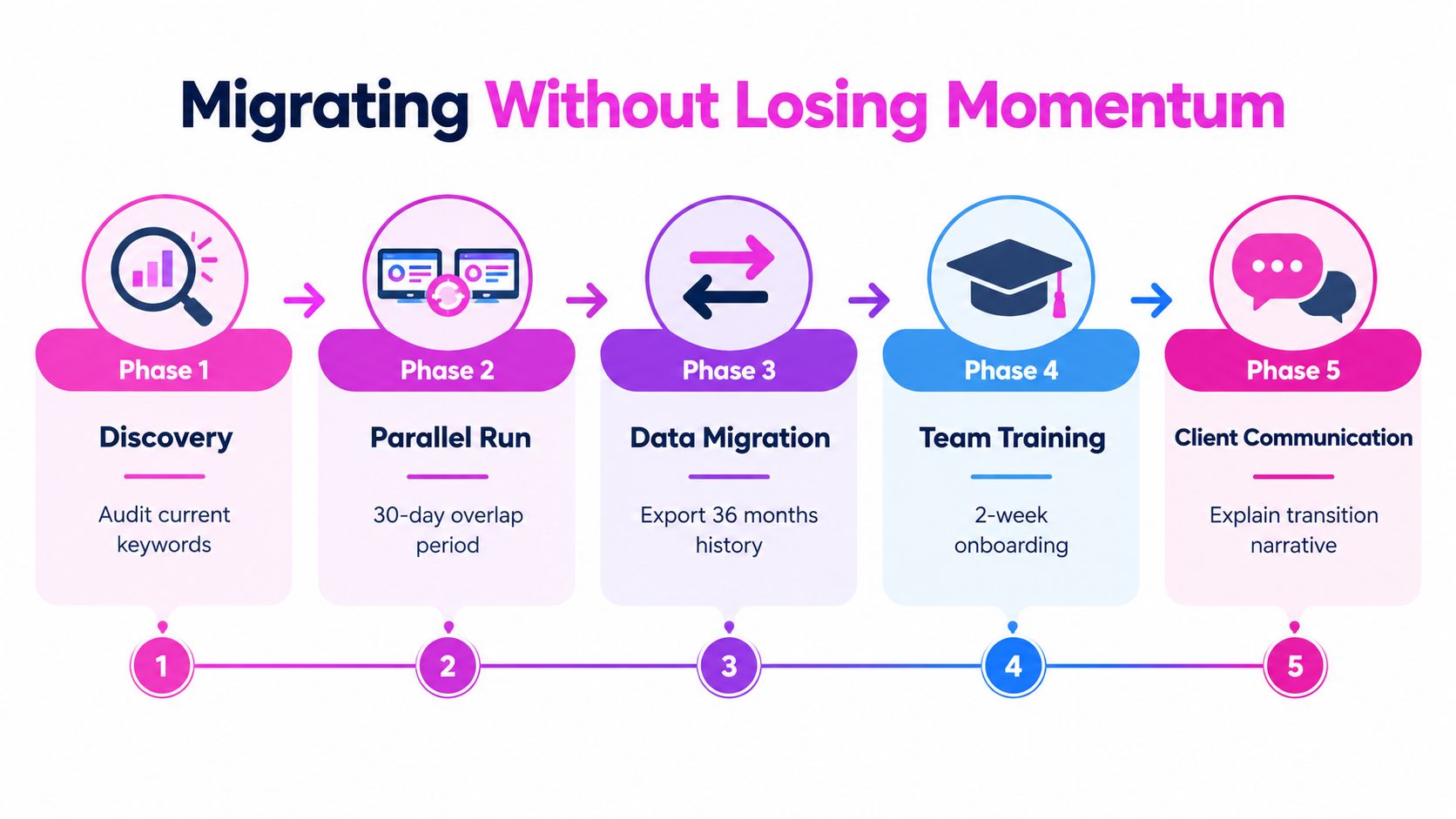
Start with a discovery inventory. Export tracked keywords, locations, devices, competitors, annotations, report templates, integrations, and historical files from the old platform. Then crawl the client sites and record critical technical findings. Deep crawling for broken links, duplicate content, redirect chains, and Core Web Vitals signals is foundational to migration validation, as described in this guide to agency SEO automation platforms.
Run both systems before cutting over
I use a parallel run of at least four weeks so the team can compare rankings, URLs, traffic definitions, backlink findings, and report totals before the old system disappears. The purpose isn't to force identical numbers. Different platforms collect and process data differently, so the team needs a documented explanation for each material discrepancy.
Migrate one client account at a time. Choose a representative account first, not the easiest one. Include a technical site, a local account, an international project, or whichever edge case creates the most risk for your agency.
Preserve context and train against real work
Export the old keyword baseline and attach dates and configuration details. Don't rely on a PDF report as your only historical record. Validate backlink data against a known high-authority domain and compare the platform's discovered links with the agency's existing records before using it in a client deliverable.
A one-hour product walkthrough won't create reliable habits. I prefer a structured two-week onboarding period using real client accounts, with sign-off criteria for research, audits, reporting, permissions, and escalation. Each team member should complete the actual tasks they'll own after launch, then explain the result to a colleague.
Client communication should frame the migration as a continuity measure. Explain what remains comparable, what will use a new definition, and how the agency will preserve the historical narrative. Confusion is more damaging when the client discovers the reporting change without context.
Matching Platform Type to Your Agency Operating Model
A research-first agency needs deep keyword, backlink, competitor, and SERP data. The priority is finding opportunities quickly, validating the exact target URL, and turning evidence into strategy. A reporting-first agency has a different bottleneck, so white-label dashboards, scheduled deliverables, permissions, and annotations should carry more weight than an expansive research interface.
A full-service execution agency needs both layers, plus technical crawling, task ownership, API access, integrations, and a clean path from finding to implementation. It shouldn't buy a research suite and assume the reporting problem will solve itself.
Private-label arrangements can also matter for agencies that package software into a broader service. Resources covering private label software by Transactional LLC are useful when evaluating ownership, branding, and delivery expectations.
For 2026 evaluations, I'd add three requirements to the traditional checklist: KI-Übersichten Zitatverfolgung, SERP-level intent classification, und historical volatility data. The platform doesn't need every feature in one interface, but the agency needs a dependable operating model for discovering opportunities, assigning work, and proving visibility beyond blue-link positions.
The right choice isn't the platform with the most features. It's the one that removes the most friction from the workflow that drives retention and margin.
SemDash brings keyword, backlink, SERP, competitor, content brief, clustering, and AI Overviews citation research into one workspace, with URL-level analysis for turning findings into client actions. Visit SemDash to evaluate whether its research and visibility workflows fit the way your agency delivers SEO.