
Exporting a competitor's keywords and copying their backlinks isn't SEO competitor analysis. It's a collection exercise, and it can leave you building pages for the wrong intent or pursuing links you shouldn't want.
If you're working out how to do competitor analysis in SEO, start with a stricter question: which competing URL deserves action, and what evidence supports that decision? Keep rankings, estimated traffic, and AI Overview citations on separate scoreboards. Then turn the findings into page-level decisions you can implement and test.
Inhaltsverzeichnis
- The Competitor Analysis Workflow at a Glance
- How to Pick Competitors Worth Analyzing
- How to Extract Keyword and Page Gaps
- How to Run a Backlink Gap Without Copying Risky Links
- How to Measure Traffic Share and AI Overview Visibility
- Common Mistakes That Skew Competitor Data
- Turn the Findings into a 30-Day Action Plan
The Competitor Analysis Workflow at a Glance
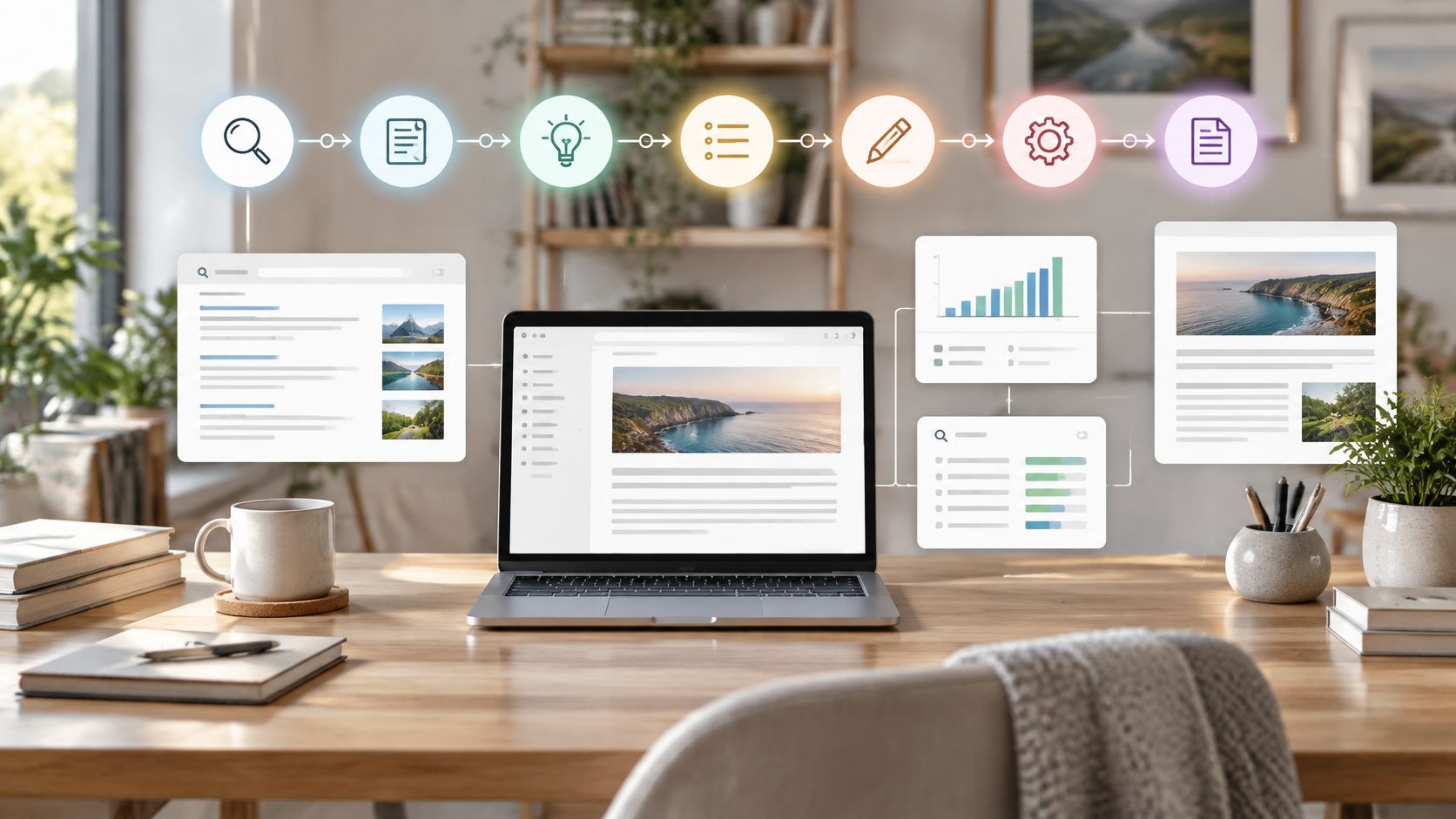
Nutze six phases, with an artifact from each feeding the next. Start with queries and URLs, not a domain-wide keyword total: Google's ranking systems guide explains that its systems evaluate individual pages while also using site-wide signals and classifiers.
That distinction changes the audit. You need to know whether you're competing against a dedicated template, a product page, or a broad guide before deciding what to change.
Competitor analysis phases, outputs and data sources
| Phase | Question it answers | Output you keep | Main data source |
|---|---|---|---|
| 1. Pick competitors | Who wins the same queries as me? | 3-5 domains with real keyword overlap | Domain overlap report |
| 2. Map keywords to pages | Which URL ranks for each query? | Keyword-to-URL sheet | Domain keywords and top pages |
| 3. Classify page gaps | Why does their page win? | Gap list tagged coverage, quality, technical or authority | SERP checker and manual page audit |
| 4. Audit backlinks | Which domains link to them but not to me? | Filtered outreach list | Backlink gap report |
| 5. Measure share and AI visibility | How much of the market and citations do they hold? | Traffic share and AI citation matrix | Traffic share and AI Overview checks |
| 6. Prioritize | What do I fix first? | Tagged backlog of act, monitor and skip gaps | Snapshots compared over 12 months |
Treat the competitor count as a manageable working sample, not a requirement to fill seats. Use the history window to distinguish sustained visibility from a spike.
Keep one decision sheet
Join the query, competing URL, your corresponding URL, gap classification, evidence, and proposed action. Inspect titles, headings, coverage, internal links, structured data, and backlink context rather than treating any isolated metric as the explanation.
I'd reserve the most time for classifying page gaps. Exports are quick; reading competing pages closely enough to distinguish missing coverage from weak execution takes judgment.
Praktische Regel: If a row doesn't identify a URL and a plausible action, keep it out of the implementation backlog.
How to Pick Competitors Worth Analyzing
Don't choose the biggest brand just because you recognize the name. You'll struggle to isolate the reason for its rankings when brand demand, distribution, and a substantial link profile differ from yours.
I'd pick three to five domains that repeatedly compete for commercially relevant queries. That's a working limit for a focused audit, not a measure of how many competitors exist.
Build the shortlist from search results
As a starting exercise, pull the top ten organic results for fifteen to twenty revenue-relevant queries, mixing informational and commercial searches. Count each domain's appearances across those result sets rather than relying on a tool's overall overlap score.
For a rough screening rule, investigate a domain appearing in about a fifth of your sampled SERPs. Don't make that a hard cutoff: a specialist winning your most valuable product queries may deserve attention despite appearing less frequently.
Keep these fields beside every observation:
- Country and device: Compare results from the market and device you target.
- Query family: Separate educational searches from comparisons, pricing, and purchase tasks.
- Competitor role: Distinguish competition for attention from competition for customers.
- Comparable page: Save the URL you can meaningfully benchmark, not just the domain.
Apply a keep-or-drop rule
| Competitor type | Working decision |
|---|---|
| Search rival | Keep when its guides or landing pages repeatedly win your queries |
| Business rival | Keep when you compete for the same buyer, but verify search overlap |
| Content rival | Keep when its maintained pages hold prominent positions for your topics |
| Aggregator | Drop from direct benchmarking; retain for learning result formats |
For marketplace businesses, separate shop-level competition from Google competition. Trendlytic's guide to research competitors on Etsy provides a focused companion workflow when you need to examine sellers inside that marketplace.
A new site needs a slightly different shortlist. If you have little ranking history, start from your intended buyer tasks rather than current keyword overlap. Keep forums and communities as content competitors when you need to understand the questions, objections, and language your future pages should address, even if you exclude those domains from traffic benchmarking.
How to Extract Keyword and Page Gaps
A keyword gap tells you where visibility differs. A page gap tells you whether to create, improve, consolidate, or reconnect a URL.
Use SemDash Domain Keywords, Keyword Gap, and URL-level mapping to assemble the exports in one workspace. Keep the raw export intact and do your filtering in a separate working tab so you can revisit exclusions.
Build the query-to-page map
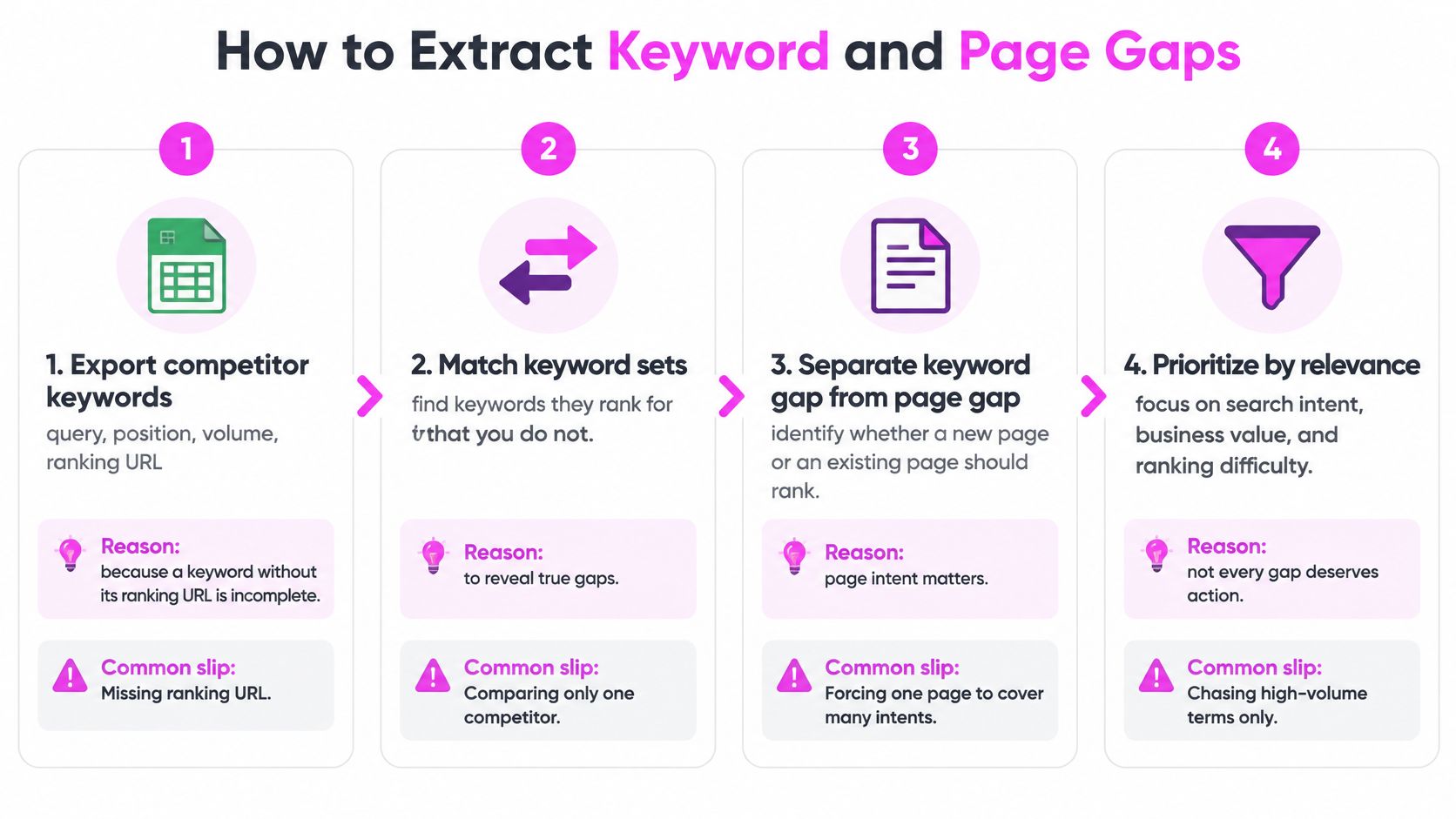
Export query, position, volume, and ranking URL. Include the market, device, and snapshot date so every observation has context. Don't stop at the highest-volume terms, such as the top fifty rows, because you'll discard useful specific-intent queries before inspecting them.
Remove noise before comparing. Exclude unrelated branded searches and move terms where you already hold a top-three position into a separate defense list. Don't delete relevant comparison queries merely because they contain another company's name.
Cluster by shared intent. Group queries that the same page could satisfy, then inspect whether the same URLs recur across their results. Word overlap alone can incorrectly merge a definition query with a buying comparison.
Open the live SERP. Record whether you need a guide, comparison, template, tool, or product page. A keyword label won't tell you whether users expect something downloadable or interactive.
Use this visual as a checkpoint before turning the export into assignments.
Diagnose the missing advantage
Compare the closest pages directly. Check useful depth, headings, examples, freshness, credentials, and internal-link paths. Apply Google's people-first content guidance rather than treating length or keyword repetition as quality.
Assign a primary gap. Use coverage when you lack the appropriate page, quality when your answer is weaker, technical when access or indexing prevents competition, and authority when comparable pages differ materially in relevant link support. Treat authority as a hypothesis, not the default explanation after a quick skim.
Choose the URL action. Specify a new URL, substantial update, redirect, or stronger internal links, then check for an existing page targeting that intent. Google's SEO Starter Guide explains how links support page discovery, which makes architecture part of the decision.
Say you find a competitor ranking for SEO competitor analysis template with a downloadable spreadsheet while you offer only a general guide. I'd classify that as a coverage hypothesis and consider a separate template URL, with a contextual link from the guide. Don't assume that extending the guide will satisfy the download task, and don't claim success until you've checked subsequent rankings and engagement.
For technical comparisons, distinguish visible enhancements from markup merely present in source code. Follow Google's structured-data guidance: validate eligible markup with the Rich Results Test, match it to visible content, and inspect accessibility before deployment.
How to Run a Backlink Gap Without Copying Risky Links
A competitor's referring-domain count isn't your outreach target. You need to understand why someone placed each relevant link, not reproduce everything you can export.
Inspect page-level links before turning referring domains into prospects.
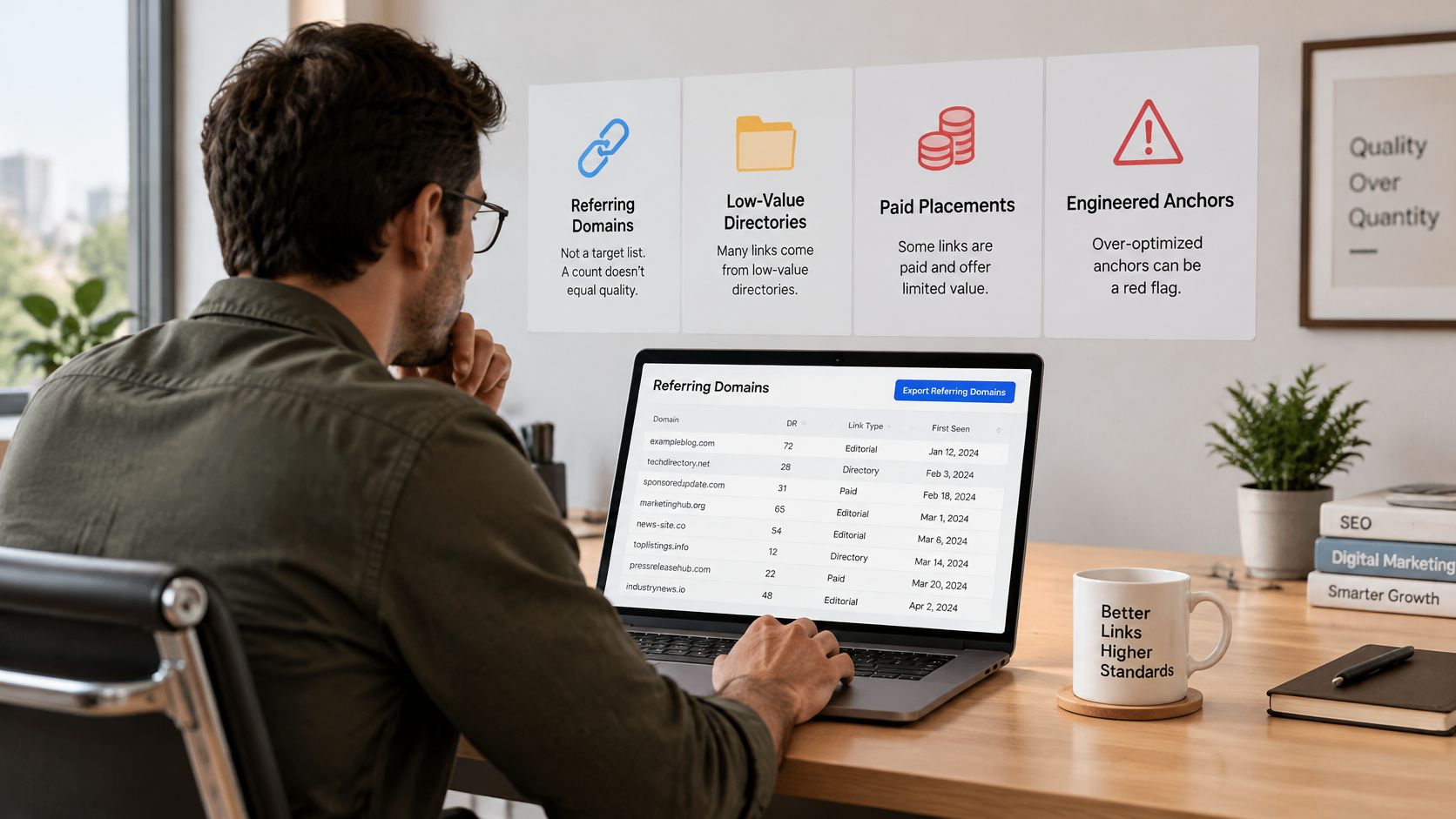
Google's spam policies define links created primarily to manipulate rankings as link spam and explicitly include buying or selling links for ranking purposes. Don't interpret a competitor's visibility as permission to copy questionable acquisition tactics.
Filter for editorial relevance
Export referring domains for competing money pages and supporting assets, not just homepages. Keep the source URL, destination URL, anchor, placement, and apparent reason for citation.
- Discard engineered placements: Remove paid ranking placements, link-only sites, and irrelevant directories. Don't automatically discard a legitimate industry association because its member listings resemble a directory.
- Group viable sources: Separate publishers, associations, research sources, resource pages, and industry blogs. Each group needs a different pitch.
- Inspect the paragraph: Look for an editor citing useful evidence, not a link inserted among unrelated businesses.
- Check shared sources: Prioritize relevant domains linking naturally to multiple competitors, then verify that your asset belongs in the same context.
Use a competitor backlink analysis workflow to keep prospect qualification separate from the raw export. The outreach list should be much shorter than the discovered-domain list.
A video walkthrough can complement the page-by-page inspection.
Pitch a specific contribution: original data, a usable template, or a comparison that corrects an outdated detail. If your page can't satisfy the linking page's reader need, don't send the request.
Keep the diagnostic evidence, not the tactic. Manipulative anchors may explain a suspicious profile, but they don't belong in your outreach instructions.
Don't assume removing spam links will restore lost ranking benefits. Build your recommendation around attainable editorial relevance, not a competitor's historical shortcuts.
How to Measure Traffic Share and AI Overview Visibility
In Pew Research Center's March 2025 browsing-panel study, users clicked a traditional result on 15% of visits without an AI summary, versus 8% when a summary appeared; users ended their browsing session on 26% of AI-summary pages versus 16% of conventional-result pages. Read those as observed associations, not proof of what will happen to your site.
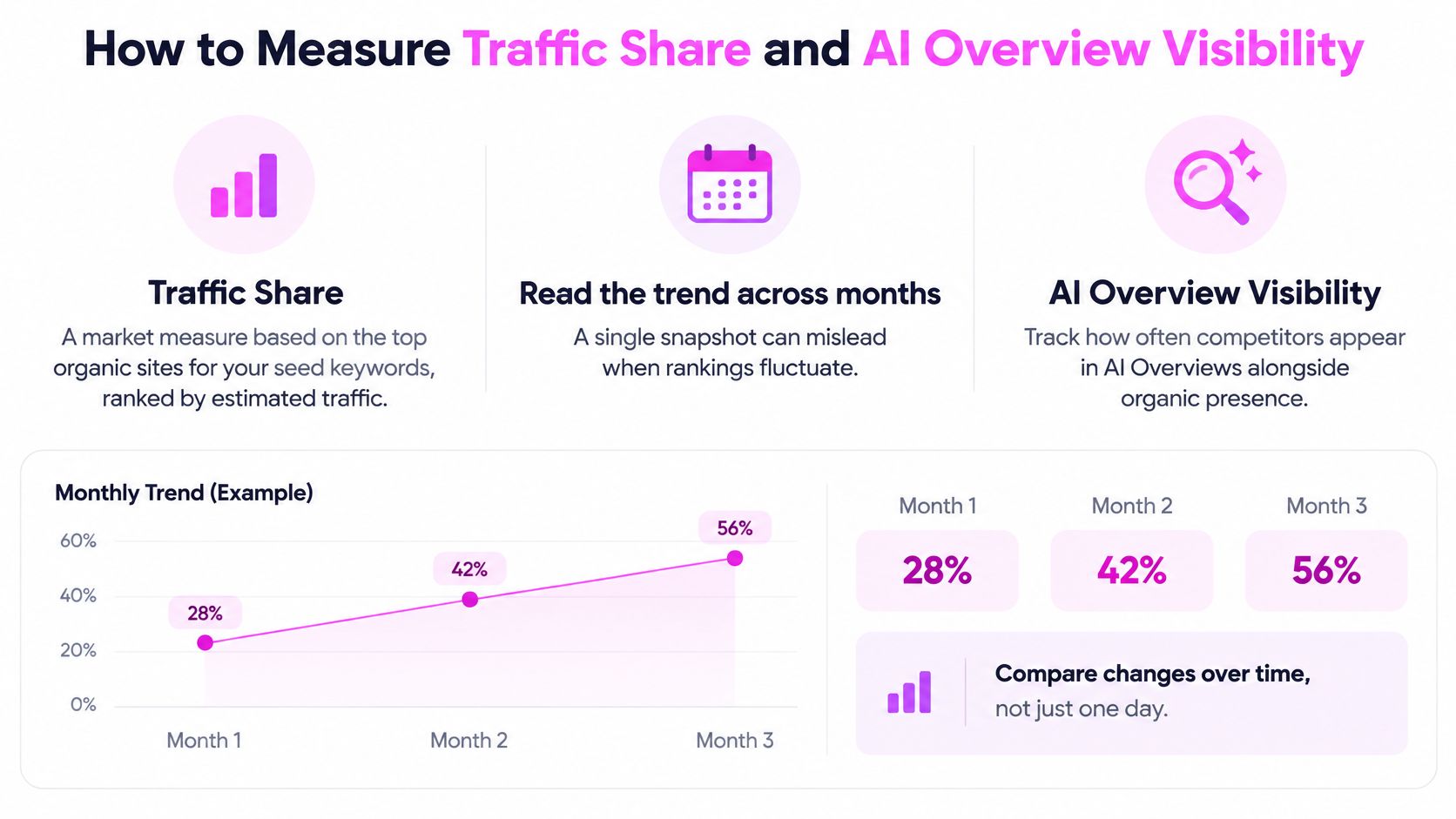
Measure Traffic-Anteil as estimated organic visibility across a fixed seed-keyword market. Keep the keyword set and estimation method consistent, and compare monthly trends rather than treating a competitor estimate as analytics access.
Use the visual below to keep market trends and citation visibility distinct.
Build separate visibility columns
For every query, save AI Overview presence, cited domains, exact cited URLs, organic positions, and answer intent. Record whether the cited URL and organically ranking URL are the same.
You can hold the leading organic position without a citation, or earn a citation from a lower-ranking page. Inspect the specific claim each source supports instead of assuming a citation represents endorsement of the whole page.
Competitor visibility tracking matrix
| Metrik | Where to get it | Warum es wichtig ist | Check frequency |
|---|---|---|---|
| Traffic-Anteil | Traffic share report for seed keywords, using a fixed top-site set | Shows estimated market gains or losses | Monatlich |
| Rank by URL | Keyword-to-URL export and SERP checker history | Shows which page holds each query and for how long | Monatlich |
| AI Overview presence | Live SERP check for each query | Identifies answer-heavy result layouts | Monthly, and after core updates |
| Cited domains and URLs | AI Overview citations per query | Identifies sources supporting the answer | Monatlich |
| Answer intent | Intent classification or manual SERP read | Separates informational, commercial and transactional gaps | Once per cluster, rechecking changes |
| Downstream conversions | Analytics for your landing pages | Connects your visibility to business outcomes | Quarterly |
Follow a consistent method to track AI Overviews, including saved observations rather than overwritten results. Don't limit the matrix to educational searches; include buying and comparison tasks.
A citation isn't guaranteed traffic, and you can't inspect a competitor's conversions from a public SERP. Use your own landing-page outcomes, flag attribution limits, and review those outcomes quarterly.
Common Mistakes That Skew Competitor Data
Treating volume as opportunity puts impressive-looking queries at the top of the backlog without checking whether you can satisfy them. Say you're evaluating a hypothetical query with ten thousand monthly searches, but the leading results are interactive tools and you plan to publish a guide. Open the live SERP and confirm the user task before counting that query as an actionable gap.
Mixing markets and devices produces false overlap. You can't use a competitor's US desktop position as a substitute for the UK mobile result you're targeting. Require country and device fields, then filter the sheet before comparing positions.
| Spreadsheet symptom | Wrong conclusion | Single check |
|---|---|---|
| Largest-volume gap always comes first | More searches means more opportunity | Match the winning page's task |
| Combined positions across markets | You face the same competition everywhere | Filter by country and device |
| “Add FAQ” with no supporting query | Copying structure improves relevance | Map each proposed section to a query |
Copying structure without understanding its purpose creates unnecessary sections. Before adopting a competitor's FAQ block, find the query or objection it answers and decide whether your reader needs that answer.
Don't assign a content change unless you can name the search need it serves.
Turn the Findings into a 30-Day Action Plan
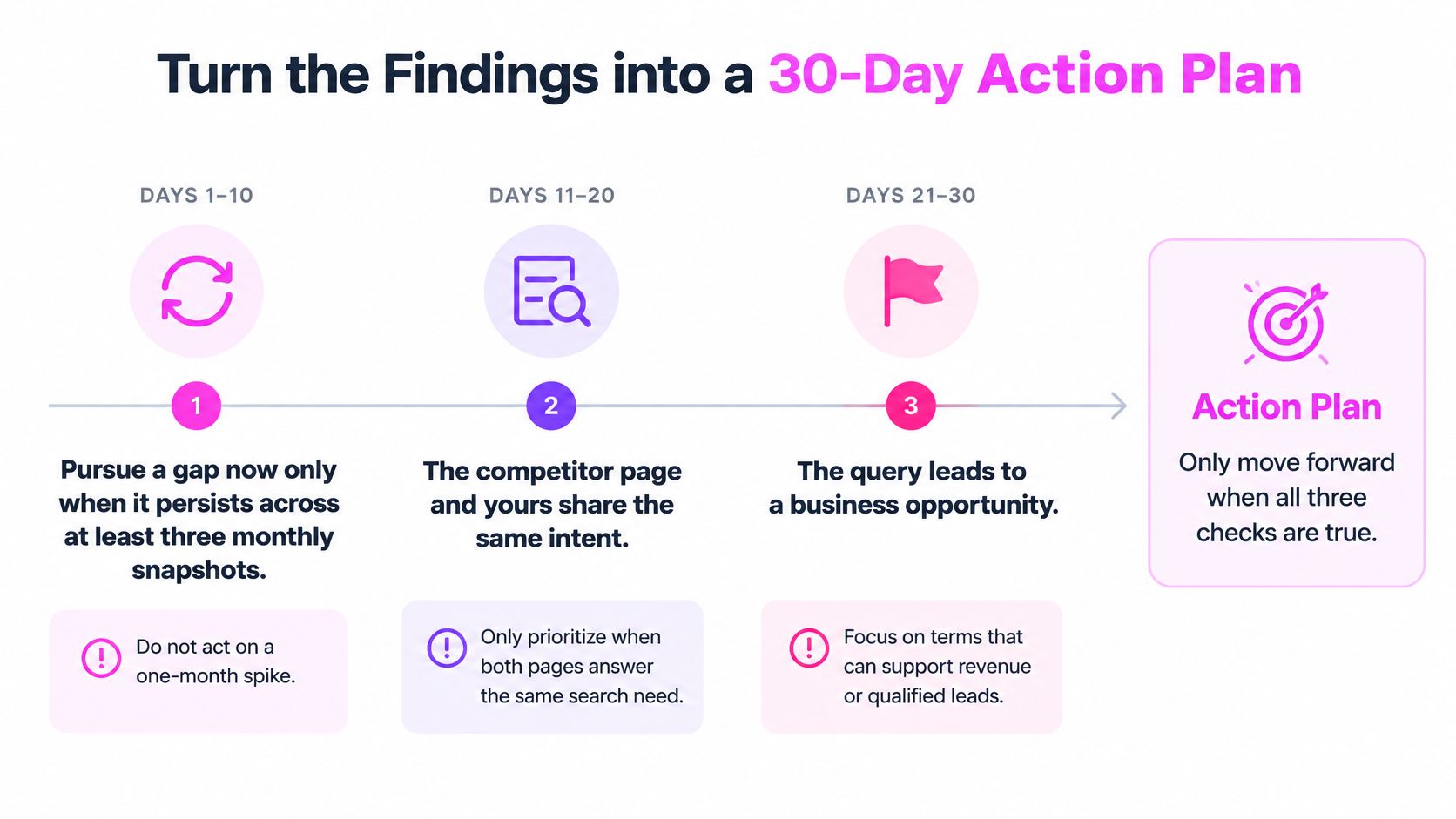
I'd pursue a gap now only when it persists across at least three monthly snapshots, matches your intended page's task, and supports a business opportunity. Use that as an investment rule, not a reason to postpone obvious accessibility fixes.
For context, the Semrush AI Overviews study reported coverage at 6.49% of queries in January 2025, 24.61% in July, and 15.69% in November. Don't commit a substantial rebuild solely because you encountered a favorable result layout today.
Decision rules for prioritizing competitor gaps
| Kriterium | Act now when | Monitor when | Skip when |
|---|---|---|---|
| Persistence | Gap holds across three or more monthly snapshots | Gap appears once or swings with AI features | Gap disappears within a month |
| Intent match | Both pages serve the same intent | Intent is mixed or shifting | Competing page serves a different task |
| Ranking page continuity | Same competitor URL holds the query for months | Ranking URL changes often | Several URLs rotate without a clear winner |
| Business value | Query leads to your product or buyer task | Informational query feeds a plausible funnel | Traffic has no commercial path |
| Link attainability | Relevant referring domains are reachable | Few relevant prospects exist | Only paid placements or irrelevant directories remain |
Use these checkpoints before assigning production work.
Schedule implementation and verification
- Week one: Fix confirmed technical issues and straightforward quality deficiencies on existing pages.
- Week two: Build or split pages for validated coverage gaps after checking intent overlap.
- Week three: Strengthen thin answers with relevant evidence, examples, and clearer explanations.
- Week four: Begin qualified outreach and rerun the traffic-share and citation matrix.
Keep owners, deployment dates, and crawl observations in the working sheet. After thirty days, verify implementation and early movement without treating the deadline as a promise of ranking gains.
We offer more than 20 SEO research tools, including Keyword Gap, Backlink Gap, Traffic Share, and Historical SERP, to help you turn competitor findings into URL-level decisions. Visit SemDash to get started for free, map your priority queries to competing pages, and build your first act, monitor, and skip backlog.