


Search intent is the goal behind a query, and it decides which type of page can rank for it.
You've got a keyword list, a promising search volume, and a draft that addresses the topic thoroughly. Then you open Google and find product categories where you planned an explainer, or comparisons where you planned a sales page. Before commissioning more content, answer a harder question: what task does the searcher expect this page to help complete?
When you ask what is search intent in SEO, don't stop at a category label. I'd treat that label as a working hypothesis, check it against the live results, and assign each distinct task to a clear page destination.
Inhaltsverzeichnis
- Search Intent Types and What Searchers Want
- How to Read Intent from the Live SERP
- Matching Intent to Page Formats
- Handling Mixed and Shifting Intent
- Four Misconceptions About Search Intent
- Confirm Intent Before You Brief Your Next Article
Search Intent Types and What Searchers Want
Say you're planning content for project management software. You could target someone learning how project management works, someone trying to log in to Asana, or someone ready to subscribe. You're working within the same topic, but you aren't serving the same need.
The classic framework separates informational, navigational, and transactional intent. The 2008 query-log study, which analyzed more than 1.5 million queries, established this three-class framework at scale. For content planning, I'd also separate commercial investigation, because comparing options requires a different experience from completing a purchase.
Search intent types and how they show up
| Intent type | What the searcher wants | Example query | Signal in the SERP |
|---|---|---|---|
| Informativ | Learn or understand something | how search intent works | Guides, definitions and featured snippets |
| Navigativ | Reach a specific site, brand or login | Asana login | The brand's own site ranks first |
| Transaktional | Complete an action such as buying or signing up | buy running shoes online | Product, category or checkout pages |
| Kommerzielle Recherche | Compare options before committing | best CRM for startups | Reviews, comparisons and listicles |
Separate the task from the topic
Use these signals as evidence, not promises about what every search will return. For a navigational query, you're checking whether Google consistently favors the intended destination. For a commercial query, you're checking whether the ranking pages help you evaluate alternatives rather than describe a product.
Transactional intent isn't limited to spending money. You might need to support a download, registration, booking, or contact request. The useful distinction is whether you're helping someone understand an action oder complete it.
Praktische Regel: Name the task in a verb phrase before choosing the page type: understand the concept, reach the login, compare providers, or book the service.
Don't confuse commercial investigation with an excuse to publish a promotional list. If you promise a comparison, give the reader criteria and meaningful differences. A sales pitch with competing product names inserted into headings doesn't fulfill that promise.
Before opening a draft, tag every target keyword with a provisional primary intent. Add a short task description beside the tag, because “commercial” alone won't tell your writer whether to produce a buyer's guide, a comparison, or a detailed review.
How to Read Intent from the Live SERP
Start with the search results page, or SERP, before deciding what to publish. You need to inspect what Google currently presents, then open the ranking pages to see how they deliver the answer.
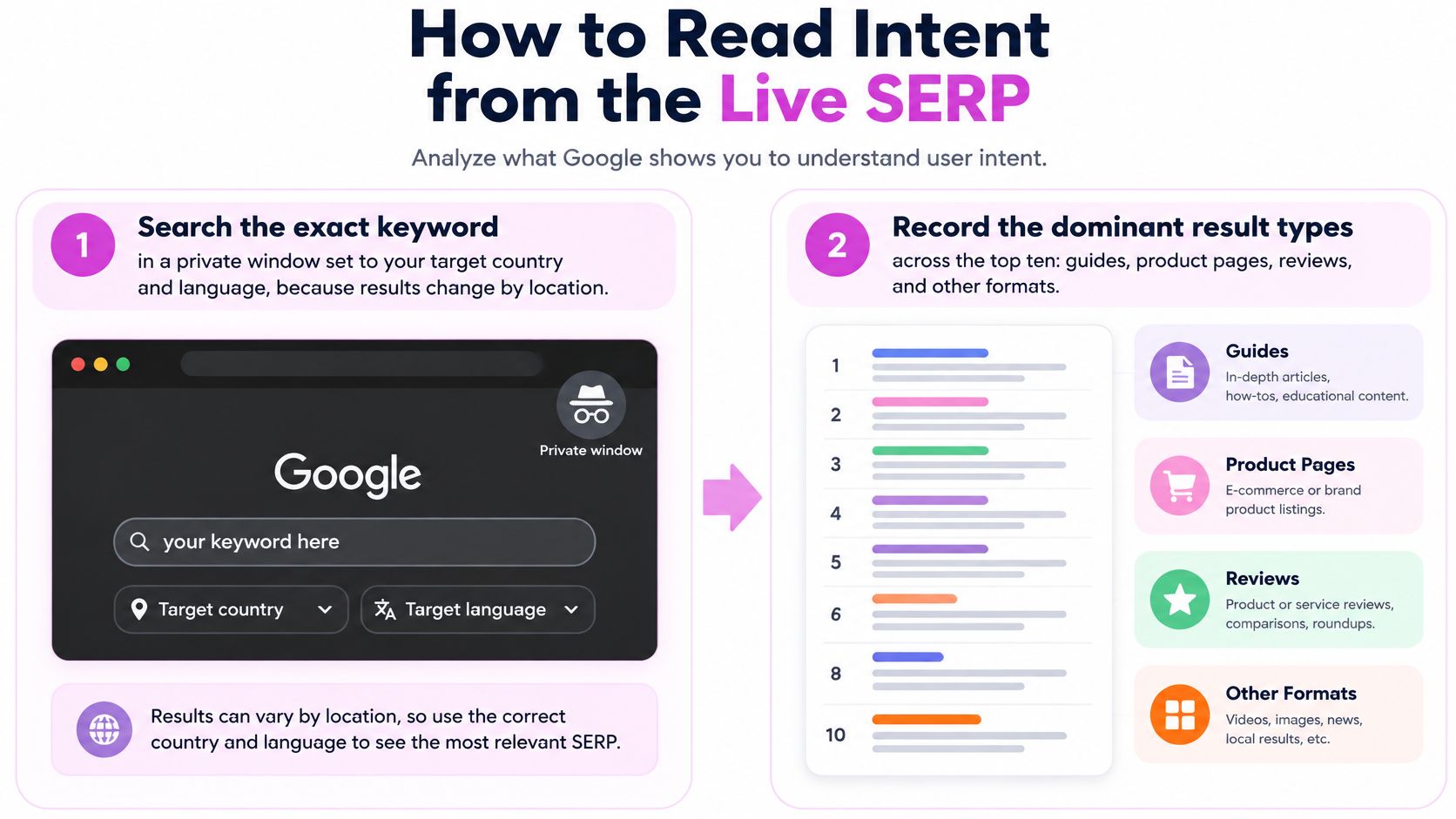
Use this visual as a reminder of the initial observation process.
Run the checks in order
Search the exact keyword. Use a private window and set the search location and language to your target market. Don't assume private browsing sets your country or removes every contextual influence; Google's ranking explanation identifies location, search history, and settings as contextual inputs.
Record the dominant result types. Inspect the top ten organic results and label each as a guide, definition, product page, category, comparison, or tool. Open ambiguous results, because a title containing “guide” might lead to a shopping category with a short editorial introduction.
Note the visible SERP features. Record featured snippets, People Also Ask, AI Overviews, shopping units, and local results, especially above the fold. Use these to identify supporting questions and competing ways to finish the task, not as instructions to reproduce every feature on your page.
Group keywords by the task. Give each cluster a primary intent and a specific outcome, such as comparing startup CRM options. Keep terms together when the expected experience overlaps, rather than grouping everything that shares a noun.
Map the cluster to a canonical destination. Check which URL currently ranks and assign the cluster to the page you want to own that task. Here, canonical means your preferred content destination; adding a canonical tag won't repair competing pages with poorly differentiated purposes.
Schedule a recheck. I'd use a three-to-six-month review cycle as a starting routine, with earlier checks after substantial ranking changes. Save the observed page types and URLs so you can distinguish a real format shift from a temporary position swap.
For a repeatable recording method, use the live SERP checker workflow. Keep a worksheet with the keyword, market, dominant format, primary task, secondary questions, preferred URL, and confidence level.
Keep uncertainty visible
In a study using real-world query logs, a supervised model classified search missions with 69% accuracy und einen 63% average F1 score, with F1 above 75% for informational and navigational missions. F1 combines precision and recall, so it helps you judge classification beyond a simple correct-or-incorrect total.
You shouldn't interpret those results as a performance benchmark for every intent tool. Use them as a reason to retain human review, especially for mixed queries that are harder to classify reliably.
Use the video alongside your worksheet when reviewing the process.
The order matters: observe the results, identify the task, then assign the label. Treat each classification as a probability, not a permanent fact.
Matching Intent to Page Formats
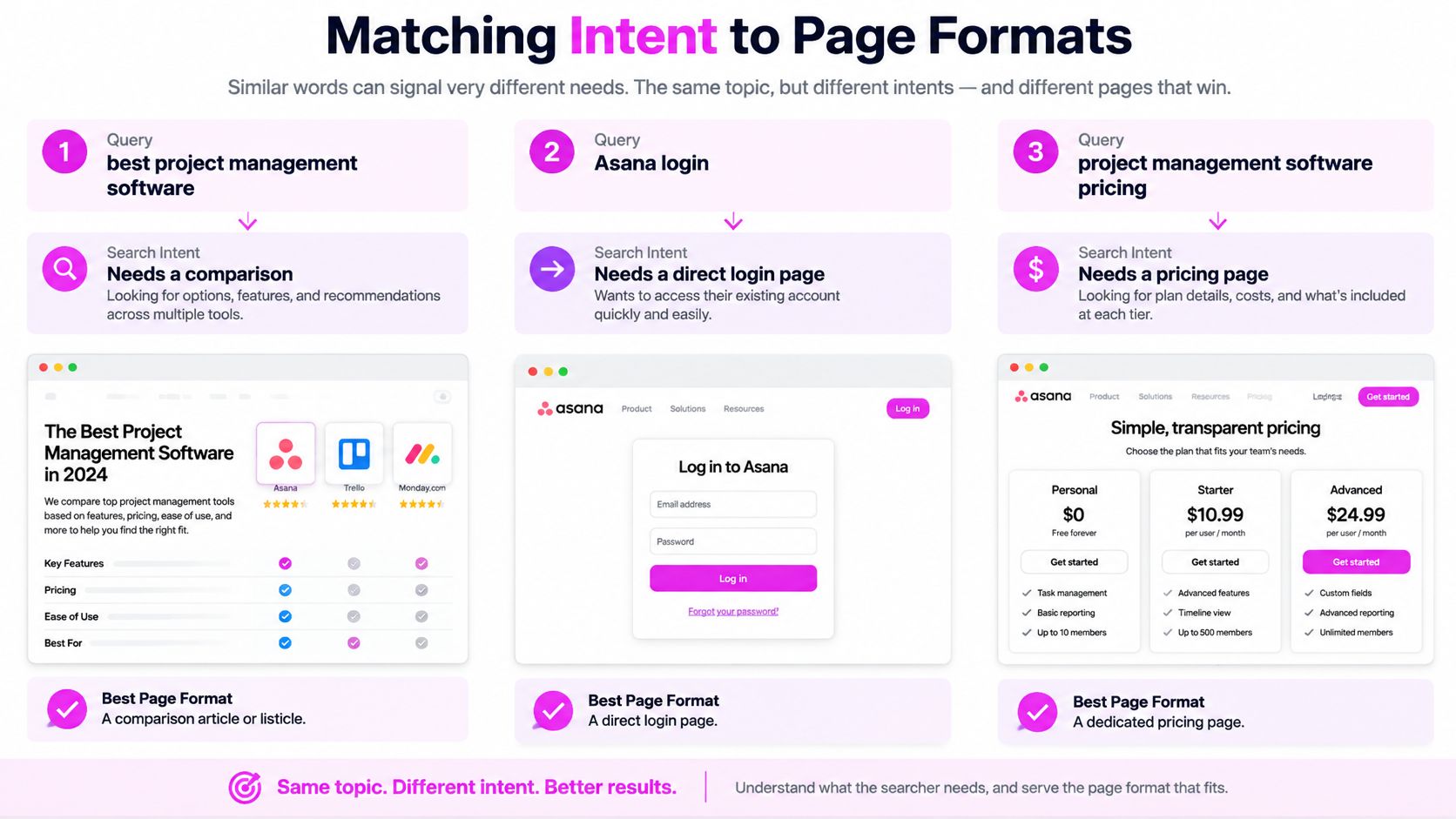
Take this project management query set as a planning exercise: best project management software, Asana login, und project management software pricing. You need a comparison for the first, a direct destination for the second, and a pricing experience for the third. Trying to serve all of them with a high-volume umbrella article would leave you without a convincing primary task.
In an analysis of more than 130,000 web queries, over 75% were classified as informational, while navigational and transactional queries accounted for about 12% each. That historical distribution gives you a reason to look beyond buy-now terms, not a publishing quota to copy.
Use the query set to compare the required destinations visually.
Specify the experience before the outline
Page format, required elements and common mistake by intent
| Intent | Page format | Must include | Häufiger Fehler |
|---|---|---|---|
| Informativ | Guide or explainer | Definition in the opening paragraph, worked examples, numbered steps | Padding the article with sales copy |
| Navigativ | Brand or destination page | Login link above the fold, official links, direct path to the destination | A long editorial that buries the link |
| Transaktional | Product, service or pricing page | Price, specifications, clear call to action, trust signals | Thin copy with no buying detail |
| Kommerzielle Recherche | Comparison or review | Criteria table, honest tradeoffs, who each option suits | A hidden winner with no stated criteria |
For a comparison, I'd define evaluation criteria before writing product descriptions. If you're comparing project management tools, explain how you assess collaboration, reporting, integrations, and onboarding. Don't announce a winner without showing which requirements make that choice appropriate.
For a pricing page, put the purchase conditions where you can find them easily. Explain what's included, how billing works, and what changes between packages. If you require a quote, state what determines the quote rather than pretending you offer a fixed public price.
For a login query, editorial depth is a distraction. If you don't own the destination, consider whether targeting that query serves any legitimate purpose for your business.
You don't need the longest page. You need the shortest reliable path to the promised outcome, with enough detail to make the decision safely.
Allocate pages around your market
Die multi-log intent analysis examined more than five million queries across three search engines and reported over 80% informationalmit roughly 10% each navigational and transactional; it also describes a 20,000-plus-query study in which intent distribution varied by topic by 15–24 percentage points. Use that variation to challenge blanket recommendations about how much educational or commercial content you need.
For an agency, you might separate an explainer about qualified leads, a comparison of prospecting methods, and a lead-generation service page. When you need implementation ideas for the prospecting task, the DMpro guide to agency prospecting provides a relevant companion resource. Keep that practical workflow separate from a service page whose main job is evaluating your offer.
Run a coverage check before adding more titles:
- Find missing destinations. Sort your keyword clusters by assigned page and flag clusters without a suitable URL.
- Find competing destinations. Flag pages assigned to the same task and decide whether to merge or differentiate them.
- Find incomplete experiences. Check whether each existing page contains the decision-making or action elements its format requires.
You can use historical percentages to frame opportunity. Choose the actual format from the keyword's current results and the task you can credibly serve.
Handling Mixed and Shifting Intent
Say you search for best CRM for startups. You begin by comparing options, then need to understand pricing, migration effort, and implementation before signing up. I'd plan for that progression without turning the comparison into an oversized pricing page and migration manual.
Nutze Google's Search Quality Evaluator Guidelines to sharpen ambiguous classifications: Wissen, Tun, Website, und Visit-in-person describe different tasks, and the guidance allows a query to carry more than one intent.
| Query | Task type | Primary intent | Page format |
|---|---|---|---|
| how to reset a router | Wissen | Informativ | Explanatory guide with numbered steps |
| reset my router | Tun | Task action | Short procedure or tool |
| Facebook marketplace | Website | Navigativ | Clear branded destination page |
| dentist near me | Visit-in-person | Local commercial | Location, hours, directions and service details |
Give the primary task priority
For a router reset query, inspect whether you need an explanation, a device-specific procedure, or direct access to an action. You can include context, but don't make someone read networking background before reaching the steps. For a local dental query, make location, services, opening hours, and booking access prominent instead of leading with a general dental-health essay.
You can fail by choosing the wrong interaction even when your information is accurate. If you publish a long article for a Do query where the useful result is a short tool or procedure, you've added work before the outcome. For a local task, you may lose the visit before anyone opens your article.
Tiebreaker: When the evidence conflicts, follow the task served by the top three results before following your hunch, then inspect the wider results for secondary needs.
Treat that as a practical starting rule, not permission to copy competitors or ignore an obviously mixed SERP.
Build a route to the next task
In its explanation of AI Overviews and AI Mode, Google describes query fan-out, where AI features can issue related searches across subtopics and data sources. Don't assume the visible wording captures the full scope of the question you're helping answer.
For the startup CRM comparison, provide a concise migration-effort column if setup difficulty affects the choice. Link to a detailed migration guide when you need procedural depth, and link to pricing when you're ready to evaluate costs.
Support the next intent without replacing the first. You should be able to understand the comparison independently and follow a clearly labeled route to implementation or purchase.
Four Misconceptions About Search Intent
All four of these mistakes trace back to one habit: treating intent as a label you assign to a phrase once, instead of a task you read from the live SERP and map to a single URL. The correction in each case is the same evidence, applied at a different point in the workflow.
Modifiers decide the intent
You can use how, best, und buy to form an initial hypothesis. You can't use them to override the visible results.
If your "best" query returns practical how-to guides rather than product roundups, inspect what you're being asked to help choose. You may need to explain a method rather than recommend a vendor. The same modifier can also signal different tasks in different niches, so a label carried over from another project still needs checking against this SERP.
Test: Remove your assigned label from the worksheet and classify the ranking pages without reading the keyword modifier. If you reach a different conclusion, revisit the proposed format.
A keyword keeps the same intent forever
An intent label is a snapshot of the current SERP, not an evergreen property of a phrase. Revisit your plan when you see different result formats, new purchasing options, or a different set of questions around the topic.
Intent also shifts within one query journey. The searcher comparing options this week may be searching for implementation help next week, and those are two separate tasks that deserve two separate destinations rather than one page stretched to cover both.
Test: Compare your saved SERP notes with the current results. If you planned an explainer but now see mostly comparisons, decide whether to reposition the existing page or create a distinct destination.
Intent percentages are universal
You can't turn a broad historical query distribution into a content allocation rule for your niche. Your branded support queries, local searches, and product evaluation terms may require a very different mix.
Test: Audit your own clusters by task and business relevance. Prioritize valuable unmet needs rather than trying to achieve an informational-to-transactional ratio.
An AI answer changes the click decision
In Pew Research Center's March 2025 study, about 18% of Google searches produced an AI-generated summary, and users clicked traditional result links less often on pages containing one. Google separately describes more exposed links and potentially higher-quality referral clicks in its AI Overview guidance, but you shouldn't equate better-qualified visits with more visits.
Separate your objectives:
- Answer visibility. Make your explanation clear enough to understand without surrounding sales language.
- Source citation. Provide evidence worth attributing, such as a documented method or original findings.
- Website conversion. Give a continuing visitor something useful to do or evaluate.
If you publish only a paraphrase of the generated summary, you provide little reason to visit and no distinctive evidence to cite. You can't guarantee either outcome by adding headings or FAQs.
Before approving the page, ask: what does this page offer that the answer box does not? Look for a working tool, original data, a usable side-by-side comparison, or implementation detail.
Confirm Intent Before You Brief Your Next Article
Choose a cluster you're considering for publication, not an easy example with an obvious answer. I'd prioritize a commercially relevant cluster where you're uncertain whether to update an existing page or commission a new one.
Your deliverable should be a defensible page decision. You need to explain the task, the format, the destination, and the distinct value before asking a writer to build an outline.
Use a pre-brief checklist
Read the cluster's live SERP. Inspect the actual ranking pages rather than relying on modifiers or an exported label. Record enough evidence that another strategist can understand why you chose the format.
Name primary and secondary intents. State the main task plainly and use People Also Ask to identify potential supporting questions. Don't include every related question automatically; select those that help you complete the primary task.
Choose a canonical URL and format. Nutze Page format, required elements and common mistake by intent to specify the destination. Decide whether you need a new page, a substantial update, or a consolidation before drafting.
Define the reason to visit. Identify the asset you'll provide beyond a basic answer: a comparison framework, original evidence, a tool, or detailed implementation guidance. If you can't name it, reconsider whether the proposed article deserves the budget.
Confirm the ranking-page match. Check whether the page currently appearing for the cluster matches your intended destination. Flag mismatches for diagnosis rather than assuming you need another article.
Record the decision, not just the label
Use an SEO content brief example to turn those decisions into instructions your writer can execute. Include the primary task, required format, supporting questions, evidence requirements, internal destinations, and material you deliberately won't cover.
In SemDash, we support this routine by classifying keyword intent and checking live results. Treat the classification as a starting point, verify uncertain cases manually, and remember that no tool guarantees rankings or traffic.
Approve the brief only when you can complete this sentence: This page helps the reader accomplish this task, in this format, at this URL. If you can't, resolve the page strategy before spending the writing budget.
We offer keyword intent classification, live SERP analysis, and keyword-to-URL mapping to help you choose the right destination before drafting. Visit SemDash, inspect a priority keyword cluster, and compare the current results with the page you plan to publish or update.