%20(1)-B86R08ZzwhPzS6UZbG3mSxRWPCwGwn.png)


Most SEO content brief examples teach the wrong lesson. They present a polished spreadsheet with a target keyword, a word count, several headings, and a tone note, then imply that completing those fields will produce a rankable page. That approach fails when the SERP is crowded, the writer skims the document, or an AI-generated brief invents a competitor that doesn't exist.
I've shipped enough briefs to know that the neatest template isn't usually the most useful one. The working document needs to explain why this page deserves to exist, which competing formats it must overcome, what the writer can leave out, and how the page can earn visibility beyond conventional blue links. Organic search remains a major commercial channel. A 2025 industry compilation attributes 44.6% of B2B revenue to organic search, while also reporting that topic-grouped content drives about 30% more organic traffic and keeps rankings 2.5 times longer than standalone posts (industry compilation on content SEO statistics).
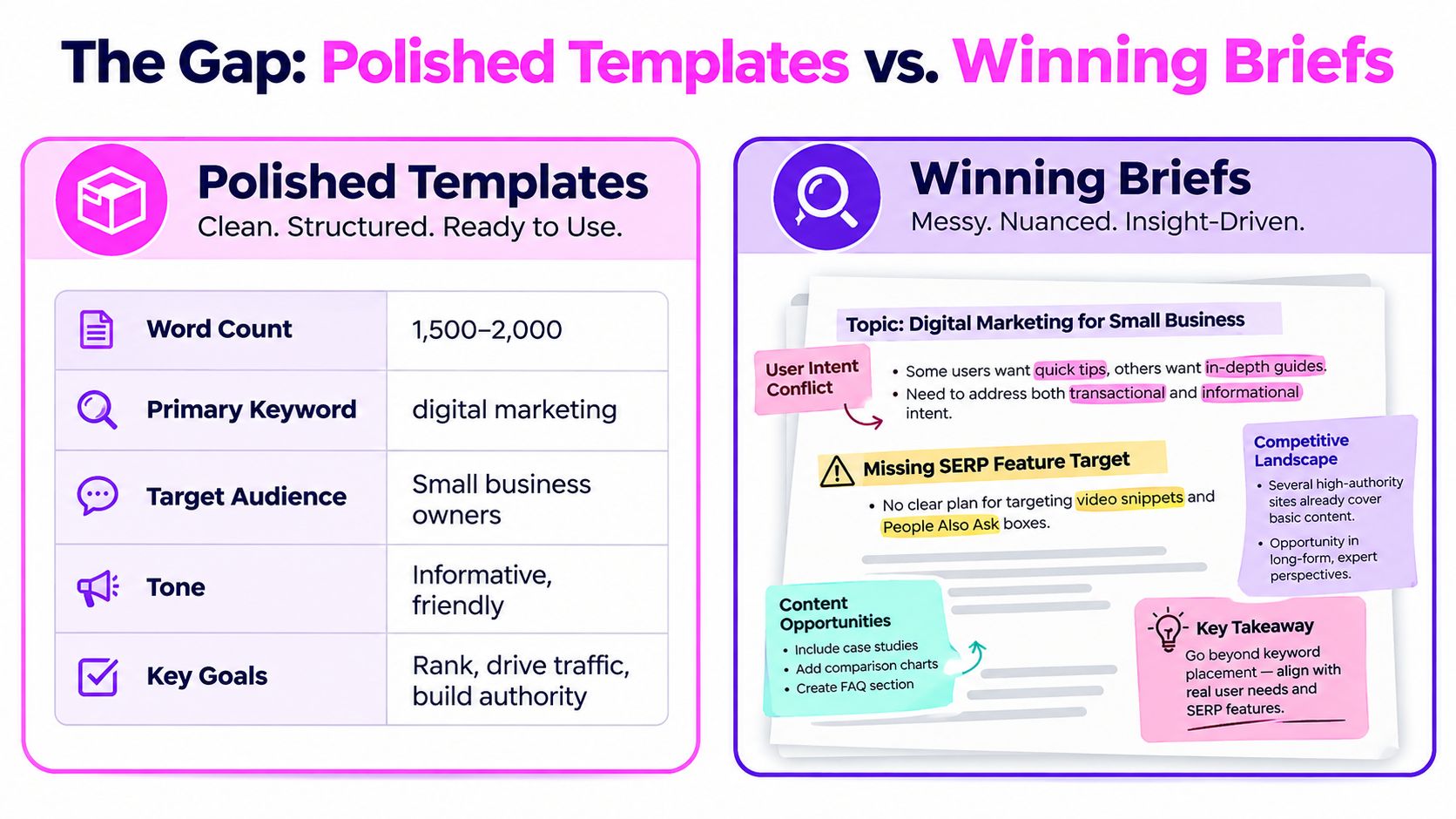
This article uses a real annotated brief for the query “SEO content brief example.” I'll show what belongs in each field, what gets ignored, how I turn live SERP observations into editorial decisions, and where AI assistance helps or creates cleanup work. If you want a complementary perspective on readable, search-focused drafting, Lumi Humanizer's SEO optimization guidance is useful because it connects optimization with the quality of the finished writing.
A brief isn't a checklist. It's a ranking decision written down before anyone spends hours drafting.
Inhaltsverzeichnis
- Why Most SEO Content Brief Examples Miss the Point
- The Core Fields Every SEO Content Brief Needs
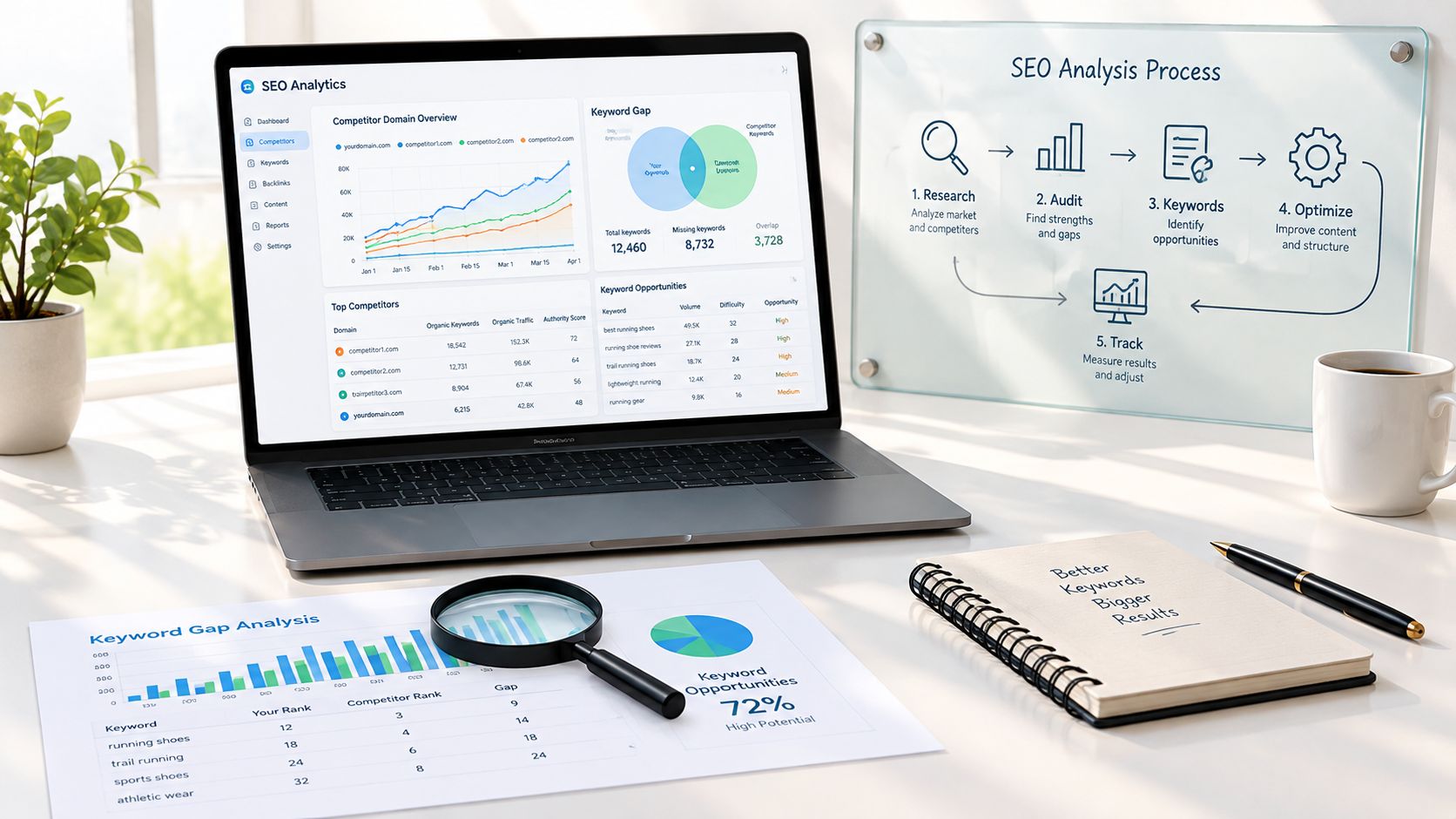
- How to Run the SERP Analysis That Powers the Brief
- Building the Header Outline From the SERP, Not Guesswork
- Matching Intent to the Right Brief Structure
- What Writers Actually Do With Your Brief
- Briefing for AI Overviews and SERP Features in 2026
- Fields to Cut or Merge So Writers Trust the Brief
- Generating a Draft Brief With AI Without Losing Accuracy
- Quick-Reference Checklist and Cross-Links
Why Most SEO Content Brief Examples Miss the Point
The popular advice says to start with a keyword and fill in the blanks. I start somewhere else: I inspect the pages already winning and ask whether our proposed page has a credible reason to compete.
That distinction matters because a keyword alone doesn't tell a writer whether the SERP favors a template, a tutorial, a tool page, a comparison, or a first-person teardown. It also doesn't reveal whether searchers want a downloadable document, an annotated example, a definition, or a product recommendation. A page can use the target phrase naturally and still miss the job behind the query.
The clean-template problem
Most public examples include fields such as:
- Primary keyword: One phrase copied into the title and headings.
- Word count: A fixed target with no explanation of coverage.
- Tone: A few vague adjectives, often “helpful” and “professional.”
- Outline: Headers brainstormed before anyone reviews the live results.
Those fields aren't useless, but they're incomplete. A first-page result for this topic averages 1,447 words, according to the same industry compilation, which suggests that a brief should define coverage and evidence rather than impose length for its own sake (content SEO statistics). The writer needs to know which topics are essential, which gaps create differentiation, and which sections would dilute the page.
Praktische Regel: If a writer can't explain the page's angle after reading the first part of the brief, the document is organized around SEO inputs instead of editorial judgment.
The other failure is operational. Writers don't read every field with equal attention. They usually look at the title, intent, audience, angle, and outline first. They skim keywords and links. They ignore long competitor dumps, repeated instructions, and AI-written commentary that doesn't tell them what to do.
A useful brief therefore has two jobs. It translates search evidence into production instructions, and it makes the most consequential decisions impossible to miss. That's why I treat the document as a search-market blueprint, not a form to complete.
The Core Fields Every SEO Content Brief Needs
I put the decision-making fields first, because the writer should understand the page before seeing supporting detail. For this example, the working title is “SEO Content Brief Example That Actually Ranks in 2026.” The format is an annotated practitioner guide, not a generic definition or a list of templates.
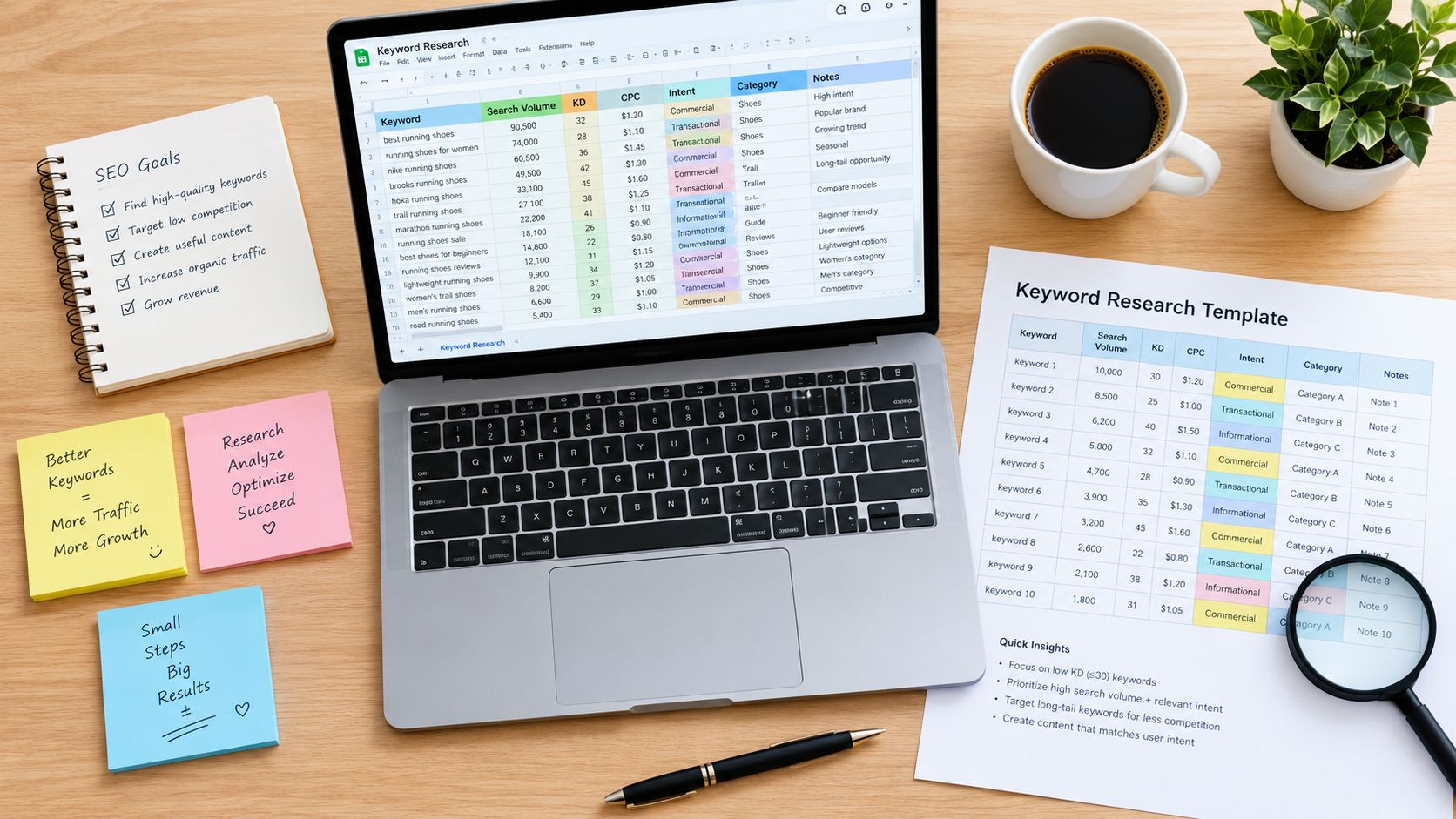
The primary query is SEO content brief example. Secondary coverage belongs in clusters, not a forced keyword inventory. Relevant clusters include content brief fields, SERP analysis, search intent, header outlines, AI Overviews, featured snippets, internal links, and competitor gaps. I don't tell the writer to insert every phrase. I tell them which concepts the page must explain naturally.
The intent classification is commercial investigation with informational overlap. The reader wants to learn how to build a brief, but they may also be evaluating templates, workflows, or software. The audience is an SEO lead, content strategist, agency operator, or experienced writer. The reading level should stay practical and clear, with terminology explained when it affects a decision.
What belongs in the working document
The brief also records the SERP blockers, top-page observations, mandatory outline, link targets, CTA, voice anchors, and metadata. A blocker isn't merely a screenshot. It says what competes for attention, such as an AI Overview, a featured snippet, a People Also Ask box, a Reddit result, or a video carousel.
The outline separates mandatory coverage from differentiating coverage. Internal links include suggested anchor text, while external references support claims or provide useful context. The CTA belongs to the page goal, not to a generic “learn more” instruction.
| Feld | What it contains | Warum es wichtig ist |
|---|---|---|
| Working title | Topic, format, and editorial promise | Prevents a generic page from drifting into a different format |
| Keyword clusters | Primary query plus related concepts | Guides topical coverage without encouraging keyword stuffing |
| Search intent | Informational, navigational, commercial, or transactional classification | Determines the page structure and conversion path |
| Audience | Role, knowledge level, and immediate problem | Controls examples, terminology, and depth |
| SERP blockers | Features and competing formats that absorb attention | Shows what the page must answer or target |
| Top-page summary | Patterns, strengths, and gaps across ranking pages | Turns observation into editorial direction |
| Header outline | Required H2s, optional H3s, and rationale | Gives the writer a usable path without scripting every sentence |
| Link targets | Internal destinations, anchor text, and external references | Connects the asset to site architecture and evidence |
| CTA | Specific next action aligned with intent | Prevents an informational page from ending with an irrelevant sales pitch |
| Voice anchors | A few concrete writing principles | Keeps the draft consistent without a long style essay |
| Meta elements | Title tag, meta description, image rules, and schema notes | Makes optimization testable during editing |
I don't use a “must-include keywords” field as a dumping ground. It creates awkward prose and teaches writers to satisfy a list instead of answering a user. I replace it with must-answer questions, concept clusters, and a short priority order.
Technical requirements should be explicit. The brief specifies H1, H2, and H3 hierarchy, title and meta description guidance, alt text, appropriate schema, target depth based on the live SERP, internal references, external sources, and the CTA. Guidance from Content Brief's SEO practices supports this intent-first approach, especially the use of recurring SERP headings, differentiators, and specific internal-link anchors.
How to Run the SERP Analysis That Powers the Brief
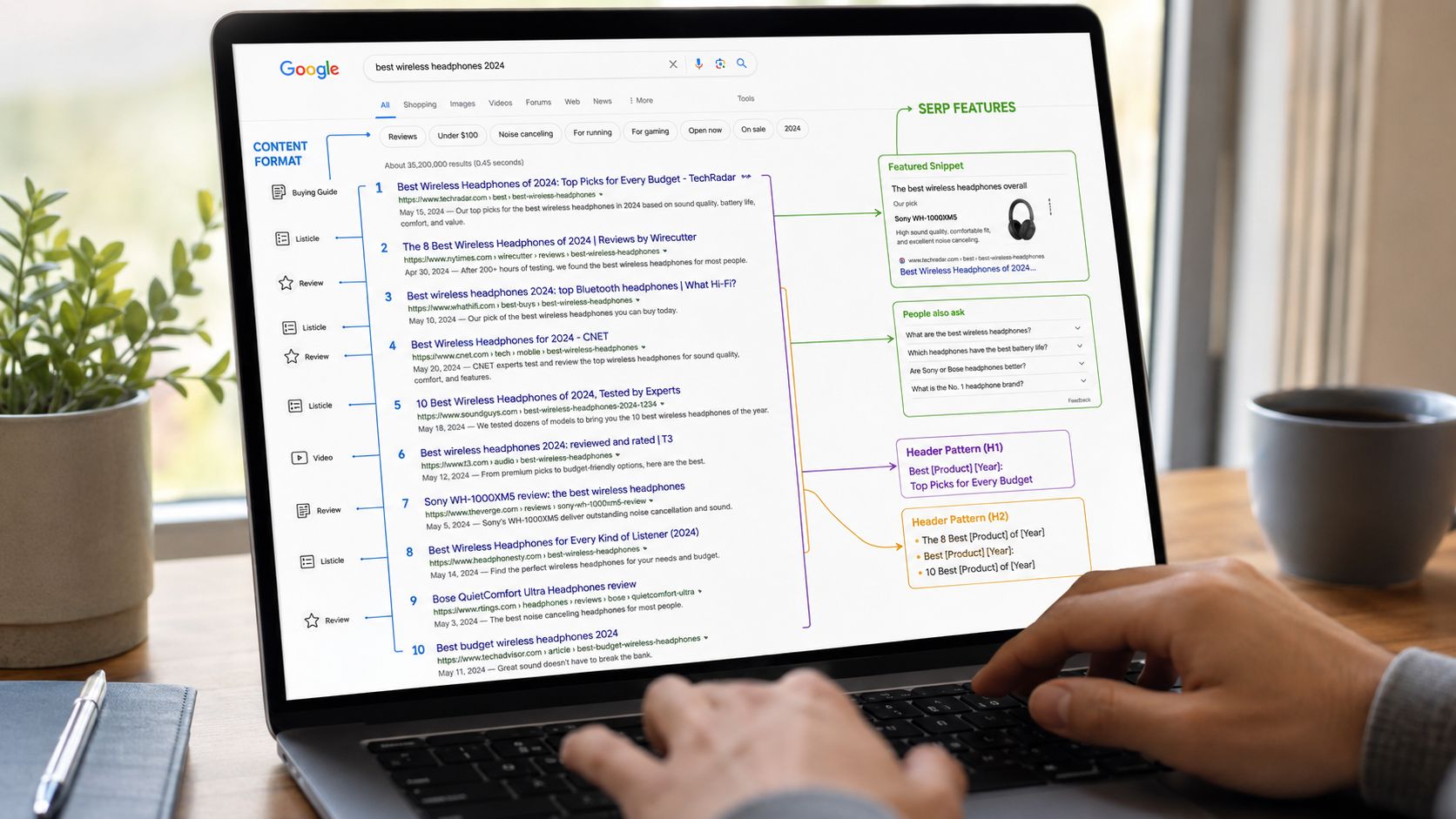
I open the live results before drafting the outline. For this query, I review the top 5 to 10 results, record the format of each page, and write a short note explaining why it appears to satisfy the searcher. The number of results is a practical review range recommended in current SEO brief guidance (SERP analysis workflow).
The result set can include agency articles, downloadable templates, content-optimization software pages, and educational guides. That mix signals a crowded SERP with mixed expectations. I don't average those formats together. I identify the dominant task first, then decide whether the proposed page should follow the dominant format or win by serving an underserved version of the same task.
The notes I actually keep
For each ranking page, I log:
- Format: Template, tutorial, tool page, checklist, or hybrid.
- Intent fit: What job the page appears to complete.
- Header recurrence: Topics repeated across competing pages.
- Feature exposure: Featured snippets, People Also Ask, videos, knowledge panels, or AI-generated result features.
- Weakness: Missing detail, generic advice, poor examples, outdated framing, or no decision rule.
- Opportunity: The specific angle our page can own without straying from the query.
I also record blockers that can absorb clicks before a user reaches an organic result. A Reddit discussion may capture experience-based questions. A YouTube carousel may satisfy readers who want a walkthrough. A featured snippet may answer a narrow definition. An AI Overview can combine several sources and reduce the need to open a conventional result.
The output isn't “competitors use H2s about intent.” The output is a directive such as: “Explain intent classification with a mixed-intent example, then show which brief fields change.” That sentence can guide a writer. A copied screenshot can't.
Die SemDash SERP analysis guide is a useful reference for turning result-page observations into structured competitive notes. In practice, I abandon a keyword when the SERP's dominant job conflicts with the page we can credibly produce. If the fit is close but the results are generic, I sharpen the angle and make the differentiation explicit.
Building the Header Outline From the SERP, Not Guesswork
I build the outline in three passes. First, I cluster the top-ranking pages by subtopic. Second, I flag the subjects that appear in 70% or more of those pages as mandatory coverage, following the planning rule defined for this brief. Third, I look for gaps that are useful and relevant, rather than adding novelty for its own sake.
For this article, SERP analysis methodology is mandatory because a writer needs to understand how the brief was built, not just copy the final fields. AI Overview formatting is a differentiator because many conventional examples stop at blue-link optimization. A crowded SERP gives us permission to add that angle only because it remains connected to the reader's underlying job.
The outline and its rationale
| Header | SERP Signal | Type |
|---|---|---|
| Why Most SEO Content Brief Examples Miss the Point | Template pages commonly explain fields without editorial trade-offs | Mandatory framing |
| The Core Fields Every SEO Content Brief Needs | Brief pages repeatedly cover keywords, intent, audience, outline, links, and metadata | Mandatory H2 |
| How to Run the SERP Analysis That Powers the Brief | Ranking pages and current guidance emphasize live result inspection | Mandatory H2 |
| Building the Header Outline From the SERP, Not Guesswork | Header patterns recur across practical SEO guidance | Mandatory H2 |
| Matching Intent to the Right Brief Structure | Intent determines format and conversion path | Mandatory H2 |
| What Writers Actually Do With Your Brief | Operational usability is underexplained in checklist-style examples | Differentiator H2 |
| Briefing for AI Overviews and SERP Features in 2026 | Feature targeting and citation planning add a current strategic angle | Differentiator H2 |
| Fields to Cut or Merge So Writers Trust the Brief | Most examples don't discuss field fatigue or document trust | Differentiator H2 |
I keep secondary H3s flexible. A writer may place “SERP blockers” before “competitor gaps” if the explanation reads more naturally. I care about coverage and logic, not preserving an arbitrary sequence.
Headers should be specific enough to communicate the answer. Question formats can help when a section directly answers a query that may be eligible for a featured snippet, but I don't turn every heading into a question. The SEO header tag guide for content strategists is helpful when deciding how much meaning a heading should carry.
Editorial boundary: The brief should define the destination and the required stops. It shouldn't dictate every turn of the sentence.
Matching Intent to the Right Brief Structure
I classify the target query before selecting the format. The four practical buckets are informational, navigational, commercial, und transactional, and the classification changes more than the introduction.
This example is commercial investigation with informational overlap. The reader needs instruction, but also wants to compare approaches and decide which workflow or tool fits. That's why the structure includes trade-offs, “best for” logic, and an annotated working document, while avoiding a product-led pricing table.
| Intent Type | Emphasized Fields | Added Fields | Dropped Fields |
|---|---|---|---|
| Informativ | Questions, depth, sources, explanatory outline | Expert perspective, evidence plan, definitions | Aggressive comparison and sales-stage CTA |
| Navigativ | Brand or destination clarity | Brand references, destination links | Broad educational detours |
| Commercial | Alternatives, evaluation criteria, differentiators | Comparison angle, “best for” guidance, proof requirements | Unrelated beginner material |
| Transaktional | Product action, friction removal, conversion path | Product schema where appropriate, decision CTA, implementation details | Broad competitor education |
For a query such as “buy Ahrefs subscription,” I'd move the brief toward a decision-stage CTA, product details, and appropriate structured-data requirements. For a purely informational query, I'd reduce competitive comparison and increase explanatory depth, source links, and first-hand guidance.
When the SERP shows mixed signals, I choose the primary intent by asking which job the majority of ranking pages complete. I treat the secondary intent as a supporting layer only when it improves that job. If the comparison content overwhelms an instructional query, the brief has probably drifted.
What Writers Actually Do With Your Brief
When this brief reaches a writer's inbox, they don't begin with the keyword cluster. They read the working title, intent, audience, target depth, and one-paragraph angle. Those fields answer the first question every writer has: What am I making, and why is this version worth producing?
Next, they skim the outline and mandatory coverage. They check internal links and CTA direction while drafting, but they rarely study a complete competitor list unless each URL includes a useful observation. A tone-and-voice paragraph longer than 150 words is routinely skimmed because it takes longer to parse than the actual instruction requires.
Where briefs create friction
I've seen briefs fail in predictable ways:
- Keyword overload: A list of 30 LSI variations makes the writer second-guess natural language instead of prioritizing concepts.
- Screenshot dumping: Raw Ahrefs or Google screenshots show activity but don't explain the editorial consequence.
- Intent contradiction: The brief labels a query commercial, then asks for a broad encyclopedia-style article with no evaluation section.
- Unusable links: Internal URLs appear without anchor text or a reason to include them.
- False precision: A word count appears as a requirement even though nobody has tied it to the topic's coverage.
The writer doesn't need every observation I made. They need the conclusion from those observations. I convert raw research into three to five written directives, such as “show the complete brief before explaining each field” or “treat AI citation planning as an extension of evidence quality, not a separate content type.”
I'd improve this example by moving the angle to the first screen, separating keyword priorities into primary and supporting concepts, and reducing competitor notes to the few pages that influence our structure. A brief earns trust when the writer can use it without translating it first.
Briefing for AI Overviews and SERP Features in 2026
I don't brief for AI Overviews by sprinkling extra keywords into an article. I add fields that make important answers clear, attributable, and easy to evaluate.
The example brief carries a quoted-answer block for the definition section. The writer prepares a concise answer of 40 to 60 words, then expands it with explanation and practical detail. That block isn't a promise of inclusion. It gives the page a clean answer unit that can serve readers and clarify the page's central definition.
The second field is a schema plan. I mark Article, FAQPage, oder HowTo only when the page supports that format and the implementation is appropriate. The third is a citation source list, with the top authoritative URLs the writer should consult and link first. The source list matters more than an arbitrary length target because a page making unsupported claims gives both readers and answer systems less reason to trust it.
| Brief Field | SERP Feature Targeted | Writer Action |
|---|---|---|
| Quoted-answer block | Featured snippets and AI-generated summaries | Place a direct answer immediately beneath the relevant header |
| PAA question set | Die Leute fragen auch | Answer recurring questions in distinct, useful sections |
| Schema plan | Rich-result eligibility and machine-readable structure | Follow the specified type only when the content qualifies |
| Citation source list | AI citations and evidence evaluation | Verify claims and link to authoritative references |
| Feature snapshot | Current SERP layout | Match the format without copying competing language |
| Visibility metric | AI Overview inclusion | Track citations and mentioned URLs separately from blue-link positions |
For informational queries, I usually prioritize answer blocks, PAA coverage, and evidence. Commercial queries need clearer comparison language and proof, because an answer feature may inform the reader without completing the evaluation. I document the exact outline location for each liftable answer rather than leaving the writer to scatter short definitions throughout the page.
Google's featured-result behavior changes with query context, so this guide to Google featured snippets is useful as a tactical reference. I track AI Overview inclusion as its own visibility signal, not as a decorative add-on to traditional rankings.
Fields to Cut or Merge So Writers Trust the Brief
A longer brief can look more rigorous while becoming less useful. Every field a writer skips teaches them to skip the next one, so I remove anything that doesn't change a drafting decision.
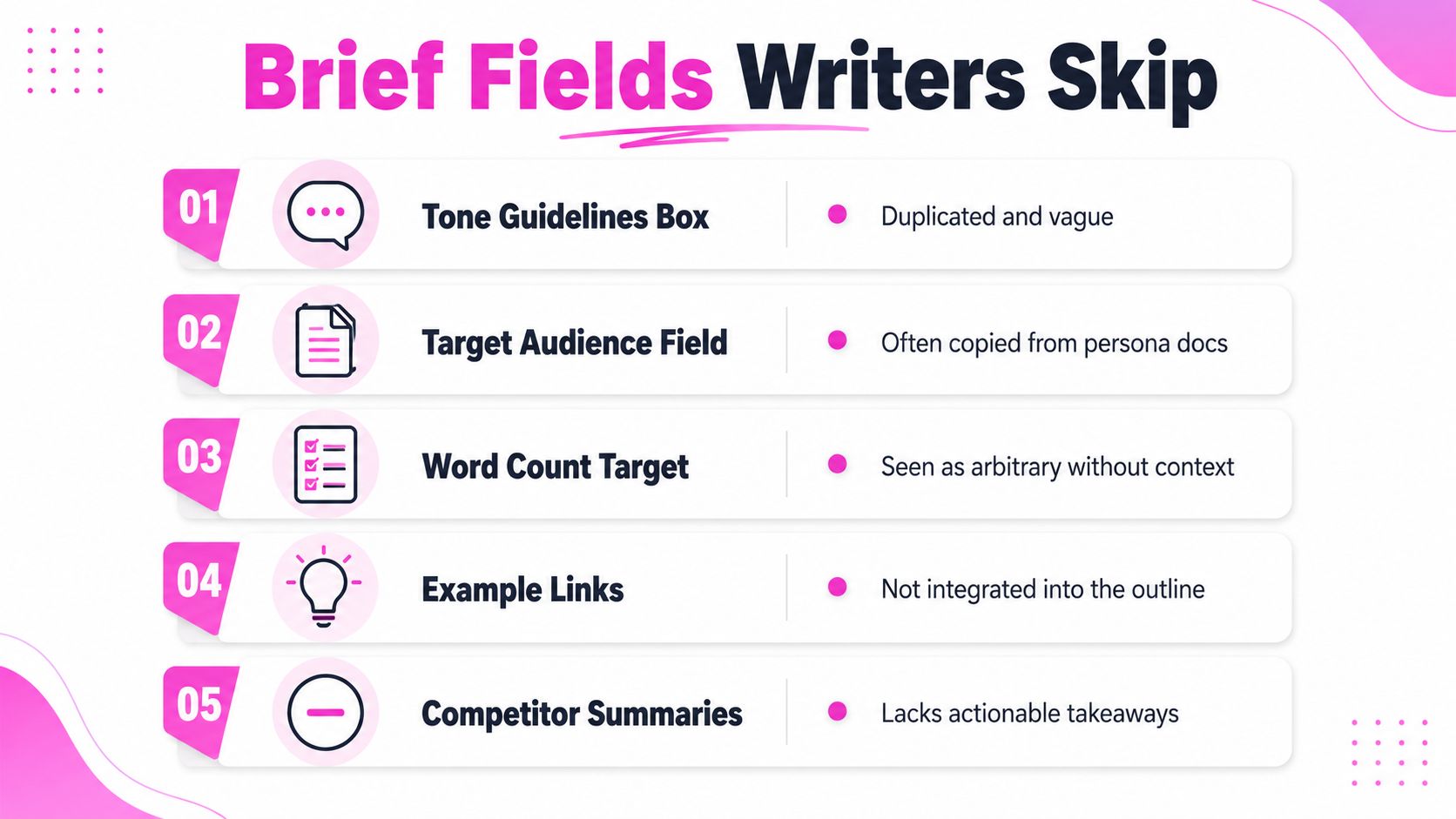
The first cut is the separate tone box. I merge it into one voice line, such as: “Write like an SEO lead reviewing a live production document, direct, specific, and candid about trade-offs.” That gives the writer a usable standard without repeating the brand style guide.
I also remove the duplicated target keyword line from every section. The page-level keyword and concept priorities are enough. A long competitor URL dump becomes a top three SERP references card, with one sentence per page explaining what to borrow or avoid.
The practical merges
- Tone guidelines box: Merge into a single voice anchor because separate boxes become duplicated and vague.
- Target audience field: Keep only the audience detail that changes the draft, since persona documentation often gets copied without application.
- Minimum word count: Replace it with a depth checklist tied to required sections. A number without rationale encourages padding.
- Internal links to consider: Replace with destination, anchor text, and placement.
- Competitor summaries: Replace with actionable observations, not descriptions of pages the writer won't open.
I don't delete useful information. I compress it into instructions that survive a skim. A depth checklist might say that the writer must show a populated brief, explain each field's editorial purpose, distinguish mandatory coverage from differentiation, and include an AI feature plan. That is more useful than telling them to reach an arbitrary length.
Generating a Draft Brief With AI Without Losing Accuracy
I use AI to create a scaffold, not to decide what the SERP means. The workflow starts with the target query and the raw top-ranking URLs. I ask the model to organize the evidence into fields, but I don't trust its competitor descriptions or feature claims without checking the live results.
The verification pass
- Provide raw inputs: Give the model the keyword and ranking URLs, not invented summaries.
- Generate structure: Ask for intent, recurring subtopics, possible gaps, blockers, and a draft outline.
- Verify manually: Check every competitor URL, SERP feature, header pattern, and People Also Ask phrasing against the current results.
- Rewrite the directives: Turn observations into writer actions, then have a human editor review the brief before assignment.
The two common failures are plausible-looking competitor pages that the model has invented and copied headers that preserve wording without understanding intent. I also recheck AI Overview and featured-snippet observations immediately before sending the document, because those features can change.
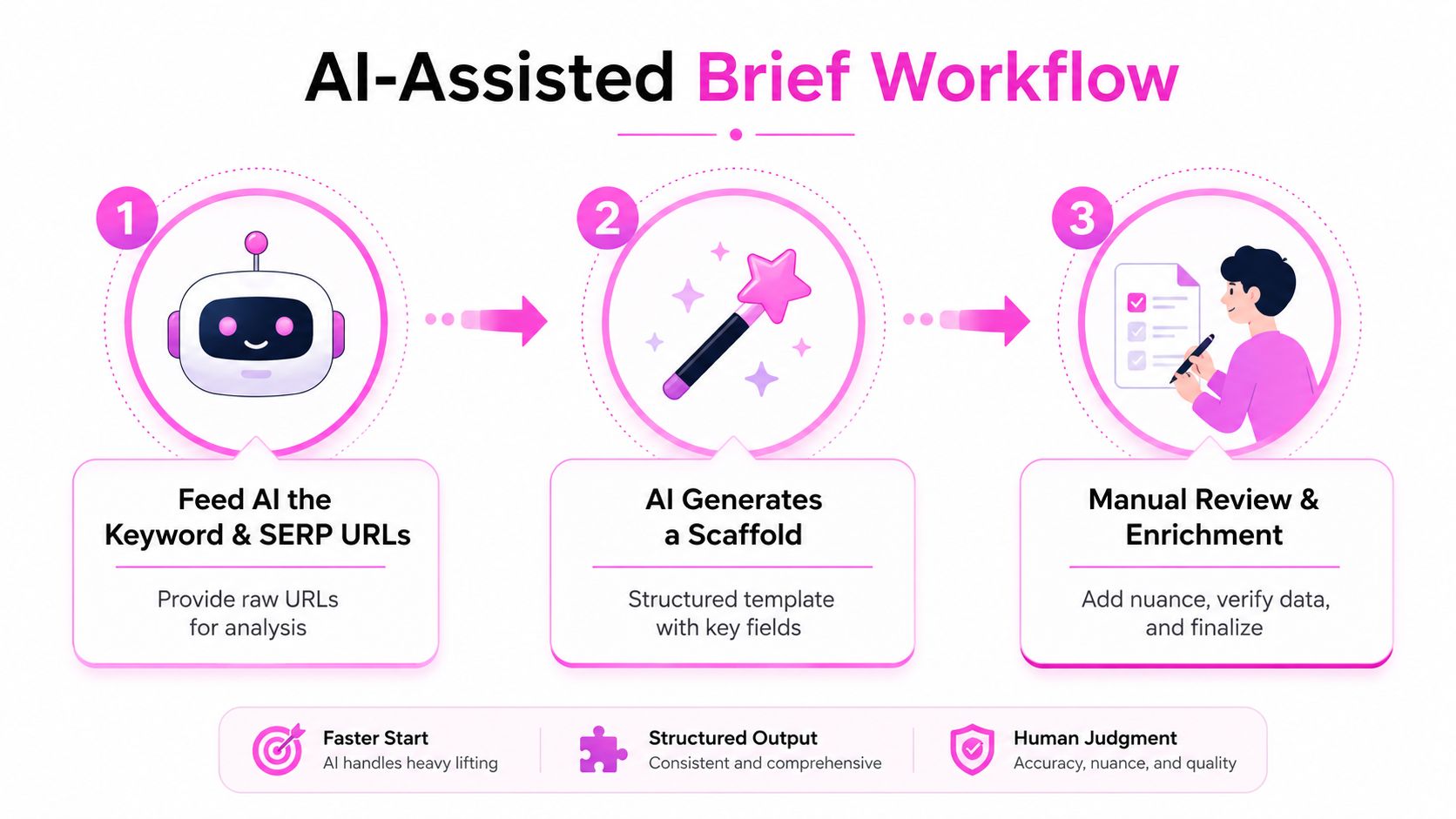
The rule is simple: AI drafts the scaffold. The SEO lead owns accuracy, prioritization, and editorial judgment.
Quick-Reference Checklist and Cross-Links
Before sending the brief, I:
- Define the page goal, audience, primary and secondary intent.
- Record the primary query and concept clusters.
- Review live results and document blockers.
- Separate mandatory headers from differentiators.
- Add internal destinations with anchor text.
- Add verified external sources and a CTA.
- Specify metadata, alt text, schema, and answer blocks.
- Convert competitor research into direct writer instructions.
- Recheck every AI-generated URL and SERP claim.
- Use the core fields, SERP blockers, und header rationale as the final review points.
Retire a template when writers keep producing the same unrankable draft despite following it. That means the template is documenting activity, not improving decisions.
SemDash brings keyword discovery, competitor gaps, live SERP analysis, clustering, and AI-assisted content briefs into one research workflow, including SERP history and AI Overview citation tracking. Visit SemDash to turn the research behind your next SEO content brief example into a checked, actionable document.