
The advice I hear most often is to start with age bands, income brackets, and a polished persona deck, then send the same offer to everyone who fits. That slide looks strategic in a quarterly review. It does nothing once a campaign has to decide who gets the email, who gets suppressed, and who should never see the discount.
A marketing segmentation strategy only earns the name when each audience is a state someone is in right now. I want an entry rule, an exit rule, a recency window, and one decision that state is allowed to change. Demographic labels can stay on a media plan if they affect eligibility. They don't get to write the message.
I fund one lifecycle objective first. Acquisition, repeat purchase, or churn prevention. I pick one basis that can change one asset this month. Everything else waits until that state produces a lift I can defend on margin, not just on a conversion rate.
Inhaltsverzeichnis
- The Segmentation Strategy Worth Running
- Segments as Customer States, Not Labels
- Data Sources That Stay Useful After Cookies
- Buyer Personas Tied to a Real Decision
- Campaign Maps That Change by Customer Status
- Prioritize Segments and Start This Week
The Segmentation Strategy Worth Running
Labels are not a strategy. If every campaign still treats a 25 to 34 band the same way, you don't have segments. You have a sorting exercise that never touches a send, a bid, or a landing page.
I define the strategy as a small set of audience states. Each state needs four things before it goes live.
- Entry. The observable event that puts someone in.
- Exit. The event or silence that takes them out.
- Recency. How fresh the evidence must be.
- One decision. The offer, channel, page, or suppression this state may change, and nothing else.
Six bases show up in almost every brief. Only some of them can carry a live decision. I use this table before I approve any new data project.
| Grundlage | Data it needs | Campaign decision | When it fails |
|---|---|---|---|
| Demographic | Age, income, household | Broad media mix and offer eligibility | Opposite intents hide inside one age band |
| Geographic | Region, catchment, climate | Local offer, language, shipping rule | Same city, different job to be done |
| Psychographic | Attitudes, values, lifestyle survey | Brand voice and creative angle | Costly to refresh and weak for suppression |
| Behavioral | Orders, visits, email engagement | Offer, frequency, and channel | Stale without a recency and exit rule |
| Firmographic | Industry, company size, role | B2B content and sales routing | Job title is not buying authority |
| Intent or lifecycle state | Query, page, stage, recency | Message and page by journey stage | Breaks if entry and exit rules are undefined |
Demographic and geographic rows are cheap and fine for eligibility, language, and shipping. They fail the moment two people in the same city, or the same age band, are trying to finish different jobs. Psychographics can set voice, but a survey that nobody refreshes cannot suppress a buyer who already converted. Behavioral data is the row I trust for offer and frequency, and only with a recency cutoff and an exit. Firmographics route B2B content. They don't prove the person can sign. Intent or lifecycle state is the row I fund first, because a query, a page, and a stage already point at one message.
What the revenue range actually allows
McKinsey reports that personalization most often produces a 10% to 15% revenue lift, with company-specific results ranging from 5% to 25% depending on sector and execution. Companies that excel at personalization generated 40% more revenue from those activities than average performers. I treat that as a ceiling set by execution, not a promise attached to a new label.
I measure incremental revenue against a holdout, not against an unrelated historical period. I also track margin, discount cost, unsubscribe rate, repeat purchase, and retention. A higher conversion rate can hide a worse offer. The practical start is a state where the offer, the data, and the channel are already reliable, such as recently lapsed customers. I document the audience rule, the treatment, the control, and the lift before I extend it.
Commerce teams that want a worked view of how states differ from static shopper types can use these customer segmentation insights from Class A Media as a second pass on the same decision. I still lock one lifecycle objective and one row from the table before anyone opens a new data project.
Segments as Customer States, Not Labels
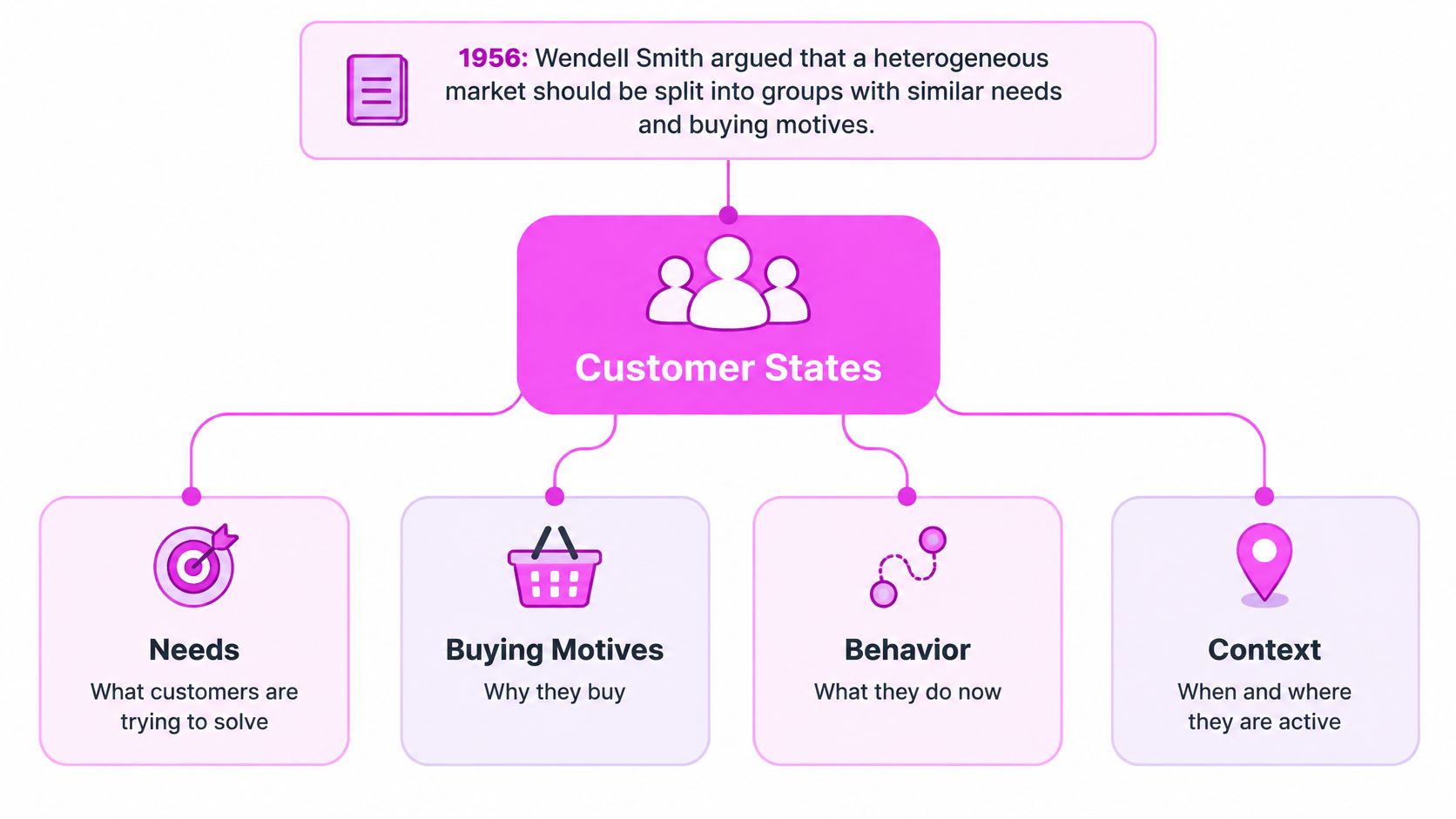
In 1956, Wendell Smith argued that a heterogeneous market should be split into groups with similar needs and buying motives, instead of treated as one mass, a case the UCLA Anderson historical review still frames as the alternative to mass marketing.
The unit has changed. A segment is a state a customer is in right now, not a permanent label. I keep three states in production, and I write the rules so two campaigns cannot claim the same person.
The map below is how I brief the difference between a label and a state.
Problem-aware researcher. Entry is a first non-brand visit with no order. Exit is the end of a 14-day recency window with no further visits, or any purchase. I exclude anyone with an order in the last 90 days and anyone already in a comparison audience. The only decision this state may change is which educational page they see.
Comparison-stage evaluator. Entry is a pricing URL or a competitor query. Exit is a purchase, or 21 days with no return to a commercial page. I exclude researchers who have not hit a commercial URL, and I exclude anyone who bought in the window. The decision is the proof module on the pricing page, not a glossary email.
Post-purchase advocate. Entry is a second order plus a review or a referral click. Exit is 60 days of silence, or an open complaint. I exclude one-time buyers and anyone with an unresolved ticket. The decision is a referral ask, not another promo.
Praktische Regel: If two states can both be true for the same person on the same day, one of the exclusion rules is missing.
A BCG survey of personalization programs across more than 50 companies in 10 industries found that two-thirds of respondents expected at least a 6% incremental annual revenue lift. In apparel, financial services, grocery, wholesale clubs, and technology, expectations reached 10% or more. Nur 13% reported customer-specific individual messages, 7% managed fully integrated communications across channels, and 65% were still on segmented or mass approaches. I scope small for that reason. One-to-one creative without identity resolution, clean data, and a production workflow is how programs stall.
Adobe's 2025 research, from a survey of more than 3,200 marketers and customer-experience professionals, identified fragmented data as a barrier to real-time, one-to-one personalization. Adding segments on top of that fragmentation makes results worse when nobody owns the definition, the suppression, or the single decision.
Think of the segment as a kitchen ticket. It says what to cook now and when the order leaves the pass. It does not describe who the diner is.
This short walkthrough is the version I send to operators who still treat a segment as a biography.
Data Sources That Stay Useful After Cookies
Before I store a signal, I run one test. If the customer would not understand why this input changed the message, I don't keep it for segmentation. That single filter removes more bad audiences than any model review I've sat through.
I separate three kinds of data, and I only promise to maintain the first two.
Declared covers preference-center choices, role, and the job the person says they are trying to finish. It is slow to collect and easy to explain. I let people see it and correct it. A stated "migrating off a competitor" beats a guessed industry code when the next email has to answer migration risk.
Observed first-party covers recent orders, on-site pages, email clicks, and support tickets. Each field gets a recency cutoff. A click from 11 months ago is not a reason to change this week's offer. Orders and tickets also create exclusions. An open complaint blocks win-back until the ticket closes.
Inferred covers lookalikes and third-party identity. I treat both as optional and easy to drop. They cannot be the only reason someone enters a state, because I often cannot suppress them cleanly when the person buys or opts out.
Methods, in the order I actually use them
I don't start with a clustering project.
- Cross-tabs first. I check whether the split changes a rate I already care about, such as purchase or reply. If the rates match, the split is decoration.
- A recency-frequency split next. Recent buyers, quiet buyers, and repeat visitors are states a lifecycle owner can act on this month.
- Cluster analysis last. I allow it only after a named owner can say the action for each cluster. A cluster without an action is a chart.
Adobe's 2025 retail digital trends report puts the tension in numbers I use with legal and media in the same meeting. Retail executives rank advanced customer segmentation among their leading data priorities, yet only 34% prioritize privacy-first and cookieless personalization techniques. 71% of surveyed shoppers reported taking action to protect their privacy, while 69% of privacy-conscious consumers still wanted brands to learn from their shopping behavior over time. Privacy and relevance are not opposites. Feeling watched is the failure.
Segment on declared preferences, recent first-party interactions, and contextual intent. Let the customer see or correct the inputs.
For search-led programs I build states from query intent, SERP features, and recurring topic demand, not from an inferred person. A pricing query and a how-to query are different states even when the device, the city, and the age band match. I check that split in our own organic traffic analysis before I let a media buyer merge them.
The mistake I keep killing is a purchased third-party segment that cannot be suppressed when the person buys or opts out. If the vendor file has no exit, it is not an audience. It is a list that will keep mailing customers you already won. A practical companion on what to keep in-house is this first-party data advertising guide for 2026. I still apply the same accept-or-drop test. If I cannot explain the signal in one sentence on a preference page, I don't store it.
Buyer Personas Tied to a Real Decision
A persona, in my workflow, is a one-page brief for a segment state. It is not a fictional biography. Stock first names, hobbies, and an age that doesn't change eligibility get deleted. Age stays only when it changes what we are allowed to sell.
Fields I require
- State name. The operational state, not a nickname.
- Entry evidence. The query, page, order, or ticket that proves they are in it.
- Job to finish. The next task, in their words where I have them.
- Blocking objection. The single reason the next step stalls.
- Proof they trust. A comparison, a migration note, a policy, or a review theme.
- Channel they already use. Not the channel we wish they used.
- One allowed offer. And, on the same line, the offer we will not make.
Two briefs I would actually hand to production
B2B comparison-stage operator. Entry evidence is a competitor or pricing query in the last 21 days, with no closed-won opportunity. The job is to pick a tool and defend the switch. The objection is migration risk, not "what is SEO." Proof is criteria, a switching checklist, and a plain pricing comparison. Channel is the pricing URL plus a short retargeting sequence. Allowed offer is a working session on migration. Excluded offer is a top-of-funnel glossary or a generic newsletter.
Commerce lapsed buyer. Entry evidence is one prior order and a quiet window we define in the state, with no open ticket. The job is to decide whether a second order is worth it. The objection is "nothing new since last time." Proof is a concrete reason tied to the last category they bought, not a blanket percent off. Channel is one email, then a stop. A discount is allowed only if margin still clears after the code. If it doesn't, the allowed offer is a new use of what they already own.
Say both people are 34, urban, and in the same income band. They still cannot share a persona. One needs migration criteria and must not get a glossary. The other needs a win-back reason and must not get an acquisition coupon. Same demographic, different next decision, so they stay in separate states.
How I build the page
I don't start in a workshop.
- I pull 15 to 30 recent records that already meet the entry rule. Support notes, query strings, and order lines beat a brainstorm.
- I write the repeated objection in their words. If I can't find a repeated line, the state isn't real yet.
- I write the allowed offer and the excluded offer on the same page, so creative can't invent a third one.
- The person who sends the campaign signs the page. If they won't sign it, the brief isn't operable.
- I set the review date to the recency window, not to the annual brand offsite. A 21-day evaluator state gets reviewed on that cycle.
The common failure is a persona so polished that media, creative, and lifecycle each invent a different version. A persona is done when someone can brief an ad, an email, and a landing page from the same page without adding new facts.
Campaign Maps That Change by Customer Status
A map is only useful if a media buyer can execute a row without a meeting. I run six states. Each row has an entry, a channel that has earned the right to speak, a message job, and a hard exclude.
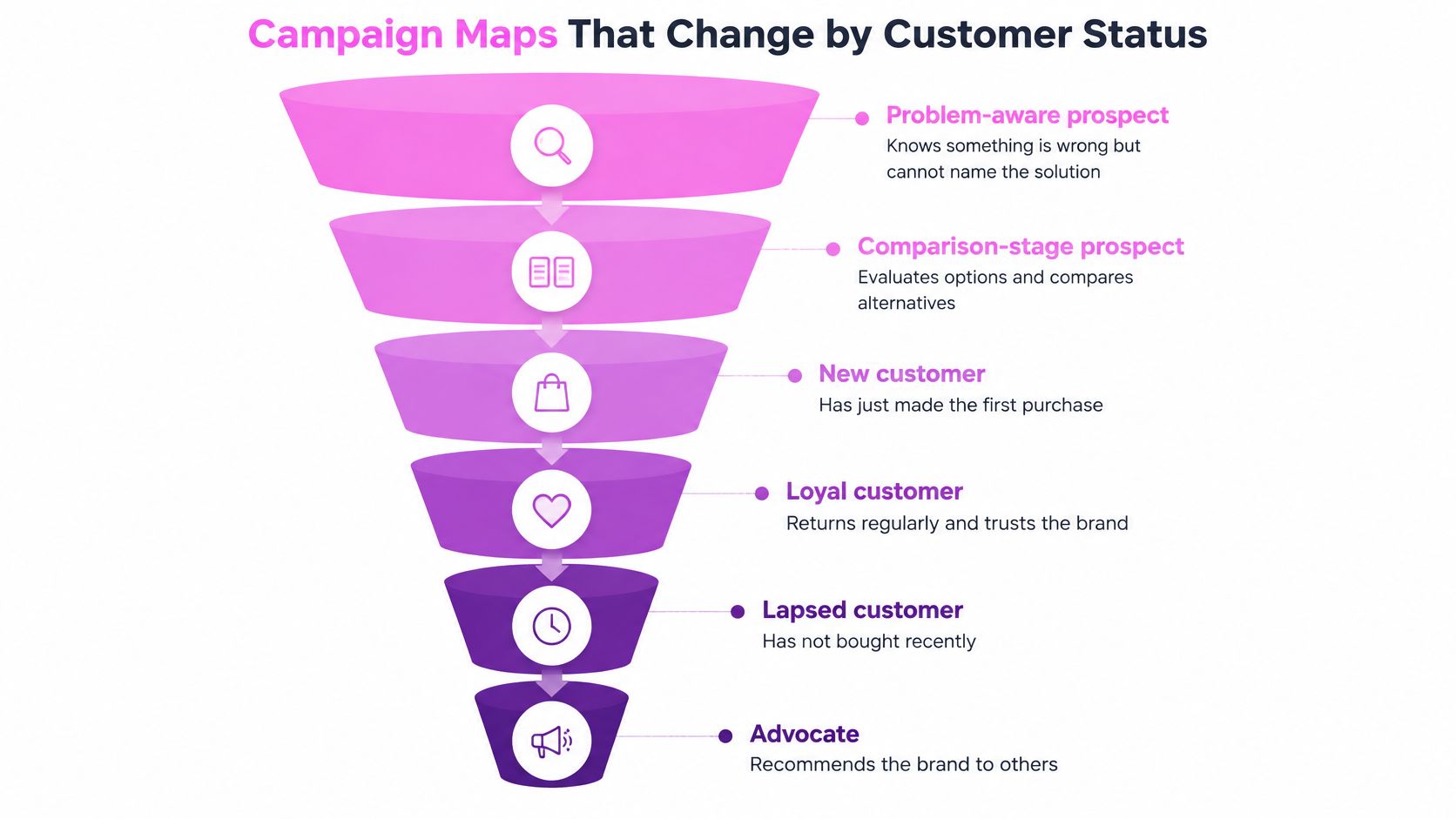
| State | Entry rule | Channel | Message job | Exclude |
|---|---|---|---|---|
| Problem-aware prospect | First visit or non-brand query, no purchase | Content and search | Teach the problem | Existing customers |
| Comparison prospect | Pricing or competitor query | Landing page and retargeting | Proof and buying criteria | People who already bought |
| New customer | First purchase inside 30 days | Onboarding | Prospects and lapsed | |
| Loyal customer | Repeat purchase, low returns | Email or owned channel | New use, not a first-order coupon | One-time and lapsed |
| Lapsed customer | Quiet past the recency window | Email, then a mail test | One win-back with a reason | Active buyers and open complaints |
| Advocate | Repeat plus review or referral | Owned ask | Referral, not another promo | Recent unhappy tickets |
Why one conversion rate lies
A randomized field experiment with an Italian beauty retailer, run from July through November 2017 and published in the Journal of the Academy of Marketing Science, found that channel effectiveness changed by customer status. Direct mail generated acquisition among prospects. Email drove sales for both online and offline channels among current-customer segments. The direct-mail elasticity for prospects was 0.132, statistically significant at p < 0.05.
I don't read that as "direct mail is back." I read it as a warning about blended metrics. One conversion rate can hide a channel that works for prospects and wastes money on customers you already have. I separate prospects from customers first, then test channel and message inside each group. A first-purchase message sent to loyal buyers isn't neutral. It trains them to wait for a coupon.
On a search-led offer I apply the rows like this. Problem-aware traffic gets an educational page and is suppressed from win-back mail. Comparison traffic gets proof and criteria on the pricing URL. New buyers get onboarding email, not the acquisition discount. Loyal buyers get a new use, not a first-purchase coupon. Lapsed buyers get one win-back with a reason, then they exit. Advocates get an ask, not another promo.
Optimove's 2025 Consumer Marketing Fatigue Report found that 81% of 329 U.S. adults surveyed in late 2024 were more likely to open an email customized to their interests. I use that only to justify relevance. It is not a license to send more often. Interest-matched mail still needs an exit, or the open rate becomes a reason to over-mail.
For B2B email specifically, I keep the comparison row tight. A useful pass on how those emails should differ by buying stage is segmentation for B2B marketing emails. The operator who arrived on a competitor query gets criteria. The operator who has never hit a commercial URL does not get that sequence.
Two edges that break a blended file
A loyal customer who hits a competitor query stays in retention. I don't flip them into prospect retargeting, because the acquisition discount is the wrong job. A lapsed buyer with an open complaint is excluded until the ticket closes. Winning them back while support is still open is how you buy a public complaint.
Fill one row before you build the rest of the matrix. Entry, channel, message, exclude. If you can't exclude someone, you don't have a state. You have a blast list with a new name.
Prioritize Segments and Start This Week
Segment size is a testing constraint, not a trophy. I don't fund the cleverest cut. I fund the cut that can reach a readable result before the offer expires.
Mastercard's experimentation guidance recommends starting with the largest visitor groups, because larger segments provide more traffic and reach statistical significance faster. The first splits worth funding are new versus returning, mobile versus desktop, loyal versus one-time, and returning visitors who have purchased versus those who have not.
| Split | Size signal | Data reliability | Offer ready | Test now |
|---|---|---|---|---|
| New vs returning | Largest traffic split | First-party analytics | Yes if one creative exists | Yes |
| Mobile vs desktop | Large | Device logs | Layout or speed fix | Yes |
| Loyal vs one-time | Mittel | Order history | Loyalty offer | After a large split wins |
| Purchased vs browsed returners | Mittel | Orders plus visits | Different proof, not a new brand | After a large split wins |
| High AOV vs low-intent browsers | Smaller | Orders and returns | Margin-safe offer only | Only after a repeatable lift |
| Niche under about 5% of traffic | Tiny | Often inferred | Rarely | No |
New versus returning is the split I fund this week when one creative already exists. Mobile versus desktop is next when the fix is layout or speed, not a new story. Loyal versus one-time, and purchased versus browsed returners, wait until a large split has won once. High average-order-value buyers against low-intent browsers can show different conversion drivers, and they also create false confidence if you slice them too early. A niche under about 5% of traffic is not a test. It is a hunch.
The only workflow I run before adding a cut
- I define one behavioral split and the one campaign state it serves. New versus returning might serve acquisition creative. It does not also serve win-back.
- I preselect one primary metric and a holdout. Revenue per visitor beats a blended conversion rate when discounts are in play.
- I run the same control-versus-treatment test inside the largest viable group. Both arms see the same window.
- I record the audience rule, the treatment, and the lift. I read margin and unsubscribes beside conversion. A win that raises unsubscribes or gives away margin is not a win.
- I add a smaller cut only after the large split repeats and someone can act on the difference. Dozens of tiny segments after an early spike raise false positives and leave too little traffic for a decision.
Before launch I check that each arm can reach a readable conversion count inside the test window. If it can't, the segment isn't testable yet. I also keep acquisition and retention goals on separate scorecards. A first-purchase offer is never judged on loyal customers.
AI is fine for clustering queries or flagging when a state's mix drifts. It is not fine for inventing audiences nobody can suppress. I use it after the entry rule exists, not instead of one.
What I skip this week
I skip the twelve-segment taxonomy, the purchased identity graph, and any promise of one-to-one creative. If the first state cannot change one message on one channel this month, it isn't a segment yet.
Search states are easier to fund when you can see which competitor URLs already own the comparison queries. I pull that from competitive marketing intelligence and attach the gap to the comparison row, not to a new persona. Our SEO Academy has video tutorials on the SEO strategies and the tool workflows behind that check. If a report you need isn't there, you can request it and vote on the product roadmap. When the state rules get stuck in a live file, the community is where other SEO operators answer the practical questions.
Start with the largest split that already has an offer. Write the entry, the holdout, and the exclude. Ship that. Add the next row only after the first one repeats.
SemDash pulls keyword, backlink, and SERP history into one workspace so you can build intent states from real queries instead of demographic guesses. Use it to separate problem-aware topics from comparison queries, then map each cluster to one page and one campaign decision. Visit SemDash and put the first state on a live keyword gap this week.