Most advice about competitive marketing intelligence is backwards. Teams are told to collect more competitor data, build a nicer dashboard, and present a quarterly summary. Then they wonder why nobody changes a brief, reworks a page, or updates a sales narrative.
What moves things is a workflow. I've seen too many programs die as a folder full of exports: one keyword gap sheet, one backlink snapshot, one deck with arrows and color coding, then silence. Good competitive marketing intelligence doesn't live in a slide. It shows up in the same weekly operating rhythm where content, SEO, paid, and product marketing decisions already happen.
That shift matters because this isn't a niche practice anymore. The broader competitive intelligence market was estimated at USD 50.87 billion in 2024 and is projected to reach USD 122.77 billion by 2033, implying a 9.1% CAGR from 2025 to 2033, according to this competitive intelligence market overview. The tools segment was also framed separately at USD 6.63 billion in 2024 with software platforms holding 68.23% share in 2024, which tells me the software layer is where teams are operationalizing the work instead of treating it as occasional research.
The part most guides still miss is the extra layer now sitting on top of classic SEO signals. Rankings, backlinks, and SERP history still matter. But if you're not tracking AI Overview citations beside them, your view of competitor visibility is incomplete.
Inhaltsverzeichnis
- Why Most Competitive Marketing Intelligence Programs Stall
- What Competitive Marketing Intelligence Actually Covers
- The Five Data Types That Drive Every Useful Insight
- A Four-Stage Workflow That Turns Data Into Decisions
- How Agencies and In-House Teams Run It Differently
- A Real Competitive Sprint With SemDash
- AI Overview Visibility as a New Competitive Layer
- Legal and Ethical Guardrails You Cannot Skip
Why Most Competitive Marketing Intelligence Programs Stall
The most common mistake is treating competitive marketing intelligence like a one-time export. Someone pulls a CSV from a free tool, highlights a few competitor keywords, drops it into a deck, and calls the job done. Three weeks later, nobody remembers where the file lives.
I've watched this fail in agencies and in-house teams for the same reason. The deliverable exists, but the operating loop doesn't. There's no owner, no cadence, and no handoff into the people writing briefs or fixing pages.
The three failure modes I keep seeing
- The one-time dump: A keyword gap export without page mapping rarely helps. You get a list of terms, but no clue which competitor URL is winning, why it's winning, or whether your site even has the right page type.
- The quarterly deck trap: Quarterly reviews feel strategic, but they're too slow for search. By the time a deck gets discussed, the SERP has already moved and the recommendations are stale.
- The fake competitor set: Teams often track two or three brands they already know. That misses the domains taking clicks in the SERP, including publishers, affiliates, and adjacent products.
What fixes it
I stopped thinking about competitive intelligence as a report and started treating it as a weekly operating system. The weekly run should answer three questions:
- What did competitors publish, update, or earn this week?
- Where did SERP overlap shift?
- Which of our pages lost ground, and to whom?
If a team can't answer those three questions quickly, it defaults to guessing. The content team guesses which topic to publish next. The SEO lead guesses whether a drop came from cannibalization or a rival page. The client or stakeholder guesses whether the strategy is working.
Praktische Regel: If your intelligence output doesn't land in the same Slack channel, task board, or standup where execution decisions happen, it won't get used.
There's another reason this has become urgent. Competitive pressure has increased. One industry summary noted that 57.5% of respondents said more of their deals were competitive than a year earlier, while only 16% said competitive pressure had eased, as cited in this history and context on database-driven marketing and competition. That lines up with what many teams already feel on the ground. Competitor moves show up faster, in more channels, and with less warning.
What Competitive Marketing Intelligence Actually Covers
Blurring competitor tracking, market research, and SEO monitoring together muddies ownership. Keep it simple: competitive marketing intelligence is the structured practice of monitoring, analyzing, und applying rival marketing signals so your team can make better decisions now, not just later.
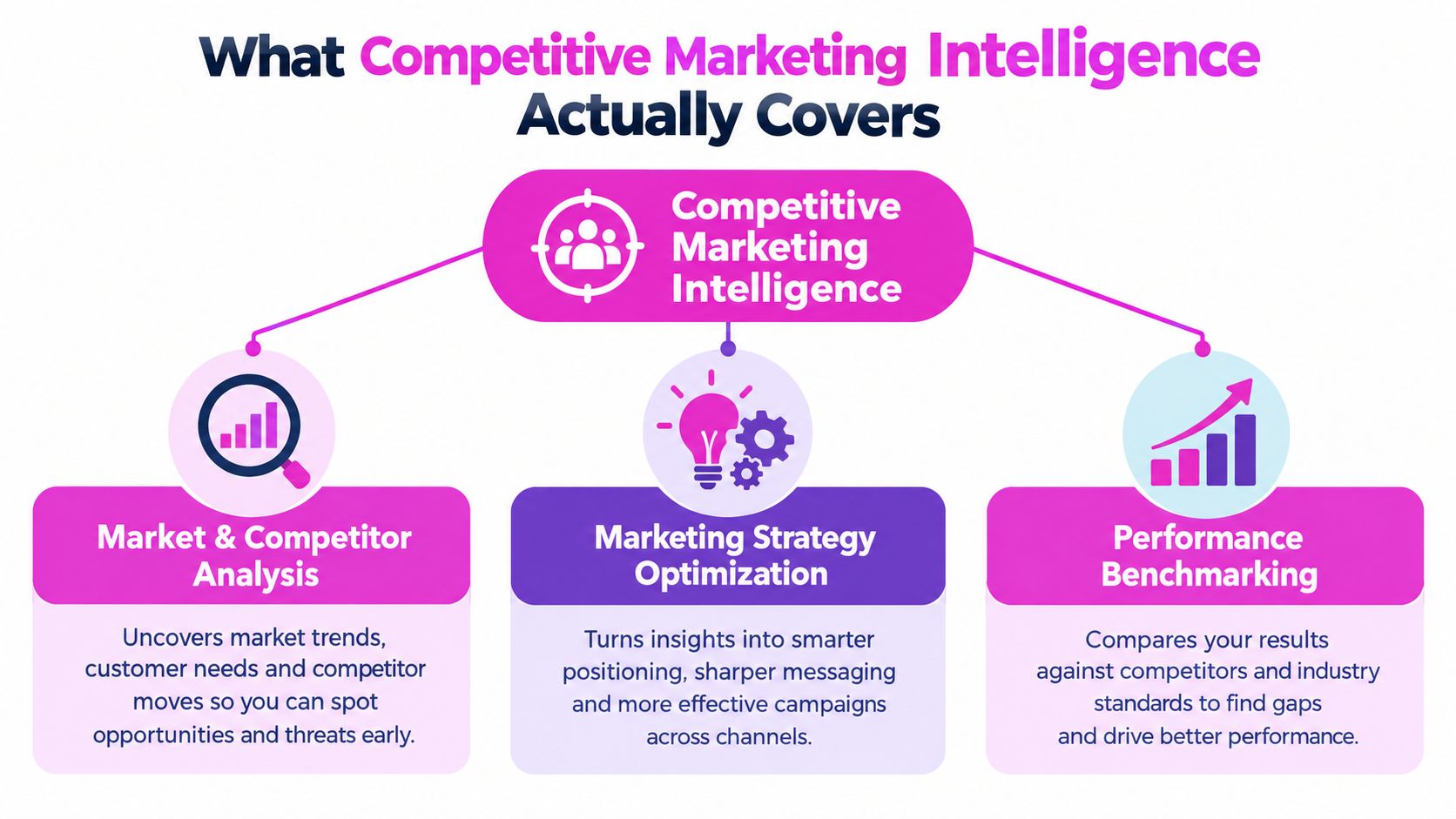
A useful way to think about it comes from this competitive intelligence 2026 guide, which frames intelligence as something teams operationalize across channels rather than a static research exercise. That's the right framing. The work only matters when it changes execution.
Monitor means fixed observation, not casual checking
Monitoring is where most programs start, but also where many stop. I'm talking about a fixed cadence for competitor keywords, backlink changes, top pages, message shifts, and SERP presence. The point is to surface changes while they still matter.
Without a cadence, teams confuse memory with evidence. They say a competitor is “suddenly everywhere,” when the story is that one page entered a cluster and began compounding.
Analyze means turning movement into explanation
Raw deltas aren't useful on their own. A ranking drop matters only when you can tie it to something specific, such as a new competitor page, a stronger backlink profile, a change in intent match, or a new search feature reducing click share.
Independent guidance on how marketers use competitive intelligence workflows describes the process as monitoring competitors, analyzing patterns and gaps, and applying findings to strategy. That mirrors what works in practice. Collection alone is weak. Structured comparison across pricing, product, message, visibility, and distribution is what makes the output decision-grade.
Apply means routing insight into the work
Teams either become useful or decorative. Intelligence has to end up somewhere concrete:
- Content briefs: New topics, page rewrites, comparison content, FAQ additions
- Link outreach lists: Domains linking to rivals but not to you
- Budget calls: Whether to defend a commercial cluster or expand into an adjacent one
- Messaging updates: Reframing copy when a rival shifts category language
The best intelligence programs don't just tell you what competitors did. They tell the next person exactly what to do with that information.
One boundary is worth keeping sharp. Market intelligence looks outward at broader category shifts, regulation, adjacency, and demand. Competitive marketing intelligence looks at the rival set and what they're doing in the channel right now. Both matter. They just answer different questions and usually belong to different owners.
The Five Data Types That Drive Every Useful Insight
When a program gets noisy, it's usually because too many signal types were shoved into one spreadsheet and treated the same. That never holds. I keep five separate streams, each with a different question, cadence, and owner.
Keywords answer where demand is already visible
Keyword gaps tell you where a competitor already has discoverable demand and you don't. But the useful version isn't “they rank for this term.” The useful version is page-level: which URL wins, what intent it satisfies, and whether your current page can compete or needs a new asset.
For SEO teams, the strongest competitor analysis combines keyword overlap, top-ranking pages, position distribution, and backlink context, as outlined in this SEO competitive analysis framework. I've found that domain-level visibility alone hides the pages you need to beat.
Backlinks answer why some pages keep winning
Backlink gap reports are less about volume than about pattern. I want to know who links to two or three rivals, what type of asset earned those links, and whether my client or team has something pitchable into that same context.
A lot of outreach fails because people export every missing referring domain and blast a template. That creates activity, not traction. I'd rather build a short list of reachable domains with obvious contextual fit.
Traffic share answers who owns the cluster
Traffic share helps you zoom out from page-level obsession. Some teams spend weeks trying to move one URL from position five to three while missing the larger issue that another domain now owns the topic cluster.
This view is especially useful when your “competitor” isn't your product rival. Sometimes the blocker is a publisher, marketplace, or UGC domain taking the informational top of funnel.
SERP trends answer what changed over time
A static ranking snapshot hides the story. Trend history shows whether a page drop was sudden, slow, seasonal, feature-driven, or tied to a competitor content push.
I rely on this to avoid bad decisions. Teams often rewrite a page that didn't fail. The page was fine. The SERP changed around it.
AI Overview citations answer who gets surfaced inside answers
This is the newest layer, and too many workflows tack it on as an afterthought. Citation tracking answers a different question from ranking: when Google generates an answer, which domains and URLs does it choose to support that answer?
That's not a vanity metric. It changes what “visibility” means for informational queries.
Five data types and the strategist question each answers
| Data type | Question it answers | Cadence | Feeds |
|---|---|---|---|
| Keyword-Lücken | Which terms and pages are competitors winning that we don't cover well? | Wöchentlich | Keyword overlap, ranking pages, intent groupings |
| Backlinks | Which domains validate rival content, and which are realistic outreach targets for us? | Weekly or biweekly | Referring domains, anchor context, linked pages |
| Traffic-Anteil | Who owns the cluster, and are we gaining or losing presence overall? | Wöchentlich | Domain share by topic, top pages, visibility mix |
| SERP trends | Did the loss come from our page, a rival page, or a feature shift in the result set? | Wöchentlich | Position history, feature presence, URL churn |
| AI Overview-Zitate | Which domains get cited in generated answers, and are those citations stable enough to matter? | More frequent checks, plus weekly review | Query set, cited URLs, competitor citation presence |
If you collapse all five into one report tab, the team stops seeing which signal is diagnostic and which signal is just descriptive.
A Four-Stage Workflow That Turns Data Into Decisions
Skipping straight from discovery to action is how guesses end up getting shipped. The missing step is benchmarking, where you normalize competitors against the same baskets, pages, and expectations.
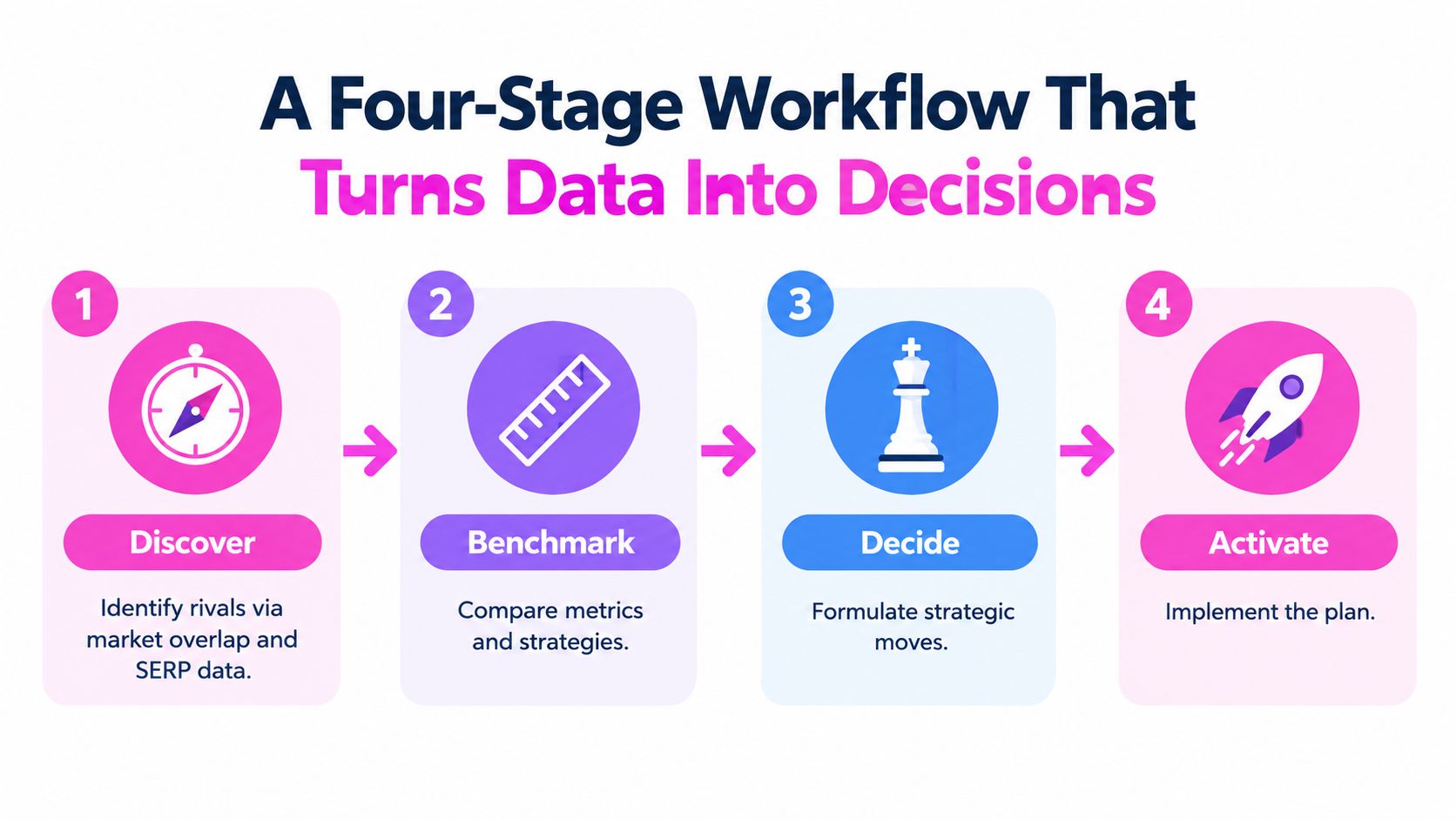
Discover the real rival set
I don't start with the brands sales mentions most. I start with SERP overlap, topic overlap, and audience overlap. The domains taking clicks from your money pages may not be your boardroom competitors.
The output here is a competitor matrix. It should separate direct rivals, publisher threats, affiliate threats, and adjacent entrants. If you don't label them differently, the team will react to them the same way, which is a mistake.
Benchmark like for like
Benchmarking is where the work becomes comparable. I usually normalize against:
- Shared keyword baskets: Brand, non-brand, informational, commercial, transactional
- Page types: Category pages, comparison pages, use-case pages, blog pages
- Authority context: Referring domain patterns by cluster, not just total count
- Visibility shape: Whether a competitor wins with a few dominant URLs or broad site coverage
The output is a gap report with page-level evidence, not just domain summaries.
Decide by effort and payoff
A long list of gaps is not strategy. The team needs a ranked backlog based on likely impact and execution cost. Some gaps deserve a new page. Some need a merge, redirect, or rewrite. Some are not worth chasing because the rival owns them with a page type you can't realistically match.
I've seen smart teams waste a month on a prestige keyword while easier page-level wins sat untouched in the overlap set.
Activate with clear artifacts
Activation should produce assets that another team member can pick up without redoing the analysis:
- Opportunity backlog for SEO and content
- Sprint brief with page-level actions
- Outreach list for digital PR or link building
- Messaging notes for paid or product marketing
The biggest failure point is fuzzy handoff. If the analyst writes “competitor gained visibility in X cluster,” nobody knows what to ship. If the brief says “expand section two, add comparison schema where relevant, refresh FAQs to target these query variants, and pitch these five domains,” the team can move.
How Agencies and In-House Teams Run It Differently
Agency and in-house teams should not run this the same way. I learned that the hard way early on. When agencies try to behave like in-house teams, they overreach into prioritization without enough internal context. When in-house teams try to mimic agency reporting, they produce nice summaries that nobody owns.
What agencies should own
Agencies are usually strongest at collection discipline and external benchmarking. They can standardize competitor sets by vertical, run recurring exports, maintain scorecards, and translate findings into client-ready recommendations.
That matters even more when the same team also has to manage multiple social accounts, content calendars, and channel reporting across clients. Standardized workflows are the only way the intelligence layer stays consistent instead of becoming bespoke chaos.
What in-house teams should own
In-house teams sit closer to revenue, product usage, customer feedback, and roadmap constraints. They should own the final prioritization, activation, and success criteria.
A lot of agencies get blocked here. The recommendation may be right, but the client or internal team knows there's no dev capacity, no legal approval path, or a conflicting product launch that changes timing.
Agency vs In-House Ownership of Competitive Marketing Intelligence
| Workflow Stage | Agency Owns | In-House Owns | Common Failure Point |
|---|---|---|---|
| Rival discovery | SERP-based competitor identification and initial segmentation | Validation against sales reality and business priorities | Agency tracks wrong rivals because internal deal context never gets added |
| Data collection | Weekly keyword, backlink, page, and visibility pulls | Internal joins with CRM, product, and revenue context | Report lands with no internal owner |
| Initial analysis | Gap reports, benchmark comparisons, recommendation drafts | Final prioritization by business value and constraints | In-house ignores external benchmarks and overweights internal opinions |
| Activation | Draft briefs, outreach inputs, stakeholder presentation | Shipping changes, budget approval, measurement | Handoff is too vague to execute |
| Measurement | Visibility reporting and annotated trend review | Pipeline, conversions, content performance, broader business impact | Each side assumes the other is tracking outcomes |
Agencies should package decisions clearly. In-house teams should decide what gets shipped first. If either side tries to own both without the other's context, the program slows down.
A Real Competitive Sprint With SemDash
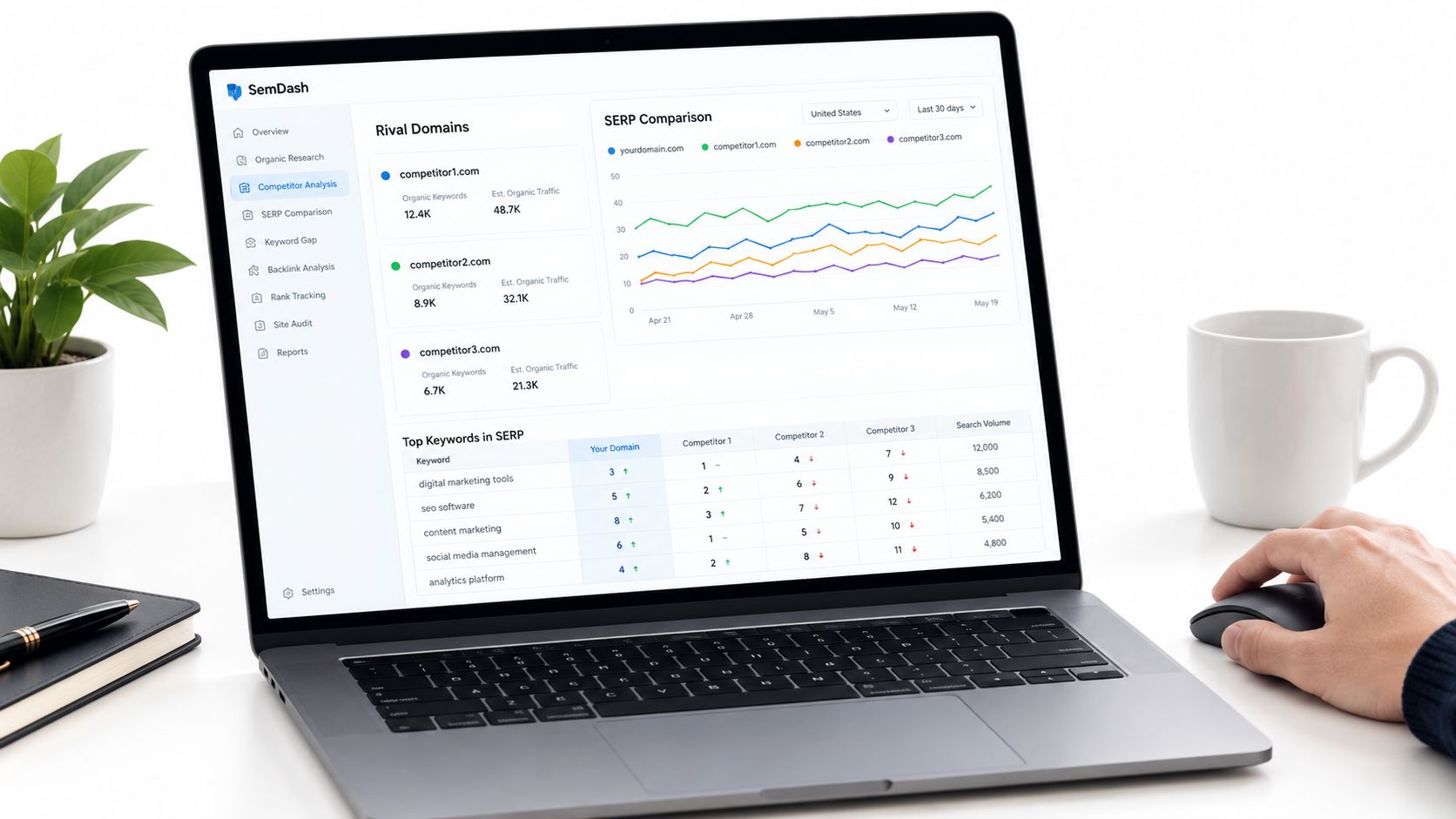
When I run a tight competitive sprint, I want one workspace that gets me from overlap to action quickly. That's where I'll use SemDash alongside the rest of the stack, because it consolidates keyword, backlink, and SERP views in one place instead of making me stitch together three separate exports.
How I'd run the sprint
First, I enter the target domain and build the competitor set from SERP overlap, not guesswork. That matters because teams routinely pick branded rivals that barely intersect in search. I want the three domains most often competing on the same query set.
Then I capture a baseline. For this sprint, I'm looking at:
- Keyword footprint by overlap
- Referring domain patterns
- Traffic share by topic cluster
- Top competing pages, not just top competing domains
After that, I move into the keyword gap report and filter hard. I'm not exporting everything. I narrow to transactional or commercially relevant terms, then check current ranking pages and whether our site already has a page that can be upgraded instead of creating another asset.
Where the sprint gets useful
The backlink gap usually gives me the fastest actionable list. I'm looking for domains that already link to two or three rivals but don't link to us. Those are warmer prospects than random prospecting lists because the pattern already shows they cite this type of content.
I also layer in SERP feature presence. If a cluster keeps triggering AI answers, I flag those pages for structural edits. That usually means tightening topical coverage, improving direct answer sections, clarifying entity references, and making the page easier to cite.
For teams that want a deeper walkthrough of this operating model, the SEO competitive intelligence playbook is worth reviewing because it's focused on turning reports into page and outreach actions, not just observation.
What the sprint hands off
The final output is a one-page sprint brief with:
- Three page updates tied to specific overlap losses
- Five link prospects with contextual reason to pitch
- Two AI Overview plays where the page has citation potential but weak structure
That's small on purpose. Most competitor programs fail because the recommendation pile is too big to ship.
AI Overview Visibility as a New Competitive Layer
The cleanest mental model I've found is this: classic organic rankings tell you who wins the list of links. AI Overview tracking tells you who gets used inside the answer. Those are related, but they are no longer the same surface.
One reason I separate them is scale. Independent coverage reported that AI Overviews appeared on roughly 48% of all searches, up from 34.5% in December 2025, and that informational and how-to queries triggered them on more than 70% of results pages, according to this analysis of AI visibility tools and search changes. That changes the monitoring job for SEO teams because losing clicks and gaining citations can happen at the same time.
Why weekly snapshots are too thin on their own
Volatility is the second reason. One large analysis reported an average daily volatility score of 0.403 on a 0 to 1 scale, with 33.5% of observations showing moderate volatility and 31.1% high volatility in AI Overview citations, based on this AI Overview study from Serpstat. Another summary in Search Engine Land said that within two to three months, 70% of AI Overview rankings changed, and cited webpages were more volatile than classic organic rankings in this Search Engine Land coverage of ranking volatility.
That's why I don't treat AI visibility like a one-time audit. It needs recurring checks and separate reporting.
What I track now
An Ahrefs-based analysis covering 863,000 keywords und 4 million AI Overview URLs found that only 38% of cited pages also ranked in the top 10 organic results, down from 76% seven months earlier, as reported in this coverage of citation divergence from top rankings. A separate Ahrefs study found that AI Overviews change about every 2 days, and roughly 45.5% of cited sources are entirely new between repeated observations in this Ahrefs writeup on AI Overview churn.
That tells me to track citation share by cluster, not just rank.
If you want a provider focused on this emerging layer, some teams evaluating external support start with the best ai visibility agency for saas category to compare how agencies define AI search reporting and citation tracking. For in-house monitoring, I'd still keep the metrics tied back to your existing search workflow. This guide to track AI Overviews is a solid reference for setting that up.
Traditional SEO Metrics vs AI Overview Visibility Signals
| Metric Category | Traditional SEO | AI Overview Layer |
|---|---|---|
| Core unit | Rank position and landing page | Cited source and cited URL |
| Review cadence | Weekly trend review is often enough | More frequent checks, plus weekly synthesis |
| Success lens | Sessions, rankings, CTR, conversions | Citation presence, citation share by cluster, downstream quality |
| Competitive question | Who outranks us in blue links? | Who gets surfaced inside the answer? |
| Failure mode | Strong rankings with declining CTR | Good citation presence with weak click yield |
Treat AI Overview presence as a leading indicator. It helps you prioritize refreshes and topic coverage. It does not replace ranking, traffic, or conversion metrics.
Legal and Ethical Guardrails You Cannot Skip
Some teams still act like competitive intelligence sits in a gray area. It doesn't. The line is clear enough if you're honest about what you're collecting and how.
What's generally fair game
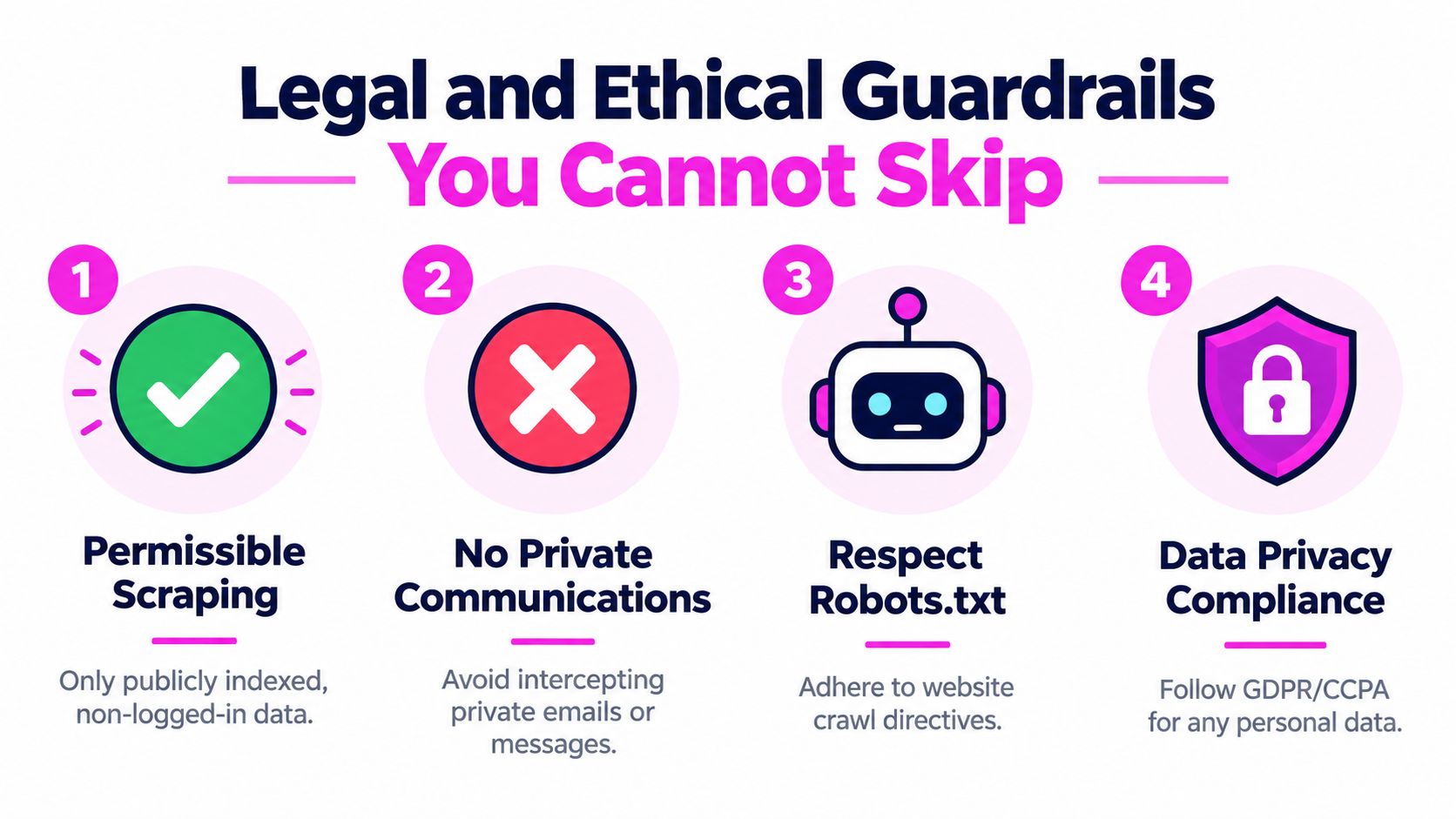
Publicly indexed SERPs, visible competitor pages, backlink profiles, ad copy, and other public marketing materials are normal inputs. If a page is public and your collection respects site rules and platform constraints, you're on solid ground.
The problem starts when teams get sloppy and treat “technically accessible” as “ethically fine.” Logged-in content, private communities, paywalled materials copied without permission, and repackaged third-party datasets are where risk shows up fast.
What I won't touch
I won't approve workflows that scrape behind logins, intercept communications, or encourage anyone to obtain internal materials from a competitor. That's not competitive marketing intelligence. That's a different category entirely, and it can create trade-secret exposure very quickly.
I'm also careful with personal data. If a workflow stores named employee commentary, social posts, or contact details, legal review should cover data retention, access, and deletion rules under privacy regimes such as GDPR and CCPA.
Human review is not optional
Automation helps with scale, but it also pulls in junk. Old pages, misattributed claims, defamatory forum threads, scraped duplicates. Before any competitive brief goes to a client, leadership team, or sales org, a human should validate the source, the date, and the relevance.
Use a simple checklist:
- Public access only: No logged-in, private, or deceptive collection
- Respect site controls: Follow robots.txt and platform rules where applicable
- Attribute carefully: Don't lift proprietary framing or pass off a third party's dataset as your own
- Review before sharing: Confirm the content is current, accurate, and appropriate for distribution
These rules don't slow the program down. They keep it defensible, repeatable, and trustworthy.
SemDash gives SEO teams one place to run the practical side of competitive marketing intelligence: keyword gaps, backlink gaps, SERP history, traffic share, and AI Overview citation tracking. If you want to build a weekly competitor workflow that turns observations into page updates and outreach actions, visit SemDash.