


You publish a category page, then add a detailed guide targeting what looks like the same query. A few weeks later, the pages alternate in Google's results, neither holds a stable position, and the traffic report looks flat despite several rounds of content updates. You've probably started questioning the titles, word counts, and freshness of both pages.
Before rewriting either URL, verify that the problem is structural. Keyword cannibalization happens when multiple URLs compete for the same query and intent, splitting clicks, backlinks, and internal link equity instead of concentrating those signals on one useful result. The most reliable way to fix keyword cannibalization is not to merge every page that shares a phrase. It's to diagnose the overlap, choose a page based on intent, and consolidate only when both URLs have the same job.
Inhaltsverzeichnis
- When Cannibalization Is Actually the Problem
- Detecting Cannibalization in Google Search Console
- Choosing the Page That Should Win
- Merging Content and Setting Up Redirects
- Rewiring Internal Links and Topic Clusters
- When You Should Not Consolidate
- Keeping Cannibalization From Coming Back
When Cannibalization Is Actually the Problem
I've seen teams treat every instance of two URLs ranking for a similar term as an emergency. That approach creates as many problems as it solves. Google doesn't automatically penalize a site because multiple pages appear for one query. As Search Engine Journal's coverage of Google's guidance explains, “keyword cannibalization” is often used as a broad label for low-ranking pages with similar topics, not as the name of a standalone penalty. (Search Engine Journal's explanation of Google's position)
A genuine problem usually looks like this:
- The URL keeps changing: One page ranks, then the other takes its place, without either becoming the clear result.
- The combined result stays weak: Total impressions remain broadly flat while clicks become divided between URLs.
- The page signals overlap: Titles, H1s, introductions, structured data, and internal anchors describe nearly the same need.
That third signal matters because it reveals what your site is telling Google. A category page and a blog post can both mention “project management software,” but they may still deserve separate rankings if one helps someone compare products and the other explains the category. If both pages present the same recommendations to the same audience, the overlap is structural. If they answer different questions, merging them may remove useful coverage.
Start with diagnosis, not word count
When two pages compete, adding more paragraphs to both often creates a larger collision. I'd first compare the query data, the ranking URLs, and the intent represented in the current search results. Only after confirming that the pages satisfy the same search need would I consider consolidation.
The historical shift in SEO has been from page-by-page keyword matching to query and intent mapping. The practical workflow is now to identify one preferred URL for a query, merge duplicate pages when appropriate, use a 301 redirect, update internal links, and remove redirected URLs from XML sitemaps. That operational approach is documented in Semrush's keyword cannibalization workflow.
Praktische Regel: If the pages have different jobs, separate them. If they have the same job and split meaningful visibility, consolidate them.
Age and site growth make this review more important. A 2026 marketing-statistics summary reported duplicate-keyword overlap rates of 2.19% for sites aged 0–1 years, 3.08% for sites aged 1–3 years, 6.44% for sites aged 3–5 years, 10.73% for sites aged 5–10 years, and 13.95% for sites older than 10 years. Those figures are reported in Neil Patel's keyword cannibalization statistics summary. The lesson isn't that every older site needs mass deletion. It's that publishing without a page-level map creates more overlap as the library expands.
Detecting Cannibalization in Google Search Console
Google Search Console should be your first diagnostic tool because it shows which URLs received impressions and clicks for a query. Third-party platforms can surface possibilities at scale, but they can also turn ordinary topical overlap into a long list of false positives.

Use the query and page breakdown
Öffnen Performance > Search Results and filter by a suspected query. Select the Seiten tab. You're looking for multiple URLs that receive meaningful impressions for the same term, not a URL that appeared once with negligible visibility.
I use a simple working sheet with the query in one column and every ranking URL in the next. Flag a query when two or more pages show sustained visibility and their intent appears interchangeable. The SemDash guide to identifying keyword cannibalization is useful if you want a broader audit workflow alongside the GSC review.
The brief's operational workflow recommends filtering by queries with more than 100 impressions per month and checking whether two or more pages split impressions for the same term, as documented in Semrush's guide. Treat that as an investigation threshold, not a universal law. A low-volume commercial query can still matter if the ranking page has strong business value.
Compare time periods before changing URLs
Use Search Console's date comparison to compare the last three months with the prior three months. Look for a leader whose clicks or CTR declined while another page gained visibility for the same query. Then inspect whether the average position moved between the URLs rather than falling across the whole market.
URL Inspection adds a technical check. Inspect each competing page and confirm which URL Google has indexed, which canonical it reports, and whether the selected canonical matches your intended page. Search Console's data should drive the decision, while URL Inspection helps explain why Google may be choosing a different version.
For a scalable audit, export the query and page data, group rows by query, and flag clusters where multiple URLs receive meaningful impressions. You can also search for cannibalized keywords with a focused Search Console process, but don't skip the intent review. Multiple URLs can be healthy when they serve distinct needs.
Choosing the Page That Should Win
Don't redirect the page with the most traffic automatically. That shortcut often preserves the wrong intent. A commercial landing page may have less historical traffic than an informational article, yet it can be the correct destination for a query where users are clearly evaluating providers or products.
I choose the winner in a fixed order. Intent fit comes first. Compare the dominant SERP results and examine each URL's title, H1, introduction, page structure, calls to action, and conversion purpose. The page that best satisfies the dominant intent is the default winner, even if its current metrics are weaker.
Backlink equity comes next. Check referring domains on the exact URL in Ahrefs, Semrush, or Majestic. Domain-level authority isn't enough because the competing pages may have very different link profiles. Prefer topically aligned links over raw quantity, since a page with relevant editorial references is usually a stronger consolidation base than one with unrelated links.
GSC engagement is the final filter. Compare clicks and CTR across the recent reporting period, separating branded and non-branded queries where possible. Branded clicks can make a page look stronger without proving that it satisfies the generic search intent you're trying to consolidate.
Make the decision auditable
| Signal | Gewichtung | How to Measure | Override Condition |
|---|---|---|---|
| Suchabsicht-Passung | Highest | Compare SERP intent, title, H1, structure, and conversion role | Override only when the page clearly serves a different intent |
| Backlink equity | Secondary | Review referring domains and topical relevance for the exact URL | Use as the tiebreaker when intent is genuinely tied |
| GSC engagement | Final filter | Compare clicks, impressions, and branded versus non-branded CTR | Use to validate the choice, not replace intent analysis |
The decision rule is simple: keep the URL with the strongest intent fit, and override that choice with backlinks or clicks only when intent is a clear tie. A documented consolidation case reported a 466% year-over-year click increase after duplicate content was merged and the weaker page redirected, according to CrawlWP's consolidation guidance. That result supports the method, but it isn't a promise that every merge will produce the same outcome.
In one 2026 study of 100 sites, 68% showed significant cannibalization, 12% had excellent control with only 1–2 URLs per top keyword, and one site had 59 URLs competing for a single query, wie berichtet von Studio36 Digital. The extreme example is a governance failure, not a reason to merge blindly.
Merging Content and Setting Up Redirects
Once I've chosen the winner, I treat the consolidation like a controlled migration. The redirect is only one part of the fix. If you redirect a useful page without transferring its unique value, you may remove content that helped the cluster satisfy users.
Build the surviving page first
Export both URLs and compare them side by side. Identify sections, examples, definitions, media references, and FAQs that exist only on the weaker page. Move useful material into the winner before rewriting it. I preserve the unique substance first, then edit for consistency, accuracy, and a single intent.
Update the winner's title tag, H1, introduction, headings, and structured data so they describe one clear page. Don't combine contradictory claims or preserve outdated sections because they add length. A longer page isn't automatically a better consolidation.
Audit every URL reference during the merge:
- Internal links: Replace links to the retiring URL with links to the winner.
- Images and assets: Check image paths, captions, and references so the merged page doesn't create broken resources.
- Embedded references: Review downloadable files, related guides, and calls to action that may still point to the old page.
- Metadata: Remove duplicate titles, conflicting canonicals, and old structured data tied to the retired URL.
Apply the redirect and clean the signals
Map a permanent 301 redirect from the weaker URL to the winner. Google's canonicalization guidance treats redirects as a strong signal when one URL permanently replaces another, making them appropriate for a true merge. Google's documentation on consolidating duplicate URLs explains why the target should become the canonical destination in that situation.
Remove the redirected URL from XML sitemaps. A sitemap that continues to list the retired page sends a mixed technical signal and wastes crawl attention. Then manually test the redirect with a cURL check, inspect the response chain, and make sure it reaches the intended winner without intermediate redirects.
A practical sequence looks like this:
- Merge unique content: Transfer useful material and resolve conflicts.
- Align page signals: Rewrite the title, H1, introduction, and supporting headings.
- Redirect the loser: Point the old URL directly to the surviving page.
- Update discovery paths: Clean sitemaps and internal links.
- Verify indexing: Add a self-referential canonical to the winner, request reindexing in GSC, and review the Indexing report.
For WordPress sites, implementation can involve rewrite rules, redirect plugins, or server configuration. Before changing rules, review a practical WordPress security rules guide so the redirect doesn't introduce broader access or routing problems.
Leaving both near-duplicate URLs live is busywork disguised as caution. It keeps signals split and can create ranking instability instead of recovery, a risk also highlighted in CrawlWP's keyword cannibalization guidance. A redirect only works as a consolidation when the old URL is retired and every important path points to the winner.
Rewiring Internal Links and Topic Clusters
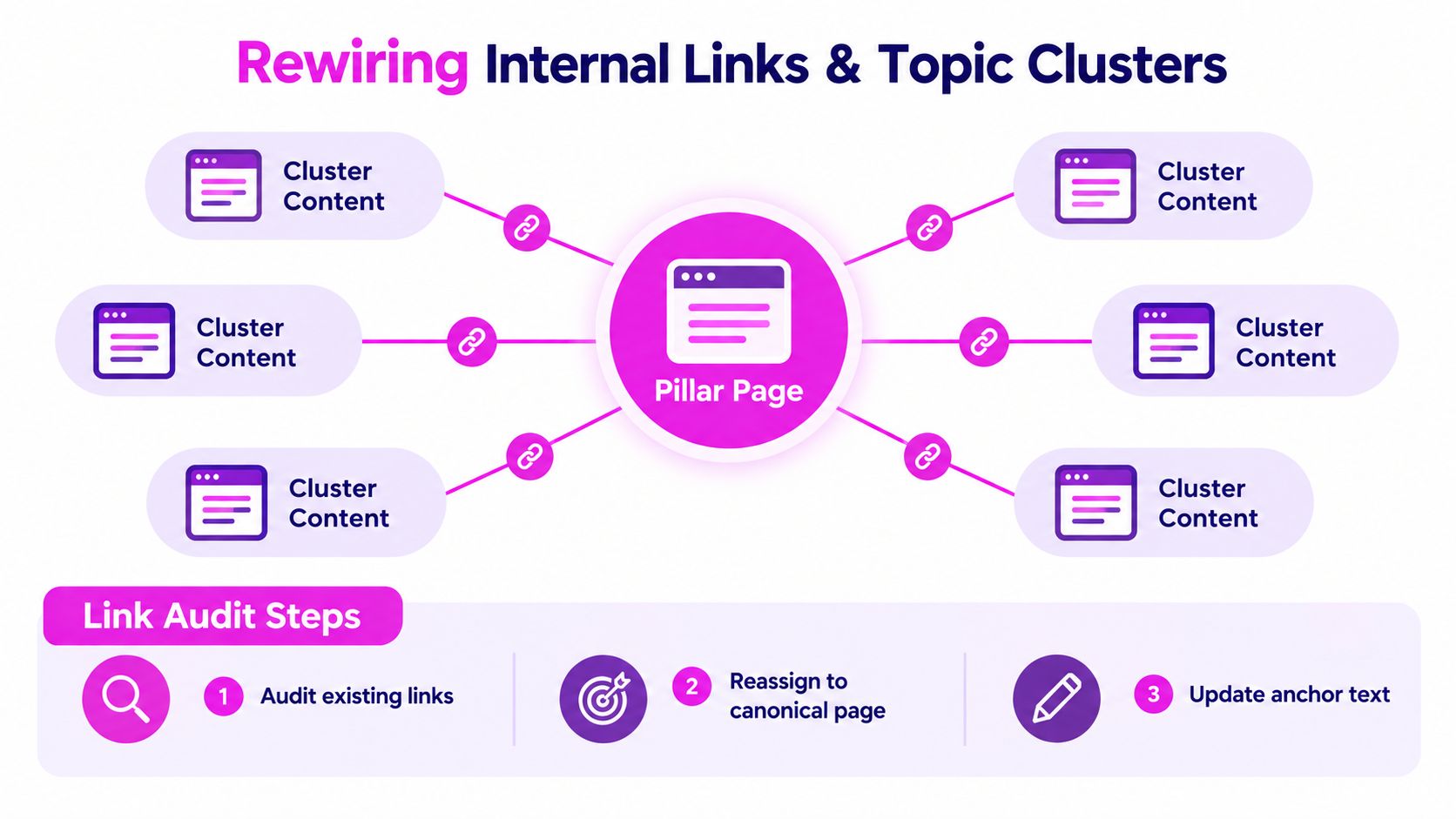
A redirect repairs the URL relationship. Internal links repair the site's interpretation of the topic. If half of your articles still point to the retired page with the old anchor text, your architecture continues to distribute relevance in the wrong direction.
Start with a crawl export and filter every internal link that targets the loser URL. Replace those destinations with the winner wherever the surrounding context supports it. Then review the anchor text. Use descriptive variations that accurately reflect the destination, rather than forcing the same exact phrase into every link.
Give every page one job
I use a hub-and-spoke model for content planning:
- Pillar page: Owns the broad primary query and provides the complete core answer.
- Cluster pages: Cover adjacent long-tail questions, use cases, comparisons, or implementation details.
- Internal links: Connect supporting pages back to the pillar when the pillar is the best next resource.
- Cross-links: Connect cluster pages only when the relationship helps the reader, not to create artificial link volume.
An article about choosing accounting software may link to a pillar about accounting software, while a page about invoice automation targets a narrower need. Those pages can share vocabulary without competing if their titles, structures, and calls to action make their roles clear.
Put the map inside your publishing workflow
Label each URL by topic cluster in the CMS or content database. Before a writer drafts a new page, assign its parent topic, primary query, supporting queries, and intended conversion role. If the idea already belongs to an existing URL, update that page instead of creating another near-duplicate.
Orphan pages are a quiet source of future overlap. Without links from a hub or related pages, new content often gets published as an isolated asset with no clear relationship to the existing cluster. A clear architecture review, such as the one described in SemDash's guide to web page architecture, helps prevent that drift.
For a practical overview of connecting content strategy with small-business search visibility, Boocoo's small business SEO guide provides useful context. The key implementation choice remains page-level ownership. One pillar should own the main query, while supporting pages earn visibility through differentiated subtopics.
When You Should Not Consolidate
Aggressive merging is the most common cannibalization mistake I see. Teams discover two URLs in Search Console, redirect one, and only later realize that the supposedly weaker page generated qualified leads, attracted relevant backlinks, or served a different stage of the buyer journey.
Keep both pages when the intents are distinct. An informational guide can explain how a product category works, while a commercial page helps users compare options or request a demo. A local service page, a product variant, or an audience-specific landing page may also need its own URL because the conversion path and content requirements differ.
Use the page itself to widen the separation:
- Informational page: Rewrite the title and H1 around learning, evaluation criteria, definitions, or implementation.
- Commercial page: Focus the title, headings, proof, features, pricing context, and calls to action on selection or purchase.
- Location page: Add local service information and route visitors to the appropriate local conversion path.
- Variant page: Make the product, format, audience, or use case explicit rather than repeating the parent page.
A useful test is whether both pages earn value independently. If both generate conversions or attract relevant backlinks, differentiate before you merge. Also check whether each page ranks for different long-tail queries, appears for different SERP features, or supports a separate internal journey.
Do not merge a page merely because the keyword appears in both titles.
The decision should reflect intent, clicks, conversions, and backlink strength. Google can show multiple URLs from one domain for a broad topic when each page addresses a different layer of the need. The more nuanced portfolio approach is to choose among merging, redirecting, canonicalizing, noindexing, or differentiating on a page-by-page basis, as discussed in SerpSmoothie's current cannibalization framework.
A blunt consolidation can destroy long-tail rankings and remove a page that users needed. I'd rather spend time rewriting a secondary page's title, introduction, internal anchors, and content focus than erase equity that the original audit failed to recognize.
Keeping Cannibalization From Coming Back
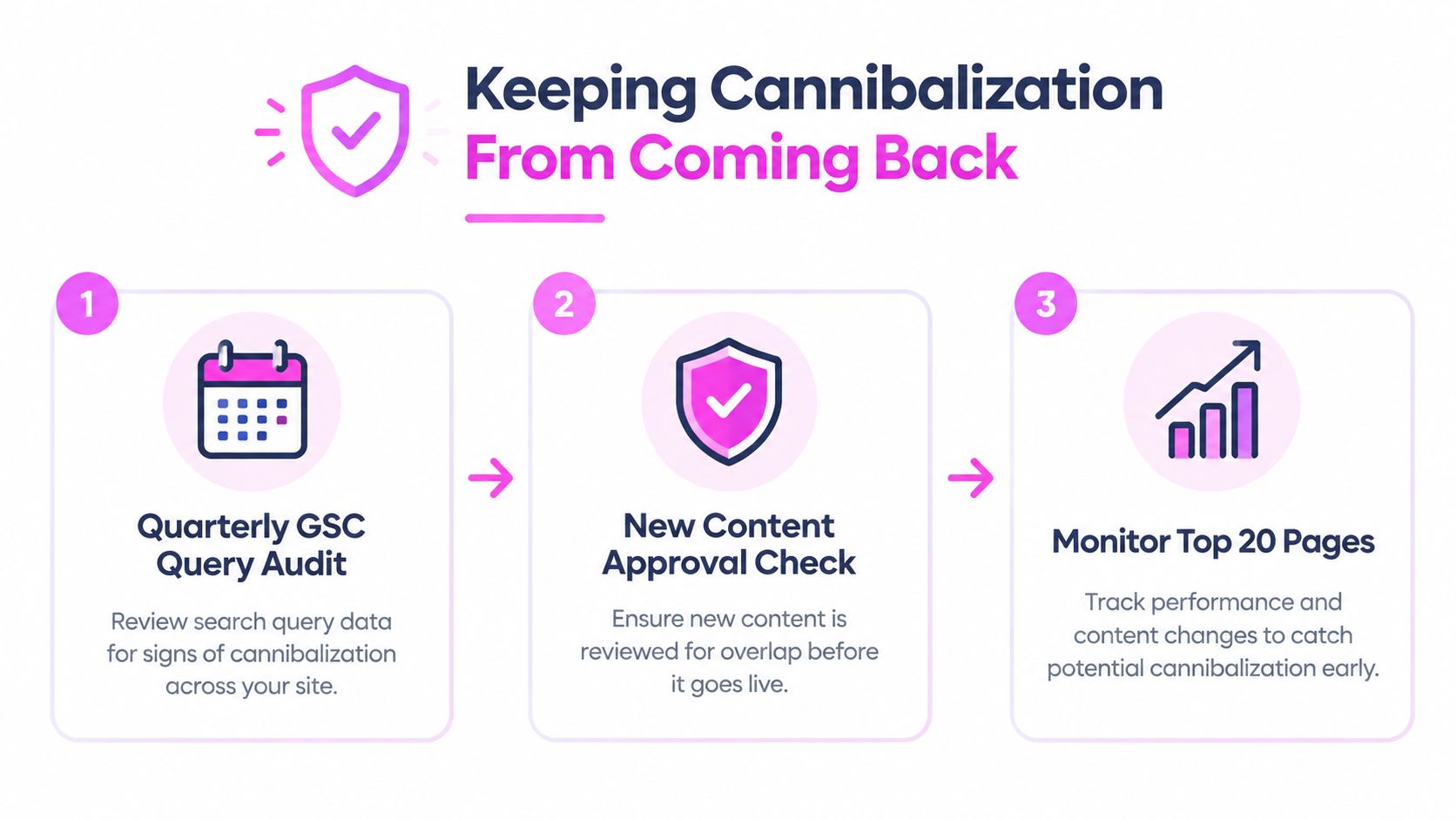
Cannibalization is a maintenance problem, not a one-time cleanup. Once a site has enough content, new pages can recreate the same overlap unless authors check existing coverage before drafting and someone owns the decision.
I'd establish a recurring GSC review that exports query-to-page data and groups URLs by query. The audit should flag cases where more than one URL receives meaningful impressions, then assign each flag to a named SEO or content owner. A twice-yearly audit cadence is explicitly recommended in recent practitioner guidance, including SerpSmoothie's audit approach. Larger sites may need more frequent monitoring for priority clusters.
Build controls into publishing
Before approving a brief, require the writer to review the existing SERP and the site's topic map. Each new URL should have a primary query, a distinct intent, supporting queries, a parent cluster, and a clear reason it needs to exist separately from current pages.
The approval checklist should include:
- Existing coverage: Confirm whether an established URL already satisfies the proposed intent.
- SERP comparison: Review the result types and page formats currently ranking for the target query.
- Page ownership: Record the primary URL and supporting URLs in a central map.
- Internal routing: Decide which hub should link to the new page and which pages should receive links from it.
- Post-publish review: Check whether the new URL begins receiving impressions for an existing page's primary query.
I also review internal anchor text before publication. A new article shouldn't use the same anchor and destination pattern as an existing page if the two URLs are meant to serve different purposes. Clear labels in the CMS make this easier than relying on a writer's memory.
Watch for drift, not just duplication
Search intent changes, product ranges expand, and old pages accumulate sections that belong elsewhere. A deeper annual sweep should combine crawl exports, backlink overlap, internal-link analysis, and intent clustering. Review pages with declining clicks, unstable ranking URLs, or increasing zero-click visibility, because those patterns can indicate that the page's role no longer matches the query.
A portfolio review is more useful than a page-count purge. Rank URLs by business value, intent fit, backlink equity, and freshness, then choose the least disruptive action. Some pages need consolidation. Others need a sharper title, better internal links, a canonical, a noindex directive, or a new supporting cluster.
The strongest prevention system catches overlap during planning rather than after traffic erodes. Keep the query map current, make page ownership explicit, and review competing URLs within the reporting cycle where the problem first appears.
SemDash helps you investigate cannibalization at URL level with keyword clustering, query-to-page mapping, backlink research, SERP history, and intent signals in one workspace. Visit SemDash to identify competing pages, assign clearer page ownership, and plan content that strengthens a cluster instead of splitting it.