
Most keyword research advice starts in the wrong place. Open Ahrefs, Semrush, or another database, export thousands of phrases, sort by volume, and call the result a strategy. I've built semantic cores that looked impressive in spreadsheets and produced almost nothing useful because the terms weren't connected to a page, a buying decision, or the intent visible in the search results.
The better starting point is the SERP and the business outcome. Keyword tools are valuable for discovery, but they can't decide whether a query deserves an article, a comparison page, a product page, or no page at all. That decision comes from understanding what searchers want, what your site can credibly satisfy, and how each topic supports the path from discovery to conversion.
Keyword research remains a foundational content-marketing input because it helps teams choose topics aligned with real demand. One industry summary reports that 75.5% of marketers use keyword research to shape what they publish, während 78% of B2B marketers build content around it (keyword research adoption data). The differentiator isn't whether you research keywords. It's whether your research produces a coherent site structure and a publishable set of pages.
Inhaltsverzeichnis
- Warum die meisten Keyword-Recherchen scheitern, bevor sie beginnen
- Ziele setzen und deine Seed-Liste richtig erstellen
- Volumen, Schwierigkeit und tatsächlichen Geschäftswert bewerten
- Intents klassifizieren und Keywords einer Seite zuordnen
- Themen clustern und sie in Content Briefs verwandeln, die ranken
- Leistung verfolgen und deinen Content-Plan aktuell halten
Warum die meisten Keyword-Recherchen scheitern, bevor sie beginnen
Keyword research fails before the first export when teams let volume choose the page. A database can show demand, but it cannot confirm whether the searcher wants a tutorial, vendor, definition, comparison, or feature page. It also cannot show whether your site can compete with the result types already winning.
Consider a B2B cybersecurity team targeting “endpoint security.” The live SERP was filled with vendor category pages, product landing pages, and established software brands. The team drafted a broad educational article because the keyword had attractive volume, yet the format was mismatched before writing began. The issue was query intent, SERP composition, and page purpose, not article quality.
Praktische Regel: Before asking “How many searches does this keyword have?” ask “What does Google believe this searcher needs?”
A semantic core should support three decisions:
- Audience need: What problem or question does the searcher express?
- Business role: Which service, product, lead, or relationship could the topic support?
- Architecture: Should it map to an existing URL, a new page, or a broader topic hub?
The tool-first workflow produces tidy spreadsheets with weak decisions behind them. Exports often combine near-duplicates, spelling variants, mixed intents, and queries the business cannot satisfy. Without a page-mapping rule, writers choose terms independently and create several URLs for one topic, leaving them to compete with each other.
The practical sequence is different. Start with the pages and outcomes that matter, inspect live results, then use tools to expand the list and estimate opportunity. The SERP check also gives low-volume topics a fair test. If a query produces relevant competitors, recurring questions, product comparisons, or an emerging AI Overview, it may deserve a place in the core even before a database records meaningful volume. Cluster related queries around the need shown in the results, then validate whether one page can satisfy them.
Search planning has shifted toward intent-led planning. Content needs to answer a real need and cover a meaningful topic, rather than force an exact phrase into every heading.
An intent analysis reported a corpus split across 26.52% informational, 17.68% commercial, 30.55% transactional, 22.29% navigational, and 2.96% mixed queries (search-intent analysis). The distribution will vary by market, but the working implication is stable: one format cannot satisfy every query type.
Every keyword must answer three questions: who searches it, what page would satisfy them, and what useful next action follows? If those answers remain unclear after checking the SERP, more keyword suggestions will not repair the plan.
Ziele setzen und deine Seed-Liste richtig erstellen
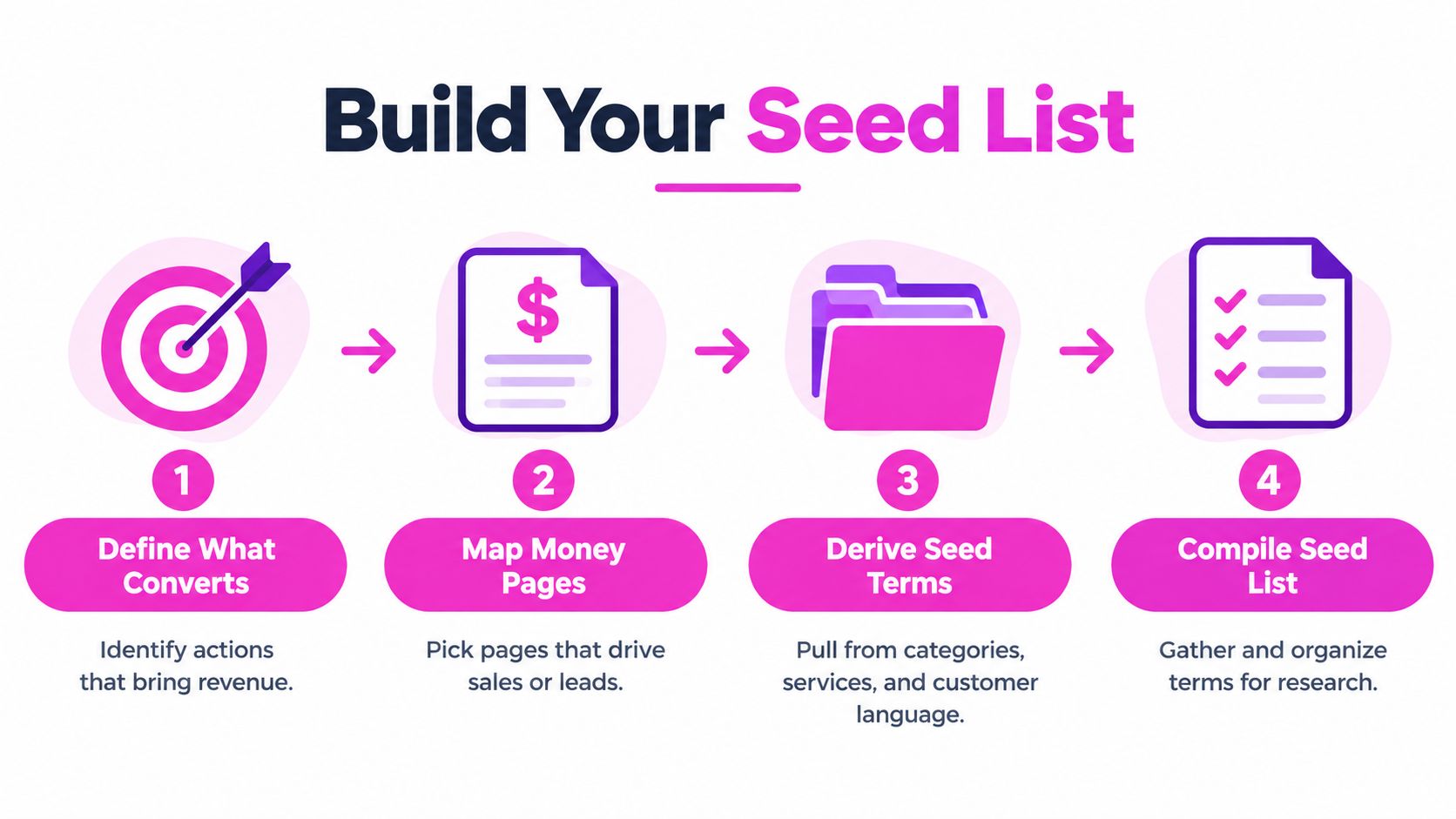
Keyword research should begin with a business decision, not a keyword tool. Define the outcome the site must support. A SaaS company may prioritize qualified demo requests, an ecommerce store may focus on product discovery and category engagement, and a consultancy may need leads for a specific service. That conversion event determines which informational topics deserve investment and which attractive terms would pull the plan away from revenue.
Beginne mit Money Pages
List the URLs closest to revenue or lead capture. For each one, record the language customers use around the product, service, or problem. Sales calls, support tickets, product menus, onboarding questions, and customer descriptions usually produce better seeds than polished marketing terminology.
For a VPS hosting page, the initial list might include “VPS hosting,” “managed VPS,” “Linux VPS,” “VPS for developers,” and “how to choose VPS hosting.” These are discovery inputs, not final targets. They represent a category, adjacent needs, and research questions that can later become separate pages or a single well-scoped resource.
A generic industry core creates noise. A hosting company can collect terms about servers, cloud computing, and website speed, yet still miss the searches tied to its offer. Build the core around audiences, use cases, constraints, comparisons, and purchase decisions. Check live search results as you collect ideas. A zero-volume term with relevant competitors, recurring questions, product comparisons, or an emerging AI Overview may reflect a real need before keyword databases record demand.
Erweitere erst, wenn die Geschäftslogik klar ist
Expand each seed along a few deliberate paths:
- Category variations: Capture customer terms for the product, service, problem, and alternatives.
- Use cases: Add audience and context modifiers, such as “VPS hosting for agencies” or “VPS for high-traffic WordPress.”
- Questions: Collect “how,” “why,” “when,” and “which” queries that may support educational pages.
- Comparison language: Review “alternative,” “vs,” “review,” “pricing,” and “best” patterns, then inspect the SERP rather than assuming the intent.
- Related discovery: Use long-tail suggestions, People Also Ask, and related-query features to find subtopics that belong around the core.
SemDash supports keyword discovery through Domain Keywords, Keyword Gap, long-tail suggestions, People Also Ask, and People Also Search data. Its keyword discovery uses a 6,6B-Keyword-Datenbank, according to the publisher's product information. Treat that output as an idea pool, not an editorial plan.
Competitor reports become useful when tied to a decision. Which pages earn visibility? Which terms connect to the product category? Where does a competitor have a relevant page that the site lacks? Domain Keywords and Keyword Gap can expose those gaps, while Top Pages and Traffic Share show which pages receive attention in the market.
Keep the raw output in a sheet with the seed, expanded query, suspected intent, related money page, and live SERP notes. The final column forces a manual check of the results, including format, recurring subtopics, competitors, and whether one page could satisfy the related queries.
The seed list should describe your customer's problem space, not your tool's database.
The finished list should be focused, connected to real site destinations, and broad enough to reveal clusters. It does not need every variation. It needs enough customer language to test demand, justify emerging topics, and make sound page decisions.
Volumen, Schwierigkeit und tatsächlichen Geschäftswert bewerten
Prioritize keywords by the decision they support, not by the largest number in a tool. I score each candidate across intent fit, business value, and competitive difficulty, then record the evidence behind the score. Intent fit and business value carry more weight because a page that attracts the wrong audience can rank without producing useful marketing results. A practical keyword difficulty and intent framework applies the same principle by giving those dimensions more weight than ranking ease.
Lies die Metriken als Signale
Search volume estimates the scale of an existing query pattern, not the value of every visit. Traffic estimates add context because click distribution, SERP features, and ranking position affect the visits a result can receive. Keyword Difficulty indicates a competitive barrier, but it remains an abstraction. Check the live results for the authority, relevance, format, and depth of the pages already ranking.
Long-tail queries often reveal a specific problem, audience, or use case. An industry summary estimates that roughly 70% of all search traffic comes from long-tail keywords (long-tail search data). Use that pattern to justify focused pages, not to discard broader terms. A zero-volume keyword can still earn a place in the plan when the live SERP shows a clear need, competitors already address it, or the topic supports a product decision. This is especially useful for emerging topics shaped by AI Overviews, where reported volume may lag behind visible demand.
Validate those opportunities manually. Search the phrase in the target market, review recurring questions and result formats, and compare the topic with customer conversations, sales objections, and existing site pages. If the SERP contains no meaningful results, keep the topic as a test rather than treating the keyword tool's estimate as proof.
Difficulty should shape sequencing. Favor specific, commercially connected pages that the site can realistically support, then build internal links and topical coverage before pursuing highly competitive category terms. The SemDash keyword research metrics guide provides a useful reference for interpreting the underlying measurements, but the final priority should come from the SERP and the business context.
Verwende eine Entscheidungsmatrix
| Keyword-Beispiel | Intent-Passung | Geschäftswert | Schwierigkeitssignal | Prioritätsentscheidung |
|---|---|---|---|---|
| VPS-Hosting | Hoch für einen Hosting-Anbieter | Hoch | Wettbewerbsfähiger Head-Term | Erstelle oder stärke die Kategorie-Seite |
| Managed VPS für Agenturen | Hoch | Hoch | Spezifischerer Wettbewerb | Priorisiere, wenn der Service und die Zielgruppe real sind |
| Was ist ein Virtual Private Server? | Mittel | Mittel | Normalerweise breiterer informativer Wettbewerb | Nutze es als unterstützende Bildung, wenn es natürlich zum Service führt |
| Server-Hardware-Geschichte | Niedrig | Niedrig | Kann einfach sein | Priorisiere nicht, es sei denn, es unterstützt einen definierten Zielgruppenbedarf |
| Checkliste für VPS-Migration | Hoch für einen bestehenden oder bewertenden Kunden | Mittel bis hoch | Validiere in der Live-SERP | Erstelle einen praktischen Leitfaden und verlinke auf Migrationsunterstützung |
The matrix is a record of reasoning, not a fake-precision score. It exposes weak assumptions and makes trade-offs visible. A smaller query with a direct commercial connection can outrank a high-volume term with poor audience fit. A difficult term with highly relevant competitors may remain a long-term target, while narrower supporting content earns priority now.
Review the matrix whenever the SERP changes or a new topic appears. For each candidate, note the evidence, the intended page, the likely business action, and the next validation step. That process lets you defend zero-volume opportunities without pretending demand is already proven, and it keeps AI Overview-driven topics tied to observable search behavior rather than tool output alone.
Intents klassifizieren und Keywords einer Seite zuordnen
Tools can label intent, but the live SERP decides whether that label is useful. Search each candidate in the target market and inspect result types, page formats, titles, recurring subtopics, and calls to action. If product pages dominate, an article may struggle even when the query sounds informational. If guides, definitions, and tutorials fill the results, a commercial landing page may miss the searcher's immediate need.
Den dominanten Zweck klassifizieren
Use four practical categories:
- Informationsorientiert: The searcher wants an explanation, process, definition, or answer.
- Commercial: The searcher is researching options, providers, features, or comparisons.
- Transaktional: The searcher is ready to buy, sign up, or request a quote.
- Navigational: The searcher wants a particular brand, platform, or page.
Mixed intent needs careful handling. “Best VPS hosting,” for example, can reflect both research and commercial evaluation. Check the dominant result format and the needs shared by ranking pages before deciding whether one page can serve the query. A tool's category is only a starting hypothesis.
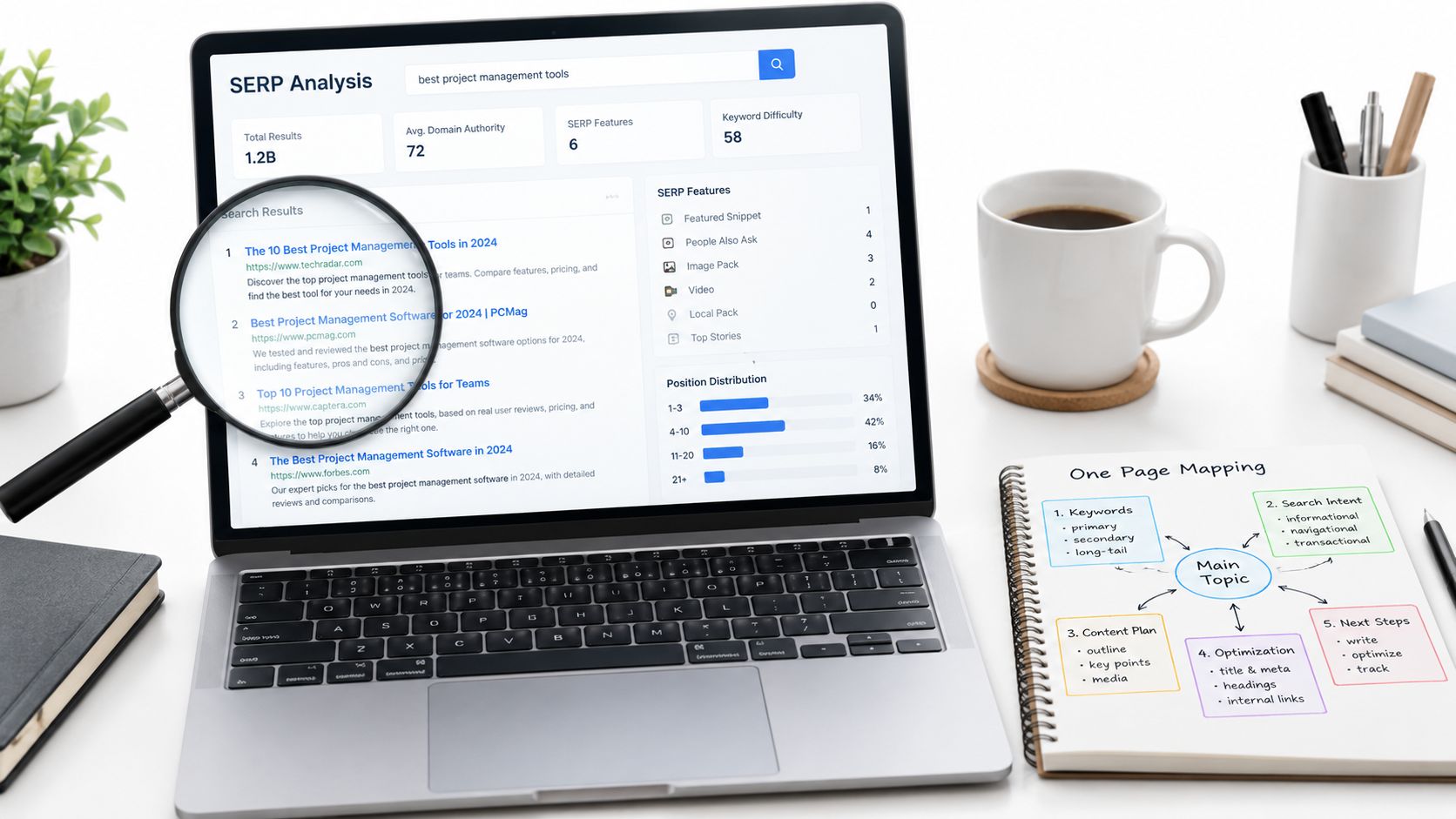
A SERP history view separates a stable pattern from a temporary result set. SemDash's SERP Checker provides 12-monatige Historie for trend and volatility analysis, while its AI-assisted classification can speed up the first review. Manual inspection still matters because the final decision depends on the format and promise your team can produce.
Wende die Ein-Seiten-Regel an
Map one primary keyword cluster to one URL. Align the primary query with the title tag, H1, URL slug, page purpose, and internal-link anchors. Let the page cover closely related subqueries when they support the same search need.
This prevents two articles from competing for the same intent and gives editors a usable brief. Organic clicks concentrate near the top of results, so page selection has a direct effect on the opportunity available to each URL. Splitting one topic across several weakly differentiated pages can dilute relevance and authority.
Zero-volume terms still deserve consideration when a live SERP shows a clear, underserved need, especially where AI Overviews are changing how people phrase or refine searches. Record the visible result formats, recurring questions, and commercial paths before assigning the topic to a page. That evidence supports a reasoned test without pretending that a keyword tool has already proven demand.
An existing page that ranks for part of the cluster usually deserves an update before a new URL. Create a new page when the SERP shows a distinct intent, audience, or format that the current page cannot satisfy without losing focus.
One dominant intent, one primary page, one clear promise.
If you cannot explain why two URLs need separate purposes, they probably should not target separate versions of the same cluster.
Themen clustern und sie in Content Briefs verwandeln, die ranken
A filtered keyword list is still not a content plan. The useful transformation happens when you group queries that can be satisfied by the same page, then define the page's primary promise and supporting coverage. Clustering by wording alone creates messy groups. I cluster by intent, SERP overlap, audience, and the job the page must perform.
For example, “VPS hosting for agencies,” “managed VPS for agencies,” and “agency VPS hosting” may belong together if the result pages answer the same need. “How does VPS hosting work?” may require a separate informational page if the SERP and expected depth differ. The goal isn't to force every related phrase into one article. It's to prevent multiple pages from making the same promise.
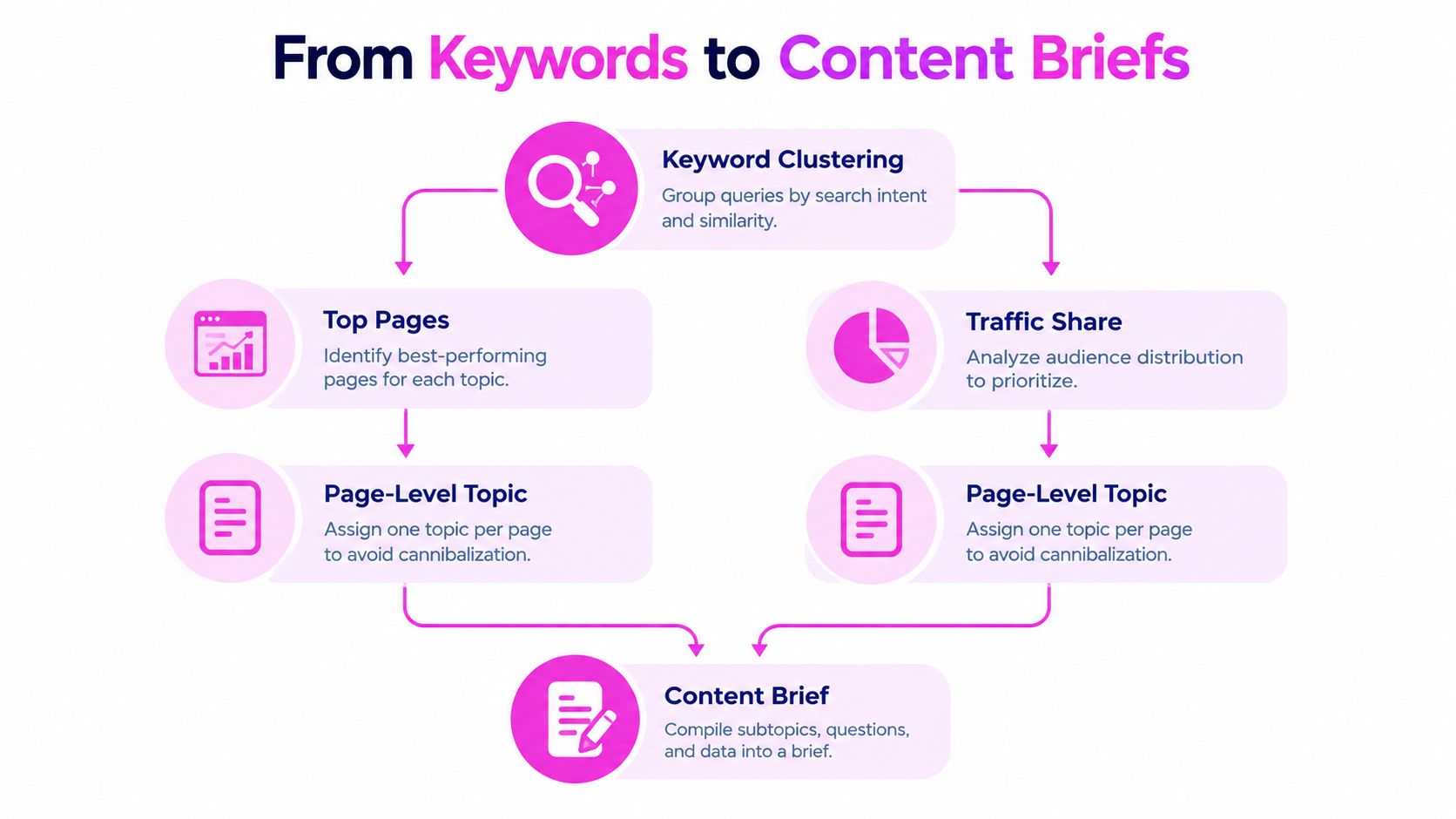
Lass rankende Seiten den Cluster formen
Top Pages shows which competitor URLs attract organic visibility around a subject. Traffic Share helps reveal whether a topic is concentrated in a few dominant pages or distributed across multiple formats. I use both to avoid writing a generic article when the market is won by tools, comparison pages, templates, or category hubs.
People Also Search suggestions are useful for finding adjacent questions and coverage gaps. I separate those into three groups:
- Essential answers: The page must address these to satisfy the main intent.
- Useful support: These strengthen the explanation and improve navigation to related pages.
- Separate opportunities: These deserve their own URL because they signal a different job or audience.
That separation is where many briefs fail. Writers receive a long list of semantically related phrases and attempt to mention all of them. The result reads like a glossary rather than a useful page. A good brief defines what belongs on the page and what should become an internal-link destination.
Erstelle Briefings rund um beantwortbare Passagen
AI-assisted briefs can accelerate the first draft of the outline when they use live SERP evidence rather than generic keyword associations. I want the brief to specify the primary query, dominant intent, competing formats, required subtopics, unanswered questions, internal links, proof points, and conversion path. The SemDash SEO content brief example reflects this page-level approach.
The brief should also account for AI Overviews and conversational discovery. A 2026 source reports that AI Overviews appeared for between 6.49% and 24.61% of queries across 2025mit 91.3% of those triggered queries being informational in January 2025 (AI Overview keyword research analysis). The same source says navigational triggers in one tracked set rose from 0.74% to 10.33% by October 2025, showing why a static “blue links only” workflow is increasingly incomplete.
I structure important answers as self-contained passages. Each passage answers one question directly, supports the explanation with relevant evidence, and links to a deeper page where necessary. I also research conversational prompts used in ChatGPT, Perplexity, and Gemini to identify how people might phrase the same need outside a conventional short query.
Write sections that can stand alone, then connect them into a page that earns the click and the citation.
This doesn't mean writing for machines instead of people. It means making the page's useful answers clear enough for searchers, crawlers, and answer systems to understand.
Leistung verfolgen und deinen Content-Plan aktuell halten
Publishing does not end keyword research. It starts the measurement cycle. Treat every new URL as a test of its original intent hypothesis. The page may attract unexpected queries, rank with the wrong URL, or expose a related need that the initial dataset missed.
Google Search Console supplies the query-level evidence. An impression means a user saw, or could have seen, a link to your site in Search, Discover, or News. A click records a result selection. Average position is the average of the highest position your property held for each impression across the queries where it appeared (Google Search Console Performance report definitions).
Diagnostiziere die Seite, nicht nur den Durchschnitt
Averages hide page-level decisions. A URL can perform well for branded searches while failing for non-branded research terms. Export query data and sort each pattern into an action:
- Rewrite: The page receives impressions for its intended topic, but its title, opening, format, or answer does not meet the SERP's expectations.
- Expand: The URL ranks for related questions, and the missing coverage belongs on the same page.
- Create: The query expresses a distinct intent that the current URL cannot answer without losing focus.
- Redirect or consolidate: Multiple URLs address the same need, and none has a defensible reason to remain separate.
Zero-volume topics need evidence beyond a volume estimate. Keyword tools cannot forecast demand for queries with no historical record, and one 2026 guide reports that roughly 15% of daily searches are brand-new queries with no historical data (emerging-query research). Validate these opportunities through audience urgency, product relevance, customer wording, competitor gaps, live SERP checks, and early query expansion or passage-level impressions. Volume often confirms demand later, rather than identifying the best starting point.
Halte die Map mit dem Markt verbunden
Review ranking changes, competitor launches, SERP format changes, and new questions. Check AI Overview citations at the URL and passage level when data is available. That view shows which page and answer earn visibility instead of treating the entire domain as one result.
Reclaim authority already connected to the topic. Unlinked brand mentions may deserve links to relevant pages, and broken backlinks can often redirect to the strongest live destination. These checks belong in the same content system because publishing another article is the wrong response when an existing page can be improved.
For small businesses connecting search content with distribution, quso.ai's small business social playbook provides practical guidance for planning social promotion around published content. Search and social serve different purposes, but coordinated distribution can put a useful page in front of its intended audience.
Set review points around evidence, not habit. Impressions with weak engagement call for an intent and SERP review. Adjacent queries may justify an expansion or supporting page. Overlapping URLs should be consolidated before more content enters the same cluster.
Use SemDash to discover keyword opportunities, compare competitor domains, inspect SERP history, cluster queries, and create detailed content briefs from live search data. Visit SemDash to turn a keyword list into an intent-led content plan with clear page-level decisions.