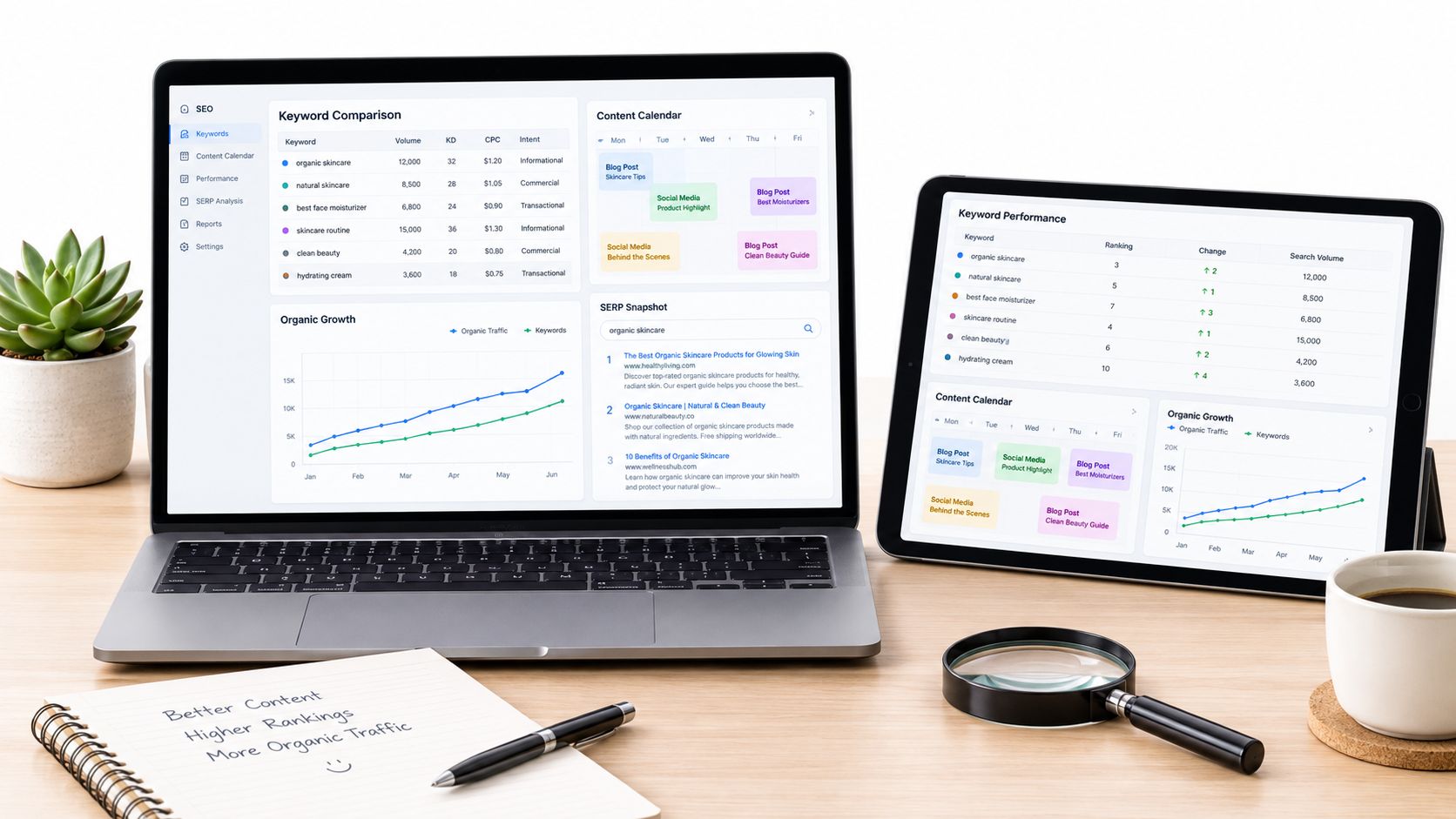


A competitor publishes a comparison page, earns a few relevant links, and starts appearing above your product page for queries that used to convert reliably. You notice the traffic decline in a monthly report, open the search results, and find that the rival has already expanded into the topic. By then, a quarterly audit gives you an explanation, not an advantage.
I've seen this happen across agency and SaaS accounts. The failure usually isn't a lack of SEO data. It's that the data arrives as disconnected snapshots, with no fixed keyword universe, no consistent comparison set, and no process for turning a ranking change into a content or link decision. Competitor SEO tracking works when it behaves like an operating system, not a one-off report.
Inhaltsverzeichnis
- Why Ongoing Competitor Tracking Beats One Off Audits
- Choosing True Search Rivals and the KPIs That Matter
- Building Your Tracking Pipeline Cadence and Dashboard
- Finding and Prioritizing Keyword and Backlink Gaps
- Alerting for Volatility Intent Shifts and AI Overview Churn
- Turning Findings Into Action and Keeping Tracking Lean
Why Ongoing Competitor Tracking Beats One Off Audits
A ranking loss often becomes visible only after the damage is established. The page that replaces yours may have spent weeks expanding into related queries, earning relevant links, and appearing across more valuable results. A one-off audit can explain the outcome, but it rarely shows the sequence early enough to guide the response.
I learned this after starting with the wrong comparison set. Brand rivals were easy to identify because sales teams mentioned them, yet several barely ranked for our priority topics. Specialist publishers and smaller niche sites appeared repeatedly in the results and captured the visibility we needed to monitor.
The mistake was comparing businesses instead of search results.
A single audit shows who ranks at one point in time. It does not reliably show who is gaining momentum, which pages are expanding their keyword footprint, or whether a ranking change reflects a strategic move or normal fluctuation. Search Engine Land's competitor-analysis guidance emphasizes month-by-month comparisons of traffic, backlinks, keywords, and ranking distribution across the top 3, 10, 30, 50, and 100 positions. That position-band framing is exactly what a scheduled pipeline should reproduce automatically.
Snapshots hide the move that caused the loss
Suppose a competitor's category page moves from page two into the top ten. A quarterly review may capture the new position without showing what preceded it. Scheduled comparisons can expose the sequence: supporting queries appear first, relevant referring domains follow, and the page then starts taking positions from several URLs across your site.
Semrush says its Traffic & Market Toolkit includes historical competitor data going back to 2017, allowing teams to review how rivals developed instead of relying only on the current results. That historical depth supports a more useful question: which changes consistently precede visibility gains?
I use a practical KPI stack:
- Traffic share: The estimated organic share captured by each tracked domain.
- Keyword overlap: Queries where your site and competitors compete directly.
- Keyword distribution: How many terms each domain owns in the top 3, 10, 30, 50, and 100 positions.
- Top pages: The URLs responsible for a competitor's visibility.
- Backlinks and referring domains: Where authority is accumulating and which pages attract it.
- SERP volatility: Whether the result set is stable or changing frequently.
- SERP-Funktionen: Featured results, shopping elements, ads, and AI-generated answer placements.
Praktische Regel: Don't ask only, “Who ranks above us?” Ask, “What changed before they started ranking above us?”
A living system catches strategic shifts
Ongoing tracking does not require checking rankings every day. Set a stable comparison set, collect comparable data on a schedule, and define an action for meaningful changes. A new content cluster may require a brief. A backlink surge may justify link reclamation or outreach. A change in result format may indicate that an existing page no longer matches intent.
The same pipeline should also record share-of-voice movement and AI Overview citation volatility. Those signals can change independently of a traditional ranking position, so a competitor may gain visibility even when the top ten appears relatively stable. The useful output is a triggered decision, not another static report.
Choosing True Search Rivals and the KPIs That Matter
Start with the search results, not the org chart. A business competitor can be commercially important and still be irrelevant to your SEO tracking if it doesn't rank for the queries that matter. Conversely, an industry publication, review site, forum, or specialist blog can be a serious search competitor without selling anything similar.
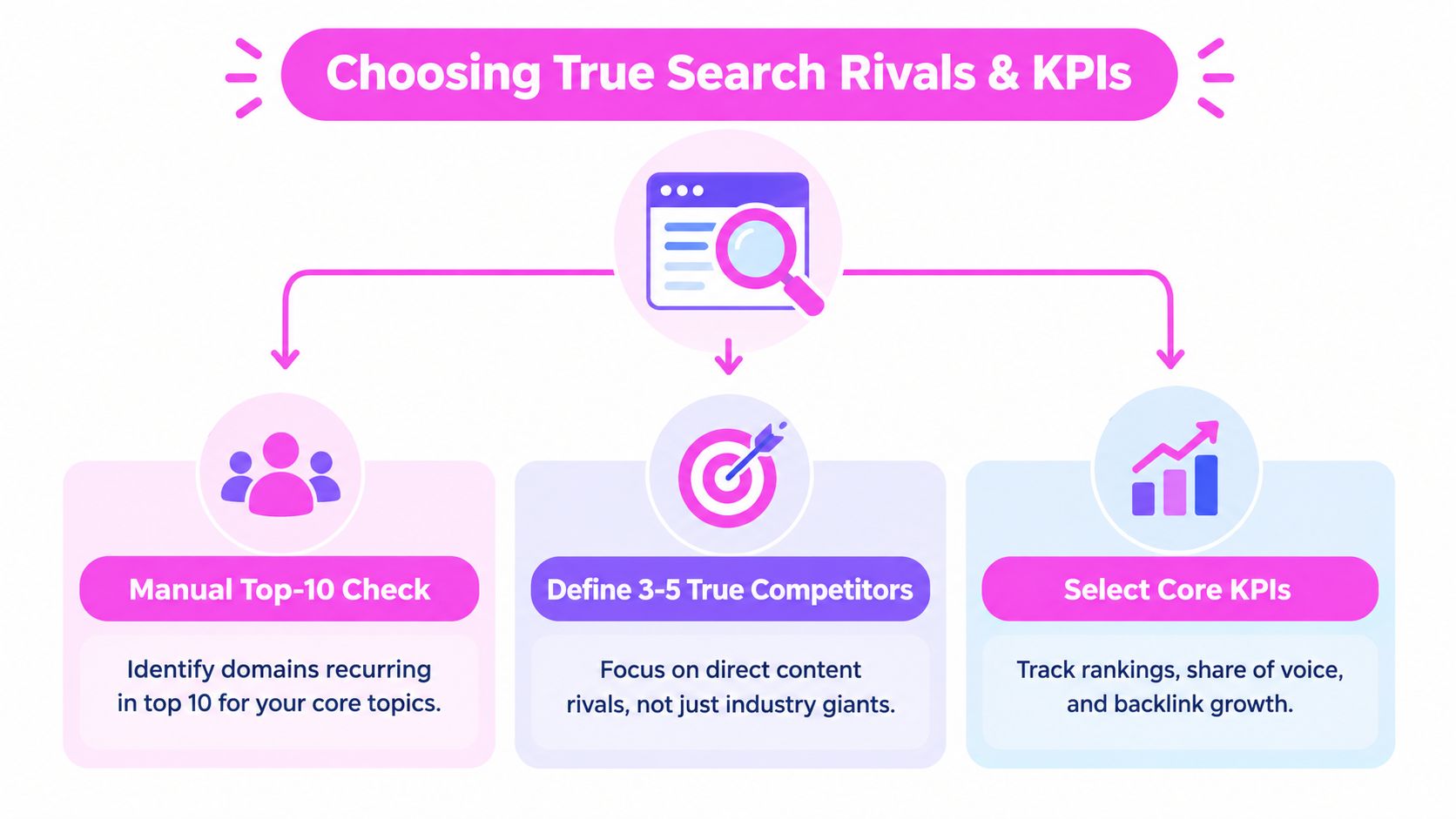
I use a manual check before opening a competitive-research platform. I list the priority queries, search them in a consistent location and device context, and record the domains appearing in the top ten. I'm looking for recurrence across multiple valuable queries, not a single appearance.
Build a focused rival set
A practical tracking set contains 3–5 true content competitors. That's enough to identify recurring patterns without turning the dashboard into an unreadable list of domains. I usually include a mix of:
- A direct commercial rival, if it consistently ranks for product or service queries.
- A specialist content site, which may reveal topic depth and editorial patterns.
- An authority publication, if it dominates informational queries.
- An emerging site, especially one gaining visibility quickly.
- A marketplace or review domain, when those formats occupy the SERP for commercial searches.
Record every domain appearing in positions 1–10 for your priority queries. Then compute each domain's share of the tracked top-ten slots. If your keyword universe contains 100 tracked queries, and a domain owns 80 of the recorded top-ten positions, its domain-level share of voice is 8%. The calculation isn't a measure of revenue or actual traffic. It's a consistent visibility benchmark.
For a broader process on distinguishing search rivals from general industry competitors, how to dominate your market offers a useful starting point.
Choose KPIs that lead to decisions
A KPI belongs on the scorecard only if a change can trigger work.
- Traffic-Anteil helps frame relative visibility, but treat tool estimates as directional.
- Keyword footprint shows whether a rival is expanding into new topics.
- Ranking distribution distinguishes a domain with many page-one terms from one with a few isolated wins.
- Top-page concentration tells you whether growth depends on one page or a broader content system.
- Referring-domain growth can expose a link push behind a ranking improvement.
- SERP feature presence shows whether classic position tracking understates visibility.
- Country and language splits prevent you from treating one market's competitor set as universal.
Keep the scorecard small. A team that tracks every available metric usually acts on none of them. I'd rather have a stable view of traffic share, keyword distribution, top pages, referring domains, and SERP features than a sprawling dashboard nobody reviews.
Building Your Tracking Pipeline Cadence and Dashboard
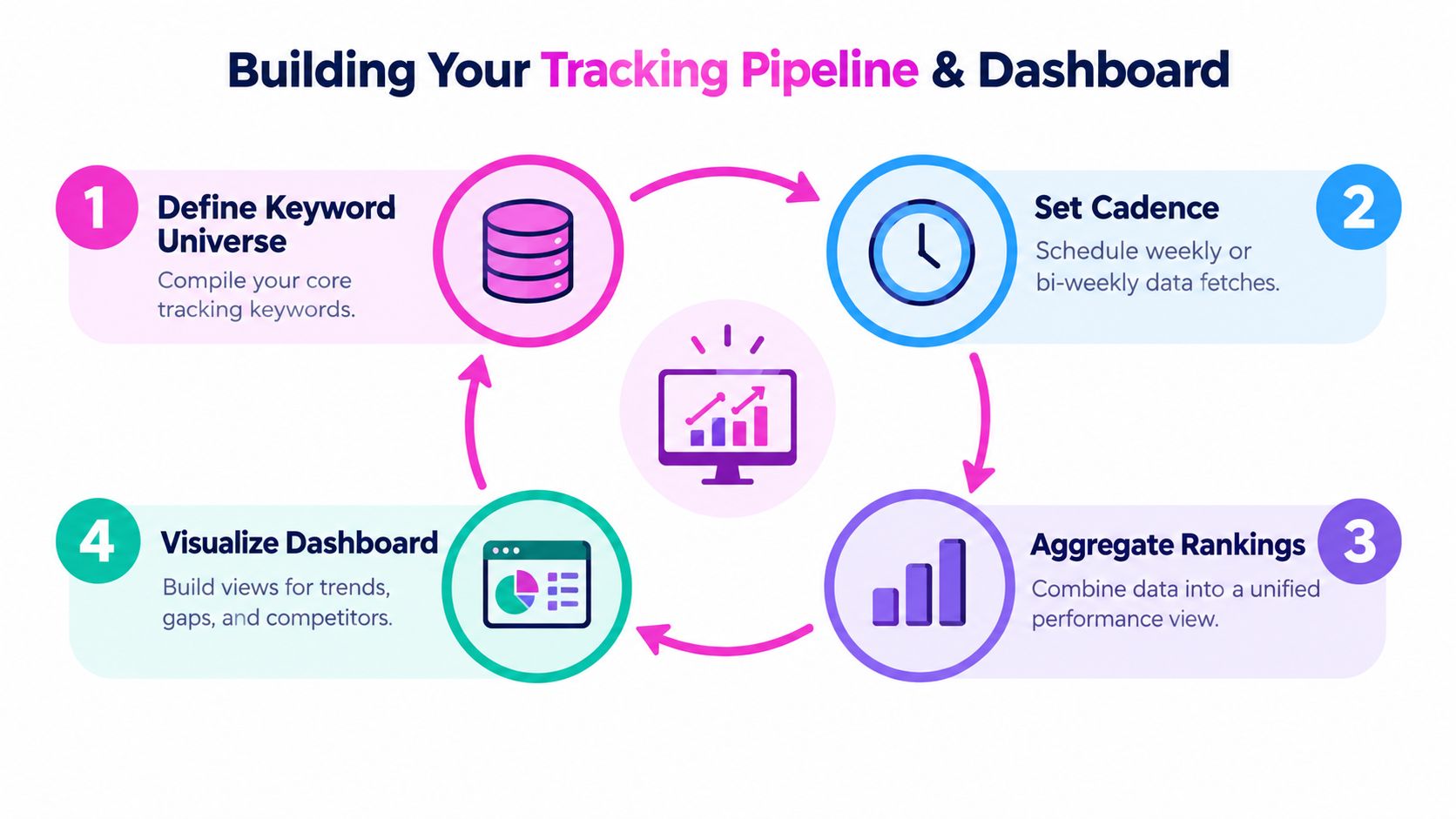
The pipeline starts with a fixed keyword universe. Without one, every report changes its sample, and your apparent share-of-voice movement may reflect a different keyword list rather than a real market shift.
I separate the universe into durable groups: core commercial queries, product or category terms, problem-aware searches, informational topics, branded comparisons, and market-specific queries. I also keep a versioned record of additions and removals. If a query leaves the list because the business no longer serves that intent, I log the reason instead of silently deleting it.
The collection process is straightforward:
- Define the query set. Include priority keywords and the SERP features you want to monitor.
- Fetch the top organic results on a consistent cadence.
- Normalize domains. Subdomains and country versions need an explicit treatment rule.
- Store the ranking page URL. Domain-level visibility without page-level mapping hides the content move.
- Calculate slot ownership. Count the top-ten positions held by each domain and divide by the total tracked slots.
- Compare against prior periods. Use the same universe or annotate any version change.
Match cadence to the decision
Weekly checks work well for ranking movement and emerging competitor pages. Monthly reviews are better for interpreting traffic share, backlink changes, content expansion, and market-level patterns. Event-driven checks matter when a major SERP feature appears, a competitor launches a relevant page, or a significant ranking loss needs diagnosis.
| Komponente | Cadence | What to Log |
|---|---|---|
| Priority rankings | Wöchentlich | Position, ranking URL, competitor URL, notable movement |
| Share of voice | Weekly or monthly | Top-ten slot ownership by domain |
| Competitor top pages | Monatlich | New pages, updated pages, pages gaining keyword coverage |
| Backlinks and referring domains | Monatlich | New links, lost links, linking-page context |
| SERP features | Wöchentlich | Ads, snippets, shopping elements, AI Overview presence |
| Deep competitive review | Event-driven | Algorithm changes, intent shifts, major market moves |
Make the dashboard explain change
A useful dashboard answers three questions quickly: what moved, why it moved, and what should happen next. I'd structure the workspace around Competitor Domains, Top Pages, Traffic Share, and a SERP Checker with historical views. A twelve-month history in the SERP Checker is useful for spotting recurring patterns and separating a temporary drop from a sustained trend.
Tools such as SEO dashboard tools from SemDash can help consolidate those views, but the software won't fix an inconsistent tracking model. Set naming conventions before importing keywords, save country and device settings, and store the exact date of each data pull.
Dashboard test: If a stakeholder can't identify the affected query set, ranking URL, competitor page, and recommended owner from one view, the dashboard is still a data warehouse, not an operating tool.
I also log SERP composition separately from rank. A competitor can hold the same organic position while gaining more attention through a new SERP feature. That's why a rank-only line chart often understates competitive pressure.
Finding and Prioritizing Keyword and Backlink Gaps
Raw gap exports create busywork. I've watched teams download thousands of competitor terms, highlight anything with apparent volume, and hand the list to writers. The result is usually a collection of overlapping briefs, weak intent matches, and pages that compete with existing assets.
The better workflow begins with your domain plus 3–5 rivals, then narrows the output before anyone creates content. Competitor keyword-gap guidance from SEOHandbook supports this filter-and-prioritize approach, particularly the need to group terms by intent and map them to pages.
Turn missing terms into page decisions
I separate keyword gaps into three working groups:
- Missing terms: Competitors rank, and your site has no meaningful result.
- Underperforming terms: You and a rival rank, but their page owns the stronger position or broader coverage.
- Expansion terms: Related queries that belong inside an existing page rather than a new URL.
Then I filter by relevance, effective volume, Keyword Difficulty, commercial value, and ranking confidence. “Effective volume” means the opportunity after considering whether the SERP is dominated by features, whether the query matches your market, and whether the winning format can realistically be produced.
Intent buckets keep the analysis grounded:
- Informationsorientiert: Explanations, definitions, tutorials, and problem-solving guides.
- Kommerzielle Recherche: Comparisons, alternatives, reviews, and evaluation pages.
- Transaktional: Product, service, category, and purchase-oriented queries.
- Navigational or branded: Searches where users are trying to reach a known entity.
The page mapping step comes before content creation. If an existing guide already answers the query, improve and expand it. If two pages address the same cluster, consolidate or clarify their roles. Create a new page only when the query represents a distinct need and no existing URL can serve it without damaging its primary intent.
Use ranking confidence instead of volume alone
I assign a qualitative score across three dimensions:
- Effective volume: How much qualified demand appears available after SERP constraints?
- Commercial value: Would the query influence pipeline, signups, purchases, or retention?
- Ranking confidence: Can the site compete with the current format, authority, and topical coverage?
A low-volume commercial term can outrank a broad informational term in priority if it maps directly to a revenue page and the SERP appears achievable. That's the trade-off most raw gap reports miss.
Treat backlink gaps as relationship research
For backlink analysis, I look for referring domains that link to competitors but not to us. The important question isn't whether a domain links to a rival. It's why. I record the linked page, surrounding anchor context, content type, and whether the link appears editorial, resource-based, partner-driven, or tied to a specific campaign.
That context changes the outreach angle. A resource-page link calls for a stronger resource. A broken competitor URL may support a replacement pitch. An unlinked brand mention can support a simple reclamation request. A domain linking to several competitors has already demonstrated topical relevance, but it still needs a credible reason to link to your page.
Don't copy the competitor's asset and expect the same result. Build the missing value, then make the outreach specific to the page and its audience.
Alerting for Volatility Intent Shifts and AI Overview Churn
Classic rank tracking and AI citation tracking need different expectations. Organic rankings can move, but AI Overview citations can change much more frequently. An independent analysis reported an average daily AI Overview volatility score of 0.403mit 31.1% of days classified as high volatility and 7% as extreme volatility, while another analysis found that about 70% of cited ranking pages changed over two to three months. Serpstat's AI Overview study provides the underlying discussion.
That volatility makes citation share a monitoring signal, not a permanent status label. A competitor cited today may disappear from the answer later, and your own URL may be cited for one prompt while a different page from your site appears for a closely related query.
Define alerts around actions
An alert should answer what the team needs to do next. I use three categories:
- Ranking volatility: Notify the owner when priority terms move beyond an agreed threshold or when several related URLs shift together.
- Intent reclassification: Flag changes in the dominant result format, such as product pages replacing guides or video results replacing text pages.
- AI Overview churn: Record whether the feature appears, which competitors are cited, and which URLs Google uses.
I once had an informational guide lose visibility after the SERP shifted toward commercial product pages. The page hadn't suddenly become inaccurate. Its format no longer matched the result set. We rebuilt the opening around evaluation criteria, added clearer product-selection sections, and linked to the relevant commercial pages. The key lesson was that a ranking drop can be an intent problem, not a writing problem.
For teams working on product catalogs, citation tracking for eCommerce is a relevant resource for thinking about URL-level visibility in AI-generated answers. For the tracking mechanics, SemDash's guide to tracking AI Overviews covers the separate citation layer that classic rank reports often miss.
Refresh on events, not only dates
A calendar refresh is useful, but it's not enough in volatile SERPs. Trigger a review when AI Overview presence changes materially across a priority query group, when citations move from your guide to a competitor's page, when ads alter the commercial environment, or when the result format changes.
The action can be update, expand, redirect, or consolidate. Don't rewrite every page after one unstable observation. Confirm the signal across repeated checks, then inspect the winning URLs and the intent pattern before assigning work.
Turning Findings Into Action and Keeping Tracking Lean
Competitor tracking earns its place when it changes the work queue. When a rival gains share, I start with the affected queries and ranking URLs, inspect the competitor's top page, and identify the mechanism behind the gain. The likely response usually falls into one of four paths:
- Improve an existing page when the intent matches and the content is underdeveloped.
- Create a new page when the query represents a distinct need with no suitable URL.
- Consolidate pages when several internal URLs split relevance across one topic.
- Recover authority through unlinked mentions, broken-link replacement, or relevant outreach.
I keep the operating rhythm simple. Each week, the team reviews priority ranking movement, new competitor pages, share-of-voice changes, and urgent SERP feature alerts. Each month, we inspect top-page movement, keyword-gap priorities, referring-domain changes, and the performance of actions already shipped.
The biggest maintenance mistake is overfitting to raw keyword lists. A gap isn't automatically a page, and a competitor's ranking isn't proof that its approach fits your audience. Intent, page purpose, commercial value, and execution effort should decide what enters the roadmap.
The second mistake is tool sprawl. If keyword gaps live in one platform, backlinks in another, SERP history in a spreadsheet, and AI citations in a separate report, nobody sees the causal chain. A consolidated workspace such as SemDash can bring competitor domains, top pages, traffic share, keyword gaps, backlink gaps, clustering, historical SERPs, and AI Overview citations into the same research process. The point isn't to collect more data. It's to shorten the distance between a signal and an assigned action.
Final operating principle: Track fewer rivals, use a stable keyword universe, and review every alert against a decision. Lean tracking beats exhaustive tracking that never reaches production.
SemDash brings competitor domains, top pages, traffic share, keyword and backlink gaps, historical SERP data, and AI Overview citation tracking into one SEO research workflow. Visit SemDash to build a scheduled competitor tracking process that connects search signals to content and link actions.