Top 12 AI for SEO Optimization Tools: 2026 Guide

For most agency and in-house teams, Semdash is the right place to start with AI for SEO optimization — it combines keyword research, competitor analysis, semantic clustering, and AI Overview monitoring in one credit-based platform so you get integrated intelligence without juggling five separate subscriptions.
Here are the top picks by category:
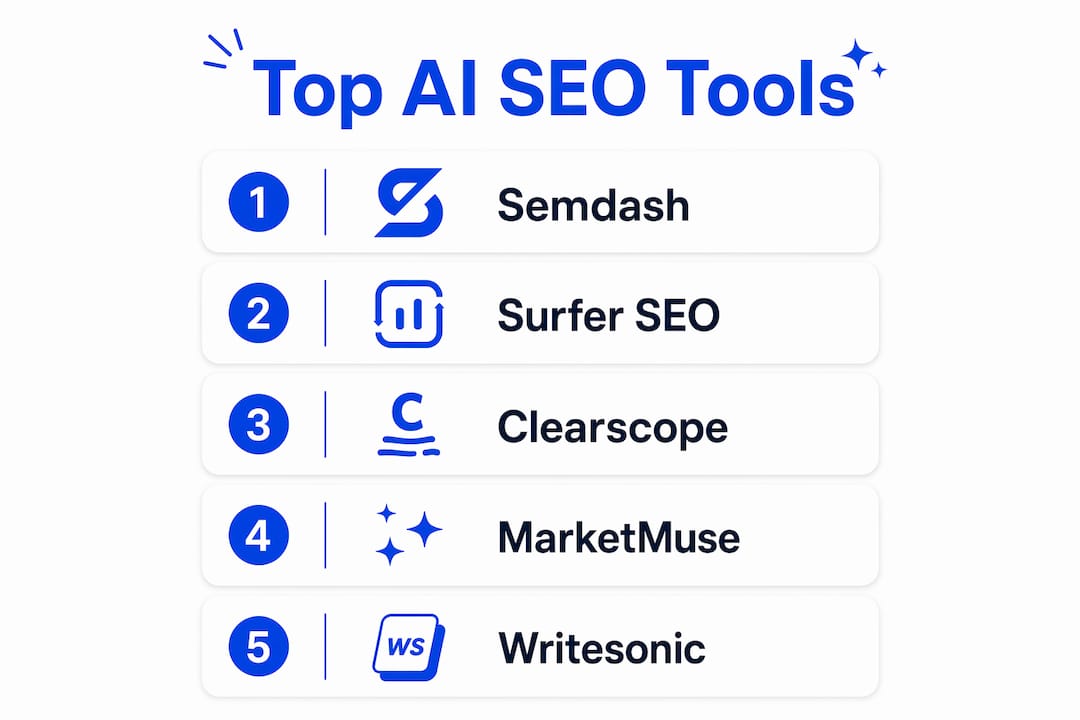
- Integrated research platform (recommended start): Semdash. Best for agencies and in-house teams that need keyword research, SERP tracking, backlink analysis, and AI Overview citation monitoring under one roof at a predictable cost.
- Content-brief-first editors: Tools like Surfer SEO, Clearscope, Frase, and Rankability. Best for writers and content teams who need SERP-aware briefs and real-time on-page scoring.
- Topic modeling and authority platforms: MarketMuse and Outranking. Best for enterprise content strategists building topical authority across large site architectures.
- Bulk content automation tools: Writesonic, GrowthBar, and Scalenut. Best for teams producing high content volume who need AI drafts with SEO guardrails.
- Technical monitoring and dashboarding: Dashword. Best for lean teams that want lightweight content tracking without a steep learning curve.
- GEO and AI-citation specialists: Platforms with dedicated Generative Engine Optimization (GEO) features. Best for brands that need to appear in ChatGPT, Perplexity, and Google AI Overviews, not just rank in traditional SERPs.
A controlled study showed formatting alone can produce a ~17% citation lift in experiments, so the tool you choose needs to support passage-level structure, not just keyword density. The TL;DR table below lets you filter by use case in under two minutes, and the per-category mini-reviews follow immediately after.
What does the TL;DR comparison table show you?

The table covers the twelve tools across the dimensions that matter most at the buying stage: primary use case, core AI capabilities, integration fit, pricing model shape, and team scale. Price tiers use this shorthand: credit-based (pay per usage unit), seat-based (per user per month), freemium (free tier with paid upgrades), and enterprise (custom contract). Team scale labels: solo (one person), small team (2–10), agency (client-facing, multi-project), enterprise (large org, custom workflows).
| Werkzeug | Best for / primary use case | Core AI capabilities | Integrations & workflow fit | Preismodell | Team & scale |
|---|---|---|---|---|---|
| Semdash | Integrated research: keywords, competitors, backlinks, AI Overview tracking | Semantic clustering, AI Overview monitoring, SERP gap analysis, content gap discovery | Google & Bing SERP data, API access, credit-based scalability | Credit-based subscription | Solo, small team, agency |
| Surfer SEO | Real-time on-page content scoring | SERP-aware content editor, NLP term suggestions, content score | Google Docs, WordPress, Jasper | Seat-based | Small team, agency |
| Clearscope | Content grading and term coverage | NLP-driven term recommendations, readability scoring | Google Docs, WordPress | Seat-based | Small team, agency |
| Frase | Brief creation and answer optimization | AI brief builder, SERP summarization, question clustering | Google Search Console, WordPress | Seat-based | Solo, small team |
| MarketMuse | Topical authority and content planning | Topic modeling, content inventory, competitive gap scoring | CMS-agnostic, API | Seat-based / enterprise | Agency, enterprise |
| GrowthBar | Fast AI drafts with SEO guardrails | AI writing with keyword integration, meta generation | Chrome extension, WordPress | Seat-based | Solo, small team |
| Writesonic | High-volume AI content production | Long-form drafts, factual grounding options, bulk generation | API, Zapier, WordPress | Credit-based / seat-based | Small team, agency |
| Scalenut | End-to-end content lifecycle | Keyword planning, brief creation, AI drafting, optimization | WordPress, Semrush integration | Seat-based | Small team, agency |
| Outranking | Content strategy with entity modeling | Entity-aware briefs, SERP-driven outlines, auto-internal linking | WordPress, Google Docs | Seat-based | Agency, enterprise |
| Rankability | SERP-grounded brief accuracy | Real-time SERP analysis, topic scoring, brief export | Google Docs, export-ready | Seat-based | Solo, small team, agency |
| Dashword | Lightweight content monitoring | Content score tracking, brief generation, keyword monitoring | WordPress, Google Docs | Seat-based | Solo, small team |
| GEO-specialist platforms | AI citation and generative answer optimization | Passage extraction scoring, entity consistency checks, per-engine citation tracking | Varies by platform | Varies | Agency, enterprise |

A note on data freshness: tools that pull live SERP data (Semdash, Surfer SEO, Rankability) reflect current ranking signals. Tools relying on cached or historical corpora may lag by days or weeks. For AI Overview tracking specifically, Semdash’s KI-Übersichtsprüfer queries live Google data, which matters when citation sets shift weekly.
Which tool fits your team? Per-category mini-reviews
Integrated research platform: Semdash
Semdash is the category anchor for teams that need research depth without platform sprawl. Its core outputs cover keyword discovery, SERP gap analysis, competitor benchmarking, backlink profiling, semantic keyword clustering, and AI Overview citation monitoring, all within a single credit-based interface. The credit model scales cleanly: a small agency running ten client projects per month consumes credits proportionally rather than paying for unused seats.
The AI Overview monitoring feature is the differentiator most tools in this list lack entirely. You can track which queries trigger AI Overviews for your domain and your competitors, then use that data to prioritize which pages need passage-level restructuring. That feedback loop, from citation gap to editorial fix, is what makes Semdash the recommended starting point for most teams.
Pros: Integrated research stack, AI Overview tracking, semantic clustering, Google and Bing coverage, predictable credit pricing. Cons: Content editor is not the primary focus; teams needing deep on-page scoring may want a complementary brief tool. Am besten für: Agencies and in-house teams managing multi-channel SEO research.
Profi-Tipp: Use Semdash’s semantic clustering output to group your keyword universe before briefing writers. Clusters that share a dominant SERP intent can often be served by a single pillar page, cutting content production costs significantly.
Content-brief-first editors: Surfer SEO, Clearscope, Frase, Rankability
These four tools share a common job: take a target keyword, analyze the top-ranking SERP, and produce a brief or scoring rubric that guides a writer toward competitive coverage. The differences are in depth and workflow fit.
Surfer SEO scores content in real time as you write, surfacing NLP-derived term suggestions and a numeric content score. Its Google Docs and WordPress integrations make it a natural fit for editorial teams already working in those environments. The trade-off is that the content score can become a crutch: writers who chase the number without reading the SERP often produce term-stuffed copy that passes the tool but underwhelms readers.
Clearscope takes a cleaner approach, focusing on term grading and readability. It is less prescriptive than Surfer SEO, which suits experienced writers who want signal without noise. Pricing is seat-based and sits at the higher end for small teams.
Frase leads with answer optimization. Its brief builder summarizes the top SERP results and clusters the questions users ask, making it particularly strong for informational and FAQ-heavy content. Google Search Console integration lets you map existing content to query gaps.
Rankability is the most SERP-literal of the four. It pulls live ranking data and builds briefs grounded in what the current top ten actually cover, rather than a cached model. For agencies that need brief accuracy over brief speed, it earns its place.
Pros (category-wide): Strong SERP-grounded briefs, measurable output quality, CMS integrations. Cons: None of these tools handle keyword research, backlink analysis, or AI Overview monitoring natively. You need a research platform alongside them. Am besten für: Content teams and agencies with a separate research stack.
Profi-Tipp: Validate any AI-generated brief by opening the top three SERP results yourself and checking whether the brief captures the angle that makes those pages rank, not just the terms they share. Tools surface patterns; editorial judgment identifies the reason.
Topic modeling and authority platforms: MarketMuse, Outranking
MarketMuse and Outranking both operate at the content strategy layer rather than the individual page layer. MarketMuse builds a topic model for your domain, scores your existing content inventory against competitive gaps, and prioritizes which pages to create or update first. It is genuinely useful for enterprise content programs managing hundreds of URLs, where gut-feel prioritization breaks down.
Outranking adds entity-aware brief generation and auto-internal linking suggestions, which makes it relevant for teams thinking about AI citation as well as traditional ranking. Its entity modeling aligns with the principle that consistent entity signals across a site and across the web are what AI systems use to anchor trust in a brand.
Pros: Deep topical authority mapping, content inventory scoring, entity awareness. Cons: Steeper learning curve, higher price point, overkill for sites under a few hundred pages. Am besten für: Enterprise content strategists and large agencies.
Bulk content automation: Writesonic, GrowthBar, Scalenut
These tools prioritize output volume. Writesonic generates long-form drafts at scale with optional factual grounding modes and API access for programmatic workflows. GrowthBar keeps things simple: a Chrome extension and WordPress plugin that layer keyword suggestions and meta generation onto a lightweight AI writer. Scalenut covers the full content lifecycle from keyword planning through brief creation to AI drafting and on-page optimization scoring.
The hallucination risk is highest in this category. AI-powered platforms can cut routine workflows from weeks to hours, but bulk drafts require a human-review gate before publication, especially for YMYL topics. A workflow without that gate is a liability, not an efficiency.
Pros: High output velocity, credit or seat pricing options, API access for automation. Cons: Hallucination risk requires mandatory human review; output quality varies by topic complexity. Am besten für: Agencies and teams with strong editorial review processes and high content volume targets.
Lightweight content monitoring: Dashword
Dashword occupies the lean end of the market. It tracks content scores over time, generates briefs, and monitors keyword performance without the complexity of a full research suite. For solo practitioners or small teams that already have a research tool and just need content scoring and monitoring, it fits without friction.
Pros: Simple interface, content score tracking, low learning curve. Cons: Limited research depth, no backlink or AI Overview tracking. Am besten für: Solo practitioners and small teams with a separate research stack.
How we evaluated these tools
Evaluation covered eight axes: core AI capabilities, integration and workflow fit, output types available, accuracy and human-in-the-loop controls, pricing shape and predictability, data freshness and source coverage, team scale fit, and total cost of ownership (TCO) including hidden credit consumption.
Sample test steps used across categories:
- Brief generation test: Generate a content brief for a defined commercial query (“best project management software for agencies”) and measure time to usable brief, structural completeness, and SERP alignment.
- Audit test: Run a site-level technical flag scan and record how many flagged issues are classified as critical versus cosmetic.
- Hallucination check: Submit ten factual prompts (specific statistics, named studies, product specifications) and count how many outputs require major factual correction.
- Credit consumption test: Run a ten-page project end-to-end and record total credit or API call consumption as a TCO proxy.
- AI Overview tracking test: Check whether the tool surfaces which queries trigger AI Overviews for a target domain and how frequently that data refreshes.
Measurable outputs used for comparison: time to usable brief, proportion of AI suggestions requiring major edits, and credit consumption per ten-page project as a reliable running-cost proxy.
Evaluation limitation: This roundup did not test customized enterprise implementations, long-term citation lift over 6–12 months, or white-label configurations. Per-engine citation behavior also shifts weekly, so point-in-time measurements reflect a snapshot rather than a stable baseline. Treat tool-specific citation claims from any vendor with appropriate skepticism until you run your own prompt-set baseline.
AI search engines also differ in how they select citations: Gemini favors entities Google already knows, Perplexity prioritizes freshness and structured pages, and ChatGPT often relies on community-weighted sources. That means a tool’s “AI optimization” claim needs to specify which engine it targets before the claim means anything.
How do you choose the right AI SEO tool for your team?
Decision criteria, ordered by impact
- Integration fit. Does the tool connect to your CMS, Google Search Console, and existing workflow? A tool that requires manual export and import at every step creates friction that kills adoption within weeks.
- Output type match. A team that needs keyword research and AI Overview tracking has different requirements than a team that needs content briefs and on-page scoring. Map your actual workflow gaps before evaluating features.
- Team scale and workflow. Solo practitioners need simplicity; agencies need multi-project management and client reporting. Enterprise teams need API access and audit trails.
- Data freshness and source coverage. Tools pulling live SERP data reflect current ranking signals. Cached-data tools may lag. For AI Overview tracking, freshness is non-negotiable because citation sets change weekly.
- Accuracy and human-in-the-loop controls. Does the tool flag low-confidence outputs? Can you see the source behind a suggestion? Opaque AI outputs with no provenance trail are a governance risk.
- Pricing predictability. Credit-based models scale with usage but can surprise you mid-project. Seat-based models are predictable but penalize low-usage months. Map your actual monthly usage before committing.
- Total cost of ownership. Add up the research platform, the brief tool, the content editor, and the monitoring tool. A single integrated platform often costs less than four point solutions even if its per-seat price looks higher.
Trial checklist: questions to answer before you buy
- Can the tool export structured briefs directly to your CMS or Google Docs?
- How many credits or API calls does a ten-page project consume?
- How does it surface provenance for factual claims in AI-generated content?
- Does it track AI Overview appearances for your domain specifically?
- What happens to your data if you cancel the subscription?
Red flags that should stop a purchase
- No human-in-the-loop controls on AI-generated content.
- Opaque credit pricing with no usage dashboard.
- No API or CMS integration.
- No ability to show data source provenance for factual outputs.
- “AI optimization” claims that do not specify which engine or which feature.
Onboarding timeline by team type
- Solo blogger: Expect a functional workflow within one to two weeks. Most tools in this list have self-serve onboarding and documentation sufficient for a single user.
- In-house team (5–15 people): Budget two to four weeks for tool configuration, workflow mapping, and a pilot on two to three pages before rolling out site-wide.
- Agency managing multiple clients: Allow four to six weeks for a proper pilot: one client account, a defined prompt set, a baseline measurement, and a review gate before scaling to the full client roster.
How to add AI into your existing SEO workflow
Step 1: Baseline your AI visibility
Before changing anything, run your target queries across ChatGPT, Perplexity, Google AI Overviews, and Copilot. Record whether your domain is cited, mentioned, or absent. This baseline is the measurement anchor for everything that follows. Run the same prompt set monthly and act only on trends that persist across multiple readings, not single-week dips.
Semdash’s AI Overview checker automates the Google AI Overviews portion of this baseline, surfacing which queries trigger AI Overviews for your domain and your competitors.
Step 2: Define your pilot scope
Pick two to five pages that already have some organic traffic and cover queries where you are not currently cited in AI answers. Narrow scope means faster learning and cleaner attribution.
Step 3: Make pages extractable
Google’s official guidance is direct: focus on crawlability, high-quality content, and user-first structure. Special files like llms.txt and artificial content chunking are unnecessary. What actually moves the needle is passage-level structure: question-style subheadings, direct answers in the first 40–60 words under each subheading, and self-contained paragraphs that an AI can lift without needing surrounding context.
Profi-Tipp: Check your pages with the AI Search Readiness Checker at Contentelli before and after restructuring. It scores passage extractability and flags sections where the answer is buried too deep for an AI to surface cleanly.
Step 4: Establish entity consistency
Consistent naming, structured data, and third-party references are the primary authority signals AI systems use to decide whether to cite a brand. Audit your off-site mentions: is your brand name spelled the same way on G2, Reddit, industry roundups, and your own site? Inconsistent naming fragments the entity signal and weakens citation eligibility across every engine.
Entity SEO in practice: A brand cited as “Acme Corp,” “Acme Corporation,” and “Acme” across different platforms registers as three weak signals rather than one strong one. Standardize the canonical name, add Organization schema to your homepage, and earn at least three to five third-party mentions that use the exact same string before expecting consistent AI citation.
Step 5: Set measurement rules and governance
Define your human-review gate before publishing any AI-assisted content. Every AI-generated draft should pass an editorial check for factual accuracy, source provenance, and brand voice before it goes live. Build a rollback process: if a page’s citation rate drops after a restructure, you need to know which change caused it and how to revert.
Track citation rate (how many of your mapped prompts return your domain), share of voice (your citations versus category competitors), and recommendation rate (how often the AI names you as the pick, not just mentions you). These metrics replace keyword position as the primary progress signal for AI-driven SEO.
Profi-Tipp: Nutze Semdash's kostenlose Tools to run a quick site health check before your pilot. Crawlability issues that block AI indexing often show up as basic technical flags, and fixing them before restructuring content saves you from attributing citation gains to the wrong variable.
Key takeaways
The single most important action right now: start with an integrated platform that covers research, AI Overview tracking, and semantic clustering, then layer content-brief tools on top once your workflow is stable.
| Punkt | Details |
|---|---|
| Start integrated | Choose a platform covering keyword research, AI Overview tracking, and semantic clustering before adding point solutions. |
| Baseline citations first | Run your target prompt set across ChatGPT, Perplexity, Google AI Overviews, and Copilot monthly before changing any content. |
| Prioritize entity consistency | Standardize your brand name across all off-site mentions; inconsistent naming fragments the entity signal AI systems rely on. |
| Protect human review | Every AI-generated draft needs an editorial gate for factual accuracy and source provenance before publication. |
| Semdash as starting point | Semdash covers research, competitor analysis, backlink tracking, and AI Overview monitoring in one credit-based platform suited to agencies and in-house teams. |
The part most teams get wrong about AI SEO
Most teams treat AI SEO as a content production problem. They buy a brief tool, generate more pages, and wait for citation share to climb. It rarely does, because the bottleneck is almost never content volume.
What actually moves citation share is entity clarity and passage extractability. A brand that appears inconsistently across the web, under three slightly different names, with no structured data and no third-party mentions on sources AI trusts, will not get cited regardless of how many well-structured pages it publishes. The off-site work, the entity audit, the G2 presence, the Reddit mentions, comes before the content restructuring in the causal chain, not after.
The counterintuitive finding from controlled formatting tests is that short, self-contained passages outperform longer, more comprehensive pages for AI citation. An engine does not reward thoroughness. It rewards extractability. A 200-word section that answers one question cleanly will get cited over a 2,000-word page that buries the answer in paragraph six.
Semdash’s AI Overview monitoring gives you the feedback loop that makes this testable: you can see which queries trigger AI Overviews for your domain, restructure the corresponding pages, and measure whether citation rate shifts within the next monthly baseline. That closed loop is what separates a real AI SEO program from a content production sprint.
Semdash covers the research layer so you can focus on the editorial layer
Most teams that struggle with AI SEO are not short on content tools. They are short on research infrastructure: they do not know which queries trigger AI Overviews for their domain, which competitors are being cited instead, or which keyword clusters share a dominant SERP intent. Semdash closes that gap.
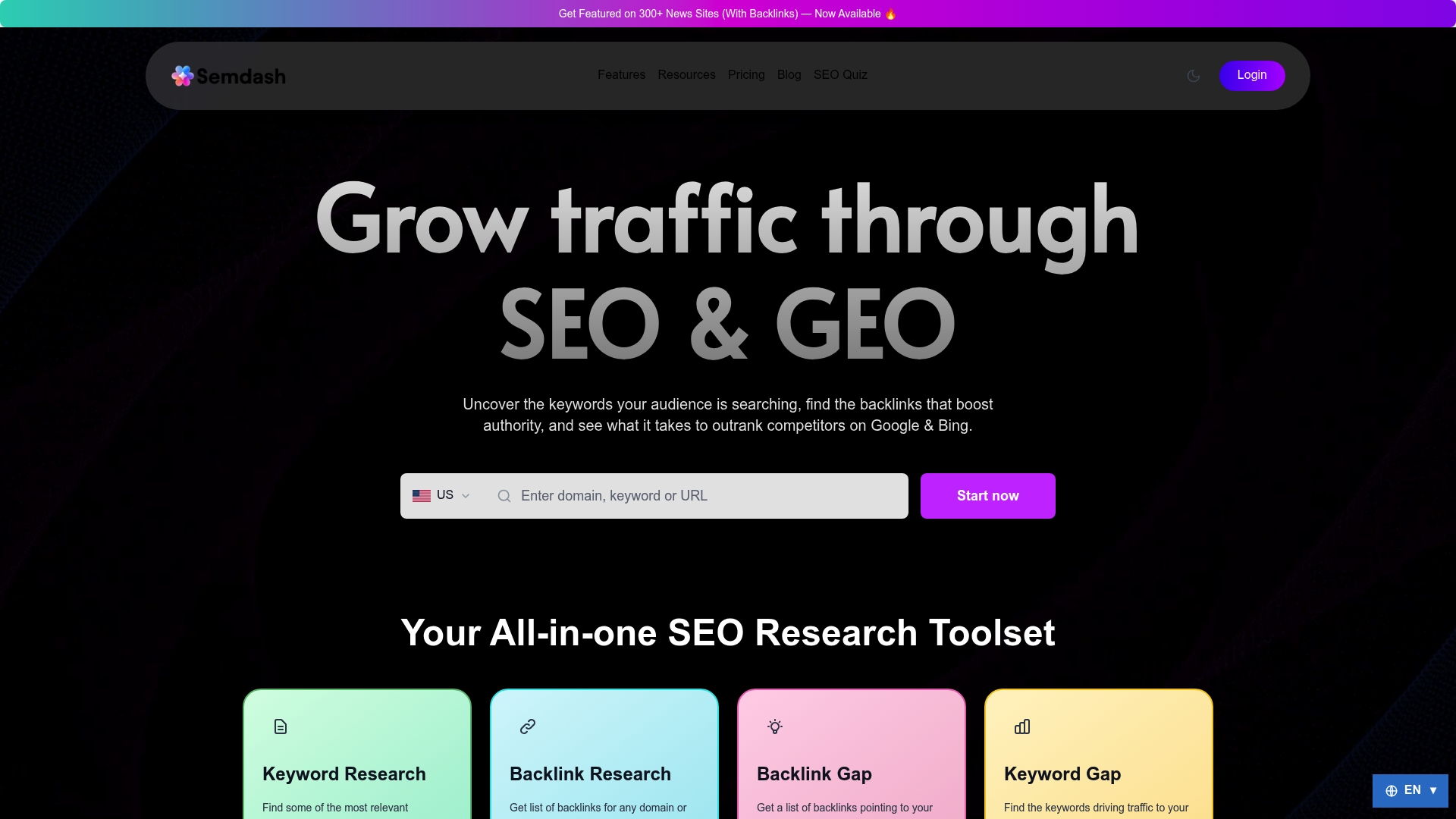
The platform combines Keyword-Recherche, competitor analysis, backlink tracking, semantic clustering, and AI Overview monitoring in a single credit-based interface. You pay for what you use, which makes it practical for agencies running multiple client accounts and in-house teams with variable monthly workloads. The credit model also means you can run a meaningful pilot, covering keyword discovery, a competitor gap analysis, and an AI Overview baseline, without committing to an annual seat contract.
What to test in your trial:
- Run a keyword cluster for your primary topic area and check how Semdash groups intent.
- Pull an AI Overview report for your domain and three competitors to see who is being cited and for which queries.
- Use the Mitbewerber-Analyse-Tool to identify content gaps your site is not covering.
- Check your backlink profile for off-site entity signals using the Backlink-Recherche-Tool.
Most teams reach a functional workflow within one to two weeks. Start at semdash.com to see current plan options and credit tiers.
Useful sources and tools for baseline measurement
These are the primary sources and free tools worth bookmarking as you build your AI SEO program:
- Google Search Central: Optimizing for generative AI features — The authoritative source on what Google actually recommends for AI Overview eligibility. Read this before implementing any technical changes.
- Cite Solutions: AI Search Engine Optimization Playbook — Practical per-engine guidance on how Gemini, Perplexity, and ChatGPT differ in citation behavior and what that means for content update cadence.
- Roar Digital: SEO for AI 2026 Guide — Strong coverage of entity SEO and why off-site naming consistency matters more than content volume for AI citation.
- Semdash AI Overview Checker — Free tool to track which queries trigger AI Overviews for your domain and competitors. Use this to build your monthly prompt-set baseline.
- SERPView Free SEO Tools — Free SERP simulators and schema checkers useful for validating extractable passage structure before publishing.
- Semdash Free Tools — Site health checkers and keyword tools available without a paid plan; a practical entry point for a quick technical baseline.
For per-engine tuning: consult Google Search Central for AI Overviews and Gemini behavior, the Cite Solutions playbook for Perplexity and ChatGPT differences, and Roar Digital’s entity guide for cross-engine authority signals.
Immediate next step: Run a ten-query baseline across ChatGPT, Perplexity, Google AI Overviews, and Copilot using the queries your customers actually type. Record citation presence or absence for your domain. That baseline is the foundation every other tactic in this guide builds on.
Häufig gestellte Fragen
What is the best AI tool for SEO optimization?
The best starting point for most agencies and in-house teams is an integrated research platform like Semdash, which covers keyword research, competitor analysis, semantic clustering, and AI Overview tracking in one place. Content-brief-first tools like Surfer SEO or Frase complement it for on-page scoring.
How does AI improve SEO performance?
AI-powered platforms can cut routine SEO workflows from weeks to hours by automating keyword clustering, content gap analysis, and site audits, freeing teams to focus on strategy and editorial quality. The measurable gains come from faster brief production, more consistent SERP alignment, and AI Overview citation tracking.
What is Generative Engine Optimization (GEO)?
GEO is the practice of structuring content so AI engines can extract and cite self-contained passages in generated answers. It complements traditional SEO rather than replacing it, with the key difference being that the win condition is a citation in an AI answer, not a ranked position in a link list.
How long does it take to see results from AI SEO tools?
Technical and formatting changes can shift AI citation rates within weeks once engines recrawl the updated pages. Authority building through third-party mentions compounds over months. Judge progress on a monthly trend across a fixed prompt set, not on any single week’s reading.
Which AI SEO tools work best for agencies managing multiple clients?
Agencies benefit most from platforms with multi-project management, credit-based or usage-based pricing, and API access. Semdash’s credit-based model scales across client accounts without per-seat penalties, and its AI Overview monitoring gives account managers a concrete citation metric to report alongside traditional rank tracking.