


Keyword density measures how often a target word or phrase appears relative to a page's total word count, calculated as keyword uses divided by total words, times 100. A 1,000-word article with 20 uses has a keyword density of 2.0%.
The arithmetic is straightforward. The popular advice to optimize toward a supposedly ideal percentage isn't. I'd use the number to flag wording worth inspecting, then compare the page with the live search results before deciding what to change.
You don't need another quota for your writers. You need a consistent counting method, a clear understanding of search intent, and a way to distinguish useful repetition from copy that sounds written for a crawler.
Inhaltsverzeichnis
- The Keyword Density Formula and a Worked Example
- Where Keyword Density Came From
- Why Google Gives No Target Percentage
- The Density Ranges Vendors Quote and Where They Conflict
- Cluster Variants Without Creating Thin Pages
- Why Density Matters Less Today and What to Track Instead
- Run the Page Audit Against the SERP
The Keyword Density Formula and a Worked Example
Start by choosing the exact phrase you want to measure. For a page targeting keyword density, count occurrences of that phrase, not every appearance of keyword oder density separately.
The opening calculation uses occurrences as the numerator and total words as the denominator. With a multiword phrase, count each complete occurrence once. Don't multiply the occurrence count by the number of words in the phrase, or you'll be measuring something different.
Keyword density calculated for common article lengths
| Example | Total words | Keyword uses | Density |
|---|---|---|---|
| Basic worked example | 1,000 | 20 | 2.0% |
| Search Atlas example | 1,000 | 15 | 1.5% |
| Long guide, 30 uses | 1,500 | 30 | 2.0% |
| VRID range, low end | 2,000 | 30 | 1.5% |
| VRID range, high end | 2,000 | 40 | 2.0% |
Treat these as arithmetic examples, not recommended writing targets. The same percentage can describe a useful explanation or an exhausting sequence of repeated phrases.
Make the count reproducible
I'd establish the counting rules before opening a density checker:
- Use article content only. Include the article's headings and text, but exclude navigation, footers, cookie notices, and unrelated sidebar copy.
- Separate exact matches from variants. Decide whether plurals belong in a separate count. Don't combine them with the primary phrase.
- Keep the denominator consistent. Count words from the same extracted content you use for counting occurrences.
- Round consistently. Use one decimal place so minor counting differences don't look more meaningful than they are.
If you're assembling advertorials or listicles with Landra's advertorial and listicle builder, apply that same extraction rule to the finished page. Measure the editorial content, not every word in the surrounding template.
Watch the denominator
Say you remove 300 filler words without deleting a single target-phrase occurrence. Your density rises even though you haven't increased repetition. That's a hypothetical editing example, but it exposes the main trap: changing article length changes the ratio.
Don't add padding to lower a score or preserve weak paragraphs to keep it stable. The calculation tells you how frequently you use a phrase, not whether you explain the subject well.
Praktische Regel: Investigate the wording behind the percentage before changing the wording to change the percentage.
Where Keyword Density Came From
To understand why this metric looks so authoritative, start with information retrieval, the problem of finding relevant documents within a collection. Counting words gave researchers a measurable way to compare documents rather than relying entirely on manual classification.
The scale mattered. In a historical account of search indexing, Search Engine Land describes a 131 MB corpus containing 46,500 newspaper articles and approximately 19 million term occurrences. Those counts illustrate computational text analysis, not an SEO prescription.
The conceptual progression helps separate the measurement from the optimization advice built around it.
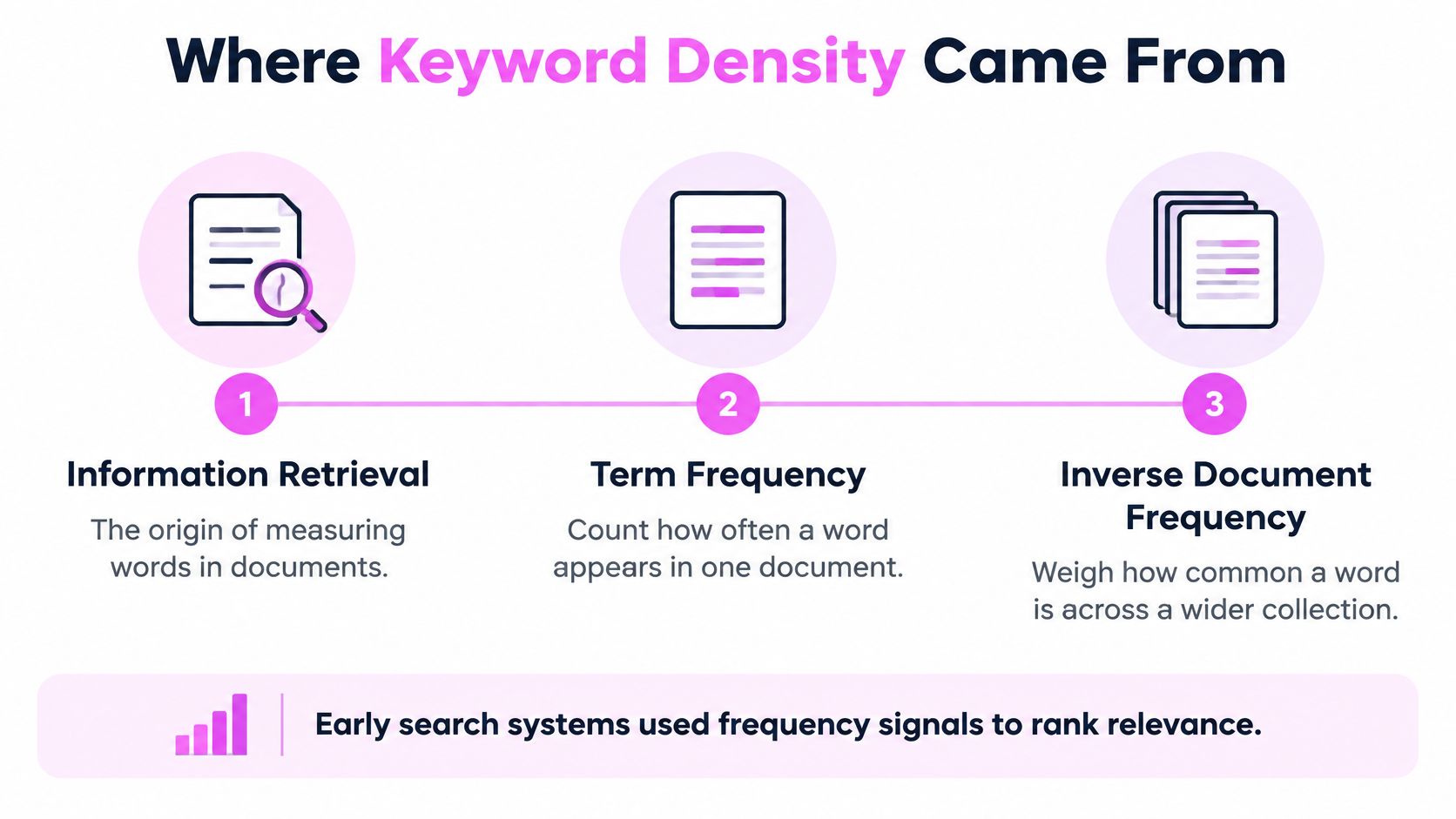
From counting terms to weighing relevance
Term frequency asks how often a term appears within a document. If you're retrieving articles about irrigation, repeated references to irrigation provide a useful clue about subject matter.
Inverse document frequency adds collection-level context. A term appearing throughout almost every document tells you less about a particular document than a more distinctive term does.
These ideas explain why counting words became useful. They don't establish that every document should contain the same proportion of a target phrase.
From retrieval measurement to an editing target
When you can change on-page wording directly, a count is an attractive lever. You can insert another phrase, rerun a checker, and watch the score change immediately.
That's also where the reasoning can fail. You've demonstrated that editing changes a measurement, not that the measurement explains why a page ranks.
| Stufe | What you're trying to understand | What to avoid assuming |
|---|---|---|
| Retrieval research | Which documents discuss a subject | A frequency signal proves quality |
| Page-level counting | How prominently wording appears | More repetition must be better |
| Diagnostic auditing | Whether wording needs inspection | Every page needs the same ratio |
I'd keep the useful part of that history: measure consistently and interpret contextually. The original value was making relevance easier to study, not giving writers a universal percentage to hit.
Why Google Gives No Target Percentage
Google doesn't publish a recommended keyword-density percentage. Its search guidance doesn't establish a target such as 1%, 2%, or 3%; it directs you toward useful wording and away from excessive repetition.
That distinction matters when you're writing a content brief. You can ask a writer to make the subject clear and answer the query completely. You can't turn an unsupported percentage into a Google requirement.
Follow the wording guidance, not an invented quota
Google's SEO Starter Guide identifies excessive repetition, including variations, as tiring for readers and contrary to its spam policies. Substituting awkward near-synonyms throughout a paragraph doesn't fix the underlying problem.
The relevant policy concerns include unnatural repetition, keyword lists, and blocks of location terms used to manipulate search visibility. Don't interpret keyword stuffing as merely crossing a numerical boundary.
For example, compare these hypothetical approaches:
- Useful repetition. You repeat a technical term because replacing it with a vague pronoun would make an instruction ambiguous.
- Mechanical repetition. You append the target phrase to headings that already describe their subjects clearly.
- Manipulative listing. You add a block of service locations without providing meaningful information about serving those locations.
Interpret extremes without inventing a threshold
If your page never names its own subject, I'd investigate whether the title and explanation are too vague. But an exact-match absence isn't automatically a defect: your target query might be a question that natural prose answers without repeating verbatim.
At the other extreme, repeated wording deserves attention when it interrupts comprehension. Read neighboring sentences, not just the aggregate score, because a page-wide average can conceal a heavily stuffed paragraph.
You don't need to prove that a sentence exceeds a threshold before removing repetition that makes it harder to read.
A fixed quota encourages the wrong implementation decisions. You start placing phrases in unrelated image descriptions, stretching headings, or repeating the subject where a shorter reference would work.
I'd make the editorial requirement explicit: use the phrase when it identifies the subject or prevents ambiguity. Remove it when its only purpose is satisfying a counter.
The Density Ranges Vendors Quote and Where They Conflict
Put the commonly quoted figures side by side and you don't get a shared standard. You get a mixture of suggested ranges, worked examples, and review triggers.
Those categories aren't interchangeable. A calculation example demonstrates arithmetic; a recommended range prescribes behavior; a review trigger tells you when to investigate.
Density figures quoted by Google and SEO sources
| Quelle | Year | Stated figure | What it actually says |
|---|---|---|---|
| Googeln | Ongoing | No percentage published | Warns against keyword stuffing and unnatural repetition |
| SalesHive | 2025 | 0.5% to 3% | Healthy keyphrase range, citing Yoast SEO guidance |
| VRID | 2025 | 1.5% to 2% | 30 to 40 uses in a 2,000-word article |
| Search Atlas | 2025 | 1.5% | Example: 15 uses in a 1,000-word article |
| Authority Specialist | 2026 | Review above 5% to 6% | Exact-match trigger for review, no universal target exists |
Read the qualifications before adopting the number
The spread isn't evidence that you should average the recommendations. You'd be combining different kinds of advice without establishing that any resulting figure improves your page.
Nor should you interpret a repetition-review trigger as permission to write up to that level. You can produce unpleasant copy below a vendor's ceiling, especially when you concentrate repeated wording in a short passage.
If you're investigating the commercial context around tools and brands mentioned in optimization advice, you can explore Yoast stores in tech through AdLibrarySpy. Keep that separate from evaluating SEO claims: a brand reference or marketing listing doesn't validate a density recommendation.
Compare pages that answer the same query
I'd compare your wording with pages serving the same intent, not a vendor's general-purpose range. A definition page, a calculator, and a product category don't need identical language patterns.
You might need repeated exact terminology in a technical explanation. In another context, you can explain the subject more naturally through related concepts, examples, and precise headings.
Google's keyword-stuffing policy gives you the more useful boundary: avoid unnatural repetition intended to manipulate search visibility. It doesn't turn the vendor figures into approved targets.
My recommendation: Use competing pages to generate questions about your content, not a new quota to copy.
If a competing page uses your phrase more frequently, inspect why. You may discover a missing explanation, or just a repetitive competitor. Neither finding justifies inserting the phrase automatically.
Cluster Variants Without Creating Thin Pages
Use one page when the intent and answer are the same. Split pages when you need to support a different task, not merely a different wording of the query.
Google's AI optimization guidance warns against producing content for query variations primarily to manipulate rankings or generative responses. When manipulation is the main purpose, you risk scaled-content abuse rather than useful topic coverage.
Group by the answer you need to provide
Für what is keyword density, keyword density meaning, und keyword density definition, you can usually satisfy the reader with the same explanation. Creating separate introductions around each wording adds maintenance work without creating a distinct resource.
I'd use a semantic keyword clustering workflow to organize candidates, then inspect the search results before deciding page boundaries. Shared vocabulary alone isn't enough; you need to check whether the expected task is also shared.
Use these editorial decisions:
- Same intent and same answer. Combine the variants into one page.
- Different task. Consider a separate resource, such as a calculator that accepts pasted text.
- Distinct subquestion. Add a useful section when it belongs within the main explanation.
- Only different phrasing. Don't create another page or heading just to accommodate it.
Make each resource earn its place
A calculator and a conceptual guide can deserve separate URLs because you use them differently. You visit the calculator to perform a measurement; you visit the guide to understand what to do with it.
Within the guide, I'd cover the definition, the calculation, and the misconceptions in that order. You can satisfy close variants naturally without making the reader move between near-duplicate pages.
Don't replace exact-match stuffing with variant stuffing. Rewriting the same answer under several synonymous headings still wastes the reader's attention.
Why Density Matters Less Today and What to Track Instead
In its analysis of March 2025 browsing, Pew Research Center reported that 58% of surveyed U.S. adults encountered a Google AI-generated summary during at least one search, and users were nearly half as likely to click a conventional result when a summary appeared. Pew also reported that 26% ended their browsing session when a summary appeared, compared with 16% without one.
That doesn't establish a causal relationship between keyword density and clicks. It does mean you shouldn't treat a phrase count, or even a ranking, as a complete account of search visibility.
Consider a search for project management tools: you need to understand the selection task, not merely how often competing pages repeat the category name.

Measure what each check can actually establish
I'd make the page easy to quote by answering questions directly, defining unfamiliar concepts, and attaching evidence to claims. That improves the resource's usability, but it doesn't guarantee inclusion in an AI-generated answer.
Signals to check instead of a density target
| Signal | Was es dir sagt | How to check |
|---|---|---|
| Exact-match density | Whether the phrase appears and how often | Count body copy, then check title, H1 and intro |
| Topic coverage | Subtopics the top results answer that your page misses | Compare headings with the top 10 results |
| Entity and synonym use | Related terms the SERP uses to define the topic | List recurring terms in top-ranking pages |
| Intent match | The format and task searchers expect | Review the page types ranking for the query |
| AI citation visibility | Whether AI answers mention or link to your URL | Track AI-summary citations separately from rankings |
Treat the comparison depth in that table as an audit procedure, not a ranking rule. For coverage, inspect the actual explanations too: similar headings can conceal very different levels of usefulness.
Related terminology needs the same judgment. Add a concept because it helps explain the subject, not because a competitor happens to mention it.
For a broader implementation walkthrough, use this video alongside your page review.
Separate visibility from outcomes
Keep conventional rankings, AI citations, visits, and useful on-site actions in separate reporting fields. Otherwise, you can mistake improved visibility for improved acquisition, or overlook useful exposure because clicks stayed flat.
Use a broader content optimization workflow to connect those checks to editing decisions. Density belongs in that workflow as a weak diagnostic, not as a substitute for relevance, evidence, or performance measurement.
Run the Page Audit Against the SERP
Start with one primary phrase and write down its exact wording before collecting anything. I'd also record the target country, language, and intended page type so you don't compare an informational guide with a different market's shopping results.
Use the process below to keep the comparison reproducible.
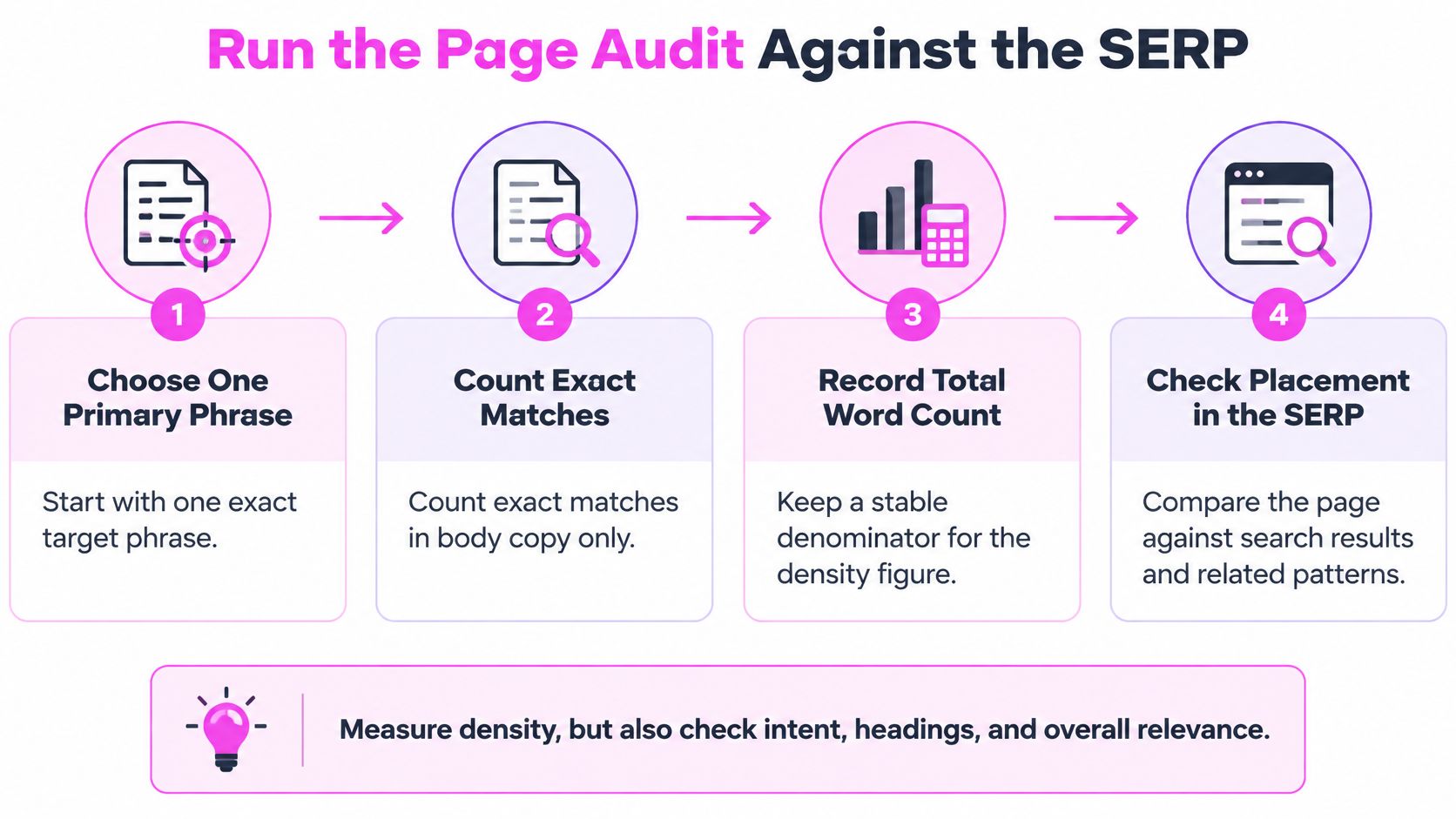
Collect comparable evidence
Count exact matches and record the word count. Extract the main article content into a spreadsheet or text-analysis tool, then save the extracted text with your audit. Keep navigation and boilerplate out of both counts so another reviewer can reproduce your measurement.
Inspect placement before adding mentions. Check the title, H1, introduction, and a relevant subheading, then inspect descriptive image and link text where appropriate. Google's Search Essentials recommends using searchers' wording in prominent and descriptive locations, but an image's alt text still needs to describe the image rather than accommodate a keyword.
Review the top 10 results as a working comparison set. Record page type, exact-match count, density, and substantive subtopics using the same extraction method for every page. Mark calculators, category pages, videos, and other unlike formats separately, because their text ratios won't support a straightforward article-to-article comparison.
Don't calculate a competitor average and hand it to a writer as a requirement. Use the differences to identify passages and omissions that deserve human review.
Turn the comparison into an editing decision
Prioritize useful coverage gaps. List missing subtopics and entities, then decide which ones help your intended reader complete the task. In SemDash, enter any domain in Domain Keywords to get its full ranking-keyword list with search volume, monthly traffic, Keyword Difficulty, and more; use our SERP Checker's 12-month view to inspect changes, and our 6.6 billion-keyword research database to find related terms to test.
Remove crawler-oriented sentences. Highlight repetitions that add neither information nor clarity, and rewrite the passage around the reader's question. Don't change your density and several unrelated page elements just to test a percentage, because you won't be able to isolate what the count contributed.
Recheck placement and read aloud. Confirm that the edited page still names its subject clearly, that headings describe their sections, and that internal anchors accurately describe their destinations. Ask whether each change helps the reader or only alters the count, and revert count-only edits.
Keep the audit separate from market measurement
A page audit tells you what to revise on a particular URL. To investigate broader competitive demand, you can track competitors' share of search using Otter A/B's explanation of that separate measurement approach.
Don't claim a ranking improvement came from density alone when you also rewrote explanations, clarified intent, or added useful evidence. Record the changes and evaluate the result as an editorial revision unless you've designed a test that can support a narrower conclusion.
The useful deliverable is a prioritized edit list, not a green density score. Finish with the missing answer to add, the awkward passage to rewrite, and the placement issue to fix.
SemDash offers competitor keyword research, SERP analysis, and content-gap discovery so you can investigate what your page needs instead of chasing a percentage. Visit SemDash, enter a competing domain, and use its ranking keywords to build an evidence-based edit list for your next page audit.