

The backlink report is flat, but your brand keeps showing up in review roundups, podcast show notes, and niche forum threads. Branded searches are climbing, yet the link dashboard doesn't register most of that activity. If you're managing SEO, it's tempting to treat every unlinked mention as a backlink you haven't recovered. That shortcut muddles two different kinds of value.
A brand mention is any page that names your company or product, with or without a hyperlink. Google documents links as a way to discover pages and assess relevance, but its public guidance doesn't confirm that plain-text mentions are a direct ranking factor. My short answer: an unlinked mention doesn't carry documented link value, but it can bring referral visits, branded searches, reputation signals, and useful outreach leads. Emerging research also connects mentions with AI visibility, though it doesn't prove that mentions cause better rankings or citations.
I classify mentions separately from backlinks, then decide whether to monitor, correct, or contact the publisher. That gives me a cleaner picture of what the brand is earning, what deserves outreach, and what might influence how it's described in search. If you're checking how consumers can post a review as part of your wider reputation workflow, Bragly's guide to steps for reviewing businesses on desktop offers a practical reference.
Inhaltsverzeichnis
- Why Brand Mentions Matter Beyond Backlinks
- Linked, Unlinked and Inaccurate Mentions Compared
- How to Find Every Brand Mention, Linked or Not
- Which Mentions Deserve Outreach and Which to Ignore
- Do Brand Mentions Actually Move Rankings?
- How Mentions Show Up in AI Answers
- Run Your First Brand Mention Audit This Month
Why Brand Mentions Matter Beyond Backlinks
A SaaS brand can appear in comparison articles, podcast notes, and specialist forums while its backlink report stays flat. Buyers may encounter the name and search for it later, creating branded demand that a link report cannot capture.
Treat mentions as an authority and demand asset, measured separately from link equity. Google describes link-analysis systems, including PageRank, as ways to interpret links between pages. A plain-text mention can help a person discover a brand, but it does not create the same crawlable connection as a link. Google's ranking documentation does not identify unlinked mentions as a standalone ranking factor, so don't report them as proven ranking gains.
A mention can still prompt a buyer to look up a product, compare options, or check reviews. For guidance on the consumer review process, see Bragly's steps for reviewing businesses on desktop.
Separate exposure from link equity
A review roundup that names a product may bring a potential customer to search for the brand. If the roundup also links to the product page, readers gain a direct route and the page gains a crawlable connection. Record the exposure as a mention and the hyperlink as a backlink; combining them obscures what each contributed.
Google's ranking systems documentation describes link analysis as part of how pages are understood and ranked. Keep link reporting intact, while tracking unlinked exposure through measures such as branded search activity and referral visits where available. Those measures can show whether attention is growing, though they do not prove that mentions caused a ranking change.
For each mention, assess its type, discovery method, potential action, and measurable outcome. This separates monitoring from outreach and keeps a brand-name appearance from being counted as a recovered backlink.
Linked, Unlinked and Inaccurate Mentions Compared
Start with the technical status of the mention, then assess its context. A visible brand name isn't necessarily a link. The page's markup and facts matter, so I check the live page before assigning SEO value.
| Mention type | What it can pass | Documented SEO value | Measure with |
|---|---|---|---|
| Linked, crawlable anchor | Discovery and a link signal | Strongest documented value; helps Google find the page and judge relevance | Referring domains and anchor text |
| Unlinked plain-text mention | Referral visits, branded searches, and outreach leads | Not confirmed as a direct ranking factor | Referral sessions and branded-query impressions |
| Nofollowed link | A visible reference and possible click | Limited; treat as discovery and referral, not a reliable ranking gain | Referral sessions and indexed target URL |
| Inaccurate or ambiguous reference | Wrong facts that readers and answer engines may repeat | Brand risk rather than SEO gain | Factual accuracy check against your own source pages |
A linked, crawlable anchor gives both readers and crawlers a route to a destination. For example, a comparison article names your product and links its name to your pricing page. Check the destination and anchor text, and record the referring domain. Google's guidance on crawlable links explains the implementation distinction: a usable link needs a crawlable hyperlink, not just visible text.
An unlinked mention can still introduce your product to an audience. A newsletter might name your tool in a recommendation without linking to it. Track referral sessions if readers search for your brand afterward, and watch branded-query impressions. Don't label it a backlink or assign it link equity.
A nofollowed link is clickable, but its attribute changes how you should treat it in your report. A review page may link to your product with a nofollow attribute. It can still send a reader, so measure referral sessions and check whether the target URL is indexed. Don't count it as a reliable ranking gain.
An inaccurate or ambiguous reference can spread the wrong description. A directory might list an incorrect founding year or confuse two products with similar names. Compare the claim with your own authoritative pages, then ask for a correction where it could mislead readers.
Arbeitsregel: A plain mention is recognition. A crawlable link is recognition plus a path Google can follow. An inaccurate mention is a risk to fix before it spreads.
How to Find Every Brand Mention, Linked or Not
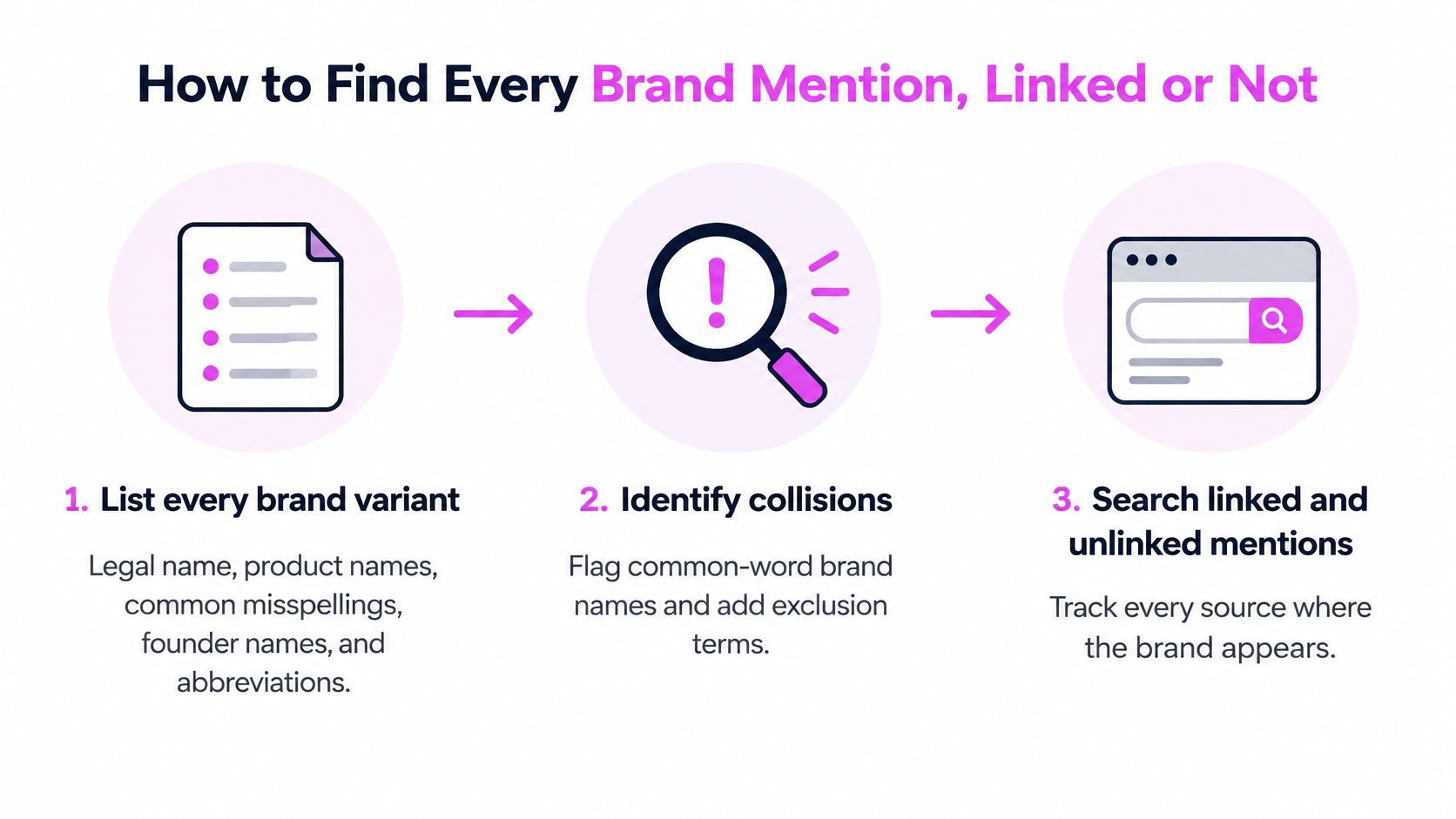
A mention log is only useful if it captures more than a page title and a brand name. I build it to answer two questions: what is this reference, and what action does it warrant? That means collecting variations, filtering noise, and checking link status on the live page rather than trusting a monitoring export.
List every brand variant. Include the legal company name, product names, common misspellings, founder names, and abbreviations. A product might be discussed without the parent company name, while an author might refer to a founder rather than the brand. Put each variant in its own row so you can trace which queries are productive.
Identify name collisions. If your brand is also a common word or surname, add exclusion terms that remove unrelated results. For example, a product called “Lumen” may appear in unrelated lighting coverage. A short list of exclusions will make alerts easier to review.
Set alerts across the places people publish. Include web search, news, forums, review sites, YouTube descriptions, and podcast pages. Different source types serve different purposes: a product review may be an outreach opportunity, while a podcast transcript or forum thread can reveal how customers describe the category.
Run quoted-phrase searches monthly. Search each important variant in quotation marks, and exclude your own domain so the results focus on third-party coverage. Alerts can miss pages, so manual searches are a useful cross-check.
Log each result. Record its URL, discovery date, source type, link status, sentiment, and topical relevance. Use the same statuses consistently: linked, unlinked, redirected, nofollowed, or inaccessible. A log lets you compare mentions without treating them all as equivalent.
Check the live page. Load it, inspect whether the brand name is linked, and follow the link to see where it goes. A redirect, removed page, or inaccessible result changes what you can report.
Review the log weekly. Flag new sources and assign an action, even if that action is “monitor.” For review monitoring, you can compare available approaches in CapyScout's overview of review tracking options.
The mistake to avoid is exporting every alert into a “links recovered” report before confirming that a hyperlink exists. Tools such as SemDash can automate detection of unlinked mentions across blogs, news sites, and directories, but a person still needs to classify the result, check its context, and decide whether outreach makes sense.
Which Mentions Deserve Outreach and Which to Ignore
A mention on a relevant, maintained comparison page may deserve a concise request. A passing reference on a thin directory page usually does not. Assess sentiment, topical fit, entity clarity, audience value, and whether the page is accessible and stable before choosing an action.
| Mention case | Signal to check | Aktion |
|---|---|---|
| Relevant page with no link | Page quality, topical fit, and whether the page is accessible | Consider requesting a descriptive link |
| Inaccurate product or entity details | Brand risk and incorrect facts | Send a correction with a reliable source |
| Industry publication or review site | Audience relevance and editorial context | Consider a focused editorial pitch |
| Forum thread or thin directory listing | Relevance and likely audience value | Monitor or skip outreach |
| Auto-generated or spam mention | Context and audience value | Ignore; do not report it as SEO gain |
Choose the move that fits the source
Request a link when a relevant page already mentions your brand and a link to a useful destination would help readers. Keep the request brief and specific. These link-building outreach principles can help keep the approach focused rather than turning it into a mass campaign.
Correct facts first when a listing gets your product or entity details wrong. For example, send the editor a clear correction and a link to current product information. Accuracy matters more than treating the error as a link opportunity.
Pitch editorial coverage when a publication reaches an audience you want to serve and the subject fits your brand. Coverage can be valuable even without a backlink, so make the pitch about the readers and the story, not just the link.
Consider a niche review site that appears on page two for a product comparison query. It names your product in a relevant comparison, but does not link to it. If the page is live, accurate, and maintained, a short request for a descriptive link to the product page is reasonable. That is a stronger case than asking an unrelated site to add a generic homepage link.
A forum signature or auto-generated directory page is usually a different case. If it offers little relevant audience value, monitor it or ignore it. Mass outreach for low-value forum signatures will not turn those pages into quality placements; it uses outreach capacity and can make your brand look spammy.
Do Brand Mentions Actually Move Rankings?
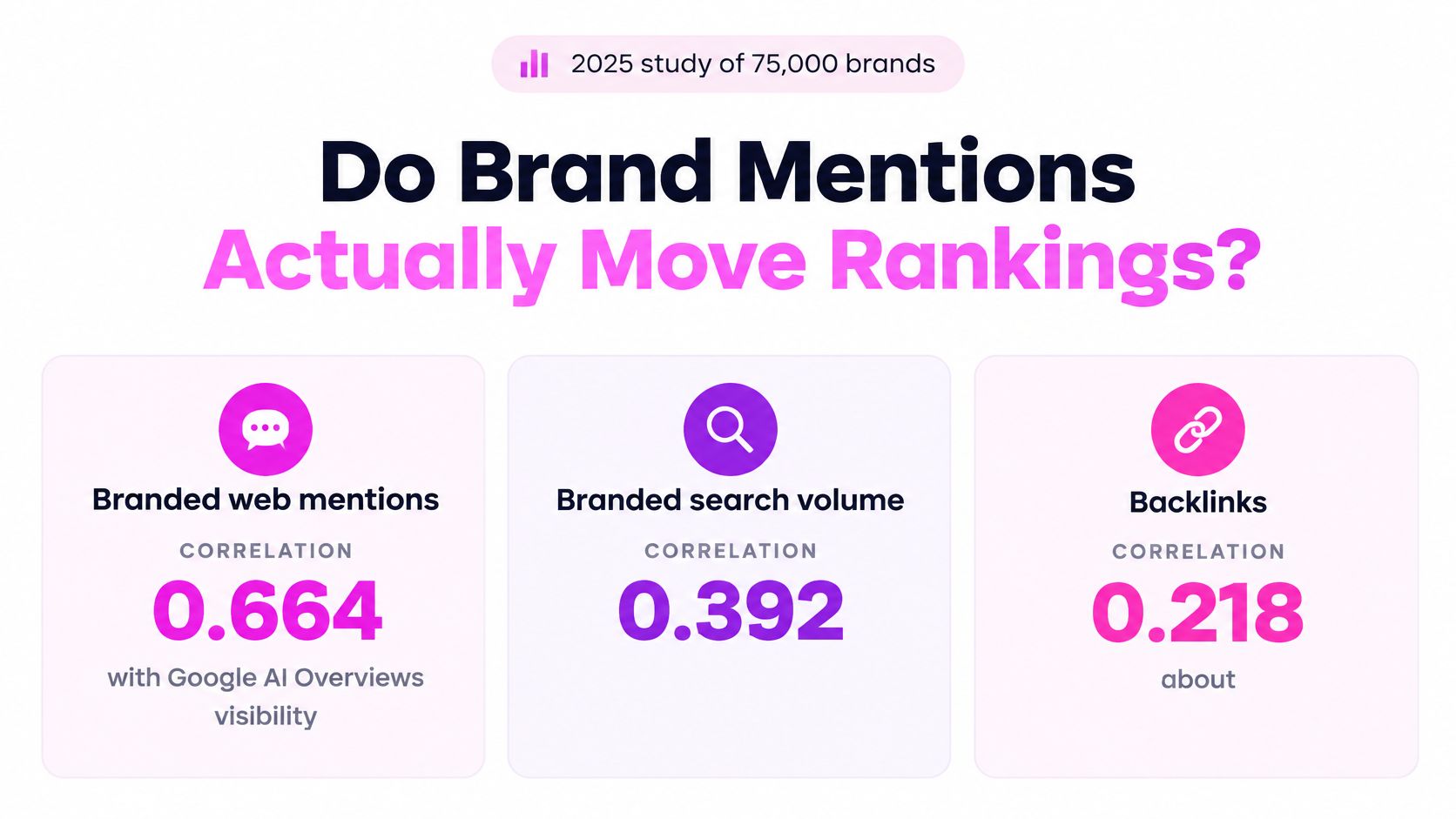
A 2025 study of 75,000 brands reported a 0.664 Spearman correlation between branded web mentions and visibility in Google AI Overviews. Branded search volume had a reported correlation of 0.392, while backlinks showed a much weaker correlation of approximately 0.218, according to the study's analysis of mentions and backlinks.
| Metrik | Correlation | What it means |
|---|---|---|
| Branded web mentions | 0.664 | Strongest association with AI Overviews visibility in the study |
| Branded search volume | 0.392 | Moderate association; demand and visibility rise together |
| Backlinks | About 0.218 | Much weaker association than mentions |
Those numbers show association, not causation. They don't prove that increasing unlinked mentions will improve rankings or get a brand cited in an AI answer. Brand popularity, topical relevance, PR coverage, and search demand could influence mentions and visibility at the same time. A team that sees both mention volume and rankings rise can't assume one caused the other.
Google's public documentation doesn't confirm plain-text mentions as a direct, standalone ranking factor. I wouldn't present an unlinked mention as a guaranteed ranking gain, and I wouldn't report it as a recovered link. I would use the study as a reason to investigate mentions as an authority and visibility signal, especially in AI search, while keeping ranking claims cautious.
Measure a cohort, not a coincidence
Choose a set of priority topics and record a baseline before acting. Then track newly reclaimed links, indexed target URLs, branded-query impressions, referral sessions, and nonbranded ranking changes. The distinction between link acquisition and demand signals matters: if a mention leads to a new link, log that as a link outcome; if branded searches rise without a link, report it as a demand outcome.
Use a control set of topics you didn't work on over the same period. Comparing the two groups won't prove causation by itself, but it helps you spot whether changes are concentrated where you took action or reflect a wider shift. Keep source relevance, geography, link status, and the wording around the brand in the log so the comparison stays useful.
How Mentions Show Up in AI Answers
A brand can appear in an AI answer without a link, while a cited URL may support an answer without naming the brand. Track these as separate outcomes: the first measures brand visibility, and the second shows which page an answer engine presents as evidence.
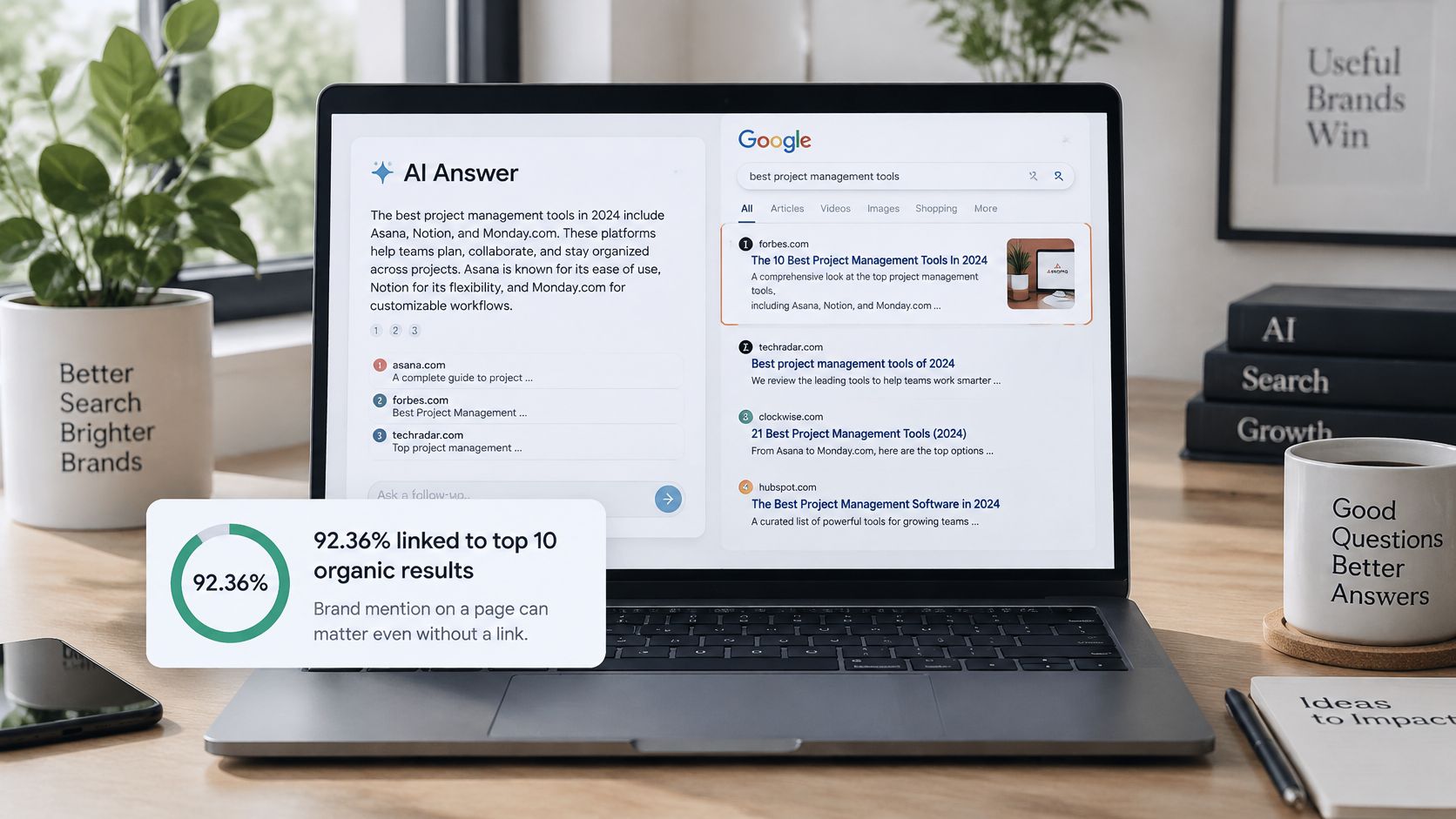
In November 2024, 92.36% of Google AI Overviews linked to at least one domain already ranking in the top 10 organic results, laut DreamHost's analysis of AI Overviews. The result makes organic visibility worth checking when you investigate AI citations, but it doesn't show that a mention causes an AI Overview to cite a page.
Google describes query fan-out as a process in which an AI feature may search related subtopics and sources. A comparison query and a practical follow-up may therefore draw on different URLs. To make appearances easier to assess, log the exact query, brand wording, cited URL, and whether the URL supports the specific claim. Record separately whether the answer names the brand and displays a link.
Give answer engines clear evidence
If several pages on your site answer the same question, consolidate overlapping explanations or select one main page. Keep it indexable and put a concise, self-contained answer near the relevant topic. This gives reviewers a specific passage to assess against a claim, instead of making them piece together an answer scattered across pages.
If an AI answer gets a detail wrong and you can't edit the cited source, start with the pages it cites. Correct your own page with a clear, sourced statement, then ask the third-party publisher to update the inaccurate claim and point to the evidence. Guidance on how to earn citations in AI answers can help you assess what makes a page useful as supporting evidence. Check the answer again after it has had time to update; a correction won't appear immediately by default.
For broader monitoring, SemDash's guide to AI search visibility explains how to inspect which URLs appear for search queries. Keep the measures distinct: a brand mention in an answer is not the same as your URL appearing as a citation.
Run Your First Brand Mention Audit This Month
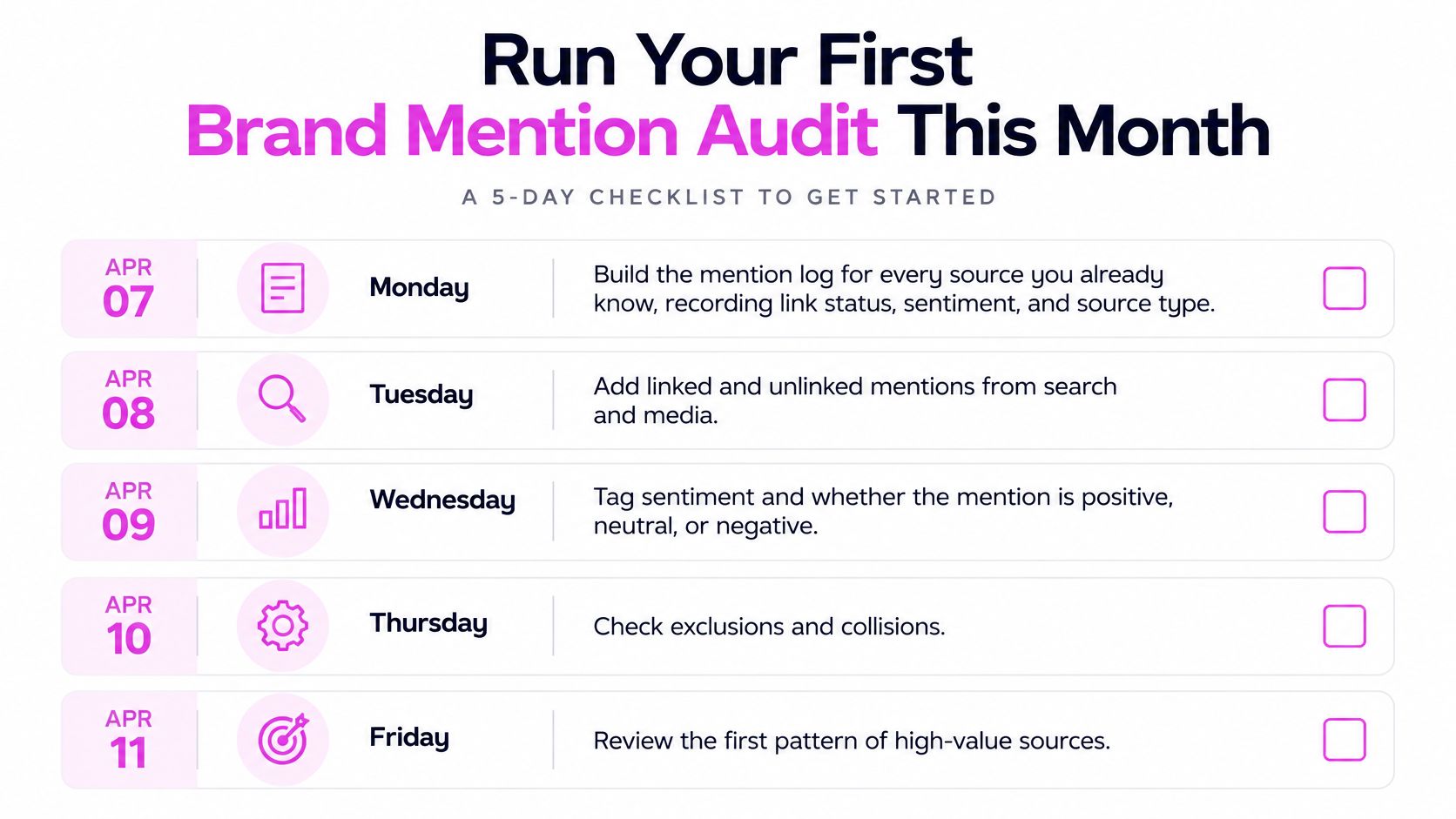
Use this dated checklist as a focused first pass. The sequence starts with building a reliable record, then narrows attention to the pages most likely to matter to your priority searches.
- Monday: Build the mention log for sources you already know. Record each URL, link status, sentiment, source type, and topical relevance so you're not treating every result alike.
- Tuesday: Find mentions on pages that already rank in the top 10 for your priority queries. Add linked and unlinked mentions from search and media, then flag those pages for a closer review.
- Wednesday: Correct the three most damaging inaccurate references. Include a source that supports the correction, and save each message so you can check whether the page changes.
- Thursday: Contact no more than five authoritative pages that mention your brand without a link. Give each editor a specific reason to add a descriptive, crawlable link.
- Friday: Record a baseline for branded-query impressions, referral sessions, and target rankings. Note which topics you plan to work on and which will remain your comparison set.
- The following Monday: Check AI Overview citations for your ten priority queries. Record the exact query and cited URL, then note which cited URLs belong to your site.
You can build alerts by hand, or use a monitoring tool to reduce the manual work. SemDash detects unlinked brand mentions across blogs, news sites, and directories, and its platform provides access to more than 20 SEO research tools with a free starting option. It also offers free live calls where you can speak with an SEO specialist. Detection can surface candidates, but a person still needs to confirm link status, judge source quality, and choose whether to act.
Use SemDash to detect unlinked mentions and keep them separate from link equity, then review each opportunity before you reach out. You can also use its AI visibility features to inspect the URLs cited in Google's AI-generated answers. Visit SemDash to start building a more disciplined brand mention workflow.