%20(1)-B86R08ZzwhPzS6UZbG3mSxRWPCwGwn.png)


Most rank tracker shortlists start with price and keyword limits, and that's the wrong first filter. A tool can be affordable yet unusable if it can't separate mobile from desktop, local from national results, or a temporary fluctuation from a persistent loss. A position is also not a universal fact. Google results vary by location, language, device, search history, and settings, so a reported “position 3” only means something when the tracking context is controlled. Google explains why search results vary.
I choose an SEO rank tracker by the decision it needs to support each week. Do I need simple daily monitoring, city-level visibility, on-demand checks, long historical charts, agency reporting, or a direct link between rankings and the exact page earning them? The ten tools below are organized around those jobs, not a generic best-to-worst ranking. I've also called out the limit that changes the buying decision, because every platform looks capable in a demo.
Inhaltsverzeichnis
- 1. Mangools SERPWatcher
- 2. Moz Pro
- 3. SE Ranking
- 4. SemDash
- 5. Semrush
- 6. Ahrefs
- 7. AccuRanker
- 8. Advanced Web Ranking
- 9. Nightwatch
- 10. SEO PowerSuite Rank Tracker
- Top 10 SEO Rank Trackers Comparison
- Match the Tracker to the Decision You Make Each Week
1. Mangools SERPWatcher
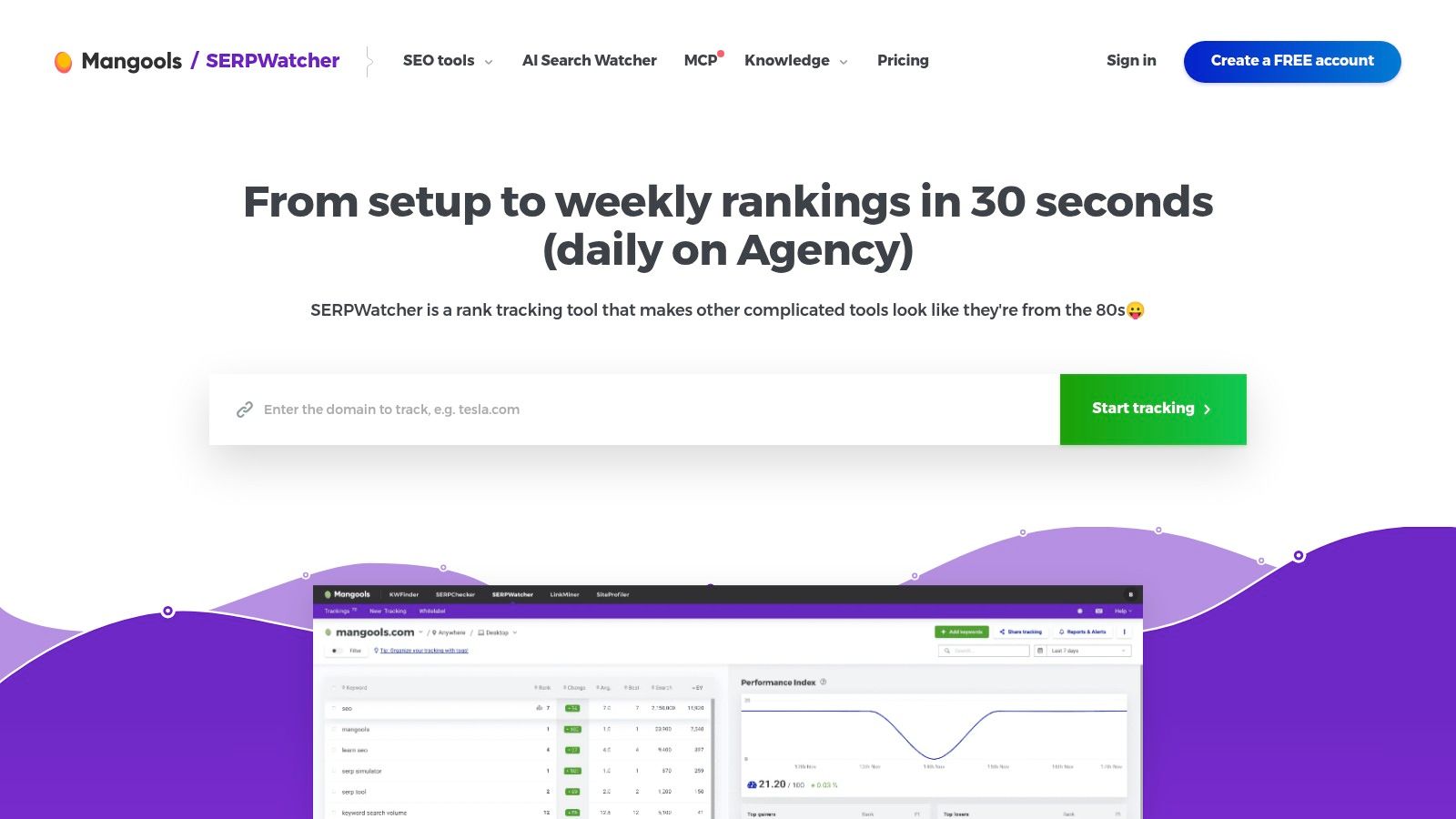
Best for straightforward daily tracking without a steep learning curve. SERPWatcher is the tool I'd put in front of a blogger, small business owner, or newer SEO practitioner who needs a clean view of keyword movement rather than an enterprise command center. Its daily updates, desktop and mobile tracking, country and location settings, SERP previews, and ranking-change alerts cover the operating basics well.
The Performance Index is useful for nontechnical users because it combines ranking positions with search volume into a single directional summary. I like that for weekly reviews where the question is, “Are the terms that matter moving in the right direction?” It gives a more useful starting point than staring at a long keyword table with no prioritization.
Where it fits and where it stops
The trade-off is scale. SERPWatcher is less comfortable when I'm managing complex international programs, large agency portfolios, or detailed client workflows that need extensive segmentation and reporting. Keyword allowances are also more constrained than those of high-end platforms, so I'd check the tracked-term count against the actual portfolio before committing.
Praktische Regel: Use SERPWatcher when the priority is understanding movement quickly. Don't buy it expecting enterprise-level workflow control.
It sits nicely beside Mangools' keyword and SERP research tools, and its accessible interface usually means less training time. If you're comparing it with broader platforms, this guide to Mangools alternatives is a useful next step. See the product details on Mangools SERPWatcher.
2. Moz Pro
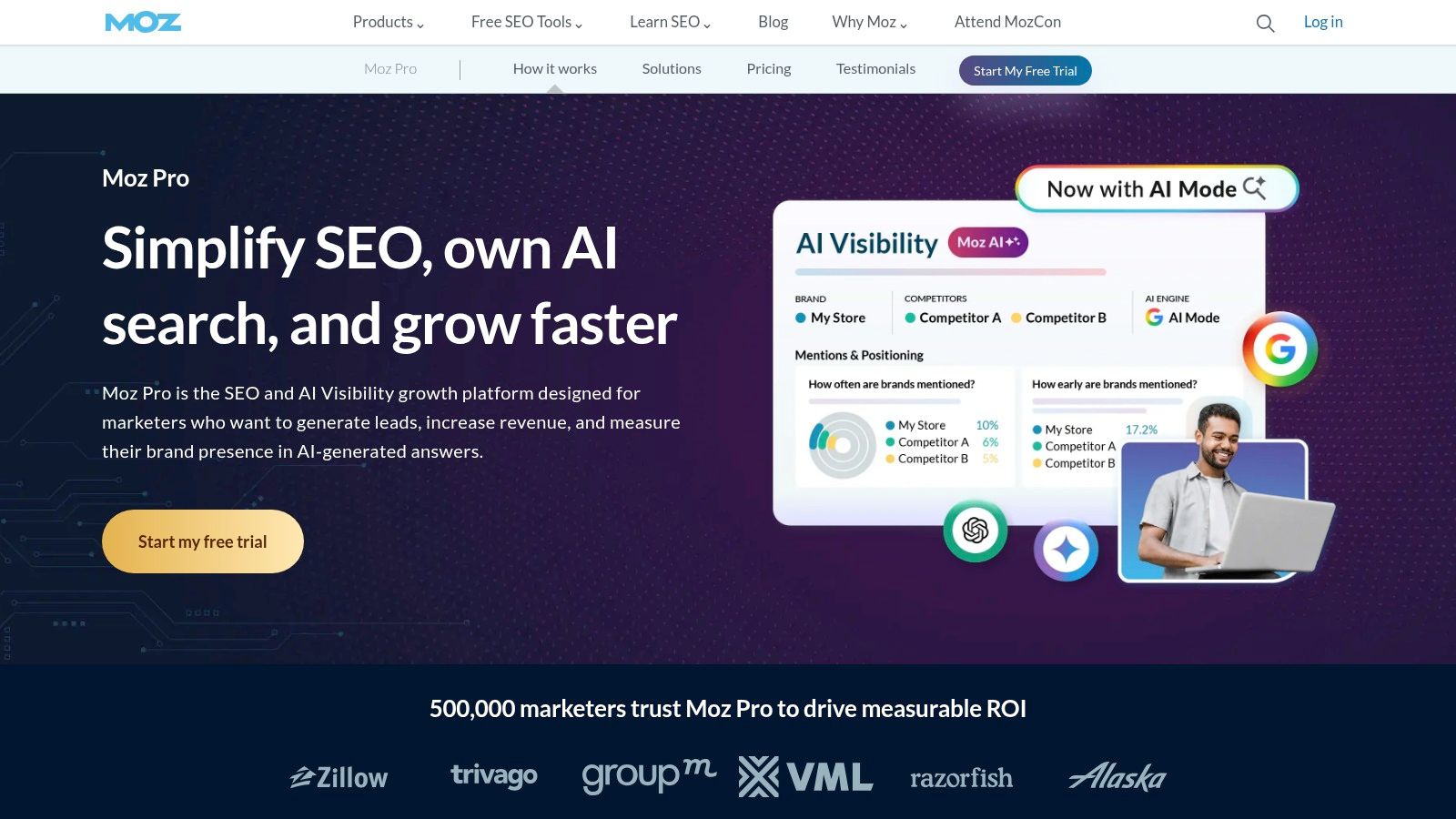
Best for teams that want rank tracking connected to approachable SEO research. Moz Pro combines rankings with keyword discovery, site crawling, link research, and page optimization. That combination works well for marketing teams where the person reviewing positions is also responsible for deciding which content to create or improve.
I'd use its competitor comparisons and visibility trends to turn a ranking review into a planning conversation. A keyword that slips matters more when a competing page takes the position, the SERP feature changes, or the query's difficulty makes recovery unlikely without a stronger page. Moz Pro's connection between tracked terms and keyword research helps keep that reasoning in one workspace.
The accessible all-in-one trade-off
Moz Pro is approachable for marketers who aren't technical SEO specialists, which is a real advantage during adoption. The downside appears when the account needs broader keyword coverage or highly granular agency workflows. Lower tiers can restrict campaigns and keyword allowances, and teams that need a particularly deep backlink database may still add another platform.
I wouldn't choose Moz Pro solely because it reports a position. Search Console's average position is an impression-weighted average of the topmost position a site's link occupied, not a literal daily rank for every search. Google's Search Console documentation explains that distinction. Moz Pro is more useful when I use controlled tracking for operational decisions and aggregate performance data to validate the business outcome.
For marketers who want one recognizable platform instead of a collection of specialist tools, Moz Pro remains a sensible shortlist candidate. Advanced agencies should test campaign limits before rolling it across every client.
3. SE Ranking
Best for agencies balancing local, international, and client-reporting needs. SE Ranking sits between lightweight trackers and expensive enterprise suites. It tracks keywords across search engines, locations, devices, and languages, then adds competitor comparisons, local SEO, map-position tracking, white-label reports, client accounts, and collaboration features.
That mix changes how I'd use it. I wouldn't treat it as just a place to check whether a page moved from position 8 to position 6. I'd create separate tracking contexts for the client's primary city, wider market, mobile audience, and important language markets, then use the reporting layer to explain the differences rather than averaging them into one headline.
Why agencies tend to like the middle ground
The main strength is balance. Smaller agencies get enough reporting and client management structure without jumping immediately to a heavyweight suite, while in-house teams can connect ranking movement with competitor visibility and local performance.
The important limitation is pricing complexity. Cost depends on ranking frequency, keyword volume, and subscription term, and some advanced capabilities require higher plans or add-ons. A weekly update may be perfectly adequate for stable informational content, while a volatile commercial portfolio may justify more frequent checks. I'd model that usage before comparing headline prices.
A rank tracker should preserve the query, URL, location, device, and date behind every movement. Otherwise, the number is hard to diagnose.
SE Ranking can feel less specialized than a dedicated rank-tracking platform, but that's also why it works for mixed agency workflows. Review the current options on SE-Rangliste, then test a representative client account rather than a tiny sample.
4. SemDash
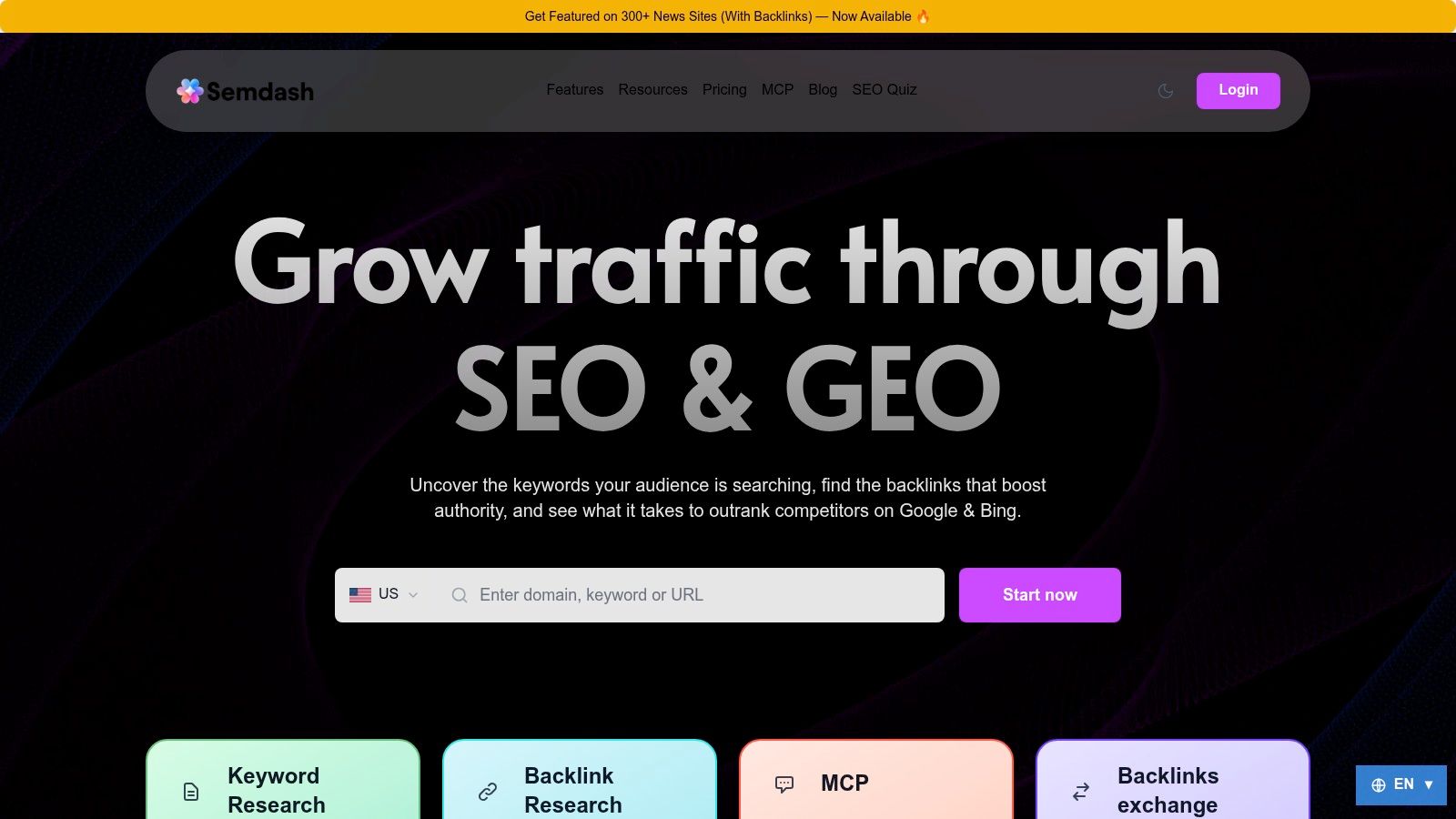
Best for connecting ranking changes to the ranking URL, SERP history, competitors, and AI visibility. SemDash suits teams that need to explain why a position changed, not just record the latest number. Its URL-level mapping shows which page ranks for each query. Domain Keywords, Top Pages, Traffic Share, and Keyword and Backlink Gap reports add context about competitor performance.
That page-level evidence changes the diagnosis. A site may gain visibility while the wrong URL ranks, or lose a query after Google switches to another page on the same domain. Check the ranking URL before changing a title, rewriting content, or creating a redirect. Keyword clustering can then group related queries into page-level topics and help reduce cannibalization.
The tracking workflow
Start with a stable keyword cohort and classify intent from live SERP results. Review the 12-month SERP history for volatility and changes in result types. Compare the ranking URL with competitor pages, inspect traffic-share and gap data, then convert the findings into a content brief or link-acquisition task. This workflow gives the position change a reason and a next action.
SemDash reports 6.6 billion Google keywords refreshed monthly, a 2.7 trillion backlink index, and approximately 600 million SERPs. These figures come from SemDash's product information, so validate coverage for a niche market before assuming that every edge-case query has equal representation. AI-assisted briefs, search-intent classification, unlinked-mention detection, broken-backlink recovery, and an optional outreach service for placement on 300+ news sites with backlinks extend the workflow beyond rank checks.
AI Overviews need their own visibility view. Pew Research analyzed 68,879 Google queries from about 900 U.S. adults in a March 2025 panel study. Standard-result clicks occurred 8% of the time when an AI Overview appeared, compared with 15% without one. The study also reported that 18% of Google searches produced an AI summary, und 88% of those summaries cited at least three sources. Pew's study details the click and AI-summary findings. SemDash's AI Overviews visibility feature separates triggering keywords, domain mentions, and exact cited URLs from traditional blue-link rankings.
Where the trade-off sits
SemDash is positioned as a budget-friendly alternative and offers free trial or free-tier access to more than 20 tools. Exact plans and rates are not specified here. I'd check current limits on the SemDash pricing page, especially for large bulk analyses and add-ons. Users moving from Ahrefs or Semrush may find fewer raw keyword hits for some edge cases, so confirm plan-level coverage before procurement.
The fit is strongest for small teams, agencies, consultants, and solo practitioners that want to move from ranking evidence to content, internal-link, and backlink actions in one workflow. The interface prioritizes speed and simplicity, with tutorials, an SEO Academy, live calls, product updates, and a public roadmap for teams that need product support.
5. Semrush
Best for agencies that want rank tracking inside a broad competitive-intelligence suite. Semrush Position Tracking covers desktop and mobile searches, countries and cities, competitors, visibility trends, share of voice, ranking distribution, local results, map packs, and SERP features such as featured snippets.
I'd choose it when ranking data needs to connect directly with keyword research, backlink analysis, site audits, content tools, and competitor discovery. For an agency, that reduces the handoffs between “the ranking dropped,” “the competitor gained the query,” and “here's the content or link work we should do next.” Its mature reporting and integrations also help when several people need the same dataset for different workflows.
The breadth tax
Semrush is not the efficient choice if all I need is a small keyword list and a simple daily position check. The platform's breadth creates a learning curve, and the subscription tier controls project and keyword limits. A team can pay for capabilities that never enter its weekly process.
I also avoid reading share of voice as a business result by itself. Rankings, impressions, citations, and SERP presence are exposure metrics. Leads, qualified traffic, and revenue are outcome metrics, and they need separate validation. A 2024 academic study estimated top organic CTR at 9.28% for position 1, 5.82% for position 2, and 3.11% for position 3, using 416,386 clicks, 31,648,226 impressions, and 8,861,416 daily queries. The study's published results show why older CTR assumptions can mislead.
Semrush makes sense when its supporting research justifies the cost. Visit Semrush Position Tracking and evaluate the complete workflow, not only the rank table.
6. Ahrefs
Best for connecting ranking history with competitor, content-gap, and backlink research. Ahrefs' Rank Tracker fits teams that need to explain a ranking change, not merely record it. Scheduled updates, historical rankings, visibility and traffic trends, average position, share of voice, competitor comparisons, SERP-feature tracking, and reporting sit alongside broader research.
That workflow matters when a ranking report must lead to a decision. From a tracked query, I can inspect the competing page, identify missing content, and review backlink evidence before recommending an update or outreach. The tool keeps those checks closer together than a standalone rank tracker.
Where the specialist choice wins
Ahrefs works particularly well for domain-level research around tracked keywords. Historical charts help separate a persistent trend from one unusual reading. Competitor comparisons also show whether the SERP shifted broadly or whether only my page moved.
The trade-off is cost at scale. Higher tiers become more expensive as keyword sets grow, with limits that can depend on projects, users, or reporting allowances. Ahrefs is also a weaker fit for highly granular local tracking across many locations. A dedicated local platform may provide a more focused workflow for that job.
Daily rankings need a time-series view. A 2025 study covering 404,192 keyword-site pairs across 898 active SEO portfolios found that 64% of tracked keywords experienced a range of at least five positions, während 50% moved by at least ten positions within one month during a 41-day observation period. The research explains why daily snapshots can overstate losses. I would check Ahrefs' history for persistence before making a major content change.
Choose Ahrefs Rank Tracker when competitor content and backlink evidence are part of the weekly tracking decision.
7. AccuRanker
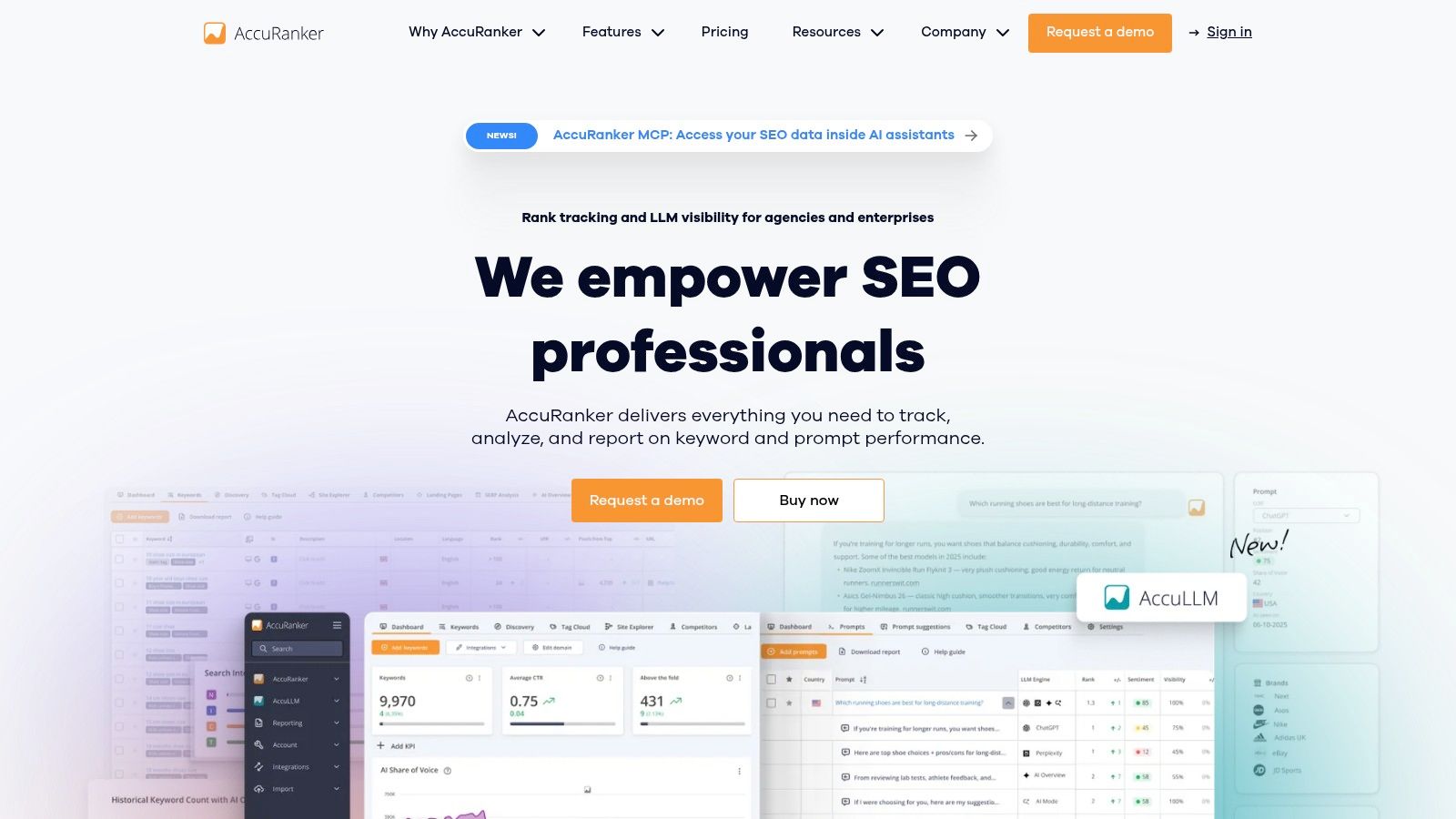
Best for specialist tracking, fast checks, and detailed segmentation. AccuRanker suits teams that treat ranking data as a working dataset rather than a small feature inside a broader SEO suite. It supports scheduled and on-demand updates, desktop and mobile tracking across locations, SERP-feature monitoring, competitor analysis, tagging, filtering, and detailed reporting views.
Its strongest use case is deciding which movement deserves attention. Agencies can group keywords by client, product, funnel stage, location, intent, or position band, then investigate a focused slice instead of scanning one long list. An on-demand check can also confirm whether a documented page update coincided with a ranking change. It does not, by itself, prove that the update caused the change.
The specialist trade-off
AccuRanker costs more than beginner-oriented tools, and the number of tracked keywords affects the bill. It also does not replace Semrush or Ahrefs for broad keyword discovery and backlink research. Pair it with another platform when the team needs competitive intelligence alongside dependable position monitoring.
Its segmentation is most useful when alerts need context. Group them by position band, search volume, and persistence so the agency responds to sustained movement rather than a single-day decline. Separate alerts for terms outside the top results from alerts for high-volume terms already near page one. That setup helps preserve attention for changes with a practical business impact.
AccuRanker fits agencies that have already chosen a dedicated rank-tracking system. Test AccuRanker with a real client-sized keyword set, because a small trial will not reveal the cost implications of larger tracking volumes.
8. Advanced Web Ranking
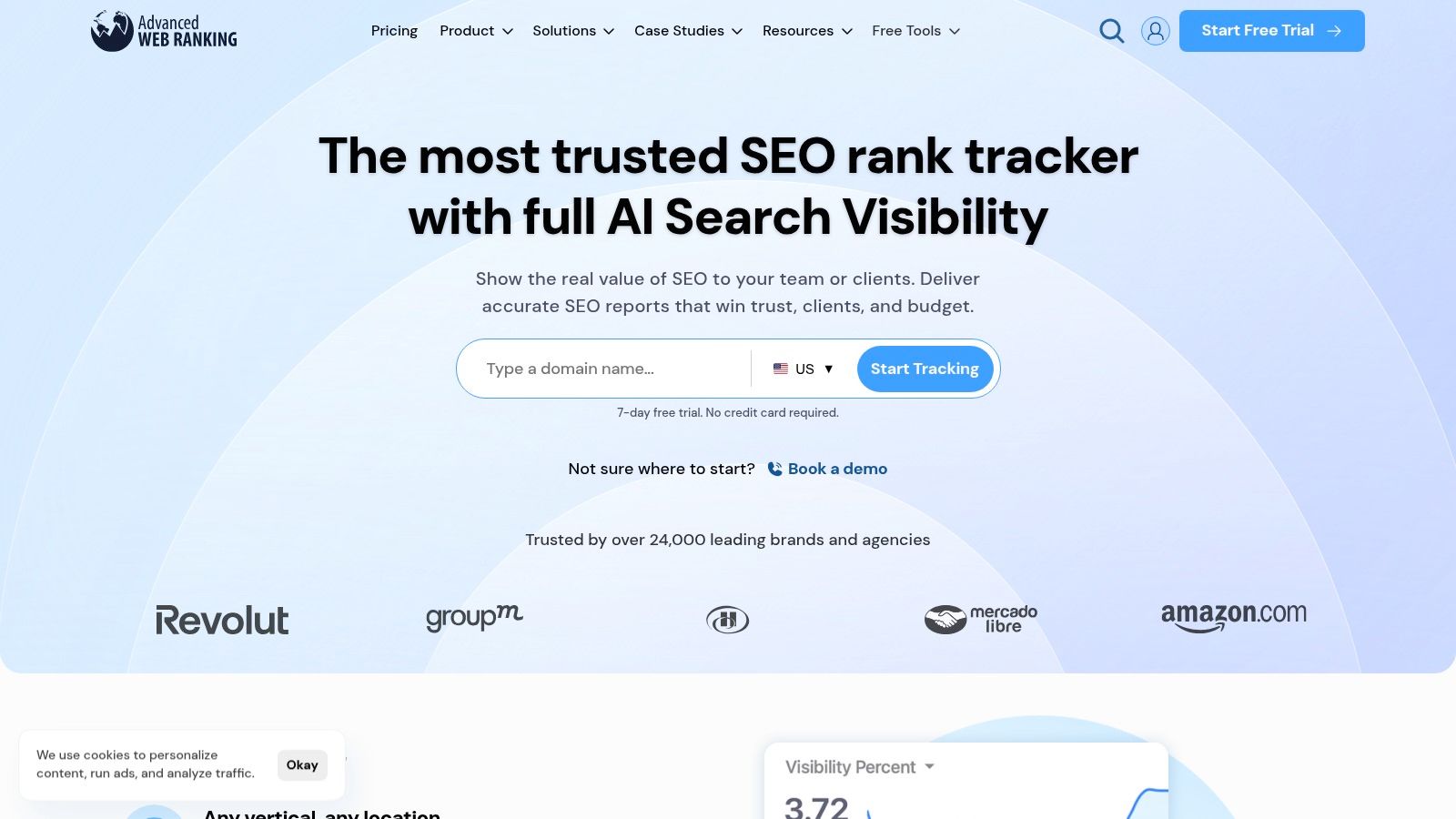
Best for international portfolios and white-label client reporting. Advanced Web Ranking focuses on dedicated position tracking, broad search-engine and location coverage, flexible reports, and scheduled delivery. It supports daily, weekly, and on-demand updates across local, mobile, desktop, and international searches, alongside competitor comparisons and SERP-feature monitoring.
Use it when the reporting deliverable matters as much as the analysis. Agencies can configure branded reports and scheduled distribution, reducing manual work when clients expect a consistent monthly or weekly view. Support for larger keyword portfolios also suits multi-market programs better than lightweight trackers.
Reporting strength, configuration cost
The trade-off is setup time. AWR offers enough control that teams may need to define location, device, search-engine, and reporting conventions before the dashboards stay consistent. That work pays off when clients need those distinctions, but it adds friction for a small team seeking a quick rank check.
A single international average rank can hide meaningful variation. Google says results may differ by location, language, device, search history, and settings, while ranking-system changes can roll out gradually across data centers. AWR is most useful when reports preserve those contexts and label them clearly.
It is not an all-in-one SEO research suite. Pair it with keyword and backlink tools if the team needs discovery alongside measurement. Reporting-heavy agencies should test Advanced Web Ranking with a real branded report before choosing it.
9. Nightwatch
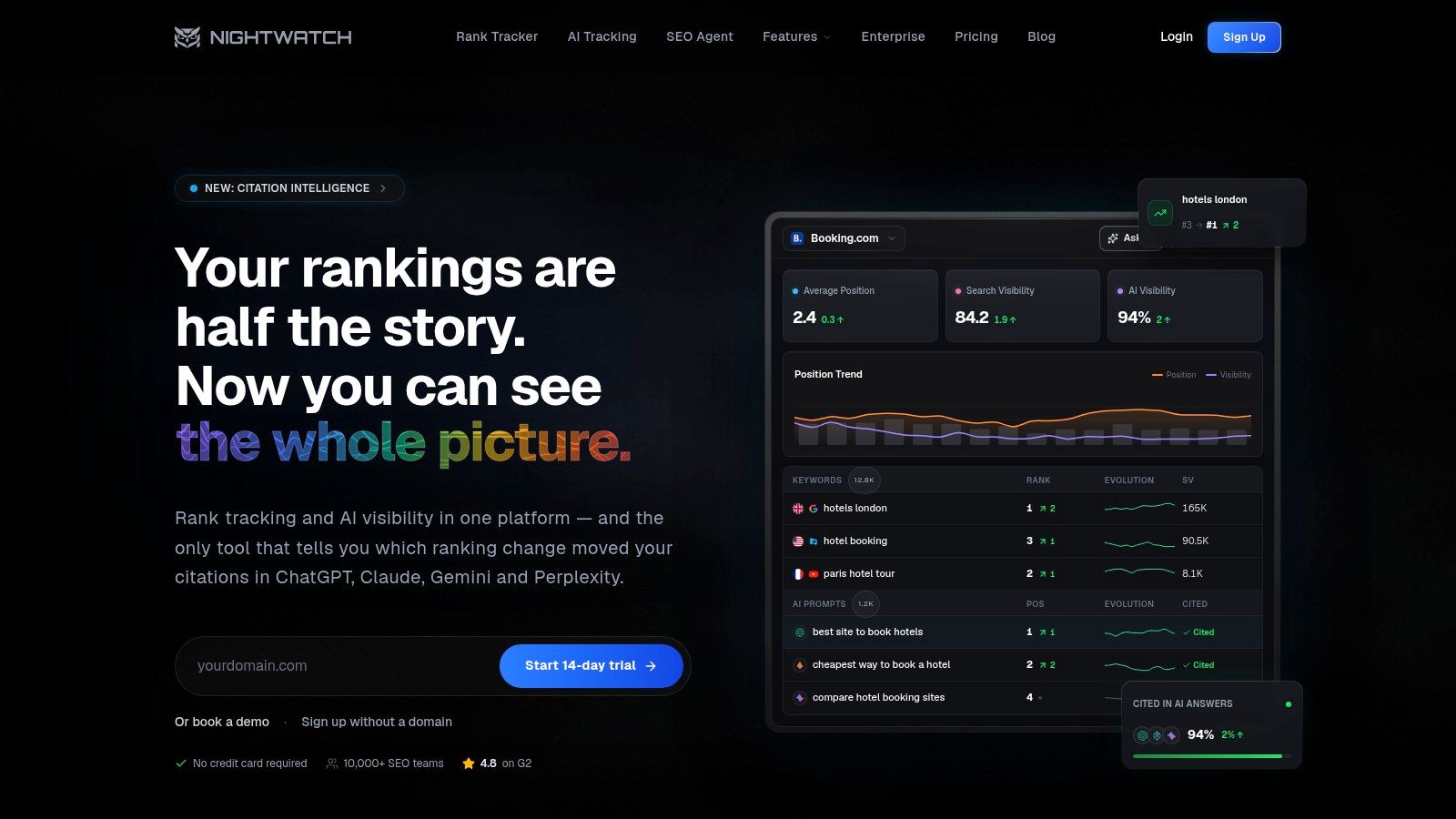
Best for local SEO, multi-location monitoring, and visual explanations. Nightwatch tracks local, national, and global rankings, including map-pack visibility, and adds competitor comparisons, custom dashboards, visualizations, and scheduled reports. That makes it especially useful when a client needs to understand how performance differs between locations rather than hearing a single national average.
I'd build separate views for each priority location and device, then compare the ranking URL and local result context. For a service business, that distinction matters. A page may rank well nationally while the Google Business Profile and local landing page underperform in a target city.
The location-driven cost curve
The limit is predictable. Pricing rises with keyword count, locations, and API requirements, and advanced agency features may require higher tiers. Nightwatch also offers less depth for backlink and content research than broad platforms, so it's not the tool I'd choose as the only SEO workspace for a content-led team.
Visualization is its practical advantage. A client can understand a location-by-location movement chart faster than a dense export, especially when the report separates desktop, mobile, map results, and organic rankings. I still pair those charts with Search Console clicks and impressions because rank movement alone doesn't establish commercial impact.
If local visibility is the decision, track the city and result type directly. A national average can hide the market you're paid to improve.
Nightwatch is a good fit for local agencies and multi-location brands that value presentation as much as raw tracking depth. Review Nightwatch against a sample of the actual cities and map queries you manage.
10. SEO PowerSuite Rank Tracker
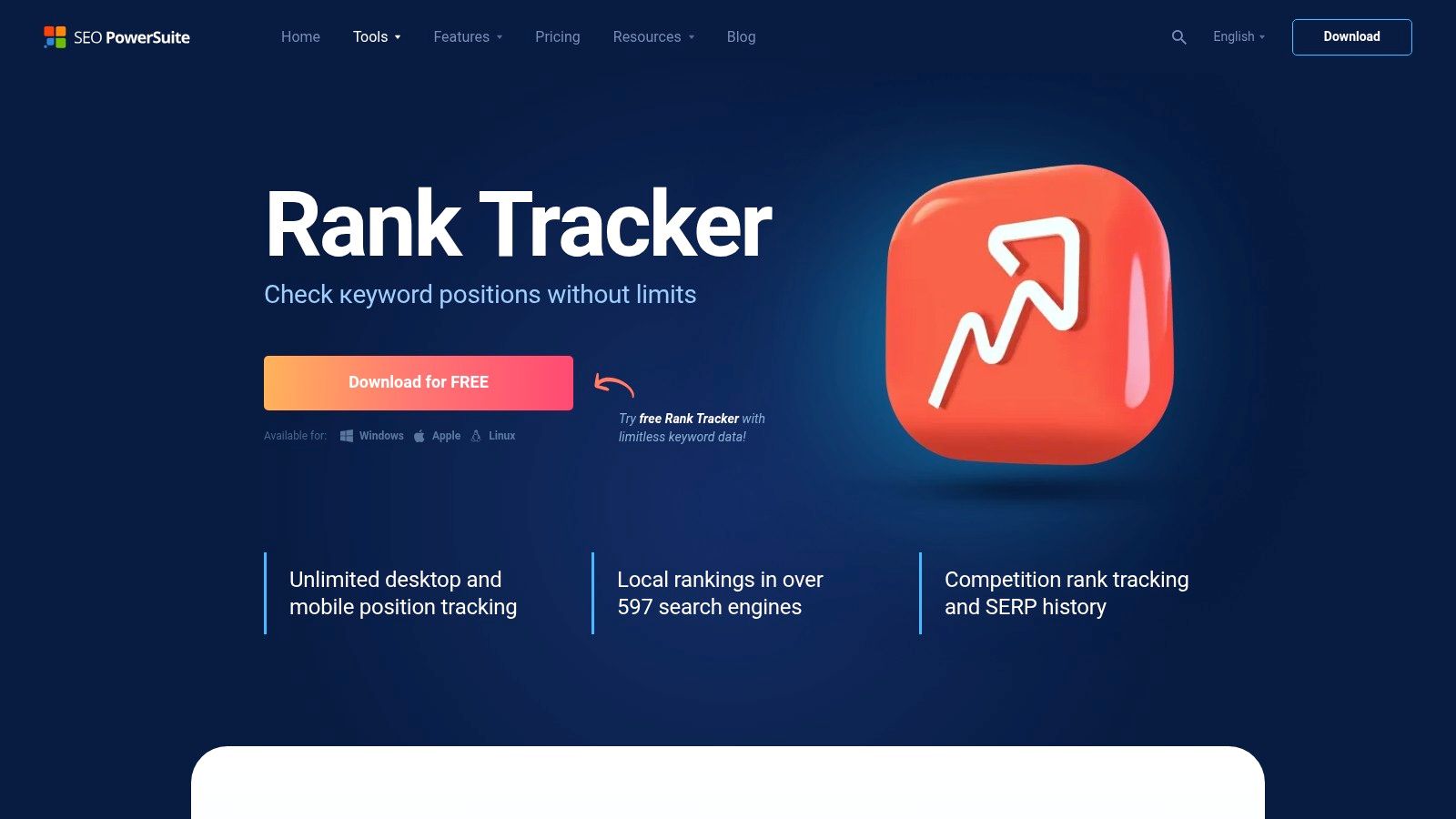
Best for advanced users who prefer installed software and high keyword capacity. SEO PowerSuite Rank Tracker is desktop-based rather than purely cloud-hosted. It supports local, national, and global tracking, desktop and mobile results, search-engine and SERP-feature analysis, competitor discovery, and customizable reporting.
That local installation changes the workflow. I can work with extensive keyword monitoring without relying on a browser-only dashboard, and paid versions can be cost-effective for high keyword volumes. The tool also gives technical SEOs substantial control over search settings and SERP analysis.
Desktop control versus cloud collaboration
The cost is operational rather than just financial. Installation, local resources, project files, updates, and team access all need management. Reporting and collaboration aren't as naturally cloud-based as they are in platforms designed for agencies, and beginners may need more time before they trust the setup.
I'd choose it when one experienced practitioner owns the tracking environment and values depth. I'd hesitate when several clients, writers, account managers, and executives need shared dashboards with minimal configuration. The desktop model can work well, but it needs a clear owner and backup process.
Before buying, I'd compare the exported reports with the format clients expect, then test local and mobile queries rather than only national desktop terms. For teams considering alternatives, this comparison of SEO PowerSuite alternatives helps frame the cloud-versus-desktop decision. See SEO PowerSuite Rank Tracker for the current product details.
Top 10 SEO Rank Trackers Comparison
| Werkzeug | Kernfunktionen | Unique selling points (✨) | Quality (★) | Price / Value (💰) | Target audience (👥) |
|---|---|---|---|---|---|
| Mangools SERPWatcher | Daily rank updates, desktop/mobile, Performance Index, SERP previews | ✨ Extremely user-friendly, quick insights for non‑technical users | ★★★☆☆ | 💰 Low | 👥 Bloggers, small businesses, new SEOs |
| Moz Pro | Rank tracking, keyword research, site crawl, SERP‑feature monitoring | ✨ Recognizable all‑in‑one with integrated keyword tools | ★★★★☆ | 💰 Mid | 👥 Marketing teams, SMBs |
| SE-Rangliste | Keyword tracking, local SEO, competitor monitoring, white‑label reports | ✨ Good price→feature balance, agency reporting | ★★★★☆ | 💰 Mid | 👥 Agencies, SMBs managing clients |
| SemDash 🏆 | 6.6B keywords, 2.7T backlinks, URL‑level mapping, SERP history, AI briefs | ✨ AI Overviews, unlinked‑mention & broken‑link recovery, fast UI | ★★★★★ | 💰 Budget‑friendly + free trial | 👥 Agencies, in‑house teams, consultants, solo marketers |
| Semrush | Daily position tracking, competitor discovery, local/map tracking, SERP features | ✨ Very extensive dataset + broad marketing toolset | ★★★★★ | 💰 High | 👥 Agencies, enterprise marketing teams |
| Ahrefs | Scheduled rank updates, visibility & SOV trends, strong backlink research | ✨ Excellent backlink + content‑gap integration with rank data | ★★★★★ | 💰 High | 👥 SEO teams, content & backlink analysts |
| AccuRanker | On‑demand/scheduled updates, segmentation, advanced filtering, SERP features | ✨ Specialist focus on speed, accuracy & agency reporting | ★★★★☆ | 💰 High (scales with keywords) | 👥 Agencies needing precise tracking |
| Advanced Web Ranking | Daily/weekly/on‑demand updates, international/local tracking, white‑labeling | ✨ Flexible reporting and scheduled client deliveries | ★★★★☆ | 💰 Mid–High | 👥 Agencies, large keyword portfolios |
| Nightwatch | Local/national/global tracking, map‑pack, custom dashboards & reports | ✨ Strong local SEO visualizations and multi‑location support | ★★★★☆ | 💰 Mid | 👥 Local SEO teams, agencies, multi‑location businesses |
| SEO PowerSuite Rank Tracker | Desktop-based tracking, large keyword allowances, SERP analysis | ✨ Powerful local/deep tracking with one‑time or standalone licensing | ★★★★☆ | 💰 Mid (one‑time options) | 👥 Advanced SEOs who prefer desktop tools |
Match the Tracker to the Decision You Make Each Week
I don't recommend choosing an SEO rank tracker by counting features. I choose it by writing down the question the team needs answered every week. If the question is “Did our priority terms move?” Mangools SERPWatcher may be enough. If it's “Which city, device, and map result changed?” Nightwatch or SE Ranking is more relevant. If it's “Can I explain the movement to a client with a branded report?” Advanced Web Ranking, AccuRanker, SE Ranking, or Semrush deserves closer testing.
For competitor-led content work, Ahrefs and Semrush make sense because ranking history sits beside backlink, keyword, and content research. For a specialist agency that needs detailed filters and frequent checks, AccuRanker's dedicated workflow is more appropriate than paying for a broad suite. For a technically confident user who wants desktop control and substantial keyword coverage, SEO PowerSuite remains a different but legitimate operating model.
SemDash fits a different decision. I'd use it when the weekly workflow must move from rank movement to a prioritized action: identify the exact ranking URL, inspect the SERP history, classify intent, compare competitor pages, find keyword or backlink gaps, and decide whether the next task is a content update, internal-link change, or outreach campaign. Its AI Overviews visibility tracking adds another layer because conventional rank can stay stable while the search experience changes around it.
I also separate controlled tracking from aggregate performance. A dedicated tracker checks the same keyword, country, language, device, and search engine over time. Search Console validates impressions, clicks, CTR, and average position across the site's real demand. Mixing those two measurements creates false disagreements because they answer different questions.
Run two or three shortlisted tools against the same keyword group and locations for a couple of weeks. Check whether each tool identifies the same ranking URL, records SERP features consistently, preserves historical context, and lets you explain a change without opening five other systems. The best tool is the one that answers your recurring decision with the least effort, even if another product has a longer feature list.
SemDash combines rank tracking with 12-month SERP history, URL-level keyword mapping, competitor research, backlink gaps, content briefs, clustering, and AI Overviews citation tracking. If you want ranking data that leads directly to practical content and link-building actions, visit SemDash and test the workflow with your own keywords and markets.