You've probably opened a competitor report, found a long list of terms they rank for, and still had no clear idea what to publish. The problem isn't a lack of keyword data. It's that a missing keyword rarely tells you whether to create a page, improve an existing one, combine two pages, or ignore the opportunity entirely.
I've seen teams waste days exporting competitor keywords that looked promising until we checked the ranking URLs and search results. Some terms belonged to a page they already had. Others represented a completely different intent. A few produced weak opportunities because the SERP had shifted or the result page offered little room for a traditional organic click.
A keyword gap tool gives you the structured comparison that guesswork lacks. It shows where competitors appear, which queries drive their visibility, and which pages earn those rankings. The useful workflow starts there, then adds URL mapping, intent classification, clustering, commercial judgment, and SERP volatility checks.
This guide focuses on that operational decision. You'll learn what a keyword gap tool reveals, which features deserve scrutiny, how to separate keyword gaps from broader content gaps, and how I turn a noisy export into a shorter roadmap of winnable pages. I'll also walk through my SemDash workflow and the checks I use before assigning a term to a writer or strategist.
Inhaltsverzeichnis
- Introduction Why Guessing Competitor Keywords Fails
- What a Keyword Gap Tool Actually Does
- Core Features to Evaluate Before You Trust the Data
- Keyword Gaps vs Content Gaps and When Not to Create a New Page
- How I Use SemDash Keyword Gap in Practice
- From Noisy Export to Prioritized Roadmap
- Conclusion Your Next Wins Without the Guesswork
Introduction Why Guessing Competitor Keywords Fails
A competitor launches a new resource, begins appearing for searches your site has never covered, and suddenly your team wants to “find their keywords.” That request sounds simple. In practice, it often produces a spreadsheet full of disconnected queries, broad topics, branded searches, and terms that your site should never target.
I've made that mistake early in competitive research. I'd compare domains, sort by apparent opportunity, and hand over a list that looked useful in aggregate. The first editorial review exposed the weakness: several keywords belonged in existing pages, several described different search intents, and some reflected competitor-specific products rather than a market opportunity.
The fix was to stop treating the report as a content brief. A keyword gap report is an evidence layer, not a publishing plan. It identifies queries where competitors rank and your site doesn't, but it doesn't make the page-level decision for you.
That distinction matters because competitor research sits inside a broader discovery process. A practical overview of adjacent methods, including audience and channel comparisons, is available in TransClipper's competitive analysis guide. For SEO, the equivalent discipline is comparing domains, ranking pages, query intent, and traffic share before deciding where your resources belong.
Praktische Regel: I don't ask, “How many keywords can we capture?” I ask, “Which topic deserves a page that can win and support the business?”
The best output is usually a smaller list than the original export. Each opportunity should have a likely page, a clear intent, a reason the SERP is winnable, and a business connection. By the end of this process, you'll be able to move from competitor visibility to a defensible decision: create, update, consolidate, or ignore.
What a Keyword Gap Tool Actually Does
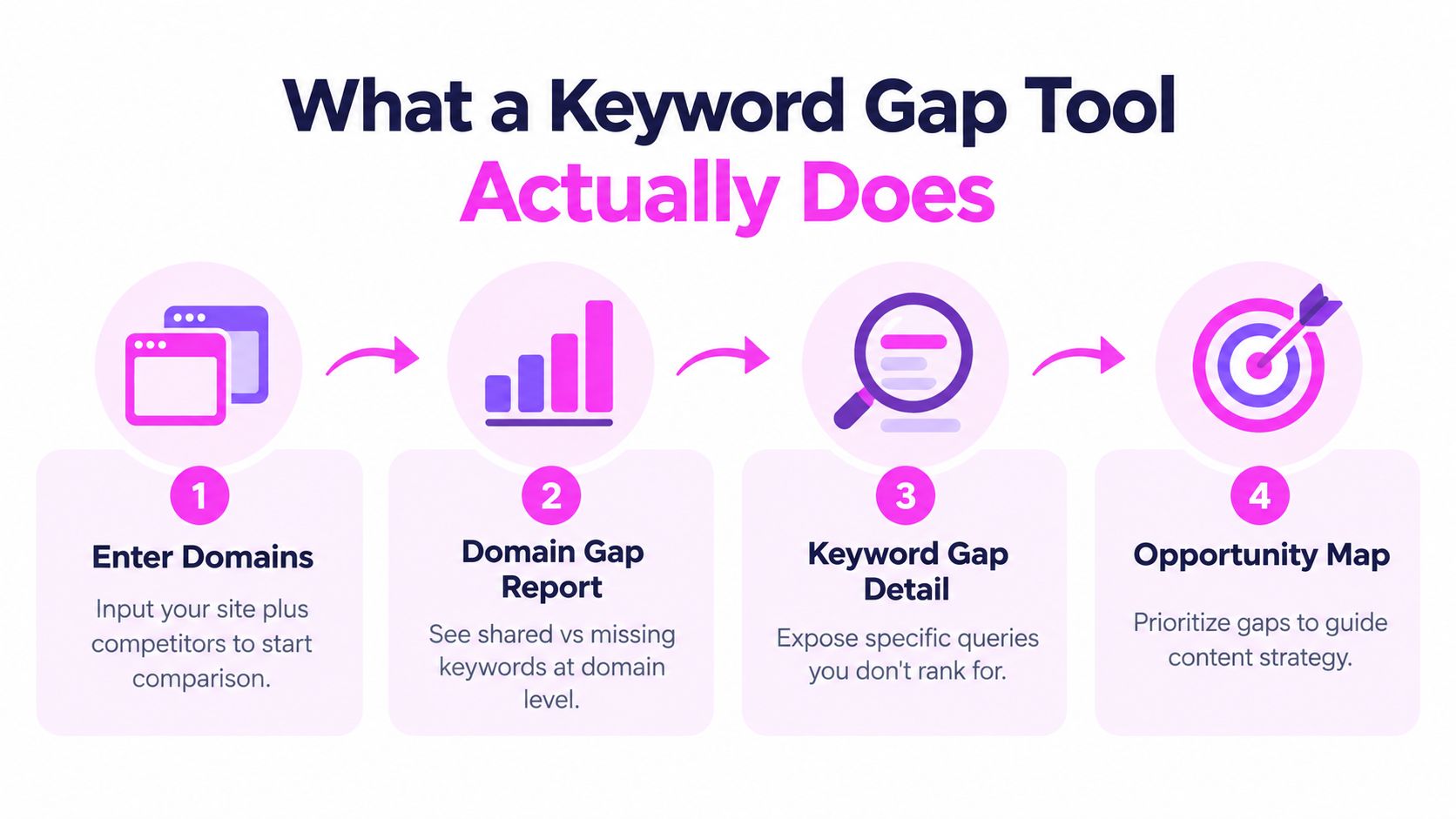
Start with the simplest comparison. Enter your domain and several relevant competitors, then compare the terms each site ranks for. The resulting overlap resembles circles on a page: shared keywords in the middle, competitor-only terms outside your circle, and terms where one competitor has stronger visibility than you.
That first view answers a useful question: where does the market appear to have demand that your site hasn't captured? Industry guidance commonly describes the workflow as adding 3 to 5 competitor domains, then filtering the results by measures such as search volume and Keyword Difficulty. The Keyword Gap Analysis guide from Keywords Everywhere describes the method as finding queries where competitors rank but your website does not.
From overlap to an opportunity map
A domain-level report is only the starting point. Suppose a competitor ranks for “project planning template,” “project planning software,” and “how to plan a project.” Those queries may look like one large gap, but they can represent a downloadable asset, a commercial category page, and an educational guide.
The same domain can rank through different URLs because each page serves a different intent. If you only inspect domain overlap, you may combine those terms into one oversized article and weaken its relevance. A useful tool connects each keyword to the precise ranking URL, so you can see whether the competitor wins with a guide, product page, comparison, template, or another format.
The report becomes more actionable when it exposes:
- Missing queries: Terms competitors rank for while your domain has no meaningful visibility.
- Shared terms: Searches where both sites appear, but one competitor may hold stronger positions or estimated traffic.
- Ranking URLs: The exact competitor pages associated with each query.
- Opportunity metrics: Search volume, estimated traffic, Keyword Difficulty, and commercial context.
- Search context: Intent, SERP features, and related query patterns.
I also use competitor discovery before running the comparison. If the selected rivals serve a different audience or business model, the gap list will be technically accurate but strategically weak. Tools that help you identify rival companies can support that initial selection, but I still validate every competitor by checking whether their content targets the same audience and buying journey.
A keyword gap tool earns its place in the workflow when it converts broad visibility differences into page-level decisions. A longer list isn't the outcome. A clearer map is.
Core Features to Evaluate Before You Trust the Data
Not every keyword gap tool provides enough context to support publishing decisions. I evaluate the product by asking whether its data changes the action I'd take, not whether its dashboard contains more columns.
Domain views versus keyword detail
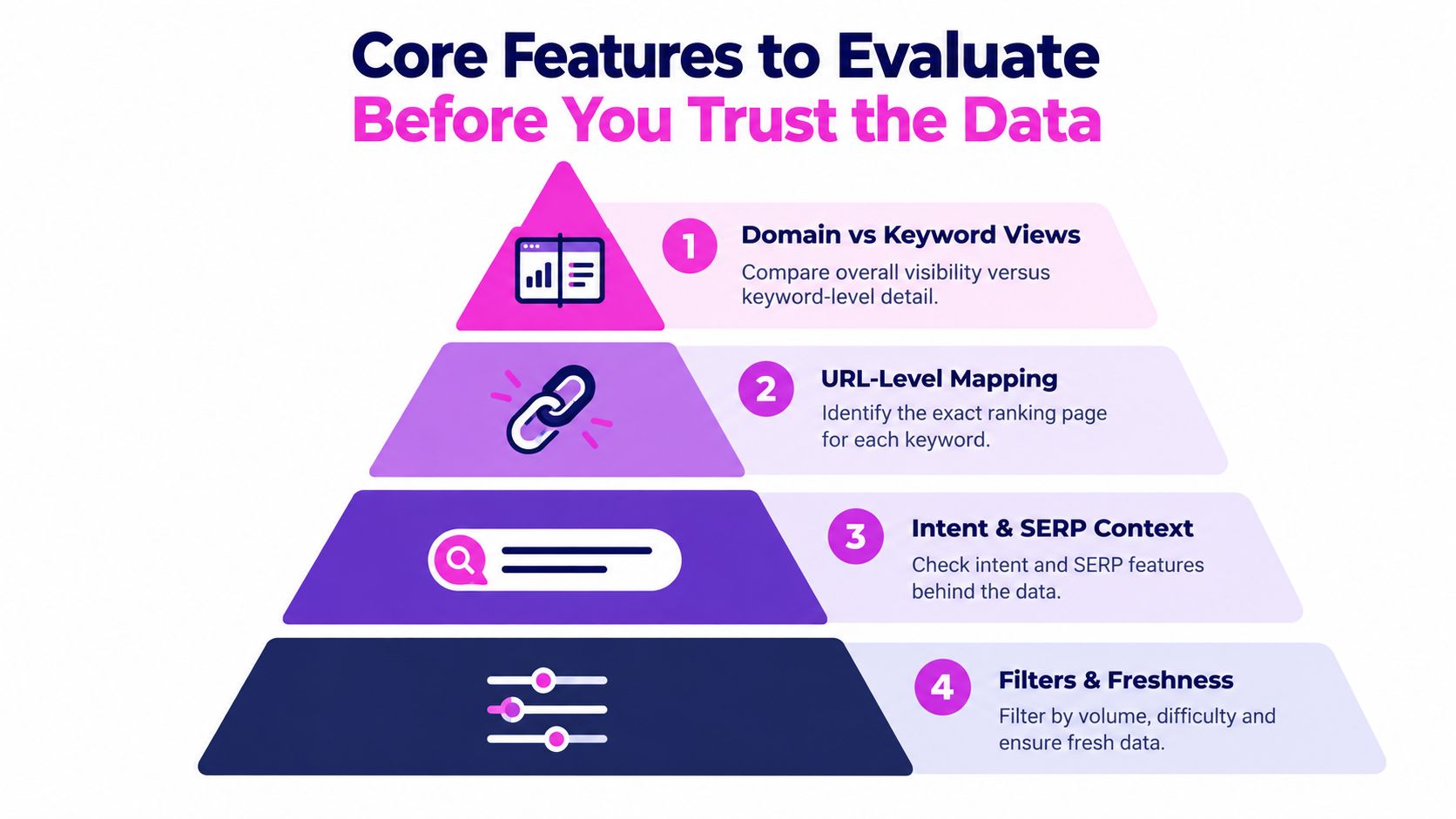
Domain comparison helps me understand competitive reach. It shows which sites overlap with mine and where a competitor appears to own a topic area. Keyword-level detail tells me whether an individual query is relevant, achievable, and connected to a page I can build or improve.
A tool that offers only aggregate counts creates false confidence. I need to open the underlying terms, inspect the competitors' positions, and see the pages earning those rankings.
URL-Mapping
URL mapping is the most important technical feature. A strong workflow ties each query to the precise ranking page, allowing exact-page comparison instead of assuming that a domain has one unified content strategy.
Semrush's explanation of keyword gap analysis highlights why URL-level workflows are stronger than domain-only comparisons. The same domain can rank through different pages for different intents, so mapping keywords to URLs helps group related queries, evaluate the right content format, and reduce cannibalization.
Metrics that support judgment
Search volume tells me whether a topic has observable demand, but I never treat it as a forecast. Traffic estimates can help compare competitors, while Keyword Difficulty provides a directional view of ranking feasibility. Neither metric replaces a SERP review.
Intent filters are equally important. I want to separate informational, commercial, navigational, and transactional patterns because the right page type depends on what the searcher wants. A missing commercial term shouldn't automatically become a blog post just because the competitor ranks with one.
SERP features and clustering
SERP-feature review tells me whether the results page includes elements that alter the click opportunity or preferred format. Featured answers, shopping results, local results, video, and AI-generated features can change the value of a traditional blue-link gap.
Clustering then groups related queries into page-level subjects. This prevents a writer from producing several thin pages that compete with one another. The tool should help me move from scattered terms to a coherent content architecture.
My decision lens: If a platform shows overlap but can't show the ranking URL, intent, and SERP context, I treat the export as research material, not a roadmap.
Keyword Gaps vs Content Gaps and When Not to Create a New Page
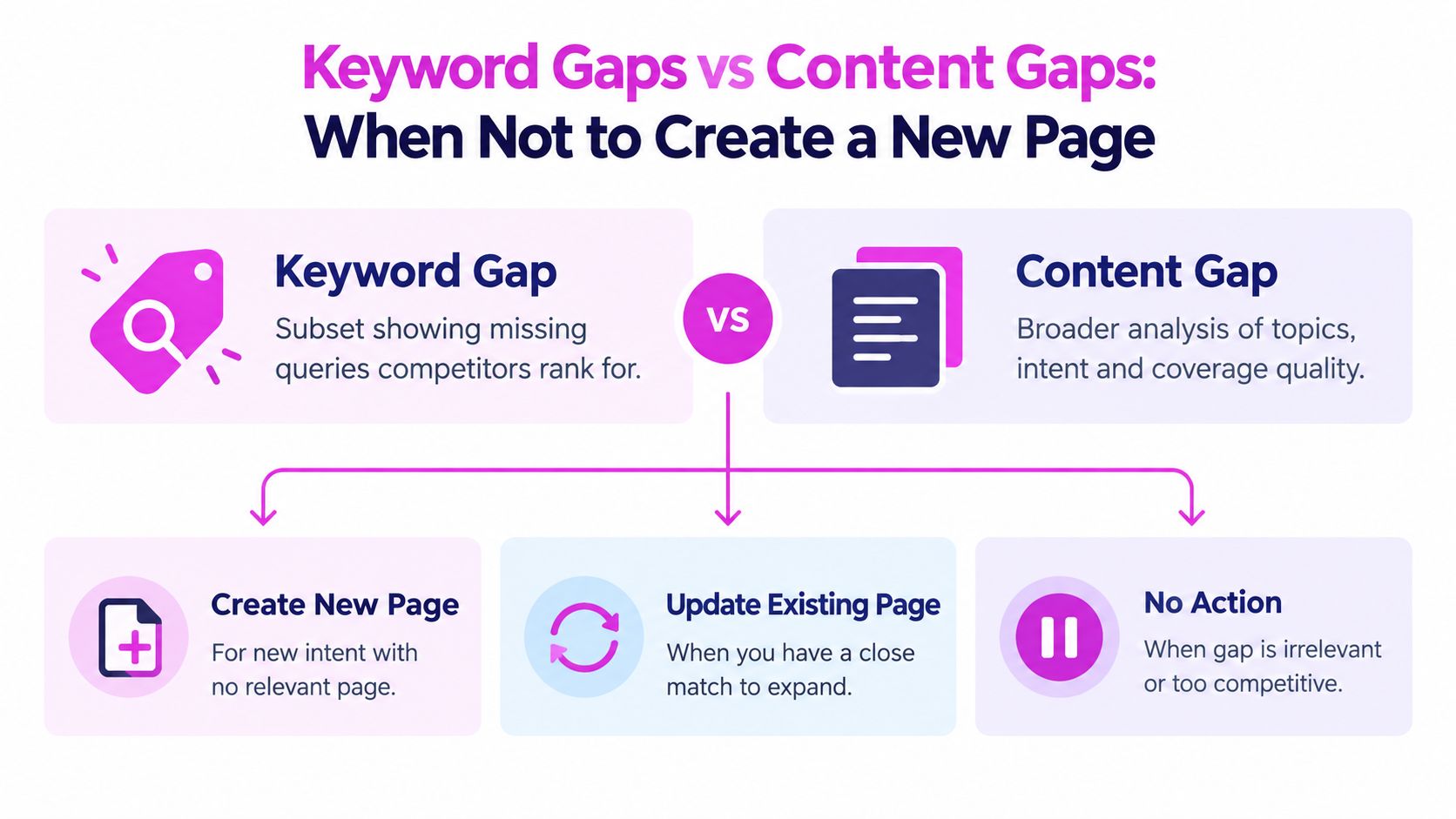
A keyword gap answers a narrow question: which queries do competitors rank for that your site doesn't? A content gap asks a broader one: where does your site fail to address an important topic, intent, quality need, or audience concern?
That distinction prevents a common publishing error. Keyword gap analysis is only a subset of content gap analysis, as explained in this content gap analysis resource. The broader process includes grouping queries into topics, reviewing existing coverage, checking whether the page matches intent, and judging commercial value and ranking feasibility.
The three decisions I make
I put every promising cluster into one of three buckets.
- Create a new page: Use this when the cluster represents a distinct intent and no current URL can satisfy it without becoming unfocused. For example, a product comparison cluster usually deserves a different page from a general educational guide.
- Update an existing page: Choose this when your site already has a close match but misses subtopics, examples, terminology, or the format the SERP rewards. Expanding the relevant page usually preserves its existing context better than starting from zero.
- Consolidate or ignore: Consolidate when several current URLs address the same intent and divide relevance. Ignore a gap when it's irrelevant to your audience, tied to a competitor's unique offering, or unlikely to justify the production effort.
The page audit comes before the content brief. I search the site, inspect titles and headings, review internal links, and compare the current URL with the competitor URL. A missing keyword can be a missing phrase inside a page that already answers the searcher's question.
Why copying competitors fails
Competitor outlines are evidence, not templates. Copying their headings can reproduce their weaknesses, create a generic article, and miss the reason their page earns visibility. I compare format, depth, clarity, freshness, and original usefulness, then decide what my page needs to do better for the audience.
For a deeper look at the broader workflow, see SemDash's content gap tool guide. The practical point is simple: a keyword gap is not automatically a page gap.
How I Use SemDash Keyword Gap in Practice
I begin with competitor selection, not the report. Inside SemDash, I enter my domain and 3 to 5 competitors that target a similar audience. A large publisher can be useful for discovery, but I also include a closer commercial rival because broad authority differences can distort the opportunity list.
I open the Domain-Schlüsselwörter view first. That gives me a sense of which competitors receive visibility from the topic area and which pages appear to carry that visibility. Then I move into the Keyword-Lücke report and isolate terms marked as missing or otherwise absent from my meaningful rankings.
The SemDash keyword research database contains 6.6B keywords, with search volume, traffic estimates, and Keyword Difficulty available for evaluation. I don't export everything. I filter early because an unrestricted gap report quickly becomes a sorting project rather than an SEO project.
My working sequence
- Select the right gap view. I separate terms that every competitor ranks for from terms only one competitor owns. The first group often reveals established demand. The second can uncover a specialist angle, but it needs more validation.
- Filter by feasibility. I cap Keyword Difficulty and apply a minimum volume threshold where it makes sense. The competitor gap analysis workflow from SEO Handbook recommends this type of filtering before grouping terms by subject.
- Inspect the ranking URL. I open the competitor page tied to each important query. The URL often tells me more than the keyword, especially when it reveals a comparison page, template, category page, or support resource.
- Cluster related terms. SemDash's clustering groups queries into page-level topics. I use long-tail suggestions, People Also Ask, and People Also Search ideas to expand the cluster without creating a separate page for every variation.
- Check the competitive picture. Traffic Share, Top Pages, and competitor domain views help me understand whether the opportunity sits inside a valuable topic or is just an isolated ranking.
This consolidated view is useful because I can move from a competitor's domain to its top pages and then to the keyword gaps without rebuilding the analysis in separate tools.
I also review whether a term supports a business action. A high-visibility informational cluster may help awareness, while a narrower commercial cluster can support a product or service page. The report doesn't make that judgment for me.
The workflow is easier to follow visually in the product walkthrough below.
My main lesson is to keep the export small enough that someone can inspect every candidate. If the list is too large to map to URLs and intents, it's too large to prioritize responsibly.
From Noisy Export to Prioritized Roadmap
A gap export becomes useful only after I reduce it to topic clusters and page decisions. I start by removing obvious mismatches, branded terms that don't fit the business, and queries where the competitor's ranking reflects a unique product or audience.
Then I apply two practical filters: Keyword Difficulty and a minimum volume threshold. These filters don't prove that a term will perform. They reduce noise so I can spend review time on queries with a plausible combination of demand and feasibility.
Next, I group the remaining terms by subject rather than treating each row as an assignment. A cluster might contain a core query, supporting questions, comparison language, and long-tail variations. I map that cluster against existing URLs and mark whether the current page needs expansion, consolidation, or replacement.
SERP volatility changes the decision
A keyword can look attractive in a static report and become a poor target after a live SERP review. I check the 12-month SERP history in SemDash where available, looking for changes in ranking stability, intent, and page format. A volatile result page may require a more cautious investment than a stable one.
I also check AI Overviews visibility. Recent industry coverage connects gap analysis with GEO and AI-search evaluation, including AI Overviews, while many traditional explainers still focus on blue-link overlap. Leitfaden zur Lückenanalyse von Search Engine Land reflects that shift in emphasis.
A competitor-only keyword may produce fewer organic clicks if AI-generated answers satisfy the query directly. That doesn't make the topic useless, but it changes the page objective. I may prioritize clear, extractable answers, original evidence, or a commercial next step instead of pursuing the term as a conventional traffic play.
| Cluster Intent | Volume and Difficulty | Current URL Match | Aktion |
|---|---|---|---|
| Informativ | Manageable difficulty with relevant demand | No suitable page | Create a focused guide |
| Commercial | Feasible difficulty with business alignment | Existing page is close | Update and strengthen the page |
| Mixed intent | Unclear or unstable result pattern | Several overlapping URLs | Consolidate after SERP review |
| Low relevance | Any metric combination | No meaningful audience fit | Ignore |
| AI-heavy result | Organic opportunity needs validation | Page may answer part of the query | Review citations, format, and value before committing |
For additional methods to narrow difficult exports, I use the principles in this guide to finding low-competition keywords, then apply my own page and SERP checks before adding work to the editorial calendar.
Conclusion Your Next Wins Without the Guesswork
A keyword gap tool is valuable because it exposes competitive visibility you can't see from your own rankings alone. It becomes much more valuable when you refuse to treat its output as a publishing queue.
My process relies on three checks:
- URL mapping: Identify the exact competitor page earning visibility, then compare it with your own relevant URLs.
- Intent and clustering: Group related queries around a page-level topic and confirm that the format matches what searchers want.
- SERP and AI visibility: Review historical behavior, result-page features, volatility, and AI Overviews before estimating the opportunity.
The biggest waste comes from publishing too quickly. SEOJuice's content gap guidance warns against treating every missing term as a new-page opportunity, copying competitor outlines, ignoring intent, and creating pages before checking existing coverage. Those habits can produce cannibalization, duplicated effort, and stranded URLs.
Run your first analysis with a narrow competitor set. Filter the export, inspect ranking URLs, cluster the survivors, and assign each cluster to create, update, consolidate, or ignore. After implementation, monitor rankings, traffic share, and the pages that begin to capture the mapped topics. The measure of success isn't the size of your spreadsheet. It's whether the roadmap leads to stronger pages and more relevant visibility.
SemDash brings Domain Keywords, Keyword Gap reports, URL-level mapping, clustering, SERP history, Traffic Share, Top Pages, and AI Overviews visibility into one SEO research workflow. Visit SemDash to compare competitor gaps, map them to the right pages, and turn your next export into a focused content plan.