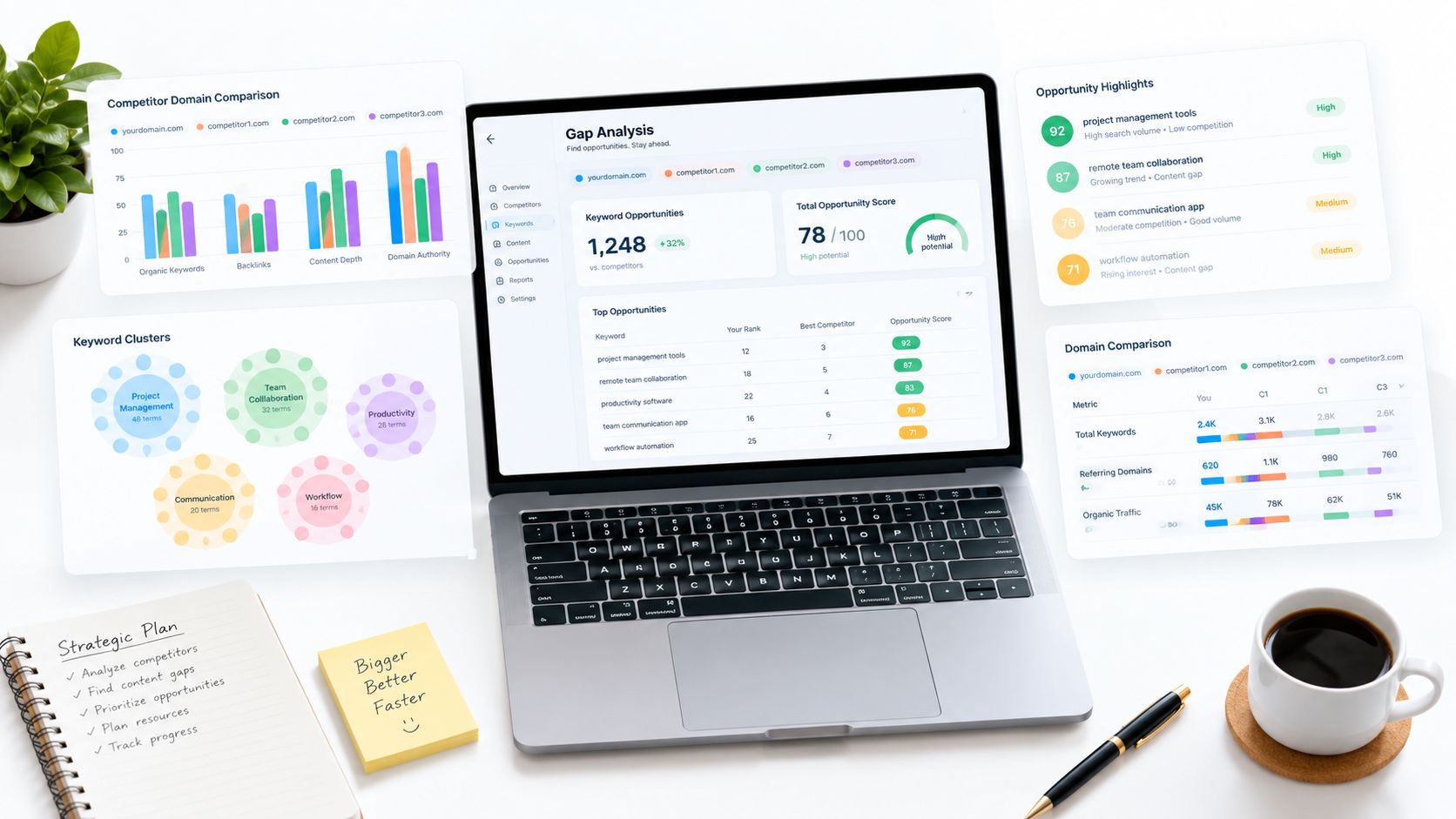
A gap report isn't a content plan. Pulling a list of competitor keywords is the easy part. The hard part is deciding whether that gap deserves a new page, an update to an existing URL, a redirect, or no action at all.
Most advice on content gap tools stops too early. It treats every missing keyword like a publishing brief waiting to happen. In practice, that's how teams create duplicate pages, miss the actual search intent, and ship content that ranks nowhere because the winning URL type was obvious in the SERP.
My workflow is stricter. I map direct competitors and SERP competitors first, compare domains and specific URLs, validate what's ranking, score the opportunity against business fit, then cluster the survivors into page-level decisions. Only after that do I write briefs. That sequence matters because keyword gaps often hide several different problems at once: thin pages, outdated sections, missing comparisons, weak internal links, or a page that targets the right phrase with the wrong format.
Industry guidance has moved in this direction too. Leitfaden zur Lückenanalyse von Search Engine Land frames content gap analysis as a structured process that compares multiple competitors and groups missing terms into page-level topic clusters rather than treating them as isolated keywords.
That's how I'm judging each content gap tool here. Not as interchangeable feature grids, but by the job each one does well inside a real workflow: discovery, page-level validation, prioritization, and brief creation.
Inhaltsverzeichnis
- 1. SemDash
- 2. Ahrefs Content Gap
- 3. Semrush Keyword Gap and SERP Gap Analyzer
- 4. Moz Pro Competitive Research
- 5. Similarweb Keyword Gap
- 6. SpyFu Kombat
- 7. Serpstat Keyword Gap
- 8. SISTRIX Opportunities
- 9. SE Ranking
- 10. MarketMuse
- Top 10 Content Gap Tools: Feature Comparison
- Turn Competitor Gaps Into Pages That Can Win
1. SemDash
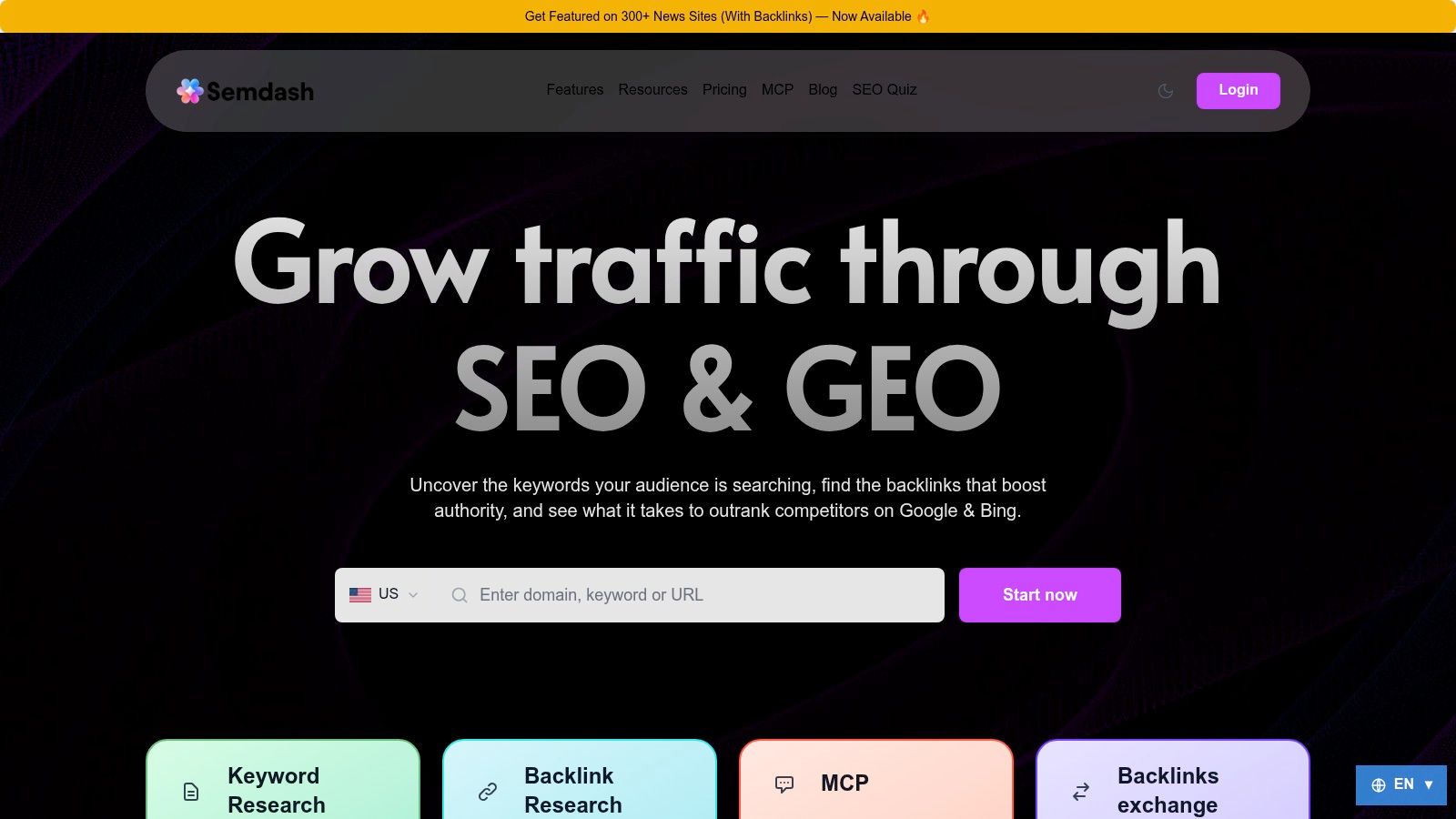
SemDash is useful if the problem is not finding more missing keywords, but deciding what to do with them. A lot of gap tools stop at discovery. They export a large list, then leave the page decision to manual review across SERPs, ranking URLs, and competitor pages. SemDash is more helpful when that handoff matters.
I'd put it early in the workflow for discovery, then bring it back in during validation and prioritization. The gap reports surface candidate topics, but the stronger part is what happens after export. Top pages, traffic share, URL-level mapping, and SERP history make it easier to judge whether a gap belongs on an existing URL, needs a new page, or should be dropped because the winning page type does not match your site structure.
That URL view matters more than another keyword count.
If a missing term is won by a comparison page, a glossary entry, and a product-led template, the job is no longer “cover the keyword.” The job is to choose the correct asset type. SemDash helps with that because you can inspect the ranking page, not just the phrase. In a real competitor-gap workflow, that shifts the tool from discovery into page-level validation.
Where it fits in the workflow
SemDash performs best across four jobs:
- Discovery: Find terms competitors rank for that your domain or target URL does not.
- Page-level validation: Check which competitor URL wins and what format it uses.
- Prioritization: Review traffic share, ranking context, and adjacent signals before assigning work.
- Brief creation: Cluster surviving terms into a page plan instead of handing writers a raw export.
That last step is where weak workflows usually break. Teams export “missing keywords,” sort by volume, and create duplicate pages that compete with existing URLs. SemDash is better used as a filter. I'd group terms by ranking page type first, remove queries that belong to another intent class, and only then turn the survivors into briefs.
What worked, what didn't
What worked for me is consolidation. If I can move from domain gaps to ranking URLs to supporting SERP context in one platform, I make fewer bad page calls. That is especially useful on mid-sized sites where the choice is often between updating an existing article and building a net-new page.
The trade-off is coverage confidence. For broad markets, the workflow is efficient. For narrow B2B niches or specialized technical categories, I would still spot-check findings against a second dataset before committing roadmap time. I'd also confirm plan limits up front, especially if your process depends on higher-volume exports or multi-domain comparisons.
2. Ahrefs Content Gap
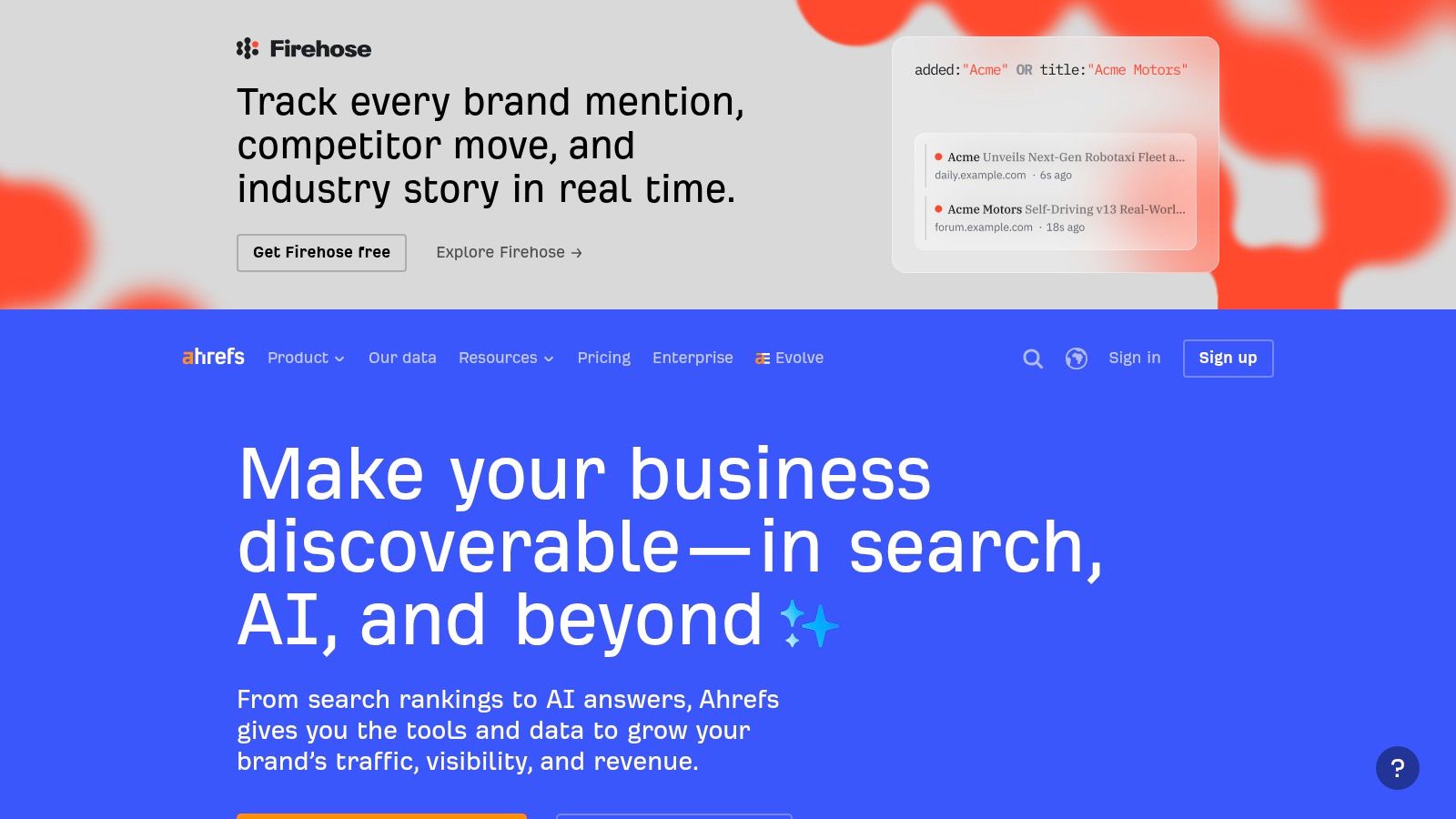
Ahrefs is still one of my default choices when I need hard competitor evidence fast. Its Content Gap feature inside Site Explorer is mature, flexible, and usually easy to trust because the surrounding backlink and ranking context is already there.
I like Ahrefs most when the question is narrow. For example: “Why does this competitor article outrank ours for this subtopic?” At that point I'm not comparing domains broadly. I'm comparing a specific page or section of the site against peer URLs and looking for missing terms, weak intent match, and link support.
Best use case
Ahrefs shines at page-level validation after discovery. Once you've identified a candidate topic, it's good for checking whether you need a new asset or whether the existing page is undercovered. That distinction saves a lot of cleanup later.
Its filters also help when the first export is too noisy. I've used that to strip out navigational junk, off-topic branded terms, and phrases that look attractive until you inspect the actual SERP and realize the result set belongs to another intent class entirely.
When Ahrefs is doing its job well, it reduces false positives, not just finds more keywords.
The downside is the usual one. It can feel heavy if all you need is recurring gap checks and brief inputs. You're paying for a broad research environment, and for some teams that's worth it. For others, it's more platform than workflow.
3. Semrush Keyword Gap and SERP Gap Analyzer
Semrush is the suite I reach for when the gap report needs to connect directly to a broader operating system that already includes audits, reporting, and stakeholder-friendly dashboards. The appeal isn't just the keyword gap feature. It's the fact that content, technical, and reporting workflows already live nearby.
Semrush's Keyword Gap view is useful because it forces quick sorting into missing, weak, shared, and unique buckets. That sounds simple, but it helps teams stop treating every opportunity as greenfield. A “weak” keyword often points to a better update candidate than a “missing” keyword does.
Why I'd use it
The practical edge is the mix of domain comparison and SERP-oriented analysis. If you want a refresher on the basic logic behind this workflow, SemDash has a solid explanation of what gap analysis means in SEO practice. Once that framework is clear, Semrush becomes effective because it gives you multiple lenses on the same opportunity.
I've had the best results with Semrush when a content team already has a backlog problem. The tool helps separate “topics we don't cover” from “topics we cover badly” and “topics where the SERP has shifted enough that our old page format won't win.”
A caution here. Semrush can nudge people toward over-collecting data. If you keep adding filters, related reports, and adjacent widgets before making a page decision, the backlog gets fatter and no smarter.
4. Moz Pro Competitive Research
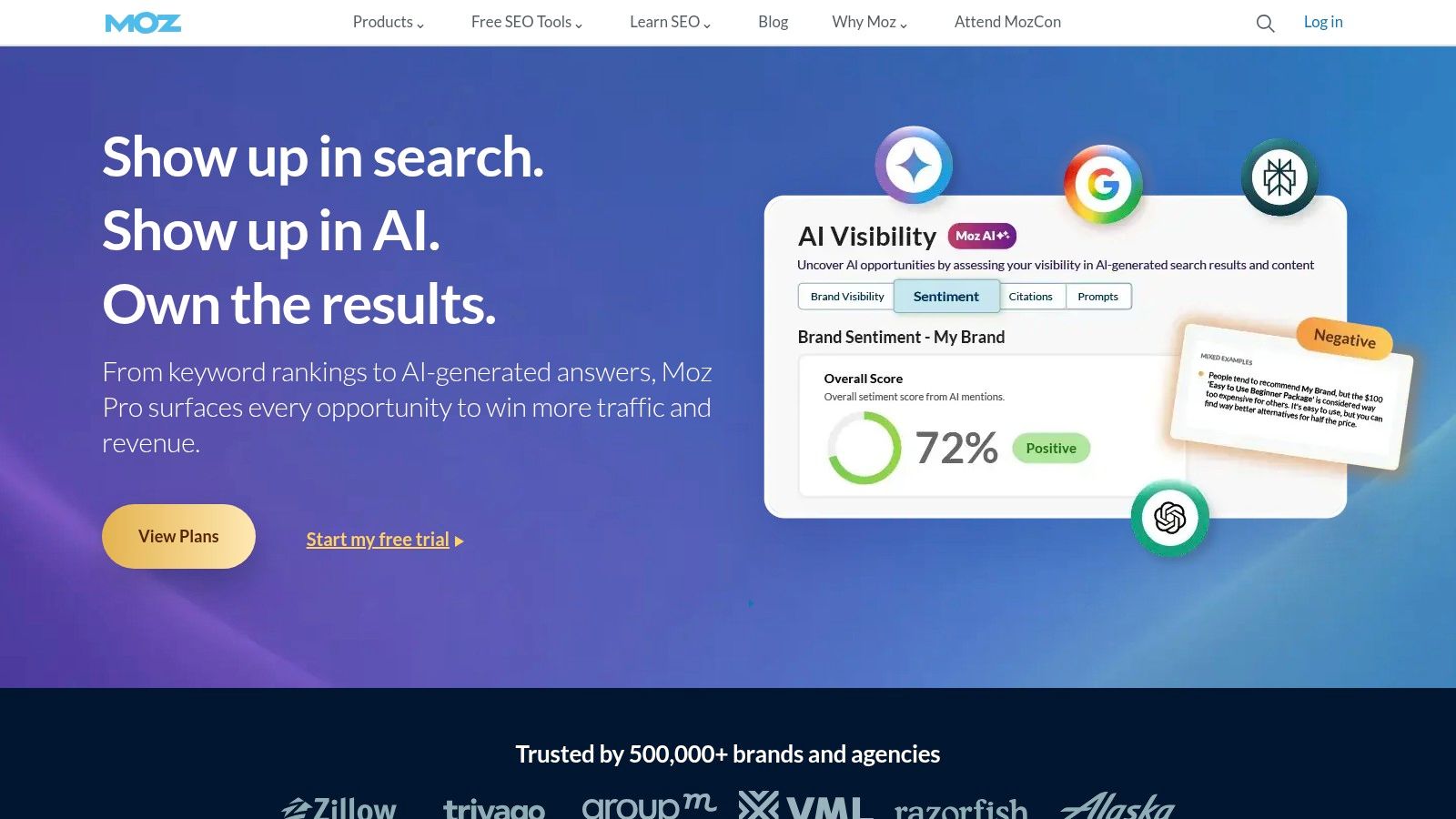
Moz Pro works well for smaller teams that need clearer guidance and less platform sprawl. I wouldn't choose it for the deepest enterprise research job, but I would absolutely use it with a team that needs to get disciplined about competitor selection before they start exporting gaps.
That matters because one of the most common mistakes in content gap analysis is picking the wrong competitors. Product competitors and SERP competitors overlap less often than people think. Moz's competitive research approach helps clean that up early.
Where Moz helps most
Moz is strongest when you need a guided competitor-to-content workflow instead of a giant data warehouse. The “true competitor” concept is useful because it prevents a lot of wasted comparisons against domains that aren't competing for your organic footprint.
If your team needs a better framing for competitive analysis generally, SemDash has a practical piece on SEO competitive intelligence. That's the lens I'd use before trusting any keyword gap export, regardless of tool.
- Good fit: Smaller in-house teams, consultants, and editors who want a manageable shortlist of topic opportunities.
- Less ideal: Deep international research, very large websites, or workflows where backlink depth is central to every page decision.
Moz also does a decent job connecting rival URLs to the topics they win on. That makes it easier to answer the question “what kind of page are we missing?” instead of just “which phrase are we missing?”
5. Similarweb Keyword Gap
Similarweb is what I'd use when pure SEO data isn't enough to make the call. Sometimes the question isn't just “what keywords do they rank for?” It's “how much of this category matters, who owns attention across channels, and are we even targeting the right segment of the market?”
That market context is Similarweb's advantage. It adds traffic-share, audience, and broader digital research layers that help when your content roadmap needs executive buy-in or market-sizing logic behind it.
Best for strategic prioritization
I don't love Similarweb for rough draft brief creation. I do like it for deciding whether a cluster is strategically worth caring about in the first place. If a competitor dominates a topic but that topic doesn't align with your customer path, it may still be a gap. It's just not your gap.
This tool is especially useful when SEO and paid teams are working from different assumptions. Looking at search coverage in isolation can create a distorted roadmap. Similarweb helps pull that back into a broader competitive picture.
Some keyword gaps are real search opportunities. Others are just evidence that another company serves a different audience slice better than you do.
The trade-off is usually access and budget. This isn't the lightweight option, and I'd want package details in writing before building a process around it.
6. SpyFu Kombat
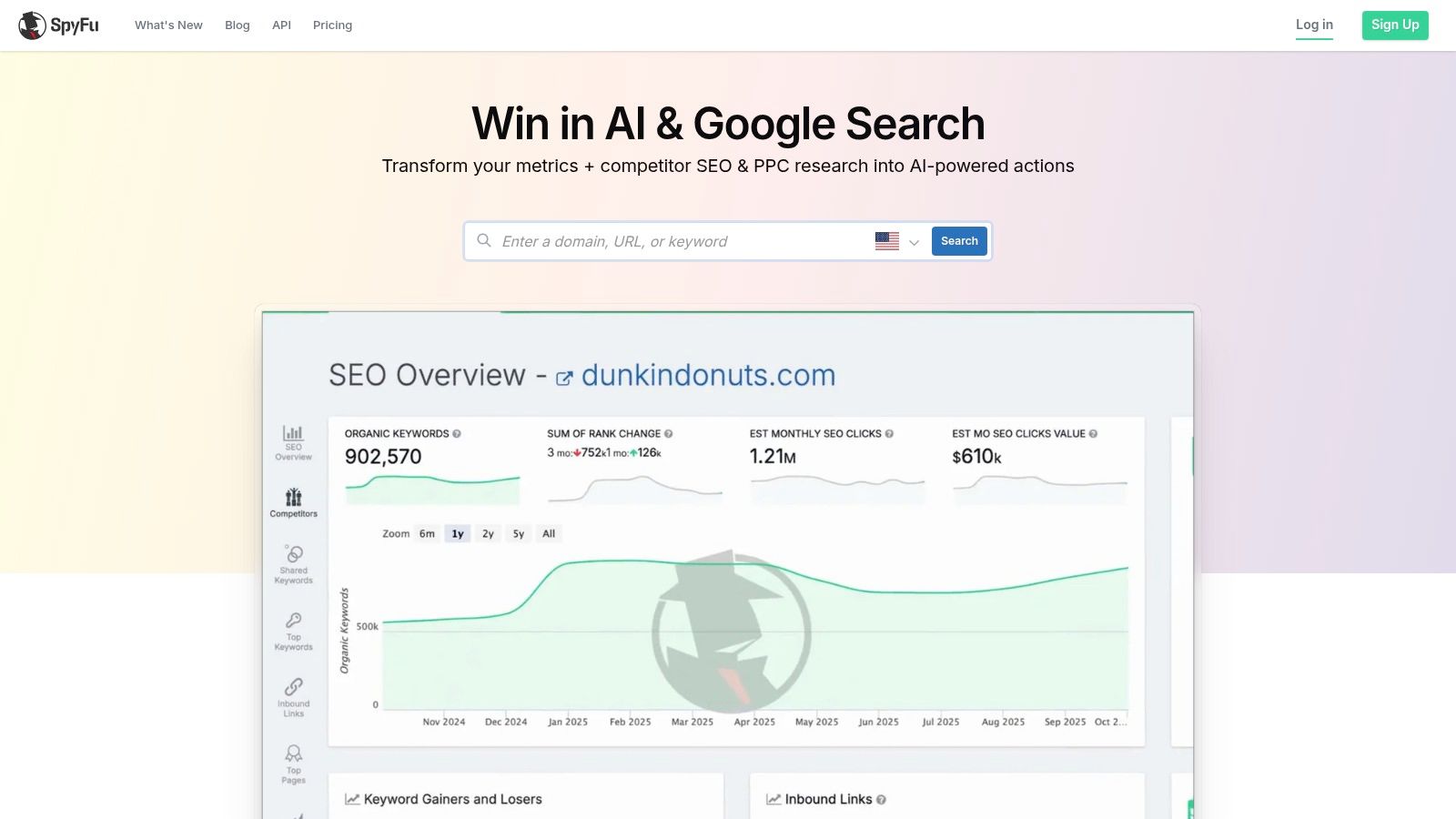
SpyFu has always made sense to me for recurring SMB gap checks. It doesn't try to be elegant in the same way some larger suites do, but Kombat is useful because it visualizes overlap and missing terms quickly across SEO and PPC.
That SEO plus PPC angle is more useful than people admit. When I see a competitor both ranking for and buying the same topic set, I pay closer attention. It usually signals business value, not just informational traffic.
What I'd use it for
SpyFu is a fast filter for competitive pressure. It helps answer questions like these:
- Which topic groups show repeated investment: If a competitor ranks and spends on them, the topic likely matters commercially.
- Where are we absent entirely: Missing from both organic and paid visibility is often a sign of a neglected category.
- Which overlaps aren't actionable: Some shared keywords look important until you realize they sit outside your offer.
I wouldn't use SpyFu as my only source if page-level precision is the whole assignment. I would use it as a cheap and efficient way to spot where the serious evaluation should happen next.
Its limits show up when you need deeper technical SEO or backlink investigation. But for agencies managing many smaller accounts, that simplicity can be a strength.
7. Serpstat Keyword Gap
Serpstat earns its place because it doesn't stop at domain-level comparison. The page-level “missing keywords” angle is where it becomes useful for content optimization rather than just ideation.
That distinction matters. A lot of teams don't need another list of broad topics. They need to know why an existing article underperforms against a rival URL that appears to cover the same thing.
Where it wins
Serpstat is handy when you're tuning a page that already exists. I've found that workflow cleaner than broad-domain reports when a site already has decent topical coverage and issue is incomplete treatment of subtopics or supporting terms.
A practical workflow from the SEO Handbook competitor gap guide recommends adding 3 to 5 competitors, filtering by difficulty and minimum volume, then grouping what survives by subject before prioritizing by effective volume, commercial value, and ranking confidence. That's the exact mindset Serpstat supports best when you move from raw exports to page-level fixes.
The caveat is regional variation. If your market spans multiple countries or language databases, I'd sanity-check whether the selected database reflects the search environment you care about. Gap quality depends heavily on that setup.
8. SISTRIX Opportunities
SISTRIX is one I respect most when historical visibility and country-specific research matter more than flashy content features. It's especially sensible for teams working heavily in European markets and for sites where stable trend interpretation matters.
I don't think of SISTRIX first for brief writing. I think of it for confidence. If I need to know whether a competitor's coverage advantage is durable or just a recent fluctuation, its visibility-oriented framing helps.
Strongest job in the workflow
This is a prioritization tool more than a creativity tool. The “Opportunities” and “Unused keywords” style reports are useful, but value is pairing gap candidates with historical visibility behavior so you don't overreact to temporary wins.
That's important because some content gaps are mirages. A competitor may rank today with a format that won't hold, or the SERP may already be shifting toward a different result type. Tools that preserve trend context help you avoid building content for yesterday's SERP.
For new users, the interface depth can take some adjustment. Once you learn where the useful filters live, though, it becomes a dependable evaluation environment.
9. SE Ranking
SE-Rangliste is the kind of platform I'd recommend when the budget has to cover more than just gap analysis. It's broad enough for agencies and SMBs that want keyword research, competitor views, backlink work, rank tracking, and reporting under one roof.
The gap-style comparisons are useful, but the bigger win is workflow efficiency. If your team is already checking positions, technical issues, and links in the same platform, content decisions get easier to operationalize.
Why it's practical
I've seen smaller teams do better with tools that are slightly less deep but much more likely to be used consistently. SE Ranking fits that pattern. It usually won't be the most exhaustive platform in the room, but it can be the one that gets adopted across the team.
- Best use: Ongoing campaign management where gap findings need to become tracked tasks, reporting inputs, and rank-monitoring targets.
- Watch out for: Very deep backlink research or edge-case enterprise investigations where larger indexes can matter more.
If your process breaks because it requires too many specialized tools, an all-rounder like this often beats the “best” point solution on actual output.
10. MarketMuse
MarketMuse solves a different problem from most classic content gap platforms. It's less about exporting missing keyword lists and more about understanding topical depth, subtopic coverage, and what a stronger page would need to say.
That makes it valuable later in the workflow. Once I've decided a page should exist, or an existing page should be overhauled, MarketMuse is the kind of tool I'd use to shape the brief.
Best for brief creation
It stands apart. The “Compete” style heatmaps and inventory views help expose missing concepts rather than just missing phrases. For writers and editors, that's often more useful than another spreadsheet of queries.
This also lines up with how the workflow around keyword research has evolved. One recent market report says 63% of marketers use Google Keyword Planner as their primary keyword research tool, 38% use AI tools in the process, and teams spend about 12 hours per week on keyword research. To me, that explains why a tool like MarketMuse can be valuable. The bottleneck often isn't finding terms. It's turning them into coherent coverage.
The downside is packaging clarity. I'd want a demo and a direct conversation before budgeting for it. But if the core issue is weak briefs, thin subtopic coverage, or inconsistent editorial depth, MarketMuse can solve the right problem.
Top 10 Content Gap Tools: Feature Comparison
| Werkzeug | Kernfunktionen | UX & Quality | Price & Value | Best for 👥 | Standout ✨ |
|---|---|---|---|---|---|
| 🏆 SemDash | Keyword (6.6B) + Backlinks (2.7T) + SERP (600M); URL-level mapping; gap, clustering, AI briefs | ★★★★☆ Fast, simplified UI; strong docs & academy | 💰 Budget-friendly; free trial + optional PR service | 👥 Agencies, in-house growth, solo SEOs, content teams | ✨ AI Overviews (AI citation tracking); unlinked-mention & broken-link recovery |
| Ahrefs, Content Gap (Site Explorer) | Domain/URL Content Gap; large keyword & backlink index; AI checks | ★★★★★ Mature, robust tools & docs | 💰 Premium, cost scales with usage/seats | 👥 SEO pros, agencies needing deep backlink context | ✨ Deep backlink context via Site Explorer |
| Semrush, Keyword Gap + SERP Gap | Keyword Gap + SERP Gap Analyzer; audits, reporting, GA4/GSC links | ★★★★☆ Comprehensive suite; evolving bundles | 💰 Premium / tiered; advanced features on higher plans | 👥 Full-service agencies, enterprises | ✨ SERP Gap Analyzer + integrated reporting |
| Moz Pro, Competitive Research | True Competitor discovery; Keyword Gap; Top Competing Content | ★★★★☆ Beginner-friendly workflows | 💰 Mid-range; approachable plans | 👥 Small teams, local SEOs, beginners | ✨ Clear guided competitor → gap → content flow |
| Similarweb, Keyword Gap & DRI | Clickstream-based Keyword Gap; traffic share; audience & ad insights | ★★★★☆ Enterprise-grade market context | 💰 Quote-only / enterprise pricing | 👥 Enterprises, market analysts, digital strategists | ✨ Market sizing, audience overlap & paid intelligence |
| SpyFu, Kombat (Domain Comparison) | SEO & PPC gap; historical ads/keywords; visual overlap | ★★★☆☆ Simple, focused UI for SMBs | 💰 Budget-friendly subscriptions | 👥 SMBs, budget-conscious agencies | ✨ Combines SEO + PPC gap analysis affordably |
| Serpstat, Keyword Gap & Missing Keywords | Domain/URL gap; page-level missing keywords; API & AI assistant | ★★★★☆ Good exports; regional DBs vary | 💰 Affordable; flexible quotas | 👥 Freelancers, small agencies | ✨ Page-level "Missing Keywords" with API access |
| SISTRIX, Opportunities & Unused Keywords | Opportunities / Unused modules; country DBs; Visibility Index | ★★★★☆ Strong historical visibility; EU-focused | 💰 Mid → enterprise; add-ons for power users | 👥 EU publishers, enterprises tracking visibility | ✨ Reliable visibility trends & country depth |
| SE Ranking, Competitor / Keyword Research | Keyword research, backlink gap, rank tracking, audits | ★★★★☆ Generous limits; well-rounded toolkit | 💰 Competitive / agency-friendly pricing | 👥 Agencies, SMBs needing all-in-one value | ✨ Affordable full-stack SEO + reporting |
| MarketMuse, Competitive Content Gap (Compete) | Topic modeling; "Compete" heatmaps; Inventory & briefs | ★★★★☆ Prescriptive briefs; writer-focused UX | 💰 Premium / sales-assisted pricing | 👥 Content teams, enterprise publishers | ✨ Deep topical analysis & prioritized content inventory |
Turn Competitor Gaps Into Pages That Can Win
The repeatable part of this process starts after the export, not before it. First, strip out irrelevant terms, duplicates, and anything that belongs to another product line, geography, or audience segment. If a keyword gap doesn't survive that first cleanup, it never deserved roadmap space.
Then validate the ranking URL and the actual SERP. Keyword gap analysis is about comparing your rankings with competitors' rankings to find relevant terms they rank for and you don't, as explained in Semrush's keyword gap analysis overview. But that's only the opening move. You still need to confirm whether the winning URL is a guide, landing page, comparison, category, or something else entirely.
I score survivors on five things: business fit, search demand, ranking difficulty, authority gap, and freshness. Freshness gets ignored too often. If the top results are winning because they answer a changed product environment or updated query pattern, a stale but thematically relevant page won't close the gap without a substantial rewrite.
When to update and when to create
Update an existing URL when the intent clearly matches and the page already has some authority, internal links, or partial coverage. Create a new page when the intent is distinct enough that folding it into the current URL would weaken both pages, confuse internal linking, or create a muddled title and heading structure.
I also check for cannibalization before I approve anything. Modern gap-analysis guidance commonly recommends comparing a handful of competitors and grouping missing terms into topic clusters to avoid overlap and focus on coverage that can move rankings, which is part of the broader gap analysis workflow described by Search Engine Land. If two term groups can live naturally on one page, forcing them into separate briefs usually creates more harm than opportunity.
A keyword list becomes a content plan only after every surviving term has a home, an intent label, and a reason to exist as its own page.
What every brief should include
Every brief I approve has to include these inputs:
- Target intent: Informational, commercial, comparison-driven, navigational, or mixed with a clear dominant intent.
- Primary topic: The main page theme, not just the head term.
- Supporting questions: The subtopics and unanswered follow-up questions the SERP keeps surfacing.
- Competing URLs: The exact rival pages that define the standard.
- Content angle: What we'll emphasize that the current results underplay.
- Internal-link needs: Which related pages should support and receive equity from the new or updated URL.
- Measurement plan: What we'll watch after publishing, including rankings, page engagement, assisted conversions, and whether the page starts replacing the wrong URL in search.
AI search adds another layer here. Recent guidance around AI-era content gap analysis argues that teams should audit AI visibility, compare traditional keyword gaps, and then map entity and structured-data gaps because citation readiness now matters alongside rankings, as outlined in Slate HQ's discussion of content gap tools for AI search. I treat that as a live consideration, not settled doctrine, but it's already affecting how I write briefs for definition-heavy, comparison-heavy, and evidence-sensitive topics.
Start small. Pick a validated batch, publish, measure, and revisit the SERP history before expanding the roadmap. The first export is a draft, not a destiny.
If you want one workspace that handles gap discovery, URL-level validation, clustering, SERP history, and AI-assisted brief creation, SemDash is built for that exact workflow. It's a practical option when you're tired of exporting missing keywords from one tool and doing the page decisions somewhere else.