%20(1)-B86R08ZzwhPzS6UZbG3mSxRWPCwGwn.png)


Best Clearscope Alternatives for Content Teams in 2026

TL;DR:
- Semdash offers an all-in-one content optimization tool that combines keyword research, competitor analysis, and AI overview tracking. It is ideal for teams seeking to reduce tools and total costs through a credit-based subscription. Frase is best for quick brief creation and budget-conscious teams focusing on research-to-draft workflows.
If you need a direct answer: Semdash is the recommended all-in-one pick for teams that want keyword research, content optimization, and AI Overview tracking under one subscription. For teams focused purely on brief creation, Frase is the strongest budget-friendly option.
- Best overall alternative: Semdash, for integrated SEO research plus content scoring at a lower total cost than Clearscope’s Essentials plan
- Best for briefs: Frase, for fast structured brief generation and lower per-article economics
Run a 30-day side-by-side pilot measuring time-to-ship, content score delta, and cost-per-article before committing to any switch.
How the top Clearscope alternatives compare at a glance
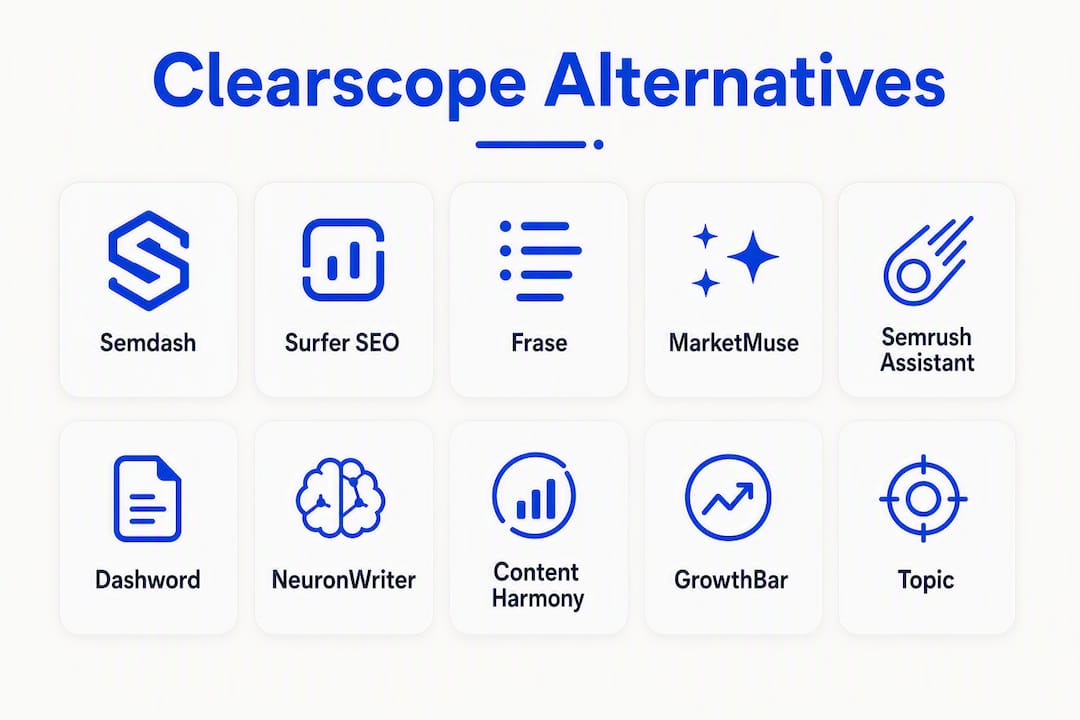
| Werkzeug | Starting price | Am besten für | Standout feature | Kostenlose Testversion | Brief + editor | Integrationen | Team features |
|---|---|---|---|---|---|---|---|
| Semdash | Tiered, credit-based | Agencies, solopreneurs, in-house teams | Keyword research + AI Overview tracking + content gap | Yes | Yes | Google Docs, CMS | Multi-seat, credit sharing |
| Surfer SEO | ~$89/month | Teams wanting scoring + in-editor execution | Real-time NLP scoring with internal-link suggestions | Demo available | Yes | Google Docs, WordPress | Collaboration seats |
| Frase | ~$15/month | Brief-driven teams and freelancer handoffs | Fast AI brief generation | Yes (5-day trial) | Yes | Google Docs | Team plans |
| MarketMuse | ~$149/month | Large content libraries, strategic planning | Corpus-level topical authority mapping | Demo available | Yes | Limited | Enterprise seats |
| Semrush Writing Assistant | Bundled with Semrush | Teams already in the Semrush ecosystem | Integrated SEO data checks | Yes (Semrush trial) | Yes | Google Docs, WordPress | Semrush team plans |
| Dashword | ~$99/month | Editorial simplicity, lower per-report cost | Minimalist real-time scoring editor | Yes | Yes | Limited | Small team plans |
| NeuronWriter | ~$23/month | Solo writers, tight budgets | Affordable NLP scoring | Yes | Yes | Google Docs | Limited |
| Content Harmony | ~$99/month | Agencies with approval workflows | High brief-to-draft fidelity | Yes (trial reports) | Yes | Limited | Approval workflows |
| GrowthBar | ~$36/month | Solo bloggers, low-friction entry | AI writing + basic SEO guidance | Yes | Yes | WordPress | Small team |
| Topic | ~$99/month | Research-backed outlines, topic modeling | Brief fidelity and topic models | Yes | Yes | Limited | Team plans |
Pricing figures are vendor-listed starting rates and can change; always verify on the vendor’s live pricing page before purchasing.
How to choose the right Clearscope alternative for your team
The sticker price is rarely the whole story. Per-report and per-seat economics often shift the real cost of switching more than the monthly subscription does. A tool priced at $15/month with a $1.50 per-article cost can still end up cheaper than a $99/month plan with a $9.45 per-report fee once you factor in volume.
Must-have capabilities checklist:
- Content scoring against live SERP data (NLP-driven, not keyword-density counting)
- Brief generation or structured outline builder
- Editor integrations (Google Docs, WordPress, or your CMS of choice)
- Enough team seats for your current workflow without a steep per-seat surcharge
- Export and reporting features for client or stakeholder handoffs
- Data freshness: how often does the tool refresh its SERP snapshot?
Three red flags to watch for:
- Hidden per-seat costs. A tool that looks affordable at one seat can double or triple in price when you add two writers and an editor.
- Weak NLP depth. Some budget tools use keyword-frequency matching rather than true NLP-based semantic analysis. Test with a competitive SERP before committing.
- Poor integrations. If your writers live in Google Docs and the tool requires a separate browser tab for every edit, adoption will stall within weeks.
A short selection flow:
- Need keyword research und content scoring in one tool? Prioritize platforms with both modules built in.
- Bottlenecked by brief creation and freelancer handoffs? Prioritize brief-generation quality over scoring granularity.
- Managing 200+ pages and planning topical authority? You likely need corpus-level strategy tools rather than a page-level grader.
- Already paying for a large SEO suite? Check whether a writing assistant is bundled before buying a standalone grader.
Questions to ask in vendor demos: How often is SERP data refreshed? What happens to my credits if I cancel mid-cycle? Can I export briefs in a format my writers can use without logging in?
Profi-Tipp: Before you calculate subscription cost, estimate your migration cost: how many hours will it take to onboard your writers to a new UI and rebuild your existing brief templates? That number often exceeds the first three months of subscription fees.
1. Semdash — the recommended all-in-one pick
Semdash is built for teams that find Clearscope too narrow. Where Clearscope grades a page, Semdash combines keyword research, competitor and content-gap analysis, backlink tracking, semantic keyword clustering, and KI-Übersicht-Überwachung in a single credit-based subscription. For a content team that currently pays separately for a keyword tool and a grader, consolidating into Semdash typically reduces total tooling cost.
Pros:
- Keyword research, SERP analysis, and content gap in one interface, no separate subscriptions needed
- AI Overview tracking fills a gap that Clearscope and most grader-only tools leave open
- Credit-based model gives flexibility across team sizes without punishing per-seat pricing
- Semantic keyword clustering supports topical planning, not just single-article optimization
- Backlink discovery and competitor analysis included, useful for agencies managing multiple clients
Cons:
- Newer platform, so the community resource library is smaller than established tools
- Pure page-grading depth may not yet match the most granular NLP scoring of the longest-standing graders
Pricing: Tiered, credit-based plans. Check semdash.com for current pricing and early-bird offers.
Trial: Free trial available. A 30-day pilot measuring content score delta and time-to-ship is the recommended test scope.

Profi-Tipp: Run Semdash’s semantic keyword clustering on your next three target topics before writing. The cluster output often surfaces secondary keywords your current brief template misses, which directly improves content score on the first draft.
Surfer SEO — scoring plus in-editor execution
Surfer SEO is the most direct functional replacement for Clearscope for teams that want both NLP scoring and in-editor execution in one place. Its real-time scoring updates as you write, and it adds internal-link suggestions that Clearscope does not offer. Surfer also refreshes SERP snapshots at editor session creation, making its scores closer to real-time than tools that reuse older snapshots.
Pros:
- Real-time NLP scoring with in-editor feedback as you type
- Internal-link suggestions built into the editor
- AI writing assistance available within the same workflow
- Strong Google Docs and WordPress integrations
Cons:
- Feature-rich UI has a steeper learning curve than Clearscope’s minimalist approach
- Pricing climbs quickly when you add seats or increase article volume
- Some teams find the scoring model harder to explain to non-SEO writers
Pricing: Starting around $89/month; seat and article limits apply at entry tiers.
What to test in a trial: Run the same article brief through Surfer and your current tool. Compare the keyword suggestions, the score at first draft, and how long it takes a writer unfamiliar with the tool to reach a passing grade.

Frase — fast briefs and research-to-draft workflows
Frase is widely recommended for teams bottlenecked by brief creation and freelancer handoffs. Its brief generation pulls SERP data quickly and structures it into a usable outline, which reduces the time between keyword assignment and writer kickoff. Per-article cost is notably lower than Clearscope’s approximately $9.45 per report.
Pros:
- Fast AI brief generation from SERP data
- Lower per-article economics than most grader-only tools
- Clean handoff format for freelancers and contract writers
- Google Docs integration available
Cons:
- NLP scoring is less granular than Clearscope or Surfer on highly competitive SERPs
- Content editor is functional but less polished than dedicated graders
- Team plan pricing adds up with multiple seats
Pricing: Entry plans start around $15/month; team plans are priced separately.
What to validate during trial: Test brief fidelity on a topic you know well. Does the generated outline match what your best human-written briefs include? If the gap is small, Frase’s speed advantage is real.
MarketMuse — corpus-level strategy for large content libraries
MarketMuse is positioned for a different job than Clearscope. Rather than grading individual pages, it maps topical authority across an entire content library, identifies coverage gaps, and prioritizes which topics to build out next. Teams managing 200 or more pages get the most value from it.
Pros:
- Topical authority mapping across a full content inventory
- Content inventory insights surface cannibalization and gap opportunities
- Strong for long-term editorial planning and pillar-cluster strategy
Cons:
- High price and steep learning curve make it impractical for small teams or single-article workflows
- Not a direct replacement for a page-level grader; you may still need a separate scoring tool
- ROI takes longer to materialize than with a grader-only switch
Pricing: Starting around $149/month; enterprise plans are significantly higher.
When to choose it: If your primary pain point is strategic topic planning rather than per-article scoring, MarketMuse fits. If you need faster per-article feedback, a grader-focused tool serves you better.
Semrush Writing Assistant — content checks inside a larger SEO suite
The Semrush Writing Assistant makes the most sense for teams already paying for a Semrush subscription. It plugs directly into Semrush’s keyword and SERP data, so recommendations are grounded in the same dataset your keyword research uses. The integration with Google Docs and WordPress is solid.
Pros:
- Pulls directly from Semrush keyword and competitor data
- Google Docs and WordPress integrations work reliably
- No separate subscription if you already pay for Semrush
Cons:
- Less precise content scoring than dedicated graders on competitive SERPs
- Semrush’s overall UI complexity carries over into the writing assistant
- Not worth the Semrush subscription cost if writing assistance is your only use case
Pricing: Bundled into Semrush plans; Semrush starts around $139.95/month for the Pro plan.
How to evaluate it: If you already have a Semrush seat, activate the Writing Assistant on your next article before buying a standalone grader. The question is whether the scoring depth is sufficient for your SERP difficulty level.
Dashword — minimalist grading at a lower price
Dashword is the closest match to Clearscope’s editorial philosophy among the budget alternatives. It keeps the interface clean, focuses on real-time scoring, and avoids the feature sprawl that slows down writers. Teams that valued Clearscope’s simplicity but not its price will find Dashword familiar.
Pros:
- Clean, distraction-free scoring editor
- Lower per-report cost than Clearscope
- Fast onboarding for writers already comfortable with grader-style tools
Cons:
- Shallower NLP analysis on complex, competitive SERPs
- Limited integrations compared to larger platforms
- Fewer supplementary features (no brief builder, no keyword research module)
Pricing: Starting around $99/month; report economics vary by plan tier.
How to benchmark it: Run Dashword’s scoring on three articles you already know rank well. If the scores align with your expectations, the NLP depth is sufficient for your content type.
NeuronWriter — budget NLP scoring for solo writers
NeuronWriter targets solo writers and very small teams who need NLP-based content scoring without a large monthly commitment. It covers the core grading workflow at a price point that makes it accessible for individual bloggers or one-person content operations.
Pros:
- Lowest entry price among the NLP-scoring tools in this list
- Covers the core content scoring and keyword suggestion workflow
- Google Docs integration available
Cons:
- Fewer integrations than mid-tier tools
- Community resources and documentation are thinner than established platforms
- Scoring granularity on highly competitive SERPs is limited
Pricing: Entry plans start around $23/month; seat options are limited at lower tiers.
Trial checklist: Test the editor fit with your writing process and confirm the export format works for your publishing workflow before committing.
Content Harmony — structured briefs and agency approval workflows
Content Harmony is built for agencies and teams that live by structured briefs. Its brief-to-draft fidelity is high, and it includes approval workflows that make client or stakeholder sign-off manageable. It is not a direct replacement for a pure page grader, but it excels at the research and planning layer.
Pros:
- High brief-to-draft fidelity with intent-driven planning
- Approval workflows built in for agency and client handoffs
- Strong at classifying search intent at the topic level
Cons:
- Not primarily a real-time page grader; you may need a separate scoring tool for final optimization
- Pricing adds up with multiple approval seats
- Steeper setup time than simpler brief tools
Pricing: Starting around $99/month; seat and workflow pricing varies.
When to pair it: Content Harmony works well alongside a lightweight grader. Use it for brief creation and approval, then run final scoring in a dedicated editor before publishing.
GrowthBar — low-friction entry for bloggers and small teams
GrowthBar is the most accessible entry point on this list. It combines AI writing assistance with basic SEO guidance in a single, easy-to-navigate interface. The trade-off is scoring granularity: GrowthBar is not built for competitive SERPs where precise NLP depth matters.
Pros:
- AI writing and SEO tips in one low-cost tool
- Very low learning curve; writers are productive within an hour
- WordPress integration available
- Affordable entry-level pricing
Cons:
- Less advanced NLP scoring than dedicated graders
- Not suited for highly competitive or technical content verticals
- Limited reporting and export features
Pricing: Entry plans start around $36/month.
When it’s a practical switch: If you publish primarily informational content in low-to-medium competition niches and want to reduce tooling cost, GrowthBar covers the basics without the overhead of a full grader suite.
Topic — research-backed outlines and topic modeling
Topic is recommended for teams that prioritize brief quality and research-driven outlines over real-time page scoring. Its topic modeling layer helps writers understand what a piece needs to cover before they start, which reduces revision cycles downstream.
Pros:
- Strong research and topic modeling layer for brief creation
- Research-backed outlines reduce writer guesswork on complex topics
- Useful for teams building pillar-cluster content structures
Cons:
- Not primarily a real-time page grader; final optimization still needs a scoring tool
- Smaller user base means fewer third-party tutorials and community resources
- Pricing is comparable to more feature-complete platforms
Pricing: Starting around $99/month; trial available.
How to combine it: Use Topic for the research and outline phase, then run the draft through a dedicated grader before publishing. The two-tool workflow adds a step but improves both brief quality and final content score.
Final recommendations by use-case
The right tool depends on what your workflow is actually missing, not on which feature list looks longest.
- Best overall: Semdash. For teams that currently pay separately for keyword research and a content grader, Semdash consolidates both plus AI Overview tracking and competitor analysis into one credit-based subscription. The 30-day pilot metric to watch is cost-per-article versus your current combined tooling spend.
- Best budget: NeuronWriter or Frase, depending on whether your bottleneck is scoring (NeuronWriter) or brief creation (Frase). Frase’s per-article economics are particularly strong for teams publishing at volume.
- Best for briefs: Content Harmony or Frase. Content Harmony wins on approval workflow depth for agencies; Frase wins on speed and per-article cost for smaller teams. Measure brief-to-first-draft revision rate over 30 days.
- Best for enterprise / large libraries: MarketMuse, for teams managing 200+ pages who need topical authority mapping. Expect a longer onboarding ramp and measure strategic coverage gaps closed per quarter rather than per-article score.
Migration cost note: Onboarding writers to a new UI and rebuilding existing brief templates often costs more in lost productivity than the first three months of a new subscription. Factor that into your pilot budget.
Profi-Tipp: For any tool you trial, run three articles through it before judging the output. The first article always takes longer than it should. The third article is the real benchmark for time-to-ship.
Wichtige Erkenntnisse
The most effective approach to evaluating Clearscope alternatives is to measure per-article economics, brief fidelity, and team onboarding time, not just the monthly subscription price.
| Punkt | Details |
|---|---|
| Per-article cost beats sticker price | Clearscope’s per-report cost often costs more than alternatives at comparable volume. |
| Migration cost is real | Onboarding writers and rebuilding briefs can exceed three months of subscription fees. |
| Match tool to bottleneck | Brief-bottlenecked teams need Frase or Content Harmony; scoring-focused teams need Surfer or Dashword. |
| Run a 30-day pilot | Measure time-to-ship, content score delta, and cost-per-article before committing to a switch. |
| Semdash consolidates tooling | Semdash combines keyword research, content gap analysis, and AI Overview tracking in one subscription. |
The case for going beyond a grader-only workflow
The conventional wisdom in this category is that you should find the cheapest tool that scores pages accurately and call it done. That framing misses something important.
Most teams that switch away from Clearscope are not actually unhappy with its scoring. They are unhappy with what it does not do: keyword research, brief generation, competitor gap analysis, AI search visibility tracking. The grader is fine. The ecosystem around it is thin.
The tools that win long-term for content teams are the ones that reduce the number of tabs open during a single workflow. Every time a writer has to leave the editor to check a keyword in a separate tool, or a strategist has to export a brief from one platform and paste it into another, you lose time and introduce errors. The real cost of a narrow grader is not the subscription fee. It is the coordination overhead it creates.
Semdash’s credit-based model is worth examining specifically because it does not punish you for having a team. Per-seat pricing is one of the most common hidden costs in this category, and it is the reason a tool that looks affordable at one seat becomes expensive at four. If you are evaluating any alternative, ask the vendor what the price looks like at your actual team size before you start a trial.
The other thing most roundups underweight: AI Overview tracking. As Google’s AI Overviews take up more SERP real estate, knowing whether your content is being cited in those summaries is becoming a standard part of content performance measurement. Most grader-only tools do not touch this. It is worth factoring into your evaluation now rather than discovering the gap six months after you switch.
Semdash is a practical, affordable alternative worth trialing
Clearscope’s Essentials plan covers content grading and not much else. Semdash gives you keyword research, semantic clustering, competitor and content-gap analysis, backlink tracking, and AI Overview monitoring in a single subscription, at a price point built for teams that cannot justify paying for five separate tools.
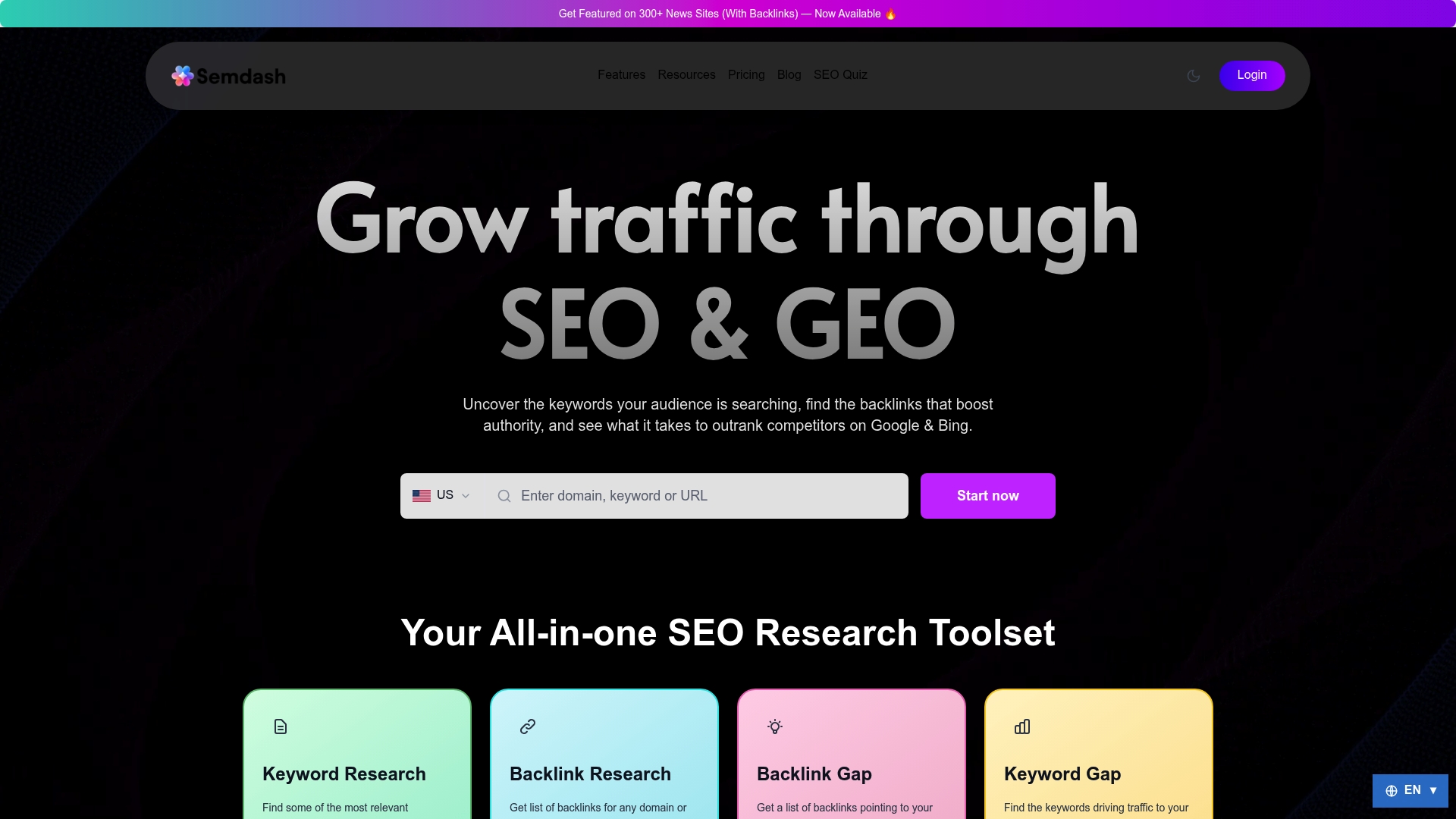
The credit-based model means your team is not penalized for adding a writer or an editor mid-quarter. You get the Keyword-Recherche depth to plan content before you write it, and the content gap data to know what your competitors are covering that you are not. An early-bird pricing offer is currently available at semdash.com/early-bird. Start a free trial, run three articles through the workflow, and measure the output against what you are producing today.
Quellen und weiterführende Literatur
Pricing and trial availability change frequently. Always verify current plans on each vendor’s live pricing page before purchasing, and run at least a short pilot before committing to an annual plan.
- Clearscope Alternative: 11 Tools Tested for 2026 | Cited
- 10 Best Clearscope Alternatives in 2026 (Ranked & Reviewed) | Okara Blog
- Clearscope Alternatives for B2B Teams | Spike
- Best Clearscope Alternatives in 2026 (Free & Paid) | ToolChase
- Best Clearscope Alternatives in 2026 | Toolsolved
- Clearscope Alternatives in 2026 | StackScored
- What is content optimisation: your 2026 guide | WebsiteSpellChecker
Häufig gestellte Fragen
How much does Clearscope cost?
Clearscope’s Essentials plan is listed at $189/month and includes 20 report credits, putting the per-report cost at approximately $9.45. Teams that need more than three seats or higher report volume typically need to upgrade to a more expensive plan.
What is the most accurate SEO content optimization tool?
Accuracy depends on SERP volatility and content type. Surfer SEO refreshes its SERP snapshot at editor session creation, making its scores among the most current available. For teams that also need keyword research and AI Overview tracking, Semdash covers a broader workflow.
What are the best free SEO tools for content optimization?
Most tools in this category offer free trials rather than permanent free tiers. Semdash offers a free trial, as do Frase and NeuronWriter. Semdash also provides a set of free SEO tools you can use without a subscription to test core functionality.
What is the difference between Clearscope and a tool like Frase?
Clearscope focuses on real-time NLP-based page grading. Frase focuses on brief generation and research-to-draft workflows, with content scoring as a secondary feature. Teams bottlenecked by brief creation typically get more value from Frase; teams focused on final-draft optimization get more from a dedicated grader.
Which Clearscope alternative works best for small teams on a tight budget?
NeuronWriter starts around $23/month and covers core NLP scoring for solo writers and very small teams. Frase is the stronger pick if brief generation matters more than scoring granularity, with entry plans starting around $15/month.