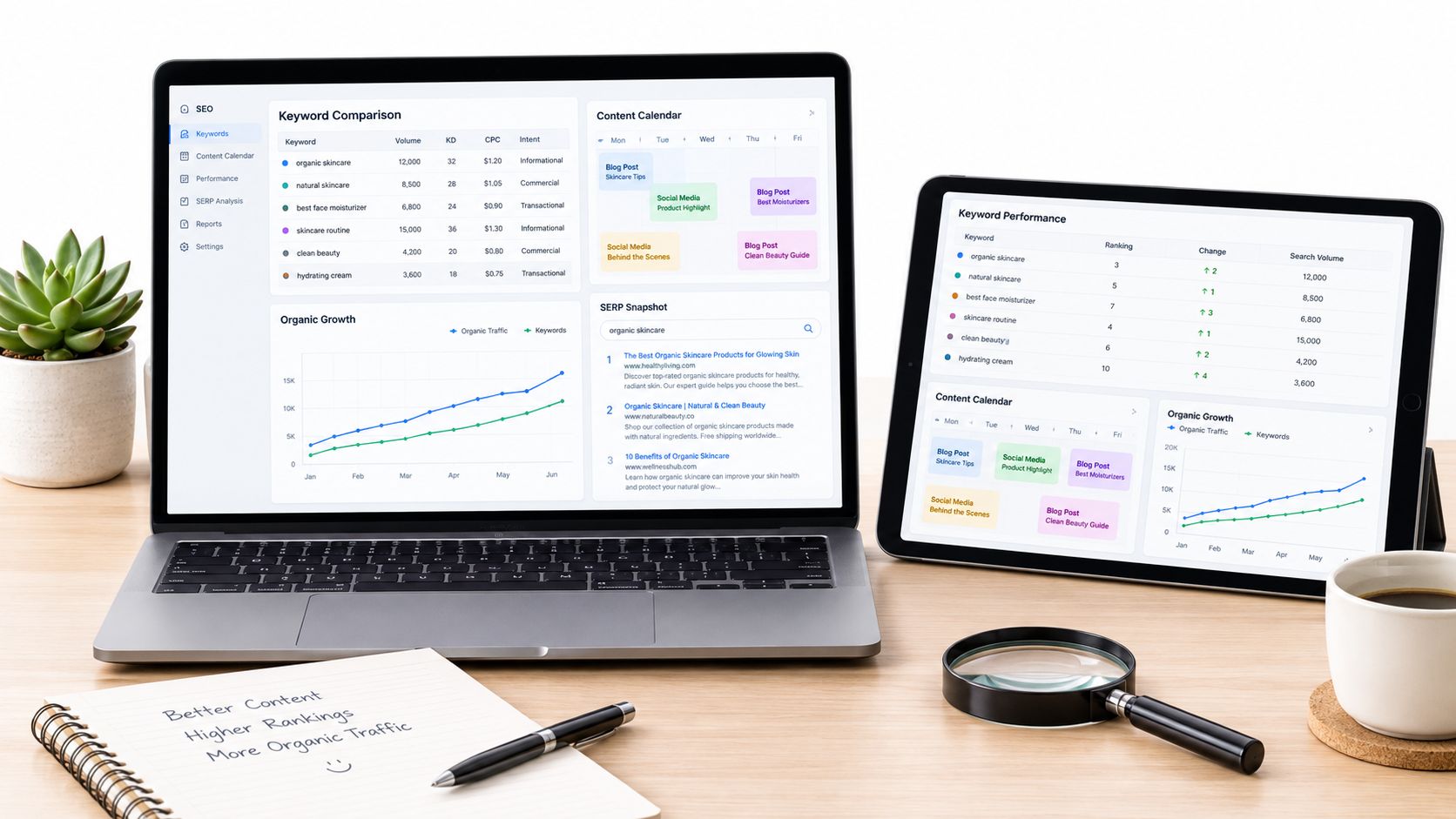

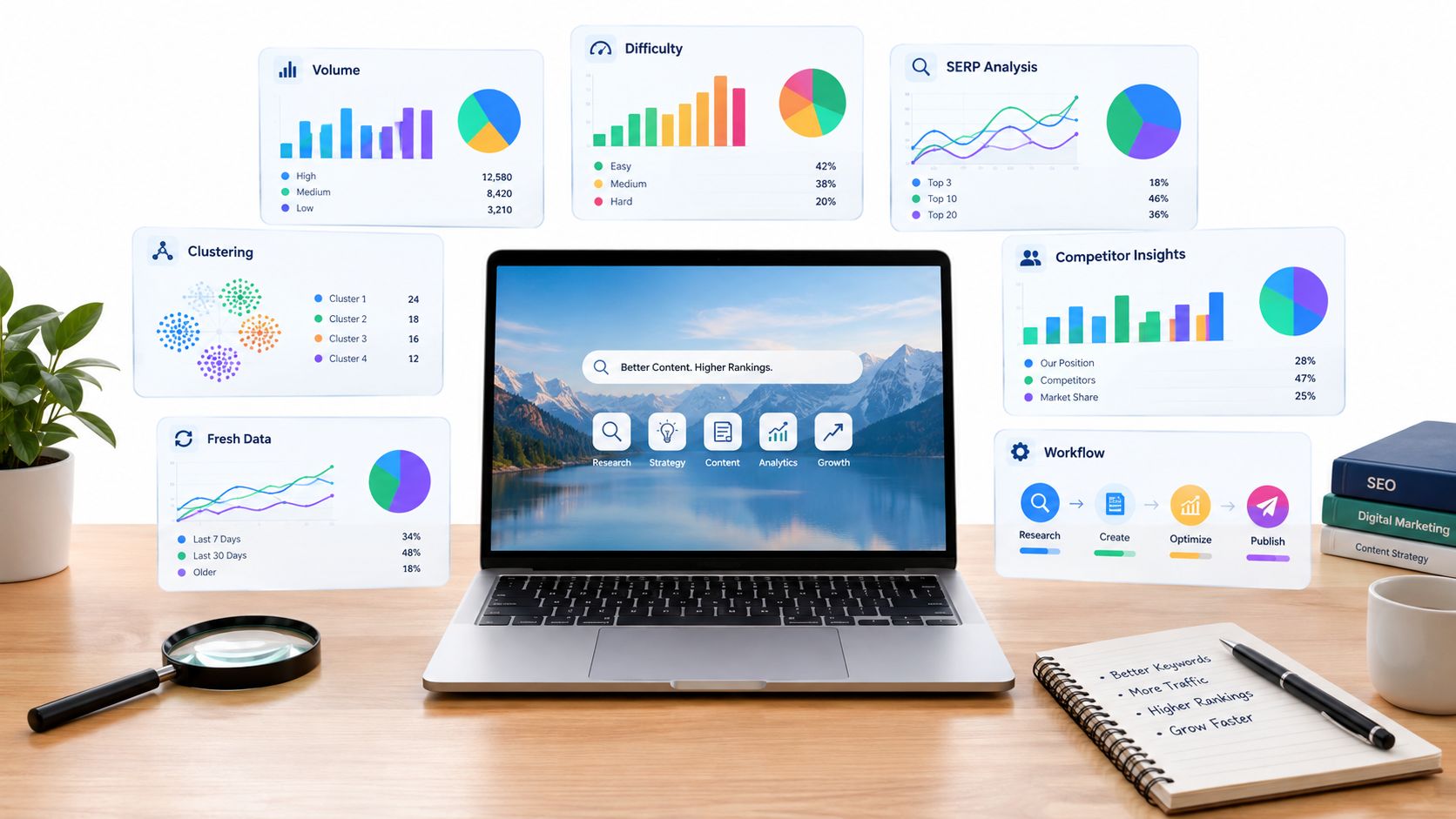
Most keyword research roundups start with the wrong question. The tool with the largest database doesn't automatically give you the best targets. A useful platform must help you make a decision, whether that's reverse-engineering a competitor's page, finding an agency-wide opportunity, clustering a content hub, or identifying a keyword that still earns clicks after an AI Overview appears.
I compare these tools by dataset freshness and scale, volume and difficulty metrics, URL-level competitor evidence, SERP and intent analysis, clustering, workflow usability, and cost trade-offs. I also test whether the output survives a manual SERP review, because a keyword score is only a starting hypothesis. SemDash is especially useful when the workflow starts with competitor pages and ends with a prioritized content or link-building plan. The other platforms earn their places by doing different jobs well.
Inhaltsverzeichnis
- 1. SemDash
- 2. Ahrefs Keywords Explorer
- 3. Semrush Keyword Magic Tool
- 4. SE Ranking Keyword Tool
- 5. Serpstat Keyword Research
- 6. Mangools KWFinder
- 7. SpyFu Keyword Research and Kombat
- Top 7 Keyword Tools Comparison
- Choose the Dataset That Matches Your Next SEO Move
1. SemDash
SemDash fits workflows that begin with competitor discovery and end with an executable SEO plan. Its published database includes 6,6 Milliarden Google-Keywords, die in den letzten 30 Tagen aktualisiert wurden, 2,7 Billionen Backlinks, 15 billion or more crawled in the last 24 hours, und 600 Millionen SERPs, die monatlich aktualisiert werden. The practical value is breadth tied to relatively current search results, rather than a static keyword export.
I use the domain and page reports to identify the terms driving a competitor's visibility, the exact URL ranking for each term, and whether that page provides a credible model for my own content. Keyword Gap surfaces missing opportunities. Backlink Gap adds referring-domain and anchor context for outreach. Together, these reports turn competitor research into decisions about pages to create, improve, or support with links.
Praktische Regel: Do not target a competitor keyword until you know which competitor URL ranks, what intent it satisfies, and whether your site can meet the same need.
Why SemDash fits action-first research
SemDash combines 12-month SERP history, volatility checks, long-tail suggestions, People Also Ask, People Also Search, and keyword clustering. Clustering is useful before assigning briefs because it groups related queries into page-level topics and can reduce cannibalization. SERP history helps confirm whether a keyword's current results are stable or whether its intent has shifted.
Its AI features serve research rather than generic drafting. SemDash can identify keywords that trigger domain mentions in Google AI Overviews, display the cited URLs, and connect live data to Claude or ChatGPT through MCP. A strategist can therefore request recommendations or generate a brief from current findings instead of relying on a static list.
The trade-offs matter. Public pricing is not prominently displayed, although the site promotes a free trial with access to a set of research tools. Some power users may find fewer total keywords than in Ahrefs, while teams requiring bulk multi-domain analysis may need another workflow. For consultants, agencies, SaaS teams, and small businesses, the combination of fresh data, URL mapping, link recovery, unlinked mentions, and an intuitive interface makes SemDash a practical option. Validate its volume and difficulty metrics against the live SERP before committing to a target.
2. Ahrefs Keywords Explorer
Ahrefs is where I go when the primary decision is deep keyword and backlink research. Keywords Explorer combines search volume, clicks, CPC, keyword ideas, SERP analysis, and traffic estimates for ranking pages. The connection to Site Explorer and Rank Tracker means I can move from discovery to competitor validation and then to monitoring without exporting everything into another system.
The most useful feature isn't the size of the idea list by itself. It's the way Ahrefs connects a query to the pages already winning, the backlinks supporting those pages, and the broader topic represented by its Parent Topic concept. I use that view to decide whether several similar terms belong on one page or deserve separate content because the SERPs show different intent.
What works and what doesn't
Ahrefs' keyword difficulty is useful when I treat it as a comparative signal, not a promise. A high score usually tells me that established pages with strong link profiles dominate, but I still open the SERP and inspect page type, freshness, topical depth, and brand bias. A low score can also mislead if the ranking pages satisfy a narrow intent that my proposed page doesn't address.
The platform's strengths are large keyword and backlink coverage, detailed SERP evidence, strong documentation, and a smooth handoff into tracking. Recent product development also includes AI features such as Brand Radar and AI Content Helper, plus MCP and API options for automation and reporting workflows.
The cost is the main constraint. Higher entry pricing, export limits, and user-seat charges matter when an agency runs repeated research across many clients. Teams that want a broader operational workspace may prefer Semrush, while those whose process starts with exact competitor URLs and link prospects should compare Ahrefs with SemDash's Ahrefs alternatives before committing.
Visit Ahrefs Keywords Explorer if your research depends on backlink context as much as keyword ideas.
3. Semrush Keyword Magic Tool
Semrush is the better fit for broad SEO and visibility operations, especially when keyword research sits beside audits, reporting, rank tracking, and AI-search monitoring. I use Keyword Magic Tool to expand a seed into modifiers, questions, related terms, and topic groups, then move those findings into Keyword Gap, Position Tracking, or a cannibalization report.
The workflow is valuable for agencies because the same account can support discovery, technical review, content planning, and client reporting. SERP feature filters help me separate a traditional blue-link opportunity from a result dominated by shopping results, video, reviews, or an AI Overview. That distinction changes how I write the brief and how I estimate the likely click opportunity.
The operational advantage
Semrush also integrates with Google Search Console and Analytics, which helps reconcile third-party estimates with a site's own query and performance data. For an established site, that first-party layer is often more useful than another batch of estimated keywords. I look for high-impression queries already associated with a relevant page, then use Keyword Magic Tool and SERP analysis to find missing subtopics or better page targets.
The platform's AI Visibility features extend the workflow into prompt monitoring, sentiment, and AI or LLM reports. That matters because keyword research now has to account for answers presented directly on the SERP. Independent analysis reports that commercial-intent SERPs with AI Overviews grew 71% over a six-month period, while finance queries grew 231% in the same period, according to TechNova Partners' 2026 keyword-tool analysis. I wouldn't use those figures to forecast traffic, but I would use the trend as a reason to inspect live SERP layouts before assigning content.
Semrush's weakness is complexity. Pricing tiers, user limits, report allowances, and add-ons can make the total cost difficult to model. It earns its place among the best keyword research tools when an agency needs one broad operating system, not when a writer only needs a small list of long-tail ideas.
Explore the Semrush Keyword Magic Tool when centralized SEO, reporting, and AI-visibility work matter as much as keyword discovery.
4. SE Ranking Keyword Tool
SE Ranking makes sense for agencies and small or midsize teams that need a balanced operating platform. I like it when the workflow includes keyword research, grouping, rank tracking across markets, on-page checks, and client reporting, but the team doesn't want the operational weight of a larger enterprise suite.
Its Keyword Tool supports discovery, while Keyword Grouper turns a raw export into topic groups. I still review the SERP manually before accepting any cluster. Automated grouping can connect terms that look semantically similar but require different page types, especially when one query is commercial and another is informational.
Where it earns its budget
SE Ranking's rank tracking is a practical companion to research. I can monitor target terms across markets, review SERP changes, and use its AI Overview tracking to identify where search presentation is changing. The platform also connects with Google Search Console, Google Analytics, and Data Studio, which helps an agency turn research into recurring reports rather than a one-off spreadsheet.
The main appeal is value without a steep learning curve. Migration and onboarding support can help a team move existing projects, and optional API or data plans support larger reporting workflows. I'd evaluate those limits early if the agency needs bulk exports or automated dashboards.
There are two details I wouldn't ignore. Plan pricing may appear differently by locale, including EUR or USD, so I'd verify the currency at checkout. Higher-volume research, API access, and additional capabilities can also introduce plan complexity, which means the cheapest visible tier isn't necessarily the right comparison.
Nutze SE-Rangliste when you need agency-friendly research and rank tracking in one accessible workspace.
5. Serpstat Keyword Research
Serpstat is a strong option for cost-conscious international SEO and clustering-heavy workflows. I reach for it when the research brief begins with a large keyword set and the immediate problem is organizing that set into coherent topics. Its Keyword Research and Keywords Selection reports add competition, trends, and SERP context, while automatic clustering provides a useful first pass at page groups.
That first pass still needs editorial judgment. On large sets, automatic cluster names can be awkward, and closely related phrases may belong to different pages if the SERP consistently separates product, category, guide, and comparison intent. I treat the output as a sorting assistant, not as a publishing plan.
Useful depth for lean teams
Serpstat also includes rank tracking with Top-100 visibility, daily updates, site and page audits, backlink analysis, and API access on higher tiers. For international work, multi-database coverage can be more useful than a huge undifferentiated keyword list, because location and language change both demand and SERP composition.
The economics are a meaningful advantage for teams that plan to keep the platform for the long term. The product advertises annual pricing and multi-year savings, while higher plans provide more generous project, export, bulk-analysis, and API capabilities. I would compare the exact limits against the number of markets and domains the team manages rather than judging by headline price alone.
Serpstat's interface can feel dense. Report names aren't always self-explanatory, and experienced researchers may still need onboarding before they find the fastest path through the product. That friction is acceptable when clustering and international databases are central to the job, but less attractive for someone who wants a very lightweight keyword finder.
Try Serpstat Keyword Research if your priority is organized topic discovery across markets rather than the simplest possible interface.
6. Mangools KWFinder
Mangools KWFinder is built for accessible long-tail research. I recommend it to bloggers, small businesses, and content teams that need to evaluate specific, lower-competition queries quickly without learning an enterprise SEO suite. The interface makes it easy to enter a seed, review related ideas, inspect difficulty, and switch location settings.
Long-tail research works best when the query is precise and the SERP appears focused. One practical workflow filters candidates by volume, keyword difficulty, and word count, using example thresholds of 0 to 1,000 volume, 0 to 29 PKD, and three or more words, as outlined by AISEO's keyword explorer guidance. Those are filters, not universal rules. A commercial query below the threshold may be more valuable than a broad informational term above it.
A lightweight SERP reality check
KWFinder becomes more useful when paired with SERPChecker. I use the SERP view to inspect result types, SERP features, and the strength of the pages ranking for the candidate. Bulk import also helps when I already have a list from customer interviews, Search Console, internal-site search, or a content brief.
Mangools bundles KWFinder with SERPChecker, SERPWatcher, LinkMiner, and SiteProfiler. That makes it a sensible complement to a larger suite, although it doesn't provide the same depth of competitor intelligence or backlink discovery as Ahrefs, Semrush, or SemDash. Its smaller database is a limitation if I need a broad market map or extensive domain-level reverse-engineering.
The product's simplicity is the point. I wouldn't buy it expecting agency-scale competitor operations, but I would use it when a content team needs fast decisions and a low learning curve. Pricing details may require the page's JavaScript to load, so check the current rates directly before comparing plans.
Visit Mangools KWFinder for straightforward long-tail discovery and basic SERP validation.
7. SpyFu Keyword Research and Kombat
SpyFu is the specialist choice for SEO and PPC competitor overlap. Its Kombat workflow shows shared, unique, and striking-distance keywords across competitors, which helps me identify gaps that a single-domain keyword report can hide. The PPC layer adds historical ad copy and paid-keyword context, so I can distinguish a competitor's proven commercial focus from content they rank for incidentally.
That distinction changes prioritization. If several competitors repeatedly bid on a term while also maintaining organic visibility, I treat it as a stronger commercial signal than a keyword that appears only in an informational blog post. It doesn't prove that the term will convert for my business, but it tells me to inspect the landing pages, offer language, and SERP features more carefully.
Where SpyFu saves time
SpyFu combines historical SEO and PPC data with rank tracking, automated reporting, white-label options, and Google Search Console integration. ChatGPT integration and AI brand monitoring can help teams query or summarize the data, but I still validate any recommendation against the actual results page.
The platform is cost-effective for competitor discovery, particularly for teams that need generous exports on Pro+ or Team plans. Its main limitation is that volume and intent modeling are simpler than what I expect from enterprise suites. The interface can also feel data-dense, so a beginner may need a defined research question before opening Kombat.
I use SpyFu when the brief is, “What are our competitors targeting in both organic and paid search, and where can we respond?” For broader URL-level backlink recovery, SERP history, and clustering, I'd compare it with SemDash's SpyFu alternatives.
Explore SpyFu when PPC evidence should shape your SEO keyword portfolio.
Top 7 Keyword Tools Comparison
| Werkzeug | Complexity & Setup 🔄 | Resources & Requirements ⚡ | Expected Outcomes ⭐📊 | Ideal Use Cases 💡 | Key Advantages |
|---|---|---|---|---|---|
| SemDash | Low–Moderate 🔄, intuitive UI, fast onboarding | Low entry cost + large, frequently refreshed datasets ⚡; some plan limits & gated pricing | ⭐⭐⭐⭐ 📊, actionable URL‑level rankings, link recovery, content briefs | SEO specialists, consultants, growth teams needing practical competitor intelligence | URL‑level mapping, fresh datasets, AI Overviews & live MCP integrations |
| Ahrefs – Keywords Explorer | Moderate 🔄, feature-rich; steeper learning for advanced workflows | High cost; large DB and export/seat fees at scale ⚡ | ⭐⭐⭐⭐⭐ 📊, highly reliable keyword/backlink metrics and SERP analysis | Agencies and teams requiring enterprise‑grade research and tracking | Massive index, integrated Site Explorer + Rank Tracker, frequent updates |
| Semrush – Keyword Magic Tool | High 🔄, broad feature set and tier complexity | High cost; add‑ons increase total spend ⚡ | ⭐⭐⭐⭐⭐ 📊, holistic visibility, topic grouping, AI visibility tracking | Large agencies and enterprises needing centralized reporting & AI visibility | All‑in‑one toolkit (SEO + AI visibility), robust reporting and filters |
| SE Ranking – Keyword Tool | Low–Moderate 🔄, easy onboarding, straightforward workflows | Flexible, budget‑friendly pricing; API/Data add‑ons available ⚡ | ⭐⭐⭐⭐ 📊, reliable rank tracking and solid keyword research for SMBs | SMEs and agencies seeking value + daily rank tracking | Strong value for money, GEO research, easy migration/support |
| Serpstat – Keyword Research | Moderate 🔄, powerful but denser interface | Affordable long‑term pricing with generous limits ⚡ | ⭐⭐⭐⭐ 📊, effective clustering and international keyword coverage | Cost‑conscious teams needing clustering and multi‑db insights | Automatic keyword clustering, transparent pricing, bulk/API on higher tiers |
| Mangools – KWFinder | Low 🔄, very approachable, beginner‑friendly | Low cost; smaller keyword/backlink database ⚡ | ⭐⭐⭐ 📊, good for long‑tail discovery and basic competitiveness | Bloggers, SMBs, small content teams focused on long‑tail keywords | Simple UI, focused long‑tail discovery, good value for basic needs |
| SpyFu – Keyword Research + Kombat | Moderate 🔄, data‑dense, competitive‑research oriented | Cost‑effective; generous export limits on mid/high tiers ⚡ | ⭐⭐⭐⭐ 📊, strong competitor + PPC insights and historical tracking | Teams aligning SEO and PPC or prioritizing competitor gap analysis | Kombat overlap analysis, historical PPC/SEO data, white‑label reporting |
Choose the Dataset That Matches Your Next SEO Move
The best keyword research tools don't produce the same kind of answer. They support different decisions, and the right choice depends on where your workflow breaks down.
Choose SemDash when you need URL-level competitor reverse-engineering, backlink-gap research, SERP history, keyword clustering, AI Overview citations, broken-backlink recovery, or a direct path from discovery to a content or link-building plan. Its scale and fresh crawl activity are useful, but its practical advantage is the connection between a keyword, the exact ranking page, the links supporting that page, and the next action.
Choose Ahrefs for deep keyword and backlink research, especially when Parent Topic analysis, SERP inspection, and mature competitor workflows drive your process. Choose Semrush when one broad platform must cover SEO, audits, reporting, rank tracking, and AI visibility across an agency's client base. The market's satisfaction data reflects that broader demand. G2 category data cited by AuthoritySpecialist reports an average SEO-tools rating of 4.4 out of 5, with SEO auditing at 9.1 out of 10 and competitor analysis at 9.0 out of 10. The same source reports keyword-research satisfaction of 93% for Semrush and 90% for Ahrefs, so both platforms have strong user approval, but that doesn't make either universally suitable.
SE-Rangliste is a sensible agency and SME value choice. Serpstat fits clustering and cost-conscious international research. Mangools is the easiest entry point for long-tail discovery. SpyFu is the clearest fit for SEO and PPC competitor overlap.
Before you trust any metric, open the live SERP. Compare the tool's volume and difficulty with the ranking URLs, identify the dominant intent and page type, check whether an AI Overview or other SERP feature absorbs the answer, and decide what your page can do better. Then put the keyword into a real content or page plan with a primary intent, supporting queries, internal-link targets, and a measurement plan. A metric can prioritize your investigation, but only the SERP can show you what Google is rewarding today.
SemDash brings keyword, backlink, SERP-history, clustering, competitor, and AI Overview data into one workflow, so you can move from a missed competitor opportunity to a prioritized content or link-building plan. Test the URL-level research process for yourself by visiting SemDash, starting with a competitor page and validating the opportunity against the live SERP.