
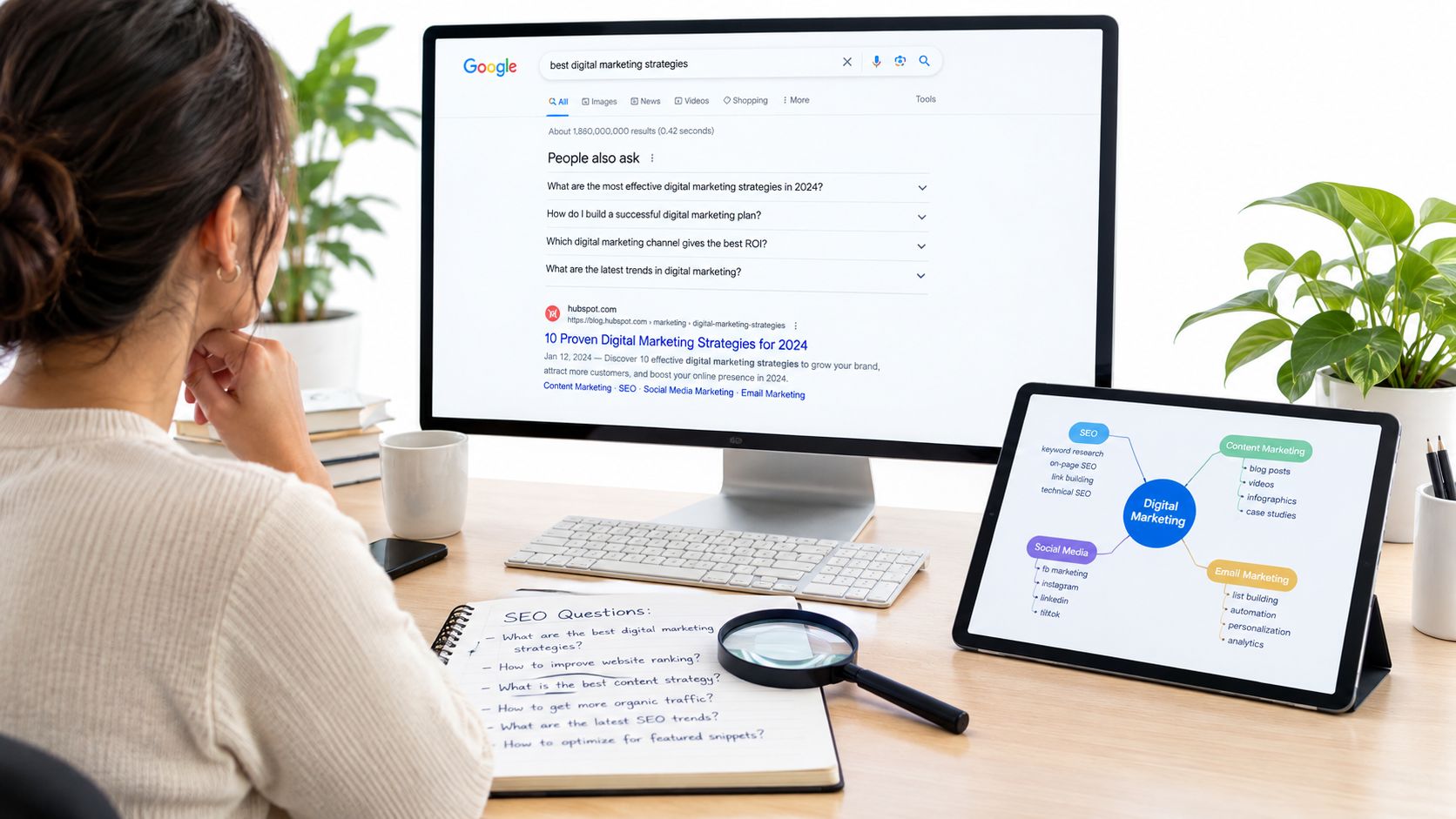
You've published the guide, checked that it ranks, and still watched Google answer the searcher before your blue link gets a chance. The expandable questions beneath the main results may look like a small SERP feature, but they can expose the exact concerns blocking a purchase, a signup, or a click. In 2026, they also sit increasingly close to Google's AI-generated answer experience.
That changes the work. People Also Ask SEO isn't just about winning a question box. It's about matching a specific question with a clear source, building enough topical context to support that answer, and monitoring whether Google continues to cite your URL when the answer layer changes.
Inhaltsverzeichnis
- Why People Also Ask Still Matters for SEO in 2026
- Finding the Right People Also Ask Questions to Target
- Writing Answers That Google Actually Picks for PAA
- Structuring Pages to Capture and Defend PAA Visibility
- Monitoring PAA Performance as AI Overviews Take Over
- Putting Your People Also Ask SEO Plan Into Action
Why People Also Ask Still Matters for SEO in 2026
A page can rank for its primary query while Google answers the buyer's follow-up question before the blue result earns a click. Those questions often expose hesitation, comparison criteria, implementation risks, and the wording searchers use just before taking action. That makes PAA more than a keyword-mining shortcut.
Google launched Related Questions in April 2015 and later developed the expandable People Also Ask format. By 2017, expanding one question could reveal 2–4 additional questions, creating the cascading discovery pattern that supported research and topical expansion, as documented in this history of Google's PAA and AI Overview changes. PAA later appeared in about 51.85% of searches in August 2024 in Semrush Sensor data. Ahrefs-based reporting placed it at roughly 43% of queries, so the feature appeared in nearly half of searches across major datasets, according to the same source.
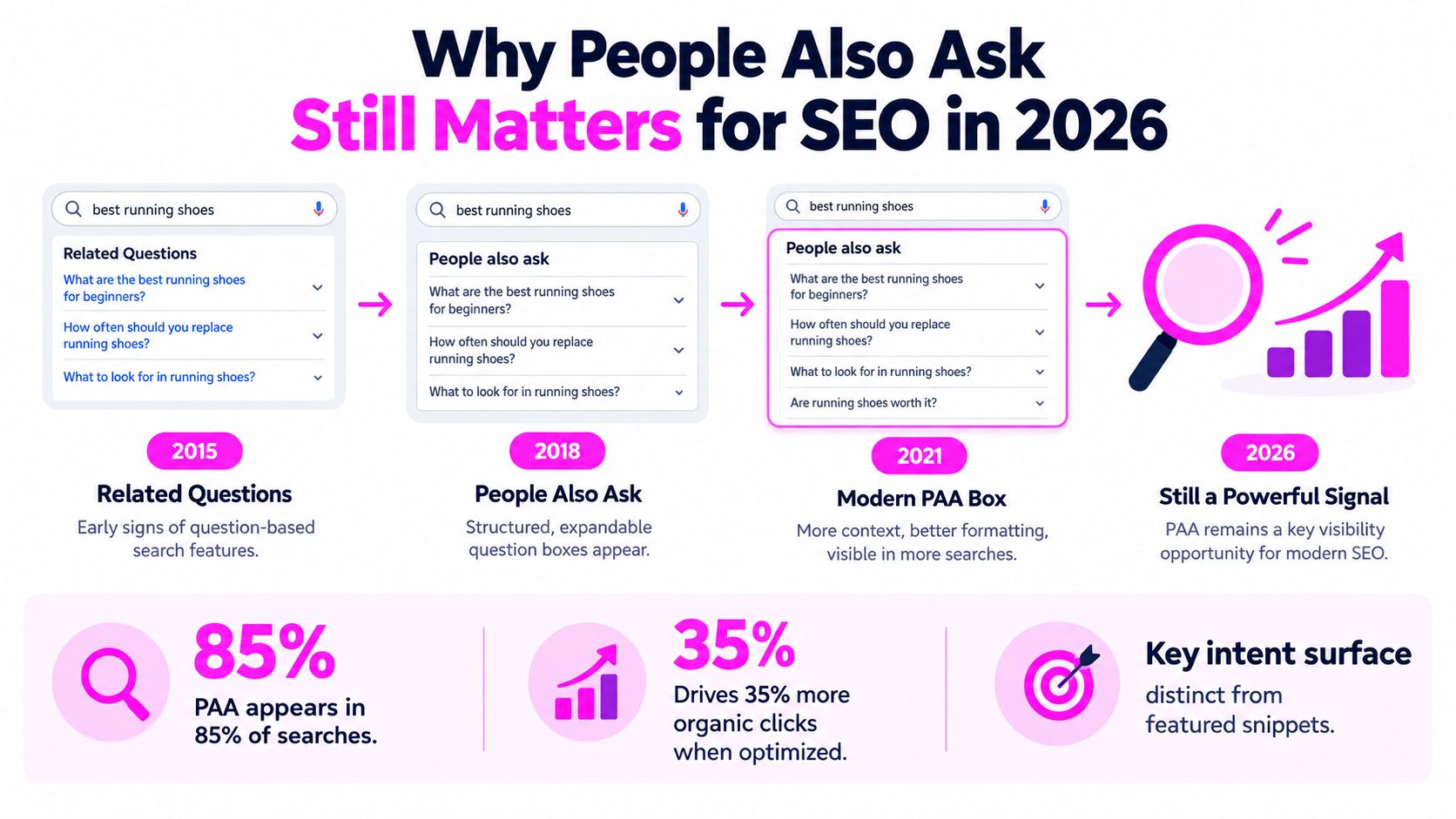
The bigger change is inside the answer layer. Analysis of more than 8.4 million English-language PAA results found that 12.6% of answers were AI-generated in July 2025. Reporting on nearly 20 million PAA examples by September 2026 indicated that AI Overviews answered about 97% of PAA questions, verglichen mit 86% in August 2026 and about 12% roughly 14 months earlier, laut GetStat's analysis of PAA and AI Overviews.
Your source page still matters, but its role has changed. Google may use its wording, evidence, or structure inside an AI-generated answer without sending the same click a conventional result would receive. I treat PAA as an intent surface and citation surface. It shows which concerns Google connects to a query and gives a page an opportunity to supply material that can be cited in an AI response.
My early mistake: I chased the largest set of related questions instead of the questions closest to a decision.
Prioritize PAA when questions support a commercial page, product category, service comparison, or high-value problem your business solves. Reduce the effort when questions are unrelated curiosities, navigational prompts, or topics your team cannot answer with first-hand accuracy. PAA may be common, but every question does not justify a new page. In 2026, the practical target is visibility as a cited source, even when the expandable box is replaced by an AI answer.
Finding the Right People Also Ask Questions to Target
I start with a page, not a keyword export. The page might be a product category, a service landing page, or an informational article supporting a commercial destination. Then I collect PAA questions around the page's central intent using a PAA research tool, People Also Search suggestions, live SERPs, and competitor data.
Ein praktischer Arbeitsablauf sieht so aus:
- Pull the question universe. Export questions for the primary query and close variants. I also inspect the follow-up questions revealed after expansion because the first visible set rarely represents the full topic.
- Cluster by answer intent. Group questions about eligibility, cost factors, comparisons, setup, maintenance, risks, and alternatives. Similar wording doesn't always mean the same answer, so I read the SERP and classify the underlying need.
- Cross-check competitor coverage. Domain Keywords and Keyword Gap reports help identify questions competitors address while my site has no useful answer. I map each gap to an existing URL before considering a new one.
- Prioritize by business proximity. Questions that help someone choose, evaluate, configure, or buy usually deserve more attention than disconnected informational questions.
- Assign one primary URL. If two pages target the same question and promise the same answer, I consolidate or clearly differentiate them.
Ich nutze SemDash's People Also Ask workflow when I need PAA suggestions alongside related query discovery and page-level clustering. The tool choice matters less than the discipline of assigning each question to a destination instead of treating the export as a publishing queue.
Research cited by a question-research platform found that answering more PAA questions correlates with stronger top-five rankings most clearly for commercial and transactional queries. The relationship weakens for navigational and informational queries, and beyond page one it drops sharply and can reverse, as discussed in this analysis of PAA coverage and ranking relationships.

Which questions deserve a dedicated answer block
| Question Type | Priority Signal | Recommended Action |
|---|---|---|
| Purchase or service-fit question | Directly affects selection | Add a dedicated block to the money page |
| Comparison question | Searcher is evaluating alternatives | Answer on the relevant category or comparison page |
| Setup or implementation question | Removes friction after consideration | Add a concise answer, then link to detailed instructions |
| Definition question | Establishes basic context | Include only if it supports the page's main intent |
| Navigational question | Refers to a specific brand or destination | Usually exclude unless it belongs to your brand journey |
| Broad unrelated question | Weak topical and commercial connection | Don't force it onto the page |
I don't create a separate article for every question. A dedicated page makes sense when the question has a distinct intent, requires substantial explanation, or can attract a meaningful supporting topic. Otherwise, an answer block on the strongest existing URL keeps relevance concentrated and reduces cannibalization.
Writing Answers That Google Actually Picks for PAA
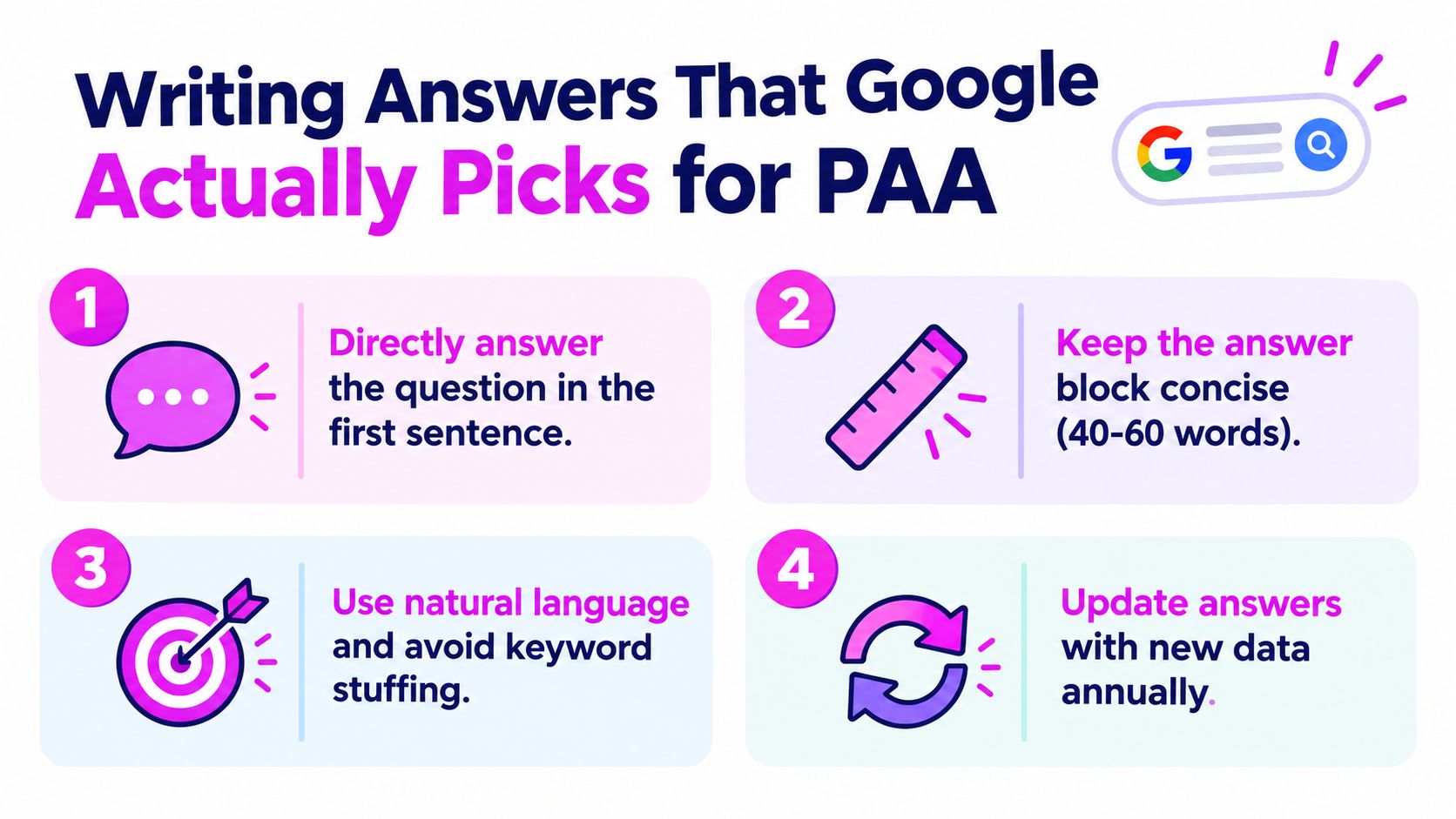
The format I test most consistently is simple. I place the exact PAA question in an H2 or H3, answer it immediately in a concise paragraph, then add evidence, qualifications, examples, or next steps below. Guidance from Semrush's PAA study and optimization recommendations supports a 40–60 word direct answer and notes that Google may select a cited page even when it isn't the highest-ranking result.
That structure gives the extractor a clean passage. It also helps the reader. Someone scanning the page can understand the answer without digging through a long introduction, while a reader who needs nuance can continue into the supporting detail.
The direct-answer pattern
Weak version:
Can businesses use project management software?
Project management software is a popular solution that many organizations use for planning, collaboration, productivity, and tracking work across different teams and workflows.
It delays the useful distinction and piles on broad phrases. A stronger version starts with the answer:
Can businesses use project management software?
Yes. Businesses use project management software to assign work, track deadlines, coordinate teams, and keep project information in one place. The right choice depends on team size, workflow complexity, reporting needs, integrations, and whether users need client-facing collaboration.
The second answer identifies the entity, states the use case, and adds decision criteria without pretending every business needs the same product. The detail underneath can explain permissions, automation, reporting, or implementation.
The exact length isn't a guarantee. I've seen longer answers selected when the question requires context, and I've seen short answers ignored because they're vague or unsupported. Conciseness helps extraction, but answer fit does the primary work.
Handling cascades without repeating yourself
Follow-up questions often overlap. “How does it work?”, “What does setup involve?”, and “How long does implementation take?” may all belong to one implementation section, but they shouldn't produce three nearly identical paragraphs. I answer the broad question first, then give each distinct follow-up its own concise treatment only when the answer changes.
Use natural language rather than inserting the target phrase into every heading. Google's PAA system analyzes existing content with language processing and displays a short answer snippet with a clickable source, as explained in this People Also Ask overview from Search Engine Land. Clear entities, explicit relationships, and unambiguous wording help both human readers and AI systems understand what the page claims.
I avoid opening an answer with “it depends” unless I immediately explain what it depends on. That phrase often signals that the writer hasn't made the decision criteria clear. State the default answer, identify the exceptions, and show the reader where the recommendation changes.
Structuring Pages to Capture and Defend PAA Visibility
A page can contain excellent answers and still underperform if its architecture makes extraction difficult. I keep the primary topic in the H1, establish the page's main intent early, and place the most commercially important question blocks where readers and crawlers can reach them without passing through a long preamble.
I then group related questions under meaningful subtopics. A product page might use sections for suitability, compatibility, setup, pricing factors, and alternatives. An informational hub might separate definitions, process questions, troubleshooting, and next steps. The question blocks support the page. They shouldn't turn it into an unstructured FAQ dump.
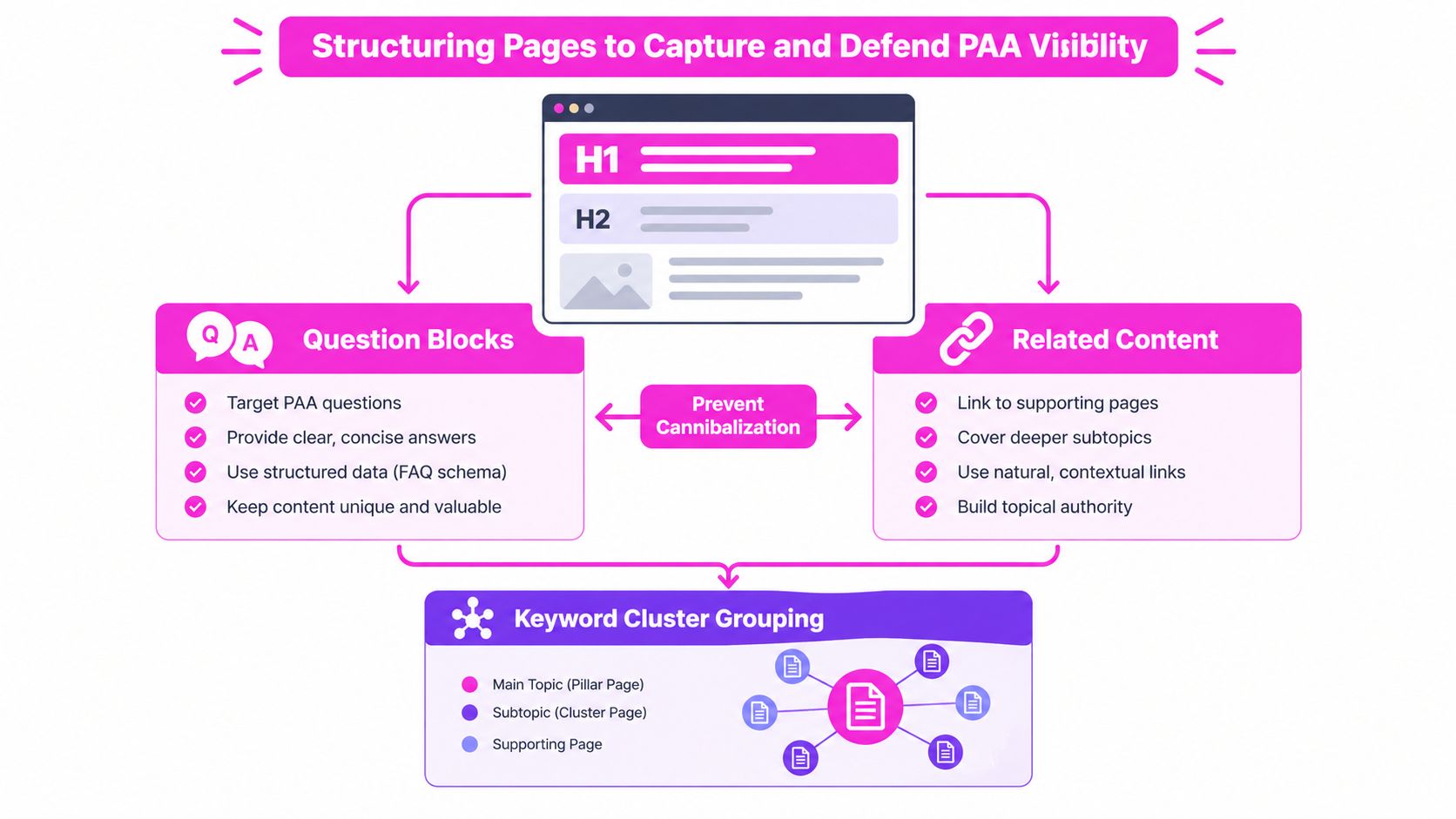
A page architecture I can maintain
- Main promise: The opening explains what the page helps the visitor decide or accomplish.
- Core answer blocks: Exact questions appear as descriptive H2 or H3 headings, followed by direct answers.
- Supporting depth: Examples, limitations, process details, and definitions sit beneath the concise answer.
- Commercial path: Relevant internal links guide qualified readers to a product, service, demo, or contact destination.
- Related coverage: Links point to different supporting topics, not duplicate pages competing for the same question.
FAQPage or Q&A structured data can help clarify page relationships, but I treat markup as a helper. It won't repair thin answers, conflicting statements, weak topical coverage, or a page aimed at the wrong intent. The extractable text still needs to be visible, accurate, and directly associated with the heading.
Google Search Console can record an impression when a user expands a PAA item and your URL appears, even if that interaction doesn't produce a click. Search Console also records the position of the PAA module, which makes it possible to watch visibility and placement change over time, according to this Search Engine Journal explanation of PAA performance data.
That distinction affects reporting. I separate visibility, citation, und traffic rather than combining them into one success metric. A page can earn impressions from expanded questions, receive few clicks, and still influence the searcher's understanding of the brand.
What usually breaks the setup
The common failures are predictable. Teams scatter the same question across several posts, bury the answer beneath a brand story, publish multiple blocks with nearly identical wording, or add schema while leaving the visible content unclear. I'd rather consolidate overlapping pages and strengthen one answer than create a thin page for every variation Google reveals.
Monitoring PAA Performance as AI Overviews Take Over
A page can keep its organic position while losing the answer citation that introduced it to searchers. PAA tracking therefore needs to cover more than whether a URL appears in an expandable box. It must show whether Google still uses that page when forming an AI answer.
I monitor three layers:
- Search Console visibility. I review PAA-related queries, impressions, average position, and clicks. Rising impressions with flat clicks can mean the page is appearing in an answer layer rather than generating conventional visits. Search Console may record an impression when someone expands a PAA item and sees your URL, even without a click.
- SERP history. I record whether the PAA module appears, its position, the questions it surfaces, and the URL cited for each question. Historical results help separate a temporary test from a recurring change in visibility.
- AI citation presence. I check whether the domain or exact URL appears inside AI-generated answers for the target query set. The practical question is not only whether the page ranks. It is whether Google selected its wording, evidence, or definitions to build the response.
PAA now works as an AI Overview delivery layer. A citation can remain valuable even when fewer users reach the page, provided the answer names the brand accurately and supports the next decision. Teams building an answer-engine workflow can use these practical AEO strategies Ireland as context, then test each recommendation against live results and the sources Google cites.
What I do when a citation flips
A citation change does not automatically prove that the content failed. Google may be testing another source, refreshing the answer, or responding to a newer page. I log the change first, then compare the competing passage with mine.
I check entity definitions, the first-sentence answer, product or policy updates, qualifications, and supporting evidence. I also verify that the page answers the exact question instead of discussing only the wider topic. If another source is easier to extract, I improve the structure and wording for clarity without copying it.
I track the change from the question level, because a domain can retain visibility for one PAA branch while disappearing from another. A workflow based on SemDash's AI Overview monitoring guidance can connect citation changes with page revisions and SERP movement. Report visibility, citation, und traffic separately. Click-through rate alone misses the value of being selected as the source inside an AI answer.
Putting Your People Also Ask SEO Plan Into Action
I'd start with pages that can influence revenue, not with a general blog-wide question harvest. Audit your product, category, and service pages for high-intent questions that competitors answer and your page ignores. Then improve the blocks most likely to remove uncertainty.
A focused 30-day plan looks like this:
- Days 1–5: Collect PAA questions for priority money pages and classify them by purchase, comparison, setup, risk, and definition intent.
- Days 6–10: Use clustering to assign each question to one URL. Consolidate overlapping articles before adding new content.
- Days 11–17: Rewrite the top five question blocks using the exact-question heading and concise direct-answer format. Add supporting detail below each answer.
- Days 18–23: Review internal links, entity clarity, outdated claims, and structured data. Remove duplicated FAQ blocks and make the commercial next step useful rather than intrusive.
- Days 24–30: Record current PAA visibility, module position, cited URLs, impressions, and clicks. Set a recurring review for citation changes and answer updates.
The failed approach is chasing every cascading question Google reveals. That produces bloated pages, overlapping intent, and answers nobody needs. I also avoid treating schema as a substitute for substance, or assuming a high organic position guarantees a PAA citation.
The operating principle: Treat PAA as an ongoing intent feedback loop, not a one-time optimization task.
When a question keeps appearing, it tells me Google sees a recurring need around the topic. When the cited source changes, it gives me a prompt to compare clarity, completeness, and freshness. When impressions rise without clicks, I report the visibility and ask whether the answer is doing enough brand or commercial work inside the SERP.
PAA is worth pursuing selectively. Focus on questions that clarify a decision, strengthen a valuable page, and can be answered with precision. Then monitor the source relationship after publication, because in an AI-shaped SERP, earning the answer once isn't the same as defending your citation over time.
SemDash helps you find People Also Ask and People Also Search suggestions, compare competitor keyword coverage, cluster questions into page-level topics, and monitor SERP and AI Overview citations. Visit SemDash to build a more disciplined PAA research and tracking workflow.