
The platform with the longest feature list isn't automatically the best SEO platform. A tool can offer keyword research, audits, rank tracking, backlinks, content briefs, and AI visibility, yet still slow down the work that matters. I care more about whether I can reverse-engineer a competitor, identify the exact page worth building, reclaim a lost link, diagnose a technical issue, monitor SERP changes and AI Overviews, then explain the result clearly to a client or executive team.
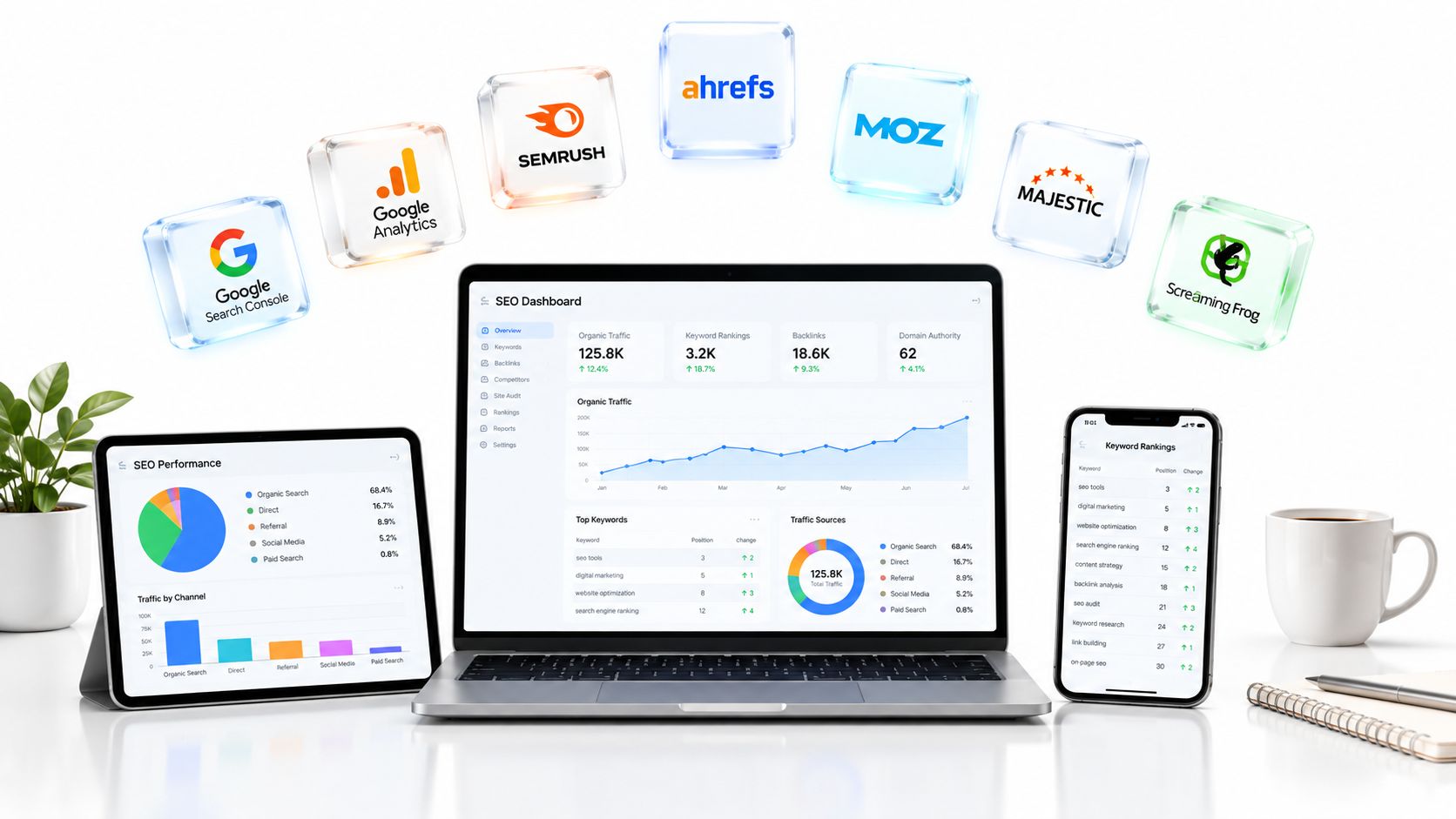
That's the basis for this comparison of SemDash, Semrush, Ahrefs, Moz Pro, SISTRIX, Similarweb, and Conductor. I'm weighing dataset depth, URL-level research, AI-search visibility, workflow fit, pricing approach, usage limits, implementation friction, and the different needs of agencies and in-house teams. Pricing and plan details can change, so verify current limits and add-ons before committing.
Inhaltsverzeichnis
- 1. SemDash
- 2. Semrush
- 3. Ahrefs
- 4. Moz Pro
- 5. SISTRIX
- 6. Similarweb
- 7. Conductor
- Top 7 SEO Platforms Comparison
- Choose the Platform That Matches Your Operating Model
1. SemDash
SemDash is the strongest value-oriented choice here when the work starts with competitor reverse-engineering, page-level content planning, and link opportunity discovery. The platform brings keyword, backlink, and SERP research into one cloud workspace, with a data footprint that's unusually ambitious for a tool positioned around accessibility. Its database includes 6,6 Milliarden Google-Keywords, die in den letzten 30 Tagen aktualisiert wurden, einer 2.7 trillion-link index with daily crawls, und 600 Millionen SERPs, die monatlich aktualisiert werden. Those figures are product claims, so I'd still validate coverage for your markets and vertical before treating them as a substitute for first-party data.
The workflow is practical. Domain Keywords and Keyword Gap reports show where competitors earn visibility, while URL-level mapping identifies the exact page ranking for each keyword. That distinction matters. A domain-level report may tell me that a competitor owns a topic, but a page-level view tells me whether I should improve an existing article, create a product page, or build a new resource.
SemDash also supports Backlink Gap research, unlinked-mention detection, and broken-backlink recovery. I can move from “this competitor has authority” to a more useful outreach list containing the referring domain, linking context, and a reason to contact the site. Traffic Share and Top Pages add another layer, helping prioritize the pages that appear to carry the most competitive weight.
Where SemDash works best
SemDash's SERP Checker includes 12 months of SERP history, with intent and volatility signals for deciding whether a page needs an update, expansion, or a different format. Its AI-assisted briefs and live-SERP intent classification are useful when writers need direction without turning a content brief into a generic keyword dump. The AI Overviews visibility workflow can also show domain mentions and the exact URLs cited, which connects classic SEO research with answer-engine discovery.
The MCP connector is a notable workflow advantage. It lets Claude or ChatGPT query SemDash's dataset directly, so an analyst can combine research and prioritization without repeatedly exporting spreadsheets. I'd put guardrails around that workflow, though. AI can summarize opportunities quickly, but it shouldn't decide intent, cannibalization, or link quality without human review.
Praktische Regel: Use SemDash's difficulty score to compare keywords inside one workflow, then inspect the live SERP before assigning the topic to a writer.
The main trade-off is depth in certain keyword comparisons. Some power users report fewer keyword variants per URL than top-tier incumbents, which could matter for ultra-deep keyword mining. Large-scale bulk analysis and formal pricing for add-on services are also less prominent than enterprise buyers may expect. Still, the clean interface, free trial or free tier with access to more than 20 tools, learning resources, public roadmap, and optional services make SemDash a compelling fit for consultants, agencies, content teams, and smaller growth organizations.
2. Semrush
Semrush remains the safest all-in-one recommendation when a team wants one login for research, execution, monitoring, and reporting. I'd use it when the workflow extends beyond organic search into paid research, local visibility, content operations, and enterprise reporting. The core SEO toolkit includes keyword research, domain and competitor analysis, Site Audit, Position Tracking, backlink research, and content support.
Its newer AI Search capabilities change the buying conversation. Semrush can track brand mentions and prompts across Google AI, ChatGPT, Gemini, and Perplexity, giving teams a way to compare classic rankings with visibility inside emerging answer surfaces. That doesn't make traditional rank tracking irrelevant. It gives me another measurement layer for branded discovery, source attribution, and prompt-level movement.
The operational trade-off
Semrush's breadth reduces tool sprawl, but breadth also creates friction. New users can open several adjacent modules and still lack a clear answer to the question, “What should we do this week?” I get better results when I configure a narrow operating rhythm, such as competitor research on Monday, content prioritization midweek, and reporting after data collection.
Historical data, cannibalization analysis, scheduled reporting, integrations, and white-label options become more relevant at higher tiers or through add-ons. That makes total cost harder to judge from the headline plan alone. Users also report upsell surprises, while lower tiers can feel restrictive for teams expecting large keyword and site limits.
For agencies, Semrush is attractive when client reporting, integrations, and a broad service menu matter more than a highly specialized link workflow. In-house teams may prefer it when SEO sits alongside PPC, content, and market intelligence. Before buying, I'd run the same competitor domain, content brief, and reporting export through the exact plan under consideration. This Semrush comparison with Similarweb is useful background, but your own domain tests should decide the purchase.
Visit Semrush to confirm current limits, AI-search coverage, add-ons, and enterprise governance options.
3. Ahrefs
Ahrefs is still the platform I'd shortlist first when backlink intelligence and fast competitive discovery drive the engagement. Site Explorer makes it easy to move from a competitor domain to referring domains, anchors, linked pages, and traffic estimates. That supports link prospecting, content gap analysis, and diagnosis of why a competitor page keeps appearing in the SERP.
Keywords Explorer, Site Audit, Rank Tracker, and Brand Radar broaden the platform beyond link research. Brand Radar adds AI visibility through tracked prompts and mentions, which is useful for teams that want to see whether a brand appears in conversational search as well as standard results.
What I'd test before committing
Ahrefs exposes plan limits clearly, and optional add-ons can suit heavy auditing or reporting users. That transparency helps agencies model capacity, especially when several clients need separate projects, crawls, or tracked keywords. The downside is that the platform doesn't offer the same traditional free-trial approach as some competitors, and its free plan is limited.
Rank tracking is another consideration. Weekly updates are the default, while daily updates aren't standard. That's perfectly workable for strategic content and link programs, but it's less comfortable for campaigns where I need frequent monitoring after a launch, migration, or major SERP change. I'd avoid paying for a broad suite and then discovering that the update cadence doesn't match the reporting promise made to stakeholders.
Ahrefs also works best when the operator understands that estimated traffic isn't first-party analytics. I use it to compare competitors consistently, not to present an estimate as a client's actual traffic. For agencies, the platform is strongest when link analysis is central to the service and exports can feed a repeatable prospecting process. For in-house teams, it fits content and technical SEOs who want quick answers without an overly complex interface.
Die Ahrefs alternatives guide is a useful starting point if link depth matters but budget, update cadence, or workflow simplicity point elsewhere.
See the current Ahrefs platform plans before comparing quotas, rank updates, add-ons, and AI visibility features.
4. Moz Pro
Moz Pro is the easiest recommendation for an SMB or a developing SEO team that needs a broad toolkit without a steep onboarding curve. Keyword Explorer and Link Explorer cover the essential research paths, while Campaigns combine multi-engine rank tracking, site crawling, and ongoing project monitoring. MozBar Premium is especially convenient for quick on-SERP and on-page checks during manual research.
The product's advantage isn't maximum dataset depth. It's the learning environment around the product. The interface is approachable, educational resources are strong, and a new team member can usually understand the basic workflow without extensive internal training. That matters when the bottleneck is adoption rather than raw data availability.
A sensible SMB choice
Higher Medium and Large tiers include AI Overviews and tracked AI prompts. That gives teams an entry point into AI-search monitoring, although advanced AI coverage may require moving up the pricing ladder. I'd evaluate the feature against the prompts that matter to the business, rather than assuming the presence of an AI module automatically creates useful visibility data.
The main compromise is link index depth and broader dataset scale compared with premium competitors. If I'm investigating a competitive industry where referring-domain quality and page-level link patterns decide the strategy, I'd run a sample comparison before selecting Moz Pro. A smaller dataset isn't automatically a problem, but it can become one when the platform misses the exact pages or domains I need to analyze.
Moz Pro suits an in-house generalist, an SMB marketing team, or an agency that values straightforward client education. It's less compelling when I need very deep link intelligence, highly granular bulk research, or advanced AI monitoring without a higher-tier commitment.
Open the Moz Pro website to check current campaign limits, AI-search availability, crawl allowances, and pricing for your team size.
5. SISTRIX
SISTRIX is built around a different decision than Semrush or Ahrefs. Its Visibility Index and historical SERP data help me understand how a domain's search presence changes over time, across more than 30 countries. That makes it particularly useful for international SEO, competitor trend analysis, and explaining whether a visibility change reflects a single page or a broader domain movement.
I like SISTRIX when the brief asks, “Which competitors are gaining visibility in this market, and which content areas are responsible?” Its keyword research, domain analysis, backlink insights, projects, content tools, and export workflows support that question without forcing every decision through a general-purpose dashboard.
Built for repeatable agency analysis
The feature and limit tables are clear, monthly cancellation is flexible, and white-label reporting supports agency operations. API access and export credits also matter when an agency needs to place SEO data into an internal reporting system or a broader marketing pipeline. Adjustable SERP update credits give heavy users more control, although they also make quota planning necessary.
The commercial trade-off is that billing is euro-based by default, which can complicate budgeting for non-EU teams. Add-on costs for extra projects and credits can accumulate quickly if I treat every client as a high-frequency monitoring account. I'd map expected projects, exports, and SERP updates before choosing a tier.
SISTRIX is a strong fit for agencies and international teams that value trend measurement, transparent quotas, and structured exports. It may feel less immediately intuitive to a small business owner who only wants a short keyword list and a basic audit. In that case, the platform's analytical strengths can become unused capacity.
Review the current SISTRIX platform for country coverage, project quotas, API access, export credits, and currency implications.
6. Similarweb
Similarweb becomes the better choice when SEO decisions depend on market context beyond SEO. Its website research combines traffic estimates, engagement signals, channel mix, SERP and rank reports, backlinks, and site audits. I can use that context to ask whether a competitor's apparent search strength is part of a larger acquisition model involving PPC, affiliates, referrals, display, or direct traffic.
That distinction changes strategy. If a competitor ranks well but receives most of its modeled visits through another channel, I may not copy its content architecture. If search represents a meaningful part of the category, I can investigate the pages and queries supporting that position while keeping the broader acquisition picture visible.
Where modeled intelligence helps
Similarweb includes SEO and GenAI visibility modules for monitoring brand presence and estimating AI-driven traffic. Product updates around Search and GenAI make it relevant for organizations that want one market-intelligence environment rather than a strictly SEO-first tool. API and export options also support BI pipelines and internal dashboards.
The limitation is data interpretation. Similarweb uses modeled and estimated data based on panel information and extrapolation, not first-party analytics. I wouldn't present a competitor's estimated traffic as a verified number, and I wouldn't use the platform to replace Google Search Console or analytics for a site I control.
Pricing is sales-led and often quote-based, so transparency is weaker than with self-serve platforms. That creates procurement friction, but it can also make sense for teams that need custom data access, cross-channel benchmarking, or enterprise support. Similarweb is overpowered for a solo consultant focused only on keyword discovery. It's much more defensible for a market-intelligence, growth, or strategy team that needs SEO within a larger competitive picture.
Explore Similarweb with your own category and competitor set, then ask sales to explain the data model, modules, exports, and usage limits behind the quote.
7. Conductor
Conductor is the enterprise choice for organizations that need SEO and answer-engine optimization connected to content production, monitoring, and governance. Its Intelligence, Creator, Monitoring, and AgentStack products are designed to connect research with briefs, content workflows, measurement, and operational oversight. That's a different proposition from buying a powerful research tool for one or two practitioners.
The platform publishes usage quotas for keywords, pages, competitors, AI credits, prompts, and reporting. That's helpful for enterprise planning because a procurement team can connect expected usage to brand portfolios and stakeholder requirements instead of buying an opaque package with no operating model.
Governance is the product decision
Conductor's strength appears when several teams need a controlled process across multiple sites or brands. High-scale crawling, monitoring, content creation, AI Search reporting, and governance can reduce the number of disconnected workflows that enterprise SEO teams maintain. The platform also aligns reporting with the changing role of answer engines, where teams care about citations, mentions, and visibility in generated answers.
That capability comes with real friction. Pricing is custom, procurement takes longer than with self-serve products, and implementation requires more coordination. A solo consultant or small business probably won't use enough governance, monitoring, or collaboration capacity to justify that complexity.
For an enterprise team, I'd make implementation part of the evaluation. Ask who owns taxonomy, prompt libraries, content approvals, integrations, and reporting definitions. A platform can support every required workflow and still fail if nobody agrees on naming, ownership, or success criteria.
Review Conductor for current plan quotas, AI capacities, integrations, governance features, implementation expectations, and procurement requirements.
Top 7 SEO Platforms Comparison
| Werkzeug | Implementierungskomplexität 🔄 | Ressourcenanforderungen ⚡ | Expected outcomes 📊 | Ideale Anwendungsfälle 💡 | Hauptvorteile ⭐ |
|---|---|---|---|---|---|
| SemDash | Low–Moderate; cloud UI, streamlined workflows | Low cost; free tier and affordable plans | Actionable competitor & link opportunities; faster content briefs | Agencies/SMBs needing budget-friendly competitor reverse-engineering | Massive fresh datasets, URL-level mapping, AI-assisted briefs |
| Semrush | Moderate–High; many integrated modules to learn | Medium–High; base plans + add-ons can raise cost | Broad visibility, reporting and cross-channel insights | Teams wanting an all-in-one research → execution → reporting suite | Comprehensive toolset, enterprise scaling, AI Search tracking |
| Ahrefs | Moderate; focused, workflow-oriented interface | Medium; clear plan quotas, no generous free trial | Deep backlink intelligence and fast competitor discovery | Technical/content SEOs prioritizing link research & audits | Large backlink index, transparent limits, efficient discovery |
| Moz Pro | Low; gentle learning curve and strong docs | Low–Medium; SMB-friendly pricing and onboarding | Reliable on-page insights, rank tracking and basics | Small teams/SMBs prioritizing ease of use and learning | Educational resources, MozBar, straightforward campaigns |
| SISTRIX | Moderate; visibility-index centric workflows | Medium; clear export/credit model, adjustable quotas | Consistent visibility trends and exportable reports | Agencies/international teams needing clear quotas & white-label | Visibility Index, historical SERPs, transparent limits |
| Similarweb | Moderate–High; cross-channel data integration | High; sales-led pricing and modeled datasets | Market & audience context plus SEO benchmarking | Competitive intelligence teams needing traffic + channel mix | Strong audience/market context and Search/GenAI updates |
| Conductor | High; enterprise governance and integrations | High; custom pricing and procurement cycles | Scaled monitoring, governance and AEO-focused reporting | Mid-to-large orgs needing enterprise-grade SEO + content ops | Enterprise packaging, usage-based scaling, AI content/reporting |
Choose the Platform That Matches Your Operating Model
The best SEO platform depends on the bottleneck your team needs to remove. If I'm running an agency, I start with client separation, exports, white-label reporting, quota economics, international coverage, and repeatable competitor and backlink workflows. A tool that produces excellent research but makes client delivery manual can cost more operationally than its subscription suggests.
Agencies should test a complete repeatable process. Take one client domain, one competitor, one ranking URL, one content opportunity, and one link-reclamation target. Then measure how quickly the team can move from discovery to a client-ready recommendation. SemDash is especially practical when competitor research, URL-level mapping, fresh keyword and SERP datasets, AI-assisted briefs, and link opportunity discovery matter more than maximum enterprise governance.
In-house teams should prioritize a different set of constraints. Content planning, technical auditing, rank monitoring, AI-search visibility, integrations, governance, and ease of adoption usually matter more than agency-style white-labeling. A platform that the content team, technical team, and leadership group can use will outperform a theoretically deeper tool that stays with one specialist.
I'd build a feature matrix with these rows:
- Keyword research: Can the platform expose useful variants, intent, volume, and difficulty?
- Backlinks: Can I inspect referring domains, anchors, linked pages, gaps, and reclamation targets?
- SERP data: Is there history, volatility, intent classification, and a suitable update cadence?
- AI search: Does it track prompts, mentions, citations, AI Overviews, or estimated AI-driven traffic?
- Auditing: Can it diagnose technical problems at the scale and frequency my sites require?
- Reporting and API: Can the team export cleanly, automate delivery, and connect data to existing systems?
- Data freshness and limits: Do crawl frequency, keyword quotas, project limits, and country coverage match the workflow?
- Pricing transparency: Can I calculate the cost after add-ons, credits, users, and overages?
Keyword Difficulty deserves careful treatment in that matrix. The score commonly uses a 0 to 100 scale, where 0 is easiest and 100 is hardest, but Google doesn't publish its ranking formula, so platforms calculate the estimate differently. Search Engine Land's explanation of Keyword Difficulty supports the practical rule I use: compare terms within the same platform, then inspect the live SERP manually. A low score isn't a guarantee if strong domains, intent-heavy results, or link-dependent pages dominate the results.
I'd also inspect the actual title shown in search, not only the HTML title tag. Google Search Central's documentation on title links explains that Google can generate title links from visible text, headings, structured elements, and links to the page. That's why I check on-page alignment before assuming a rewritten title means the keyword strategy failed.
Finally, the category is becoming infrastructure rather than a collection of optional reporting tools. One 2026 estimate values the global SEO software market at USD 98.67 billion in 2026 and projects USD 293.54 billion by 2034, implying a 14.6% CAGR, laut Straits Research's SEO software market estimate. A separate estimate places the market at USD 96.42 billion in 2026 and approximately USD 295.06 billion by 2035, with a 13.26% CAGR, as described by Minuttia's state of AEO report. Those projections explain the crowded market, but they don't choose your platform. Your real domain tests should.
SemDash brings keyword, backlink, SERP, competitor, URL-level, AI Overviews, and content-brief workflows into one practical workspace for teams that want actionable research without enterprise-level complexity. Test the same competitor, page, brief, and link-reclamation workflow described above by visiting SemDash, then choose based on the data and operating fit you can verify.